
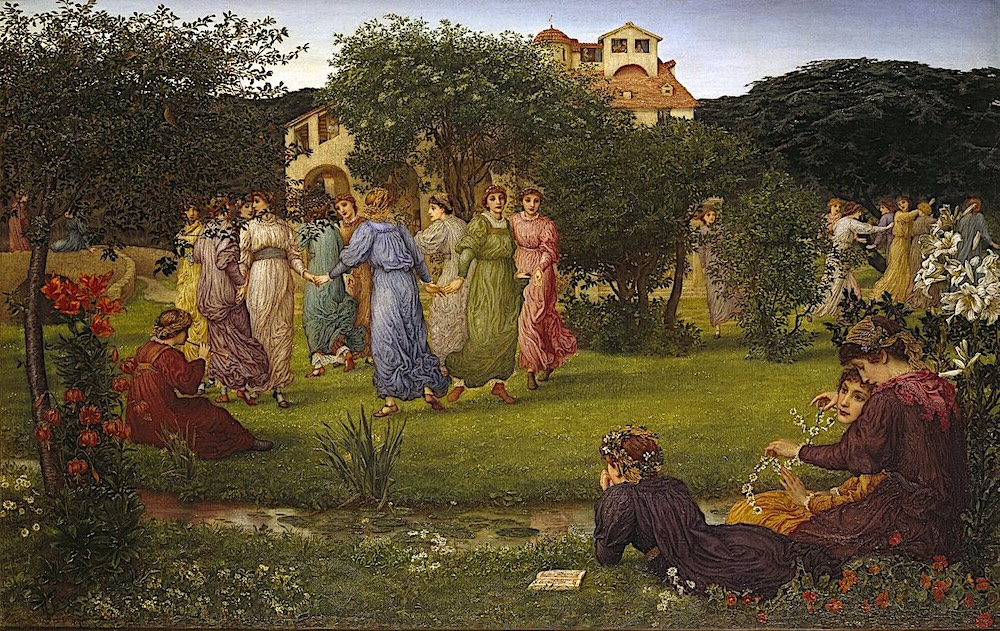
The Dancing Girls, by Thomas Matthews Rooke, RWS (1842-1942). c.1882. Oil on canvas. 24 x 38 1/4 inches (61 x 97 cm). Collection of the Ashmolean Museum, Oxford, accession no. WA1941.65. Image courtesy of the Ashmolean Museum via Art UK under the terms of the Creative Commons Attribution-NonCommercial-NoDerivatives licence (CC BY-NC-ND). [Click on the images to enlarge them.]
Despite the beauty of this work Rooke did not exhibit it at either of the principal London venues of the time, the Royal Academy or the Grosvenor Gallery. This idyllic scene features two groups of maidens in classical costumes in the midground who dance in a circle holding hands in the yard of a grand house. Some of the dancers face inwards towards the circle while others face outwards towards the spectators. In the left foreground a girl dressed in a dark red gown plays on a pipe. In the right foreground two seated young women construct a daisy chain next to a clump of white lilies, while a young girl who was lying down reading an illuminated book pauses to observe the dancers. In the language of flowers white daisies signify purity and innocence while white lilies signify a chaste life. This group of young women is separated from the dancers by a narrow stream. In the background is an Italianate-style villa surrounded by trees and with low hills in the background. By 1882 Rooke had already made a number of visits to Italy on behalf of his patron John Ruskin so he would have been very familiar with such architecture and landscape.
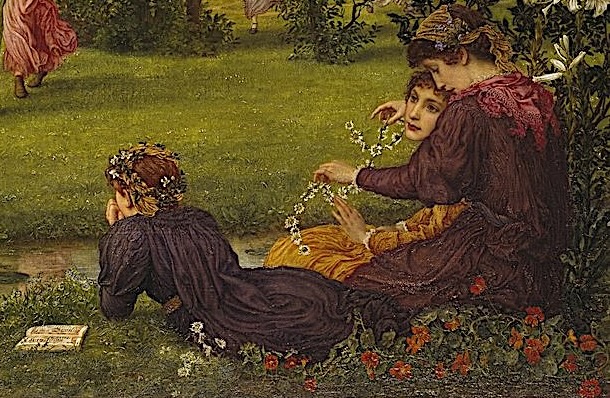
Closer view of the young women with flowers in the right foreground.
John Christian feels the group of dancing figures was probably inspired by Edward Burne-Jones's earlier The King's Wedding of 1870, now in the collection of Clemens-Sels-Museum, Neuss (85). It is also reminiscent of Edward John Poynter's later Horae Serenae that was exhibited at the Royal Academy in 1894. This painting was based on his earlier design The Wandering Minstrels from 1889 for a panel painted by Poynter for the Alma-Tadema/Poynter Steinway piano designed by Lawrence Alma-Tadema for Henry Marquand, a New York banker and real estate entrepreneur.
It appears Rooke also designed classical figures of girls dancing to be painted on art furniture based on a drawing by him exhibited in A Dream of the Past in Toronto in 2000. This drawing and a related one are now in the collection of the National Gallery of Canada (accession nos. 42899 and 42900).
Note: Scott Thomas Buckle writes, "An undated copy by T.M. Rooke of a detail from Fra Angelico’s The Last Judgement was offered for sale at Christie’s, London, 11 July 2018, lot 35. Presumably painted on a visit to Florence for Ruskin, it shows a group of angels wearing different coloured dresses, advancing in a circle within a garden in Heaven. Rooke’s painting of The Dancing Girls is a marked deviation from his Old Testament-themed paintings of the preceding decade, and one wonders if he is quietly referencing the heavenly scene from Fra Angelico, and disguising his interpretation of it as a non-narrative Aesthetic Movement painting. Some of his other works in a similar vein from the 1880s, may also be veiled depictions of Paradise, created in a period between Rooke’s earlier biblical paintings and his later topographical depictions of churches and cathedrals."
Bibliography
Christian, John. The Last Romantics. The Romantic Tradition in British Art. London: Lund Humpries, 1989, cat. 28, 85.
The Dancing Girls. Art UK. Web. 16 January 2026.
Lanigan, Dennis and Douglas Schoenherr. A Dream of the Past. Pre-Raphaelite and Aesthetic Movement Paintings, Watercolours and Drawings from the Lanigan Collection. Toronto, University of Toronto Art Centre, 2000, cat. no. 67, 176-77.
Created 16 January 2026