
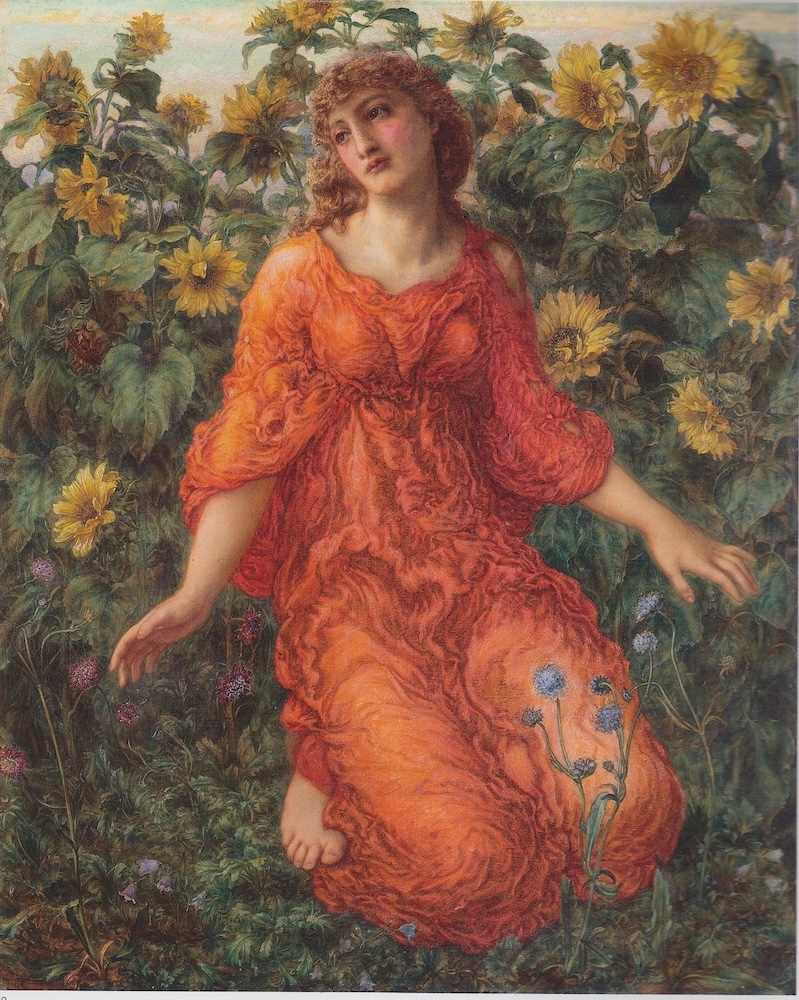
Clytie Turning Towards the Sun, by Thomas Matthews Rooke, RWS (1842-1942). 1884. Oil on canvas. 24 by 20 inches (61 by 51 cm). Private collection. Image courtesy of Sotheby's.
This painting was exhibited at the Grosvenor Gallery in 1884, no. 240. The story of Clytie is taken from Book IV of Ovid's Metamorphoses. Clytie was a water nymph who was in love with Apollo, the sun god. Apollo abandoned her because of her jealousy. She withdrew to a lonely place where she pined away with unrequited love, not eating or drinking, but gazing all day at the sun with her face turned constantly on him. Finally her limbs rooted in the ground and became transformed into the stems of a plant, while her face became a sunflower. When the picture sold at Sotheby's in 2006 Christopher Newall commented: "Rooke shows Clytie in the process of transformation from woman to sunflower; the orange colour of her dress suggests still the warmth of Apollo's love, but she appears already to be sinking towards the ground. Her hair is growing wild, while her face will turn into that of a flower, and one which will always follow the course of the sun" (68). Rooke's handling of the orange semi-transparent drapery does not equal the mastery shown by classical painters such as Frederic Leighton, Albert Moore or Lawrence Alma-Tadema and falls in unnatural folds. Clytie is portrayed kneeling on the ground, her arms outstretched, and gazing skywards towards the sun. The background features the sunflowers that Clytie will be transformed into.
Rooke was not the only Victorian painter to paint this subject. Evelyn de Morgan painted a Clytie of quite a different composition that she exhibited at the Grosvenor Gallery in 1887, no. 348. Frederic Leighton painted his principal version of Clytie, the last of his great classical mythological subjects, in the latter part of 1895 during the last year of his life. Following his death Clytie was the only painting by Leighton to be exhibited at the Royal Academy in 1896. It is a much more dramatic painting than Rooke's, showing Clytie kneeling with her head thrown back, her hair nearly touching the ground, and her arms raised up to the setting sun entreating Apollo not to forsake her. Leighton had done an earlier version of Clytie that was exhibited at the Royal Academy in 1892. This was largely a landscape painting, with only a diminutive figure of Clytie visible at the lower right. G. F. Watts' famous bust of Clytie was exhibited in an unfinished state at the Royal Academy in 1868, but not completed until 1878. It was shown at the Grosvenor Gallery, Winter Exhibition in 1881-82.
Contemporary Reviews of the Painting
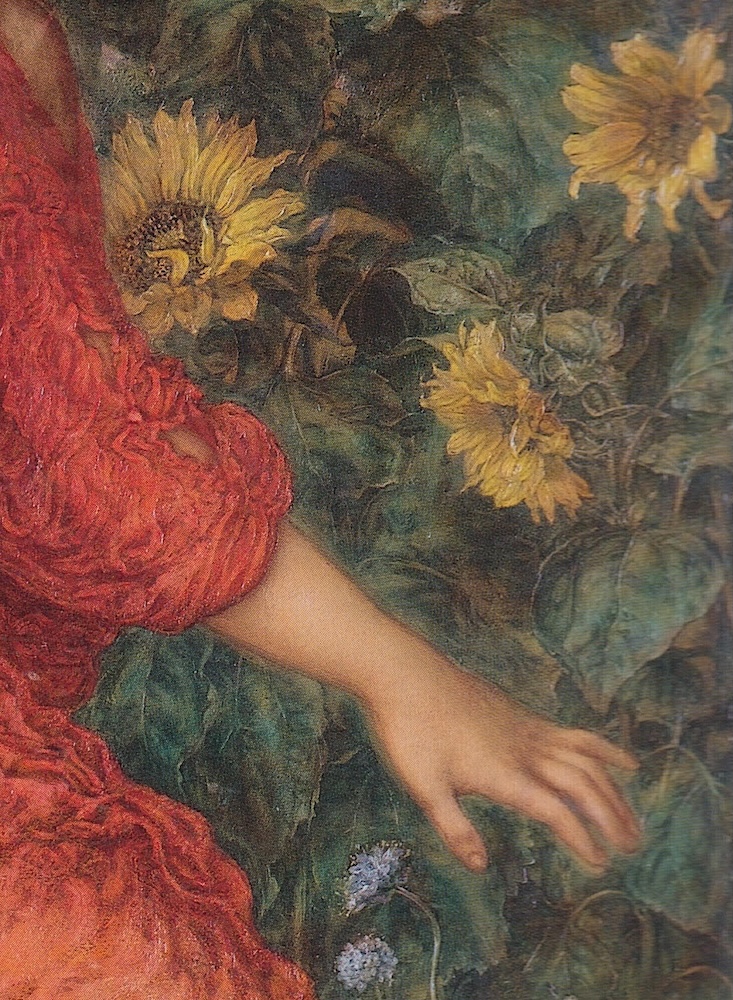
Detail: "some good drawing and careful painting."
A reviewer for The Academy pointed out the major weakness in Rooke's painting in that the figure of Clytie was lacking in pathos: "Mr. Rooke cannot be said to have made an advance with his companion pictures, Daphne flying from the Sun (229) and Clytie turning towards the Sun (240), though both works contain some good drawing and careful painting. The conception is in neither case adequate, and real pathos is wanting, while the draperies are impossible in fold, and the treatment of the hair is almost precisely similar to that of the garments" (337).
Bibliography
Blackburn, Henry. Grosvenor Notes. London: Chatto & Windus (May 1884): no. 240, 52.
"Fine Art. The Grosvenor Gallery." The Academy XXV (24 May 1884): 336-37.
Newall, Christopher. Victorian & Edwardian Art. London: Sotheby's (December 14, 2006): lot 129, 68-69.
Created 16 January 2026