

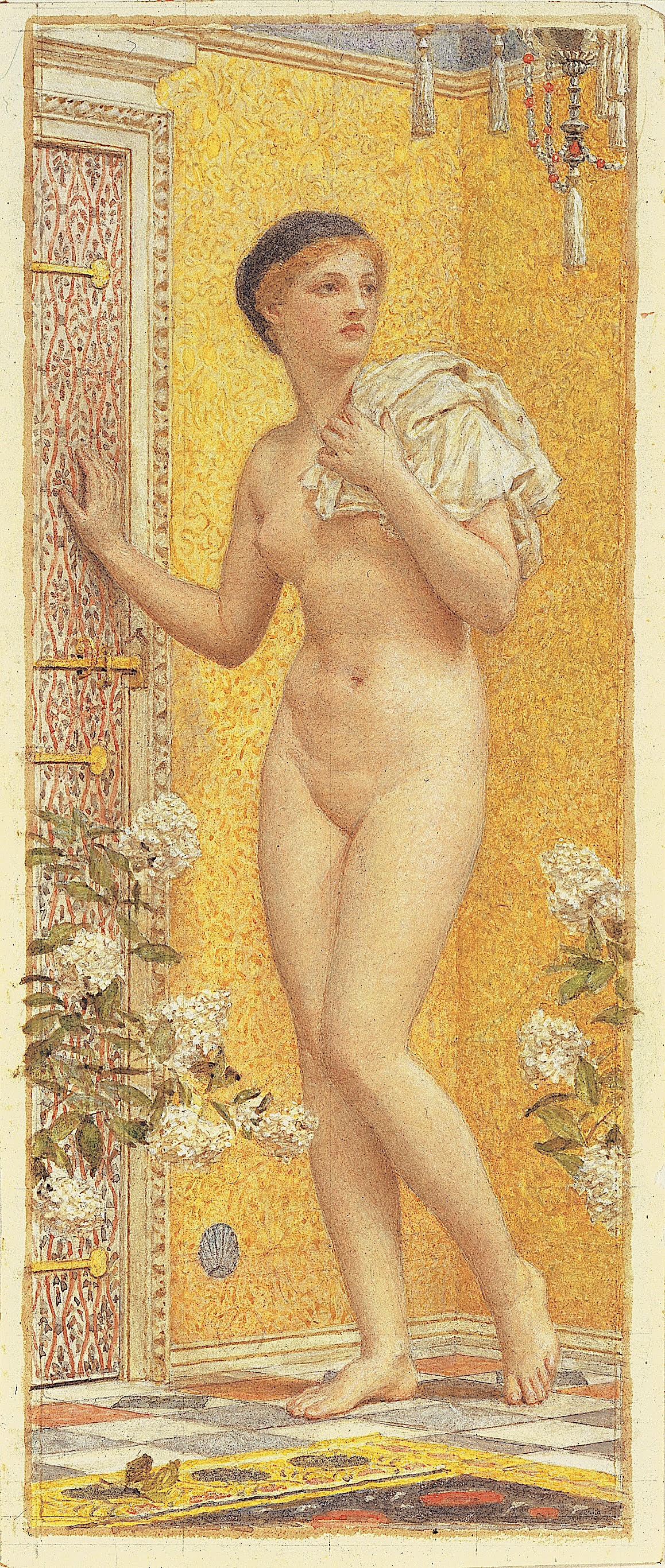
White Hydrangea by Albert Joseph Moore, ARWS (1841-1893). 1885. Oil on canvas. 44 1/4 x 16 7/8 inches (112.3 x 42.9 cm). Collection of Salar Jung Museum, Hyderabad, India. Image taken from The Magazine of Art XVII, 1894: 363. Right: A Yellow Room. 1885. Pencil, watercolour and gouache. 15 x 6 inches (38.1 x 15.2 cm). Private collection, image © 2002 Christie's Images Limited. Right click disabled; not to be downloaded.
Moore exhibited White Hydrangea at the Royal Academy in 1885, no. 356, and A Yellow Room at the Royal Society of Painters in Water Colours, no. 232, that same year. White Hydrangea is a three-quarter life-size oil painting, whereas the watercolour version is much smaller. Exhibiting both works the same year made comparisons between the versions much easier, with the two compositions being very similar, differing primarily in the colour of their backgrounds. The background of White Hydrangea is a brown door inlaid with iridescent mother-of pearl and set in a wall decorated with a close pattern in shades of dark warm grey. In A Yellow Room the door is painted in a geometric pattern of red, grey and white and the wall is a vivid golden yellow colour. The floor in White Hydrangea is of green, white, and black with a black mat and small pile of pink drapery at the lower left. The floor in A Yellow Room is white, grey and rose with a yellow and charcoal grey mat. White Hydrangea lacks the large spray of white hydrangeas that are seen on the left in A Yellow Room.
A.L. Baldry noted that the figure's "comparatively simple pose was tested and adjusted by action so as to get exactly the right turn of the body and the correct placing of the hand upon the door" (84). Robyn Asleson has shown how a cartoon related to White Hydrangea in the collection of the Victoria and Albert Museum "clearly reveals 'the familiar grid of curved horizontal and vertical lines, overlaid by a diaper pattern of long intersecting diagonal curves. The contours of the figure were accommodated to this geometric framework, which also determined the disposition of the hydrangeas, the patterned wallpaper, Moore's anthemion, and every other element in the composition" (175).
These two works were Moore's first realistic treatment of a full-length female nude since he exhibited A Venus at the Royal Academy in 1869. Once again these works proved to be controversial, as were a number of other paintings of the nude on display at the Royal Academy or The Grosvenor Gallery that same year. On 18 May 1885, while White Hydrangea was on display at the Royal Academy, it was scratched by an unknown assailant wielding either a pin or a knife. Then two days later, on 20 May, a letter was printed in The Times, entitled "A Woman's Plea" and signed "A British Matron," that started a national controversy about the exhibition of the nude figure. The letter was actually written by J.C. Horsley R.A., known to be a long-standing opponent of artists studying the nude, and which earned him the epithet "Clothes-Horsley." White Hydrangea was one of the works specifically singled out in the letter to The Times: "I wonder that the friends and relatives of the young lady (No. 360) [Hubert von Herkomer's Miss Katherine Grant] can countenance the juxtaposition of her beautiful portrait and all its innocence with No. 356 [Moore's White Hydrangea], and I deplore the enforced contact with the latter picture which the fair friends and admirers of the former, young, fresh, and innocent as many of them must be, have necessarily to undergo" (qtd. Asleson, 174). Moore had to spend a week repairing the damage done to his picture.
Other Contemporary Reviews of White Hydrangea
The reviewer for The Academy, likely Claude Philips, admired the painting's colour harmonies but complained that the figure appeared to be based on an ancient Greek sculpture rather than life:
Mr. Albert Moore, weary, no doubt, of being met with the reproach that he constantly repeats himself, sends this year a piece which is a rather marked variation from his later style: he entitles it, White Hydrangea (356). A nude female figure, whose blond tresses are crowned with a small black velvet toque, is seen standing in a court-yard or chamber, in the act of opening a door, and around her are disposed groups of the flower which gives its name to the picture. In so far as it is a harmony compounded of white and pale grey, relieved with touches of yellow, black, and rose colour, and by contrast enhancing the delicately tinted carnations of the central figure, it is highly successful, as can well be imagined, Mr. Moore being the painter; but, as a study from the nude, it must be pronounced a failure. The torso of the figure is evidently been studied from a statue - apparently the Aphrodite of Melos - rather than from life, and with it the lower limbs scarcely seem to accord. The whole is crowned with a pretty, modern, girlish head, in the artist's usual manner, the effect of which, it must be owned, is, under the circumstances, somewhat comic. [335]
F.G. Stephens in The Athenaeum felt once again that Moore was capable of better things:
There appears to be no reason why A. Moore, despite the remonstrances of his admirers and the zealous faith of those who have been his prophets from the days when he painted with a serious intention to do justice to his powers by higher efforts than White Hydrangea (356), should give us nothing more important than this figure of a naked virgin of the usual quasi-Phidian type and style, wearing a black cap on her blonde tresses, and a piece of white linen on one plump shoulder. She is walking or standing in a garden or bath. The design is needlessly obscure on these points, and, in short, it is almost inexplicable on every point, except the intention of the painter to charm us by methods the use of which long practice must have made easy to him. The figure is much more carefully drawn than ordinary with Mr. Moore; only the left leg and foot are open to censure. This is said to be a Greek figure, yet the damsel is so very modern that she might well be the "young lady of the house," who, after the bath, wandered about at home, sweetly unconscious of her nakedness. The fresco-like impasto and silvery-grey half-tints of the flesh are signs of good draftsmanship, but, apart from these and the figure, the picture lacks the searching skill and exhaustive studies that ennoble the Diadumene of Mr. Poynter, which faces the White Hydrangea. [667-68]
A critic of The Builder complained that the nude maiden was not treated in an idealised fashion: "This is a trifle, however, to the absurd incongruity of Mr. A. Moore's figure, called White Hydrangea (356). Except when the nude figure is palpably and obviously a study, it expects to be idealised, and many of Mr. Moore's pictures are purely ideal. But this figure is so exactly the type of a modern society young lady, and so exceedingly realistic in her tripping walk, that there is a kind of ludicrous impropriety about it; it is as if we were sitting in a rather aesthetic drawing-room, and the young lady of the house suddenly tripped in, with a little conventional simper on her face, and an unfortunate but entirely innocent forgetfulness of the fact that she had nothing on but her cap" (647). The Pall Mall Gazette preferred the watercolour version: "White Hydrangea. Not quite so fresh as Mr. Albert Moore's recent water-colour of the same design, with a yellow background" (qtd. The Artist, 230).
Contemporary Reviews of The Yellow Room
A reviewer for The Artist admired Moore's treatment of the nude: "Colour is also the main motive in Mr. Albert Moore's Oranges, Lanterns, and A Yellow Room, typical illustrations of his art theories. The Yellow Room is, moreover, an admirable instance of refined treatment of the nude and of skilful flesh-painting" (133). A reviewer for The Athenaeum, likely F.G. Stephens, this time complained about the drawing of the figure's right leg and foot and not the left: "We recommend the Yellow Room (232), by Mr. A. Moore, although there is nothing in it he has not already given to the world. It is a study of the fair rosy carnations of a nude figure relieved in light on a yellow ground. So far as they go the drawing and modelling are sound, but the right leg and foot are bad" (606). The Illustrated London News reported: "Albert Moore has three figure-pieces, of which the most important is A Yellow Room (232), a nude figure, excellently drawn, standing against a rich yellow background" (454).
Image from the Magazine of Art scanned by George P. Landow. You may use this image without prior permission for any scholarly or educational purpose as long as you (1) credit the Internet Archive and the University of Toronto Library and (2) link your document to this URL in a web document or cite the Victorian Web in a print one.]
Bibliography
"Art Notes." The Illustrated London News LXXXVI (23 May 1885): 533.
Asleson, Robyn. Albert Moore. London: Phaidon, 2000. 172-75.
Baldry, Alfred Lys. Albert Moore. His Life and Works. London: George Bell and Sons, 1893. 84, 96-97.
Blackburn, Henry. Academy Notes XI London: Chatto and Windus (May 1885): 10.
"Collated Press Opinion on The Royal Academy Exhibition." The Artist VI (1 July 1885): 230.
"Current Art – I." The Magazine of Art VIII (1885): 350.
"Fine Art. The Royal Academy." The Academy XXVII (9 May 1885): 334-36.
Green, Richard. Albert Moore and his Contemporaries. Newcastle Upon Tyne: Laing Art Gallery, 1972, cat. 63, 26.
Important British Art. London: Christie's (June 12, 2002): lot 46. https://www.christies.com/en/lot/lot-3935130
"The Royal Academy Exhibition." The Builder XLVIII (9 May 1885): 646-47.
"Royal Society of Painters in Water-Colours." The Artist VI (1 May 1885): 133.
"Royal Society of Painters in Water Colours." The Illustrated London News LXXXVI (2 May 1885): 454-56.
Smith Alison. Exposed The Victorian Nude. London: Tate Publishing, 2001. 94.
_____. The Victorian Nude. Sexuality, morality and art. Manchester: Manchester University Press, 1996. 225-27.
"The Society of Painters in Water Colours." The Athenaeum No. 3002 (9 May 1885): 605-06.
Stephens, Frederic George. "Fine Arts. The Royal Academy." The Athenaeum No. 3004 (23 May 1885): 666-68.
Walker, Robert. "Private Picture Collections in Glasgow and West of Scotland: Mr. William Connal's Collection of works by Albert Moore."" Magazine of Art. 17 (December 1893-November 1894): 360-66. Internet Archive version of a copy in the University of Toronto Library. Web. 7 September 2013.
Created 7 September 2013
Last modified 5 October 2026