
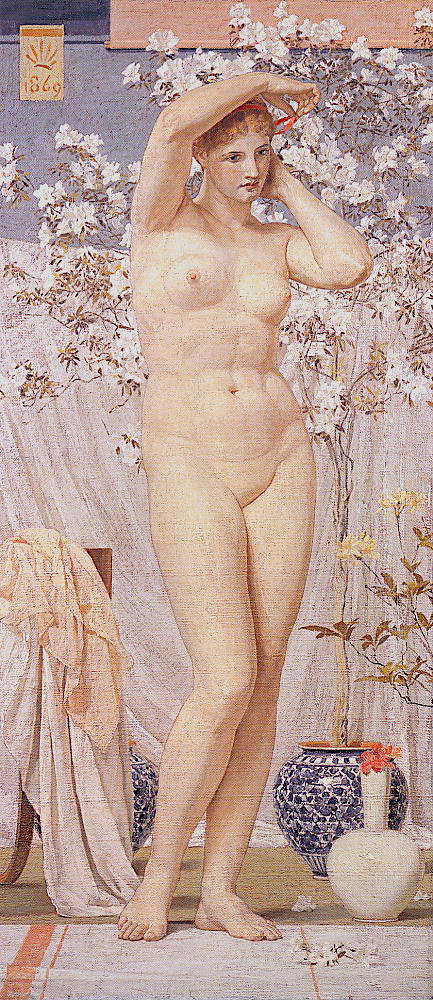
A Venus by Albert Joseph Moore, ARWS (1841-1893). 1869. Oil on canvas. 63 x 30 inches (160 x 76.2 cm). Courtesy of York Museums Trust, accession no. YORAG : 698, reproduced for purposes of non-commercial academic research. [Click on the image to enlarge it.]
A Venus was shown at the Royal Academy of 1869, no. 699. His initial ideas for the picture began the previous year, based on an oil sketch for the painting dated 1868. The work was commissioned by the well-known collector Frederic Leyland. It is Moore's first full-size full-length female nude and a progression from his initial full-length female nude, The Wardrobe of 1867. The use of the indefinite article in the title shows Moore was seeking to represent a type of ideal beauty rather than the mythological Roman goddess (Smith, Exposed, 94).A Venus shows a standing woman, whose torso was obviously inspired by the Venus de Milo, with her arms raised tying a fillet in her hair. The left hand holds the ribbon at the back of the head while her right hand takes it around twice so that the two ends may be tied together. This action replicates a standard pose in Greek sculpture, the diadumenous [fillet binder] later featured in Edward Poynter's Diadumene that he exhibited at the Royal Academy in 1884. Moore's figure is standing on a mat before a blue wall hung part way down with white fabric. Her robe is draped across a chair to the left. To the right is a white flowering azalea shrub planted in a blue and white Chinese pot. A similar blue and white Chinese pot is seen behind the figure's right leg, partially obscured by drapery. Moore's anthemion device is seen in a cartouche at the upper left, similar to the format Whistler was using with his butterfly signature in a cartouche at around this same time, such as in his The Balcony of 1865. Moore's colour scheme is a harmony of flesh colour, blue, and white.
Alison Smith notes that "Moore'a application of a limited range of pale chromatic tones to a coarse canvas serve to suppress the rich saturated properties of the oil medium, lending the surface the texture of a wall painting" (Exposed, 94). Smith also says that the "chalkiness" appearance of A Venus at the Royal Academy proved controversial, surprisingly not on moral grounds because of its sensuality, but because of the surface qualities of the dense opaque paint layer applied to a heavy-grained canvas. Critics found the coarse surface inappropriate for the female nude. (Victorian Nude, 132-33). Some critics objected to the use of this seemingly "masculine mode" of paint application to a quintessentially feminine subject (Asleson 105). It had been largely due to the influence of Frederic Leighton and G.F. Watts that Moore's painting was even hung at the Royal Academy. Both artists had previously exhibited full-length female nudes at that institution, Watts's Thetis in 1866, and Leighton's Venus Disrobing for the Bath in 1867. Apparently, the hanging committee of the Royal Academy were not going to hang Moore's painting until Leighton threatened to withdraw all his own works from the exhibition if it wasn't shown.
An oil sketch for the composition is in a private collection. A full-size cartoon for the painting in black chalk on brown paper is in the collection of the Victoria and Albert Museum (accession no. 1636-1900).
Contemporary Reviews of the Painting
E.W. Godwin in The Architect felt the position of where the painting was hung did not allow it to be shown to its advantage: "Mr. A. Moore, in 699, has a large and careful drawing of a nude figure, called A Venus. The rough canvas, the painting, and the light in which the picture now stands, contribute to produce an effect of slightness in this work which it might not present in another position. As now seen, the flesh looks as if it had been built up by a long process of stratification; and some of the modelling of the body looks, from the same cause, rather coarse" (289).
The critic for The Art Journal obviously did not care for the work:
As a companion to Electra [F. Leighton] hangs in astounding contrast A Venus (699), by Mr. A. Moore. The figure is in no way obnoxious to good morals; indeed, it is too ugly and repulsive to be objectionable except to taste. The torso, which is the best part, appears to be an adaptation from the Venus of Milo. Mr. Moore may, perhaps, have in some measure spoilt himself for the painting of easel-pictures by the practice of mural decoration. Thus, instead of the translucency and juiciness of oils, or a finish suited to near view, here we have the rawness, opacity, and a surface as of plastered wall, with a certain rude defiant power which is intolerable save at a distance. And, indeed, due distance does give a certain "enchantment to the view," so that at the remove of the further side of the room, the figure tells out with somewhat of the light-giving power of fresco. Still, if the function of Art, as formally supposed, be to please, Mr. Moore, it must be confessed, is yet far from the end desired. [201]
F. G. Stephens in The Athenaeum found the picture original and eye-catching: "Mr. A. Moore's striking picture, A Venus (699) – a life-sized picture of a nude, girl-Venus, standing binding her hair by the edge of a bath, and in design one of the most original works here. The execution is at first sight, antipathetically to the subject, rough, yet one gets over this seeming defect in a very little time and the real error of disproportion of the body to the limbs is more evident; also grows our sense of the artist's power in modelling so masterfully the contours, drawing the forms and grouping the tints and tones of this noteworthy picture. He has a rare enjoyment of beauty. In Art Mr. A. Moore is a youth" (738). The critic of The Spectator, likely W. M. Rossetti, disliked the surface qualities of the picture: "Mr. A. Moore's 'A Venus' (699) is a fine study of form, and without the blot that stains Mr. Leighton's Rhodos. The colour is of the chalky artificial character which Mr. Moore commonly affects, and is better suited for wall decoration than for a picture proper. The texture, too, is leprous" (706).
A reviewer for The Illustrated London News regarded this work, despite its merits, as being simply a piece of wall decoration:
A study by Mr. A. Moore of a nude female figure fastening her hair with a blue fillet, and backed by a white azalea and grey patterned hangings, is, with small propriety, designated 'A Venus' (699). The design is good, the contours are very firmly drawn; but, so far from approaching sensuousness of life, the flesh is stone itself. The colouring is not disagreeable, regarded merely as a harmonious arrangement for decorative purposes of an extremely limited scale of hue. But the work can only rank as a studiously flat conventional wall-decoration; not as a picture proper or complete fine-art product. The bas-relief character of the modelling, the elimination of shadow, the non-naturalness of the whole as a representation, precludes its being classed in the latter category (526).
A L. Baldry quoted the assessment of the picture made by the Pall Mall Gazette in their notice of May 31, 1869 writing of it as:
A balance or comparison, not of tints, but of tones or degrees of colour in which the relations, and not the local truth, of the various coloured surfaces are reproduced;' and goes on to say that 'the scale selected runs with delicate intervals through the fainter notes of salmon, gold, blue, and green, with the widest white as its highest tone.' The same paper, in discussing the drawing and composition, declares that 'the lines of the body are of exquisite beauty – intimately delightful, though firm, chaste, and severe. For knowledge and refinement the modelling is everywhere such as to recall no later master than Flaxman. As accessories, one or two flowering shrubs, and flat, cool surfaces of wall, pavement, and hangings, seem rather to melt together into a tremulous and faintly coloured atmosphere, than to assert their individual existences. The face has the inexpressive, self-sufficiency beauty of the Athenian ideal.' The criticism is finally summed up with these words: 'Mr. Moore has rendered at once, with intense sympathy, and with the skill of a master, the associations which the highest culture has gathered around the name of Aphrodite" (Baldry, 38).
J. B. Atkinson, however, in Blackwood's Edinburgh Magazine found the painting hideous:
Yet another phase of modern antique is presented by Mr. Albert Moore's repellent picture of Venus, borrowed apparently from the Venus of Milo. Such nudities are quite unobjectionable, because absolutely disagreeable. The figure is neither marble, paint, nor flesh, but stucco … it must be confessed that few of our artists are better trained in the schools of strict monumental decoration than Mr. Moore, though it were certainly to be desired that he should learn to mitigate what is obnoxious in his mannerism. [224-25]
The critic of The Saturday Review found the work a novelty but again somewhat repulsive: "The Venus by this artist is assuredly a novelty. Other Venuses may have erred on the side of being over alluring; this, on the contrary, if it has a fault, is only somewhat too repulsive. The best part is the torso, taken apparently from the Venus of Milo. The general matter is hard and crude, with this advantage, however, that like tempera and fresco, the artist gains by his method light and force, especially at a distance" (744).
Bibliography
"Art. The Royal Academy." The Spectator XLII (12 June 1869): 705-06.
Asleson, Robyn. Albert Moore. London: Phaidon, 2000. 104-08.
_____. "Nature and abstraction in the aesthetic development of Albert Moore." In After the Pre-Raphaelites, edited by Elizabeth Prettejohn. Manchester: Manchester University Press, 1999: 43-45.
Atkinson, Joseph Beavington. "The London Art Season." Blackwood's Edinburgh Magazine CVI (August 1869): 220-39.
Christian, John. Victorian Dreamers. Masterpieces of Neo-Classical and Aesthetic Movements in Britain. Tokyo; The Tokyo Shimbun, 1989, cat. 46, 126.
Colvin, Sidney. "English Painters of the Present Day. II. Albert Moore." The Portfolio I (1870): 4-6.
"Fine Arts. The Royal Academy". The Illustrated London News LIV (22 May 1869): 526-27.
Godwin, Edward W. "Royal Academy." The Architect (5 June 1869): 289-90.
Green, Richard. Albert Moore and his Contemporaries. Newcastle Upon Tyne: Laing Art Gallery, 1972, cat. 24, 17.
Hedberg, Gregory. "Albert Moore." The Victorian High Renaissance. London: Lund Humphries, 1978, cat. 73, 143-44.
Prettejohn, Elizabeth. Art for Art's Sake. Aestheticism in Victorian Painting. New Haven and London: Yale University Press, 2007. 108, 112-13, 116-18, 126.
"The Royal Academy." The Art Journal New Series VIII (1 July 1869): 197-204.
"The Royal Academy." The Saturday Review XXVII (5 June 1869): 743-45.

Smith Alison. Exposed The Victorian Nude. London: Tate Publishing, 2001, cat. nos. 30 & 312, 94-95.
_____. The Victorian Nude. Sexuality, morality and art. Manchester: Manchester University Press, 1996. 132-33.
Spencer, Robin. The Aesthetic Movement: Theory and Practice. London: Studio Vista, 1972. 42.
Staley, Allen. The New Painting of the 1860s, Between the Pre-Raphaelites and the Aesthetic Movement. New Haven, CT: Yale University Press, 2011. 133-35 &147-48.
Stephens, Frederic George. "Fine Arts. Royal Academy." The Athenaeum No. 2170 (29 May 1869): 738-39.
A Venus. Art UK. Web. 26 August 2026.
Created 18 May 2022
Last modified 26 August 2026