
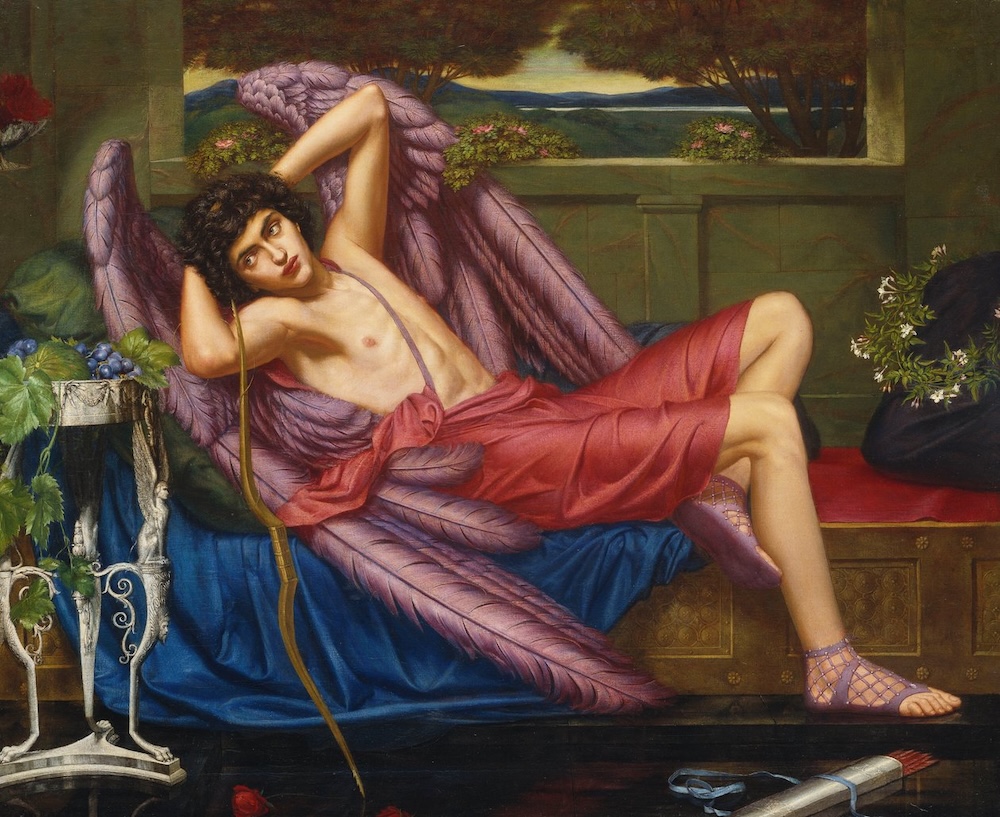
Love in Idleness by Sidney Harold Meteyard (1868-1947). 1908. Oil on canvas. 34 ½ x 41 ¾ inches (87.6 x 106 cm). Private collection. Image ©1994 Christie's Images Limited. Right click disabled; not to be downloaded.
Meteyard exhibited Love in Idleness at the Royal Academy in 1908, no. 578 and then later that same year at the Autumn Exhibition of the Royal Birmingham Society of Artists, no. 463. In the past this subject had been misinterpreted by scholars and dealers as Icarus. The term love-in-idleness first dates from the late 1500s and refers to the flower love-in-idleness, which is the wild pansy (Viola tricola). Shakespeare, for instance, uses the term love-in-idleness in a number of his plays, including The Taming of the Shrew, A Midsummer Night's Dream, and The Tempest.
Eros was the Greek god of love and sexual desire while Cupid was his Roman equivalent. In Meteyard's painting a half-naked Eros with purple wings and clad in a red garment, his hands clasped behind his head, lounges at a window seat propped up against a green pillow. His bow rests against his right arm while his quiver of arrows lies on the floor at the bottom right. To the left is a metal Roman tripod table very similar to those that had been discovered at Pompeii. Cupid appears to be staring at the grapes and melon it contains. Directly behind Eros is a marble wall with a large horizontal window through which can be glimpsed a landscape. A row of trees is nearby, followed by a green meadow leading to a river, with a row of dark blue rolling hills in the distance. Red roses symbolic of love and passion are littered along the floor.
When the painting sold at Christie's in 1994 John Christian felt it had perhaps been intended as a pendant to Meteyard's earlier Hope comforting Love in Bondage and had been influenced by the work of Edward Burne-Jones:
But they make a nice contrast, Love in Bondage expressing anxiety, tribulation and care, Love in Idleness striking a note of hedonism, luxury, playfulness, and irresponsibility. We can only speculate on what, if any, relationship the pictures bear to Meteyard's private life, which, as already noted, is almost completely shrouded in mystery. Stylistically, we are on surer ground. Love in Idleness is characteristic of Meteyard in the linear treatment of the forms and the refulgent, slightly acid colours, to both of which his experience of working in stained glass, enamel and illumination no doubt contributed. Cupid's pose looks back in a general way to classical prototypes, and there seems to be an echo of Burne-Jones's Wine of Circe in the "Pompeian" jardinière on the left and the rectangular window, opening onto water, which pierces the wall behind the figure. [62]
While Christian sees Burne-Jones as the principal influence, an equally important influence would seem to be Simeon Solomon, particularly in Meteyard's portrayal of Cupid, such as Solomon's Love in Autumn of 1866 or Love Dreaming by the Sea of 1871. Meteyard's Cupid is much more sensuous than the figures of Cupid normally found in the work of Burne-Jones. In 1866 Julia Margaret Cameron had produced her photograph of Love-in-Idleness featuring a naked young boy Freddy Gould as Cupid, kneeling holding a bow, and with a quiver of arrows strung across his right arm.
Bibliography
Christian, John. Fine Victorian Pictures, Drawings and Watercolours. London: Christie's (25 March 1994): lot 70. 62-63.
Harrison, Martin and Bill Waters. Burne-Jones. London: Barrie & Jenkins Ltd., 1973. 183-84.
Marshall, Nancy Rose and Stephen Wildman. "Sidney Harold Meteyard." Yellow Nineties 2.0. Ed. Lorraine Janzen Kooistra. https://1890s.ca/wp-content/uploads/meteyard_bio.pdf
Symbolists 1860-1925. London: Piccadilly Gallery, no. 57.
Created 26 March 2026