
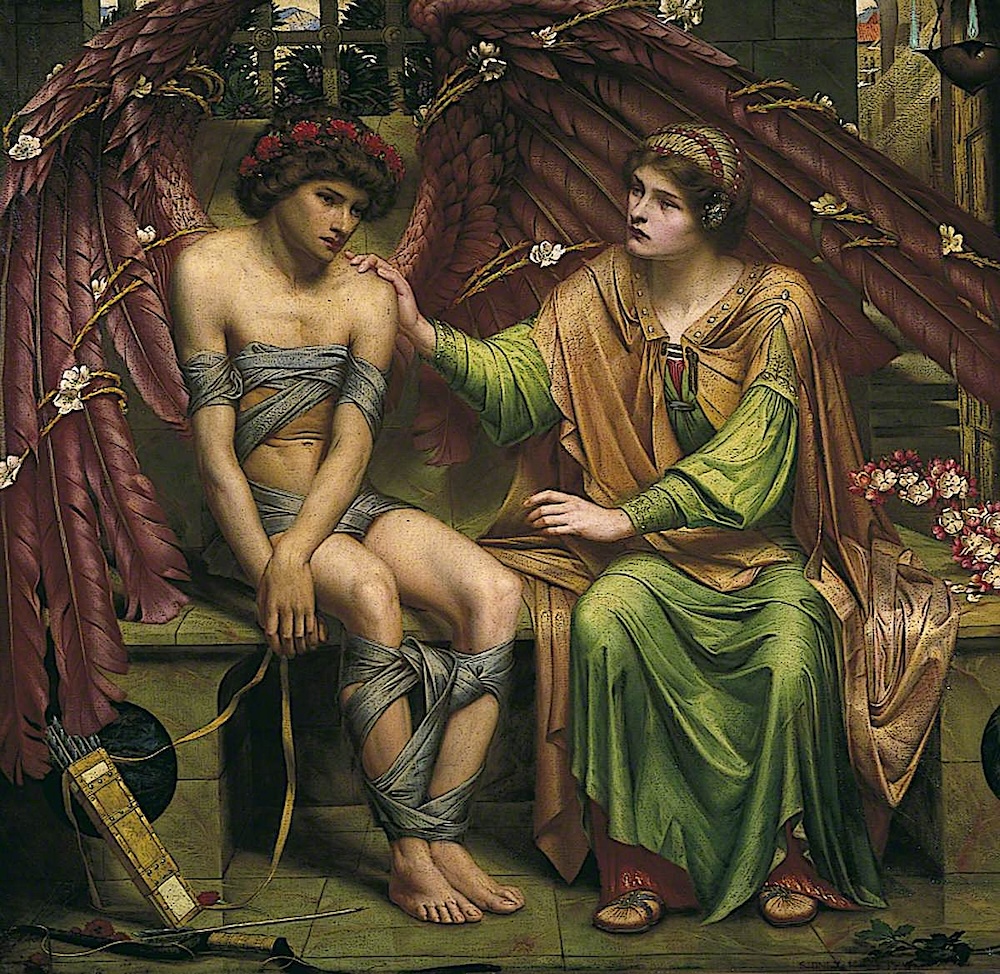
Hope Comforting Love in Bondage, by Sidney Harold Meteyard (1868-1947). 1901. Oil on canvas. 41 x 43 inches (104.2 x 109.2 cm). Collection of Birmingham Museums and Art Gallery. Image courtesy of Birmingham Museums Trust under the terms of the Creative Commons Zero licence (CCO). [Click on the image to enlarge it.]
Meteyard exhibited this painting at the Royal Academy in 1901, no. 543, accompanied in the catalogue by this quotation: "And in Love's darkest hour." Meteyard then exhibited it later that same year at the Royal Birmingham Society of Artists, no. 321. It is one of the first and probably the best-known of his symbolist works. The painting depicts the youthful Cupid, naked yet bound by strips of grey fabric, with a crown of red roses around his head. White rose briars are shown threaded through his wings. Love appears introspective and sad, with his gaze fixed towards the ground. Hope is represented as a solemn woman clad in a lime-green robe and golden mantle who is compassionately reaching out her right hand to touch Love's shoulder and comfort him. The two figures are seated on a marble bench. Stephen Wildman has pointed out that in this work: "Meteyard dispenses with the stylistic mannerisms of late Pre-Raphaelitism in favour of powerful union of rigorous life drawing and suffused colour" (65).
When Hope Comforting Love in Bondage was shown at the Victorian Radicals several years ago, Victoria Osborne gave this explanation of its meaning:
In this work, the dejected figure of Love, a winged adolescent Cupid crowned with roses, is consoled by the robed figure of Hope. Love's limbs are bound, and he has cast aside his bow and quiver. In the Victorian language of flowers, wild roses, with their soft blooms and sharp thorns, represented romantic love, particularly its mingled pleasure and pain. The painting implies that being in love inevitably leads to hurt: if Cupid beats his wings, they will be torn by the thorns that entwine them. Yet, the figure of Hope, her green robe suggesting spring and new life, urges optimism, not despair. Meteyard's depiction of love as a beautiful, androgynous, suffering youth recalls the characteristic imagery of Simeon Solomon, but the physical types, tonality, and mood of solemn contemplation also reflects the overwhelming influence of Edward Burne-Jones on Birmingham painting at the turn of the century. [249]
Burne-Jones frequently portrayed Blind Love as being crowned with roses. G.F. Watts, who was particularly known for his symbolic works, is another possible influence, such as his painting of Hope, the first version of which was completed in 1886. Like Watts's painting, Meteyard's picture reminds us that the support and empathy of others can provide hope and optimism in the face of adversity and emotional distress. Such a theme can also be found in Evelyn De Morgan's Hope in the Prison of Despair of 1887.
Bibliography
Christian, John. Burne-Jones and his Followers. Tokyo: Isetan Museum of Art, 1987, cat. 55, 134.
Hill, Joseph, and William Midgley. The History of the Royal Birmingham Society of Artists. Birmingham: The Society & Cornish Brothers Ltd., 1928, plate 89.
Hope Comforting Love in Bondage. Art UK. Web. 26 March 2026.
Marshall, Nancy Rose and Stephen Wildman. "Sidney Harold Meteyard." Yellow Nineties 2.0. Ed. Lorraine Janzen Kooistra. Web. 26 March 2026. https://1890s.ca/wp-content/uploads/meteyard_bio.pdf
Osborne, Victoria. Victorian Radicals. From the Pre-Raphaelites to the Arts & Crafts Movement. New York, DelMonico Books, 2018, cat. 107, 248-49.
Wildman, Stephen. The Birmingham School. Birmingham: Birmingham Museum and Art Gallery, 1990, cat. 51, 65.
Created 26 March 2026