
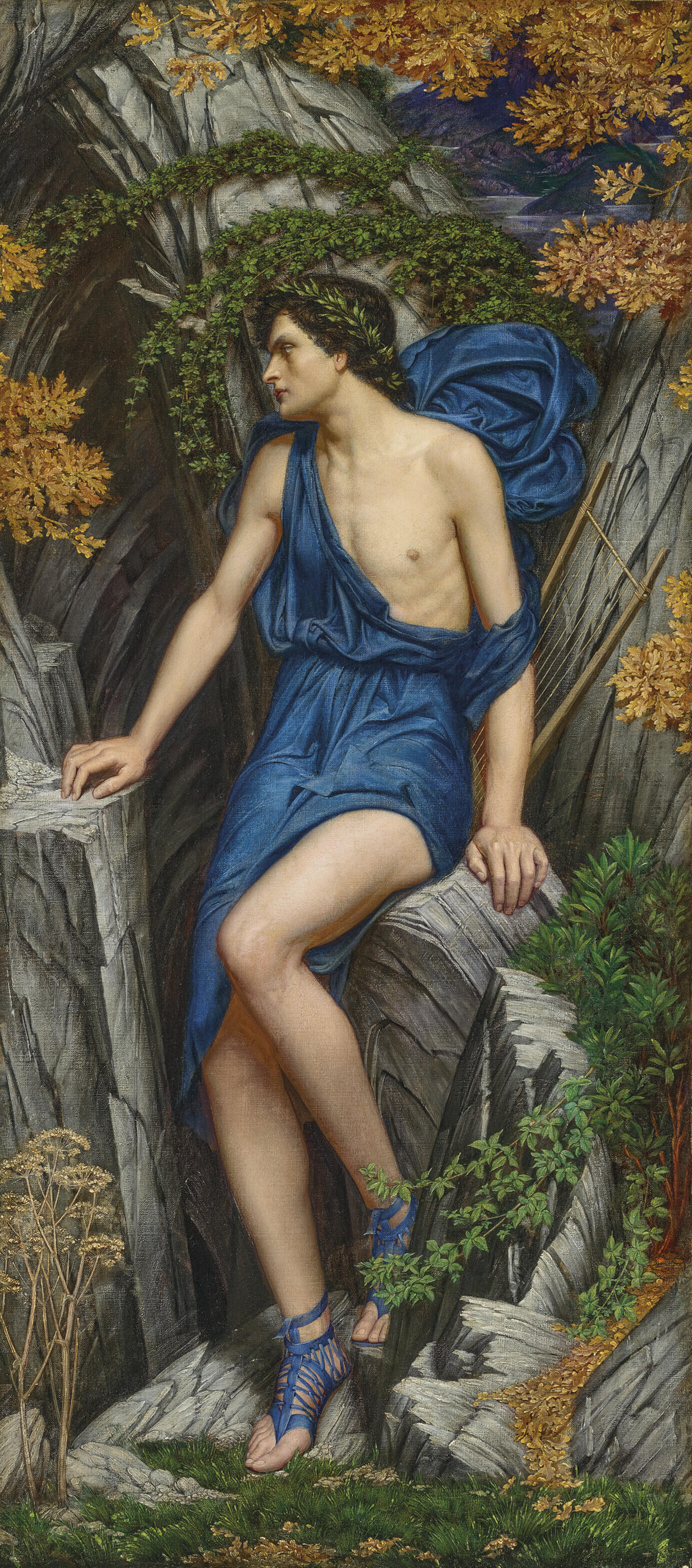
The Return of Orpheus by Sidney Harold Meteyard (1868-1947). Oil on canvas. 40 ½ x 18 inches (103 x 45.8 cm). Private collection. Image ©2022 Christie's Images Limited. Right click disabled; not to be downloaded.
Meteyard exhibited this work at the Royal Academy in 1907, no. 511. When the painting sold at Christie's, London, in 2022 from the Isabel Goldsmith Collection their experts described the scene:
Orpheus is shown at the mouth of a cave, the entrance to the Underworld. The fading autumn leaves around him suggest that he has failed in his quest to retrieve his bride Eurydice, who had died shortly after their wedding after treading on a nest of vipers. According to Greek myth, Orpheus had been allowed by the gods of Mount Olympus to retrieve her and bring her back to life, if only he never looked back. This he almost achieved, but fatally he did so when he was at the mouth of the cave in sunshine, while Eurydice was a few steps behind him in shadow. She had not crossed the threshold from limbo to life, and the gods would allow no second attempt to reach her. Orpheus was distraught, hence his resolute gaze into the middle distance. He sat on a rock and ignored the attentions of the Maenads, a group of women. Frustrated, they tore him limb from limb and tipped his body into a river. Myth relates how his head kept singing however, accompanied by his lyre, until it was found by nymphs a long way off. The myth's purpose, like the Old Testament story of Lot's wife, who looked back on Sodom and Gomorrah when she was commanded not to and turned into a pillar of salt, is to urge the audience to face the future not the past.
In Meteyard's painting Orpheus is shown seated clad in blue and with both hands resting on grey rocky outcrops. A laurel wreath is around his head, symbolic of his achievements in lyrical poetry and music. His lyre can be seen propped up behind his left arm. He has a disconsolate expression on his face, reflective of the loss of his wife to Hades for the second time. The composition has been influenced by Edward Burne-Jones, not only in the figure of Orpheus, but in the rocky background which is reminiscent of Burne-Jones studies for The Hill Fairies for his The Last Sleep of Arthur in Avalon. Burne-Jones made many drawings originally intended to illustrate "The Story of Orpheus and Eurydice" for William Morris's The Earthly Paradise. He also designed a series of roundels on this subject in 1879 to decorate the piano Frances Graham was given by her father to celebrate her twenty-first birthday. The Greek myth of Orpheus and Eurydice was popular with Victorian painters with versions by Frederic Leighton, G.F. Watts, Edward Poynter, J.R. Spencer Stanhope, and Charles Fairfax Murray. Harry Bates also sculpted a relief of Orpheus and Eurydice, c.1880s.
Bibliography
Important 19th Century European Paintings. New York: Sotheby Parke Bernet (October 28, 1982): lot 86.
The Isabel Goldsmith Collection: Selected Pre-Raphaelite and Symbolist Art. London: Christie's (July 14, 2022): lot 28. https://onlineonly.christies.com/s/isabel-goldsmith-collection-selected-pre-raphaelite-symbolist-art/sidney-harold-meteyard-1868-1947-28/155367
"Modern English Art." The English Illustrated Magazine (February 1908): 438 and 440-41.
Created 26 March 2026