
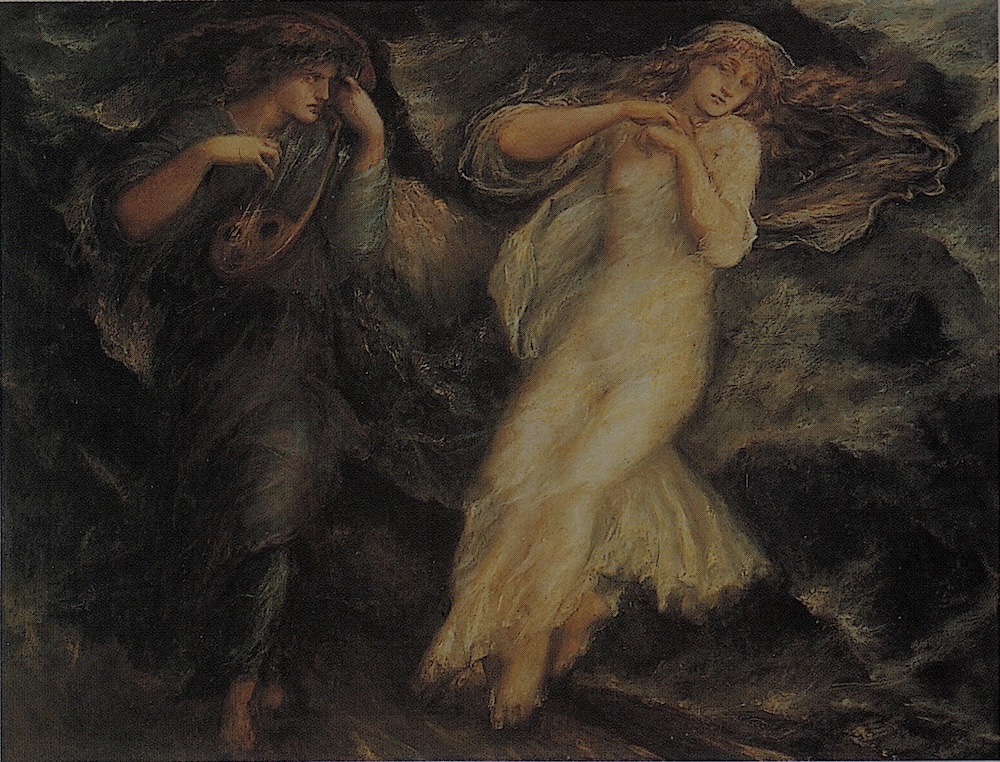
Orpheus and Eurydice, by Charles Fairfax Murray (1849-1919). c.1890-95. Oil on canvas. 34 x 42 inches (86 x 112 cm). Private collection. Image courtesy of Sotheby's, London. [Click on the image to enlarge it.]
The tragic tale of Orpheus and Eurydice was one of the most famous of the Greek myths. Orpheus was the most talented musician of the ancient world, both as a vocalist and playing on his lyre. He fell in love and married the beautiful wood nymph Eurydice, but unfortunately she was bitten by a viper and died. Orpheus decided to descend into the underworld to try to get his wife back. He played and sung before King Hades and Queen Persephone and so charmed them that he was allowed to take Eurydice back, but only on the provision that he did not look back at her until they had returned to the land of the living. In a moment of doubt Orpheus forgot his pledge, looked back at his wife too soon, and she was cast back into the underworld forever. Murray would have been familiar with the myth through "The Story of Orpheus and Eurydice" included in William Morris's The Earthly Paradise.
The myth was a favourite subject for artists from the Renaissance onwards. Victorian artists who painted this subject include Frederic Leighton, whose early The Triumph of Music: Orpheus, by the Power of his Art, Redeems his Wife from Hades dates from 1856, and whose later, quite different composition, Orpheus and Eurydice, was completed in 1864. Edward Burne-Jones produced a series of designs related to the story of Orpheus and Eurydice, initially in c.1866 in conjunction with William Morris's The Earthly Paradise. He later resurrected his Orpheus and Eurydice designs in 1879 for the circular roundels incorporated into the exterior decoration of the famous piano made for his important patron and friend William Graham as a present for his daughter Frances for her twenty-first birthday. Other versions of this theme include Edward Poynter's painting Orpheus and Eurydice of 1862, and G. F. Watts's version, exhibited 1869 — in fact Watts painted numerous versions of the subject around this time, including both his horizontal half-length and vertical full-length compositions. Later versions by other artists include John Roddam Spencer Stanhope's Orpheus and Eurydice on the Banks of the Styx of 1878. Even as late as c.1922 Charles Ricketts produced his version of the story. Harry Bates also sculpted a relief of Orpheus and Eurydice in around the 1880s.
According to Murray's diary entry of February 8, 1877, he had already begun a sketch of this subject. Its date of completion is uncertain, but he likely began it in the late 1880s or early 1890s (Tucker 176). In a letter to Samuel Bancroft of 23 April 1893 Murray mentions that he has been so busy in various ways that he hasn't yet completed either Girls Crossing Stream or the Orpheus and Eurydice (Elzea, letter 11, 24). Murray's composition is unusual, with the doomed lovers attempting to exit a dark amorphous underworld and showing the moment when Orpheus looks back at Euridice, following which she is cast back into Hades. Orpheus is shown clad in dark clothing and carrying his lyre while Eurydice is dressed in a white robe with her long blonde hair flowing freely.
Bibliography
Elzea, Rowland Ed. The Correspondence between Samuel Bancroft Jr. and Charles Fairfax Murray 1892-1916. Delaware Art Museum Occasional Papers II. Wilmington: Delaware Art Museum (February 1980): 24.
Tucker, Paul. I Giardini delle Regine: Of Queen's Gardens: The Myth of Florence in the Pre-Raphaelite Milieu and in American Culture (19th-20th centuries). Margherita Ciacci and Grazia Gobbi Sica Eds. Livorno, Italy: Sillabe, 2004, cat. 17, 176.
Victorian Pictures. London: Sotheby's (5 June 1996): lot 146, 95.
Created 22 February 2026