
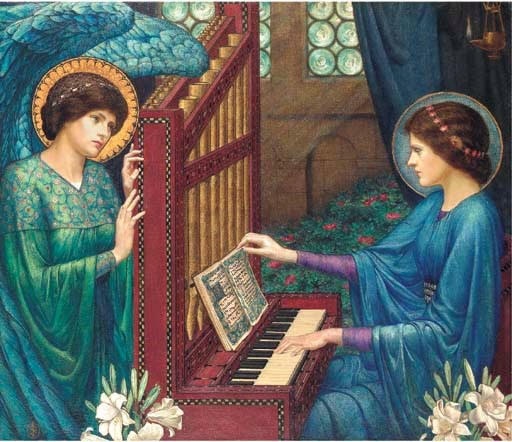
Saint Cecilia. Oil on canvas. 30 ¾ x 36 inches (78.1 x 91.4 cm). Private collection. Image ©2004 Christie’s Images Limited. Right click disabled; not to be downloaded.
Surprisingly this painting was not exhibited at either the Royal Academy, the New Gallery, or the Royal Birmingham Society of Artists, thereby making it difficult to firmly establish its date. When it sold at Christie's in 2004 their experts concluded that, because of the predominantly green, blue and purple colour scheme, it was reminiscent of "I am Half-Sick of Shadows", so the work may date from about the same period, shortly before the outbreak of the First World War.
Paintings of St. Cecilia, the patron saint of music, were extremely popular amongst artists of the Pre-Raphaelite circle dating back to D.G. Rossetti's wood-engraved illustration to Tennyson's poem, "The Palace of Art" in the Moxon Tennyson of 1857. Edward Burne-Jones portrayed the subject in terms of stained glass and developed at least one of these designs into a finished painting. Other versions of St. Cecilia were painted by Elizabeth Siddal, Simeon Solomon, Arthur Hughes, J. M. Strudwick, John Atkinson Grimshaw, J. W. Waterhouse, Marie Spartali Stillman, and E.R. Frampton. C. F. Murray produced a number of drawings for this subject but apparently never completed a finished easel painting.
Meteyard treats the subject in a conventional manner showing St. Cecilia dressed in a blue gown and seated at an organ playing music from an illuminated manuscript while looked upon by an angel dressed in green with blue wings. This image reflects lines from Tennyson's poem, "The Palace of Art":
"Or in a clear-wall'd city on the sea,
Near gilded organ-pipes, her hair
with white roses, slept Saint Cecily;
An angel look'd at her."
The facial features of the saint and her accompanying angel look similar and it is possible both were modelled from Meteyard's second wife and close collaborator, Kate Eadie. It is also possible that the model for the right-hand figure could have been Kate Eadie’s sister Norah. In the painting the artist chose white lIn the painting the artist chose white lilies rather than white roses as symbolic of St. Cecilia's virginity, purity, and innocence. White lilies and blue clothing are normally attributes associated with the Virgin Mary.
Bibliography
Important British Art. London: Christie's (24 November 2004): lot 3, 122-25. https://www.christies.com/en/lot/lot-4387765
Created 24 March 2026