
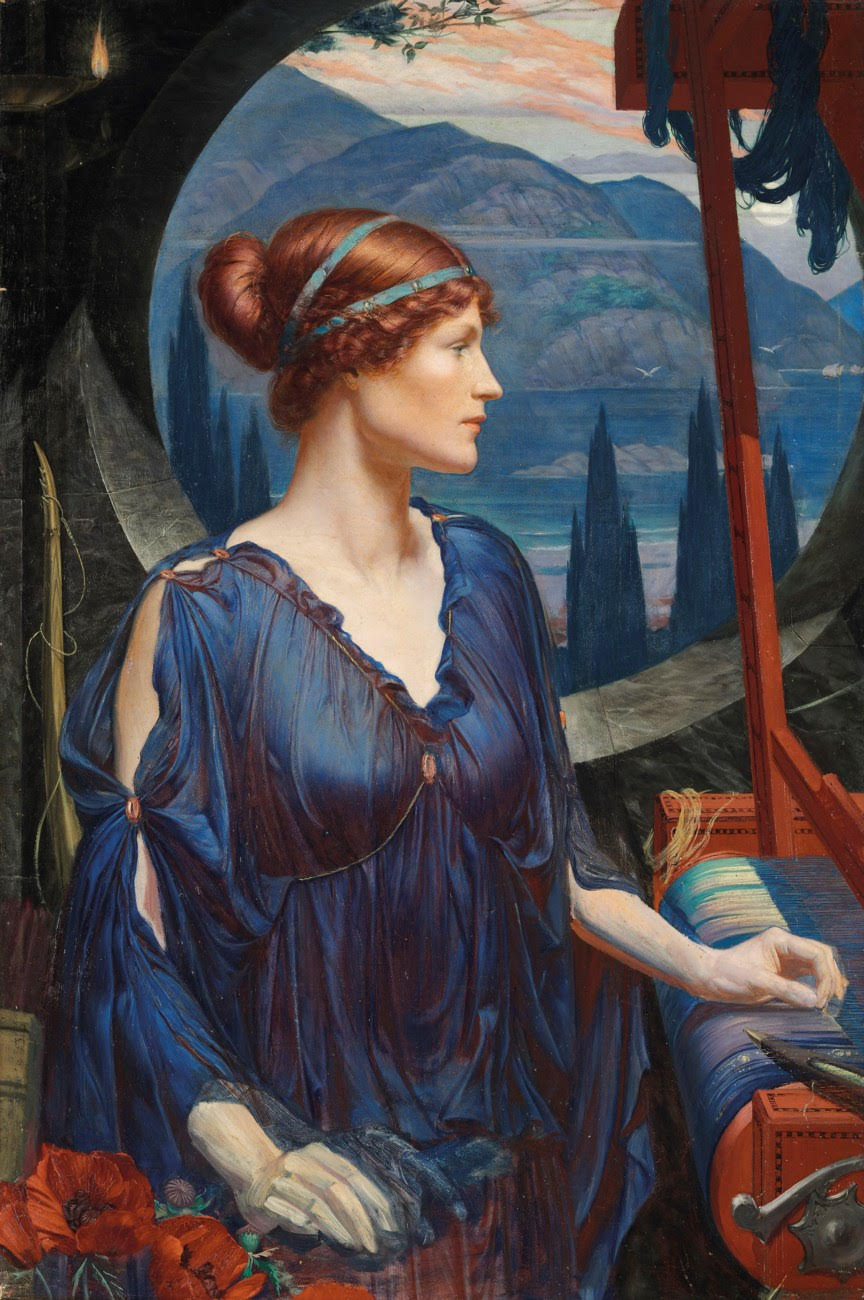
Penelope at her loom, by Sidney Harold Meteyard (1868-1947). Oil on canvas. 39 x 26 inches (99 x 66 cm). Private collection. Image ©2018 Christie's Images Limited. Right click disabled; not to be downloaded.
Penelope at her loom is a rare example from Meteyard's small oeuvre of oil paintings. The subject is taken from Homer's The Odyssey, and illustrates a narrative that was to prove popular with other Victorian artists, including Dante Gabriel Rossetti, Thomas Seddon Frank Dicksee, Frederick Sandys, John Roddam Spencer Stanhope and John William Waterhouse. Whilst including many of the elements that are usually associated with the story, Meteyard's interpretation is markedly different from other treatments of the subject by contemporary or earlier artists. In the story, Penelope is left at home in Ithaca, whilst her husband Odysseus goes off to fight the Trojan War. When he does not return, and is thought dead by most, Penelope has to devise various schemes to delay the advances of a seemingly endless stream of suitors, including the announcement that she shall not consider marrying again until she has completed the weaving of a burial shroud for her husband's father. Each night she quietly unpicks the progress that she had made with the previous day's weaving, and manages to carry on undetected for three years, before one of her servants discovers her deception and reveals it to Penelope's suitors. Odysseus finally returns home twenty years after first he set off, and, disguised as a beggar, learns of his wife's chastity and the unwanted advances of her many suitors. After an archery competition, Odysseus slays every one of his would-be rivals, before managing to convince Penelope that he is in fact her long-estranged husband.
Rather than illustrate a more dramatic episode from the story, Meteyard focuses upon the figure of Penelope herself, her loom and the Ionian landscape beyond. A small fleet of ships can be seen upon the horizon, hinting at the return of Odysseus, and the flame burning at the upper left of the painting is semblative of Penelope's enduring fidelity. To the left is the bow of Odysseus that Penelope will use to challenge each of her suitors to string, knowing that only her husband would have the strength to do so; the same bow (and arrows) that Odysseus will use to slay his rivals. The poppies at the bottom left are a symbol of remembrance for her lost love, but also the source of an opiate to help Penelope to forget her grief at his prolonged absence. Their presence may also be a humorous allusion to the name Poppy sometimes being used as a nickname for Penelope. The sumptuous blue of Penelope's dress recalls the use of lapis lazuli in Italian Renaissance paintings, but also the deep blues present in works by contemporaries like Edward Burne-Jones and Edward Robert Hughes.
In searching for suitable source material, Meteyard must have been familiar with Pintoricchio's fresco of Penelope with the Suitors that was formerly in the Palazzo del Magnifico, Siena, but was acquired by the National Gallery, London, in 1874. In the fresco, Penelope is depicted wearing a blue dress and is seated at her loom. A ship can be viewed through the window behind her, and Odysseus's bow and quiver of arrows are present to her left. Meteyard chooses to portray Penelope alone, focussing upon her beauty, the exquisite draperies of her dress and the symbolic objects that encircle her. The almost claustrophobic nature of her surroundings would suggest that Penelope has no room for anyone else in her world, save for he whom she looks for in the distance. The parallels to pictorial treatments of The Lady of Shalott are obvious. The loom, the eternal flame and the profile of a beautiful woman set against a rounded window could just as easily illustrate Alfred, Lord Tennyson's poem, yet no Arthurian knight is present in the view beyond.
Although dealing with a story from ancient Greek mythology, Penelope at her loom appears to be subtly imbued with symbolic references to the times in which the artist lived, most particularly World War I. The red poppies are a sign of remembrance, particularly in association with The Great War, whilst the figure of Penelope, awaiting the return of her husband from the war, is representative of the wives left behind to "keep the home fires burning." The bow and arrows are also symbols of war, and though not obviously associated with the First World War, could be seen as an allusion to a popular story in which British troops at the Battle of Mons in August 1914 were said to have been supported by a ghostly troop of mediæval archers from the Battle of Agincourt. Meteyard's choice of colours for Penelope at her loom may have a nationalistic significance, for which one would expect a proliferation of red, white and blue in his palette, yet there is more use of black than white, possibly to emphasize the mournful nature of the subject.
Meteyard was meticulous in making chalk studies for different elements within his paintings and designs for stained glass, sometimes devoting a single sheet to studies of flowers, or filling an entire sketchbook with studies of hands. This attention to detail is evident in all of his paintings, and, in this instance, pentimenti within the lower portion of the canvas reveal how the artist has shown the revised position of Penelope's right hand. It is not known if the painting was ever exhibited during Meteyard's lifetime – the unresolved nature of the lower portion of the composition would suggest that it was not.
Comparison between the head of Penelope and the study for the head of Vivien indicates that the same model was employed for both pictures. The model is most likely Meteyard's pupil and second wife, the enamellist Kate Eadie, who collaborated with him upon stained glass commissions and other works, and modelled for him frequently.
Bibliography
British Art: Victorian, Pre-Raphaelite & British Impressionist Art. London: Christie's (11 December 2018): lot 137, 36-37. https://www.christies.com/en/lot/lot-6184693Created 24 March 2026