
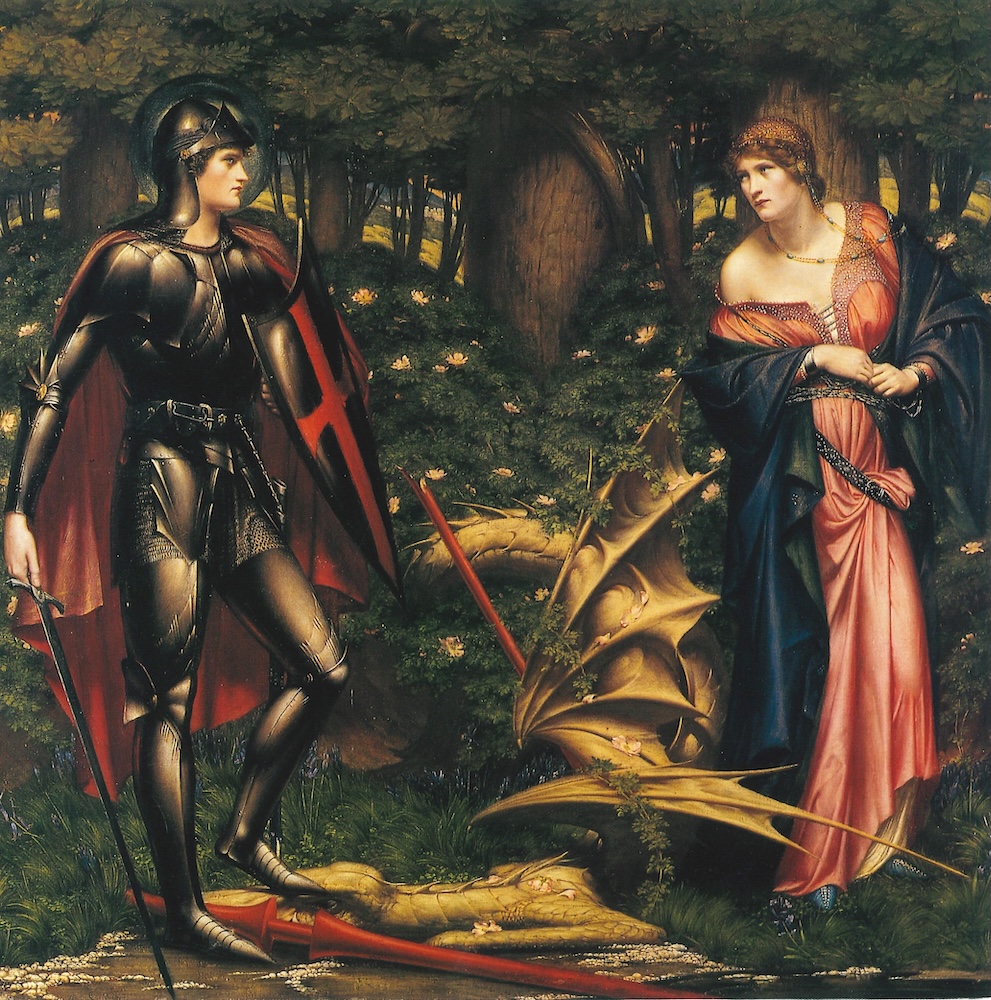
St. George and the Dragon. 1904. Oil on canvas. 43 ½ x 44 ½ inches (110.5 x 112.4 cm). Private collection. Image ©1993 Christie's Images Limited. Right click disabled; not to be downloaded.
The most famous tale associated with St. George, as patron saint of England and champion for Christianity, is of him slaying the dragon which was terrorising the city of Silene in the province of Libya, on the day when the king's own daughter, the Princess Sabra, was to be sacrificed to it. As the princess was being led to her doom, the passing knight, learning of her dreadful fate, determined to slay the dragon and save her. However, the dragon's scales were like steel and his spear simply broke into pieces,; he could only defeat it in the end by aiming at a small patch of vulnerable skin. The grateful inhabitants held a huge feast in his honour, and the king offered him his daughter in marriage. St. George caused all the people, including the king, to be baptised into Christianity.
Meteyard exhibited this work at the Royal Birmingham Society of Arts in Birmingham in 1904, no. 347. In Meteyard's painting, St. George, clad in black armour with a red cloak and holding his sword in his right hand and his shield containing the sign of the cross in his left, stands with his foot on the head of the dragon he has just slain. His lance is shattered and part lies between his feet with the remainder lying on the tail of the dragon. St. George's armour is reminiscent of that worn by Perseus in Edward Burne-Jones's The Perseus Series such as The Doom Fulfilled. The Princess Sabra wears a pink dress with a dark navy-blue mantle and is tied to a tree awaiting her fate, her hands clasped together, and looking directly at her rescuer. The scaly winged dragon is of a golden colour. The knight and the princess are shown in a clearing in a wood.
John Christian feels that Meteyard was influenced in his hard metallic style by the hard formalised style of Burne-Jones's later works:
In St George and the Dragon he finds congenial motifs in the Saint's plate armour and the dragon's scaly body, while even the Princess's drapery looks as if it had been cut out of sheet metal. The harsh reds and greens of the colour scheme underline this formal toughness. The subject of St George had impeccable Pre-Raphaelite credentials, having been treated at various dates by Rossetti, Burne-Jones, and Morris. There are also numerous parallels in the work of the sculptors, - Gilbert, Drury, Frampton, Reynolds-Stephens, Bayes, Turner and others - who were inspired by late Pre-Raphaelite paintings to execute figures of St George and other armoured heroes, often in the context of First World War memorials. [Christie's, 1993, 110]
These sculptors were all affiliated with the New Sculpture Movement of the late nineteenth and early twentieth centuries, a movement that had been shaped by Pre-Raphaelitism.
The subject of St. George and the Dragon was popular with Old Master painters, including the famous one by Paolo Uccello that is now in the National Gallery, London. In the Victorian era Rossetti treated this subject in a series of cartoons for stained glass. The windows were made by Morris, Marshall, Faulkner & Co. in 1861-62 and are now in the collection of the Victoria and Albert Museum. Edward Burne-Jones, assisted by Charles Fairfax Murray, completed a series of seven paintings on the theme of St. George and the Dragon from 1865-67 for the dining room of Myles Birket Foster's home "The Hill" at Witley in Surrey. Both Rossetti's and Burne-Jones's series are treated in a much more "medieval" manner than is the painting by Meteyard. The painting by Solomon Joseph Solomon of c.1906 was also in a more modern style and was his diploma picture for the Royal Academy of Arts.
Related Material
Bibliography
Casteras, Susan P. The Substance or the Shadow: Images of Victorian Womanhood. New Haven: Yale Center for British Art, 1982, cat. 27, 71.
Christian, John. Fine Victorian Pictures, Drawings and Watercolours. London: Christie's (11 June 1993): lot 116, 110-11. https://www.christies.com/zh/lot/lot-3008567
_____. The Last Romantics. The Romantic Tradition in British Art. London: Lund Humphries, 1989, cat. 85, 109.
Elzea, Rowland and Betty Elzea. The Pre-Raphaelite Era 1848-1914. Wilmington: Delaware Art Museum, 1976, cat. no. 4-30, 80-81.
Created 30 March 2026