
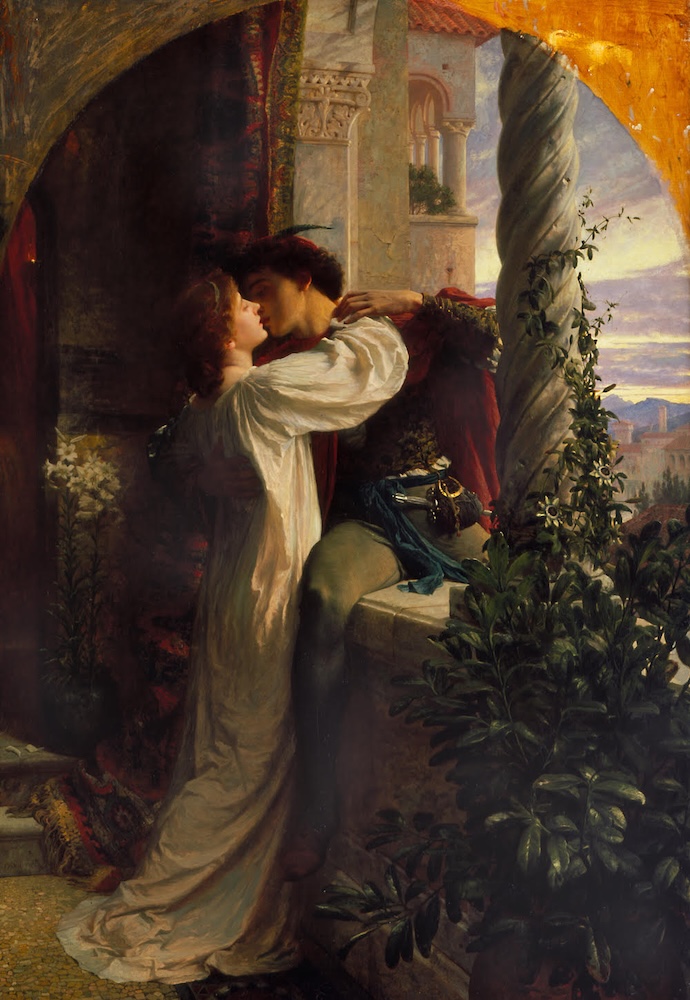
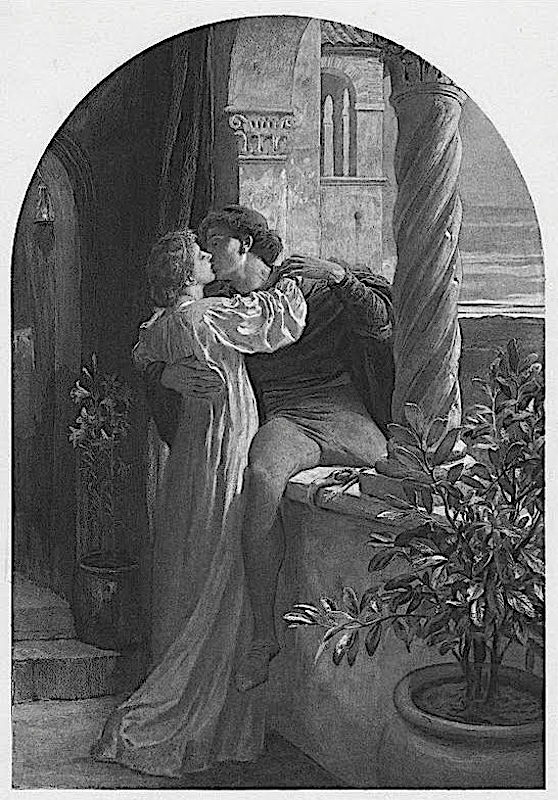
Romeo and Juliet, by Sir Frank Dicksee (1853–1928). 1883-84. Left: 1883-84. Oil on canvas. 66 1/2 x 46 inches (171 x 118 cm). Collection of the Southampton Art Gallery, accession no. 1006. Image courtesy of Southampton Art Gallery, via Art UK, reproduced for purposes of non-commercial academic research. Right: Photogravure frontispiece to the play, courtesy of the author. [Click on the images to enlarge them.]
Romeo and Juliet was exhibited at the Royal Academy in 1884, no. 430. The painting's title was accompanied in the Royal Academy catalogue by the following lines from Shakespeare's play: "Romeo. Farewell, farewell, one kiss and I'll descend." Of all Shakespeare's plays Romeo and Juliet seems to have been the one that fascinated him, and that he most favoured to illustrate, particularly the balcony scene, which he had first painted in 1876. In 1884, the same year this painting was exhibited, Romeo and Juliet. With twelve illustrations by F. Dicksee was published by Cassell & Company, London. The illustration that served as the basis for the painting was the book's frontispiece. A sketch design for the painting is in the collection of the Victoria and Albert Museum. The painting shows the youthful lovers embracing as Romeo prepares to descend from the balcony of Juliet's home. She is clad in white and white lilies are seen in a pot to the left, symbolic of her purity when she married Romeo. Simon Toll notes that the twisting passion flowers winding around the marble pillars have "obvious sexual and romantic allusions" (62). The view of Verona in the background, as well as the carved marble column of the balcony, were based on sketches Dicksee had made on a visit to Italy in 1882. This painting was obviously inspired by Venetian High Renaissance art and remains one of Dicksee's most popular works. An etching of the work by Charles-Albert Waltner was also published by Thomas Agnew & Sons.
Contemporary Reviews of the Painting
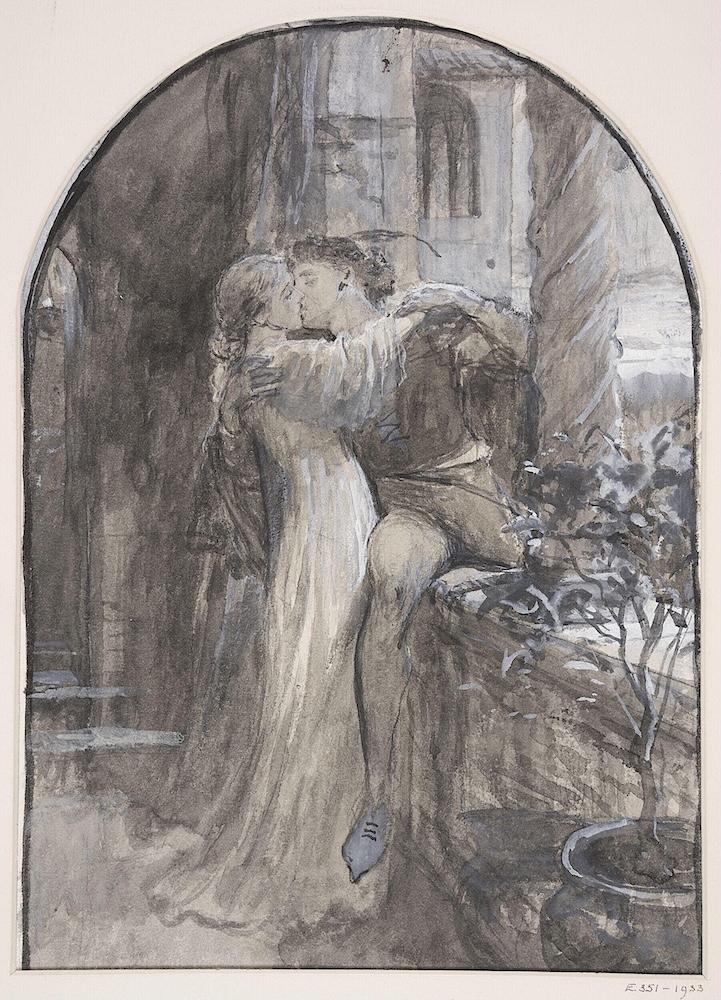
Sketch Design for Romeo and Juliet, c.1880-84. India ink and Chinese white on paper; 12 x 8 inches (30.5 x 20.3 cm). Collection of the Victoria and Albert Museum, London, accession no. E.351-1933. Image courtesy of the Victoria and Albert Museum.
This painting received very mixed reviews when one considers that in 2012 it was voted by the public to be "the most romantic painting in Britain." A reviewer for The Art Journal merely commented: "Romeo and Juliet by Frank Dicksee, A. The lovers at the touching moment when banished Romeo leaves his lady's window, with the words – 'Farewell, farewell, one kiss and I'll descend'" (211). The Magazine of Art thought: "Mr. Frank Dicksee, in Romeo and Juliet, is far below last year's level" (351).
F.G. Stephens in The Athenaeum felt this work suffered in comparison to Ford Madox Brown's more vigorous depiction of this same scene:
It would be well if manner implied strength and a distinct individuality in design. That such is not the case will be obvious to those who turn to Mr. Dicksee's Romeo and Juliet (430), the design of which is so trite that is hard to convince ourselves that it is not a work of the school of Ary Scheffer. Original or not, the design, as here represented, is not without grace of the commonplace sort. But the figure of Juliet lacks passion, and the legs of Romeo are by no means what they should be. Comparisons, when instructive, should be made, and therefore it may be well to refer Mr. Dicksee to Mr. F. M. Brown's intensely vigorous design in which the painter has embodied the passion of Shakespeare's imagining. The picture of Mr. Dicksee's lacks virility; accessories are those of a stage scene, with the exception of the laurel bush in front, which, although its colour is cold and heavy, has been painted con amore and with skill equal to that shown in another picture of Mr. Dicksee's. [733]
Harry Quilter in The Spectator also found it disappointing:
Last in this notice, to get rid of disagreeable subjects, let us mention the Romeo and Juliet of Mr. Frank Dicksee, a young artist who four years ago painted a good picture and has been going down the hill ever since. This is quite the worst he has produced. The lovers are parting at dawn – she, in her night-dress, clinging to her sweetheart; he, with one leg over the window-sill, in the regular stage attitude. The painting is careful, dull, and smooth, the drawing fair, the colour like that of the Munich school - that is to say, execrable; but the whole picture is absolutely uninteresting and conventional. [649]
On 1 June 1884 the publication The Artist gave a "Collated Press Opinion" on the current Royal Academy exhibition, including the work by Dicksee, which received mixed reviews:
"Romeo and Juliet is carefully designed and drawn; shows the result of much thought and learning, and yet it is not entirely satisfactory. Perhaps a painter should seem to have painted so passionate as subject with more passion." – Pall Mall Gazette.
"The figure of Romeo is admirably drawn; all the accessories - especially the laurel in the foreground - are painted with extreme care; and, taken altogether, the picture must rank far higher than most of Mr. Dicksee's recent efforts." – The Times.
"If he could have realised Romeo the picture might have been a great one; in this he has not been successful, but for the rest we have nothing but praise." – The Observer.
"The painting is a provoking example of commonplace romanticism, and is all the more irritating through the circumstance that in many portions the draughtsmanship and the execution are really superb. But there is hopeless insignificance in this long-legged lackadaisical Romeo; clambering out of window in the ungainliest manner conceivable, and this back view of Juliet in her nightgown." – The Telegraph.
Sydney Hodges in The Magazine of Art, when writing about Dicksee's early works, found this work more conventional than most: "For the first time after this Mr. Dicksee appears to have descended into a more conventional groove, and produced a picture from a subject which has been a favourite one with all painters since the English school was founded, namely, Romeo and Juliet. Though not, perhaps, so happy in colour as some of his previous works, there was much in this picture to elicit admiration. The face of Juliet was exceedingly beautiful, and the effect of the breaking morning light especially happy" (219).
Bibliography
19th Century European Paintings & Sculpture. New York: Sotheby's (February 2, 2024): lot 833.
Blackburn, Henry. Academy Notes. No. X. London: Chatto and Windus, 1884: 40.
"Collated Press Opinion on The Royal Academy Exhibition." The Artist V (1 June 1884): 195.
"Current Art." The Magazine of Art VII (1884): 347-52.
"The Exhibition of the Royal Academy" The Art Journal New Series XXIII (1884): 209-11.
Hodges, Sydney. "Mr. Frank Dicksee, A.R.A." The Magazine of Art (1887): 217-22.
Monkhouse, Cosmo. "Mr. Dicksee's Illustrations to Romeo and Juliet." The Portfolio: An Artistic Periodical XVI (1885): 59-60.
Quilter, Harry. "Art. The Royal Academy." The Spectator LVII (17 May 1884): 648-49.
Romeo and Juliet. Art UK. Web. 2 July 2026.
Romeo and Juliet. Victoria and Albert Museum. Web. 2 July 2026.
Stephens, Frederic George. "Fine Arts. The Royal Academy." The Athenaeum No. 2954 (7 June 1884): 733-35.
Toll, Simon. Frank Dicksee 1853-1928, His Art and Life. Woodbridge: ACC Art Books, 2016, cat. no. FD.1884.1, 52-54, 60-64, & 226-27 and cat. no. FD.1884.4, 227-28.
"Works for the Principal Exhibitions." The Artist V (1 May 1884): 138.
Created 2 July 2026