
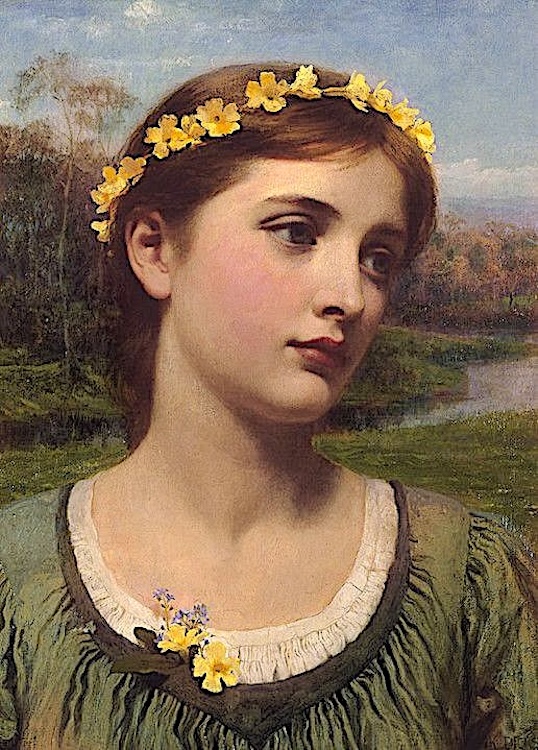
Spring (Spring Maiden), by Sir Frank Dicksee (1853–1928). 1884. Oil on canvas. 16 x 12 inches (41 x 30.5 cm). Private collection, image courtesy of Sotheby's. [Click on the image to enlarge it.]
Dicksee showed this work at an exhibition of modern art the Fine Art Society in London in 1884, no. 4. Although it may not be considered one of his masterpieces and is more of a "pot boiler," it holds special importance for the present writer, who, as a young man with very little knowledge of the Pre-Raphaelites, or even of Victorian art in general at that point, bid for it unsuccessfully at auction when it appeared at Waddington’s in Toronto in the early 1970s. This was the first Pre-Raphaelite painting he ever bid on. He tried again when it came up for auction at Sotheby's several decades later, again without success. The price had risen very considerably by then.
The painting features a beautiful girl, clad in a green dress, and with a crown of yellow primroses in her hair. In view of Dicksee's choice of Spring as a title for this picture, yellow primroses were most likely chosen for being an emblematic herald of Spring rather than for their symbolic meaning in the language of flowers. The latter is possible, however, because yellow primroses can symbolise youth, happiness, joy, and optimism. In the midground of the painting is a stream flowing through a meadow, while a forest is seen in the background. Simon Toll has suggested that the model for Spring might possibly have been Agatha Thornycroft, of whom Dicksee had drawn a pencil portrait in 1884 (60). She was the young wife of his friend, the well-known sculptor Hamo Thornycroft.
When the painting was exhibited at the Fine Art Society in 1884 The Academy reported, "We are first met by a sweet face of an English girl, crowned with primroses, to which Mr. Frank Dicksee has given the name of Spring (302). When the painting sold at Sotheby's in 2003 their expert stated that this picture was unrecorded and had never been exhibited, being unaware that it had been shown at the Fine Art Society. Their expert mentioned, however, that
It relates closely to a series of paintings painted by Dicksee in the 1880s and is a highly accomplished and radiant picture. The first of these series of pictures is Benedicta, a head-and-shoulders view of a beautiful maiden dressed in a Fifteenth Century dress. This picture was painted for a series of depictions of beautiful women painted by famous artists commissioned by The Graphic magazine and published as successful engravings, much admired by Queen Victoria. Beatrice was painted for a subsequent Graphic series of depictions of Shakespearean heroines, and it is likely that Sylvia and another picture Cynthia were conceived as designs for the same series. None of these pictures were exhibited, which supports the theory that they were all painted as part of commissions for The Graphic. Spring Maiden may have originally been intended as part of the Shakespearean Heroine series to portray Ophelia, her hair arranged with field flowers close to the banks of the stream where she drowned…. Spring Maiden is not merely a study of beauty. It summarizes all the qualities of technical excellence, poetic imagination and sensitivity of touch which made Dicksee's work so beautiful. It has the restrained sophistication of English painting combined with a warmth and colour of the Italians and the beauty seen through the eyes of a man who clearly worshipped women, albeit from afar. [206]
It seems more likely, however, that this painting was not connected to the Shakespearean Heroine series but was conceived as a painting in its own right, especially considering its original title was Spring and that it was, in fact, exhibited.
Bibliography
The British Sale. London: Sotheby's (12 June 2003): lot 269, 206-07.
"The Fine Art Society." The Academy XXV (26 April 1884): 302.
Toll, Simon. Frank Dicksee 1853-1928, His Art and Life. Woodbridge: ACC Art Books, 2016, cat. no. FD.1884.2, 60-61 & 227.
Created 2 July 2026
Last modified 10 July 2026