

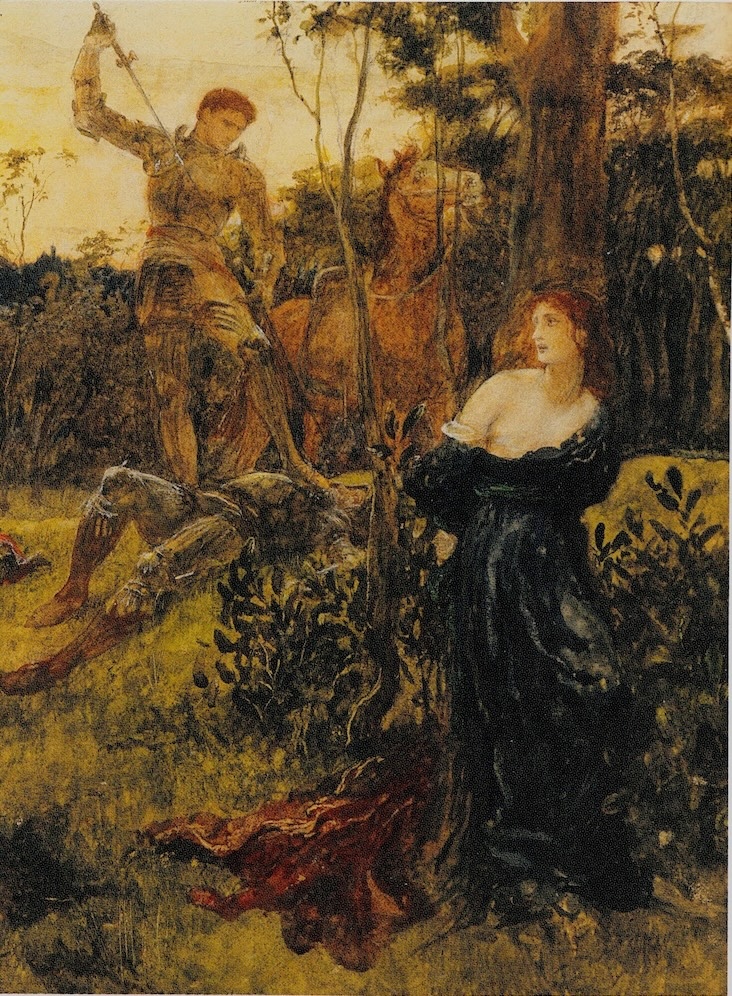
Chivalry, by Sir Frank Dicksee, 1853–1928. 1885. Left: Oil on canvas. 71 7/8 x 53 3/4 inches (182.7 x 136.6 cm). Private collection, image ©2012 Christie's Images Limited. Right click disabled; not to be reproduced. Right: Study for Chivalry. Pencil, watercolour and gouache with scratching out. 13 1/4 x 9 7/8 inches (33.6 x 25.1 cm). Private collection, image courtesy of Maas Gallery.
Chivalry was exhibited at the Royal Academy in 1885, no. 53, and was a commission from Sir John Aird. It shows a knight standing over his vanquished foe and preparing to sheath his sword. A damsel in distress is tied to a nearby tree. Amanda Kavanagh has pointed out that Dicksee's design was developed from his earlier illustration, "I Made All Haste to Get Away", to a modern story, R.D. Blackmore's novel Erema; or My Father's Sin. The story was published in The Cornhill Magazine, Volume XXXV, in the January 1877 issue and the related illustration was used as its frontispiece. Dicksee frequently worked out his final compositions by means of a watercolour sketch and Chivalry was no exception.
When Chivalry sold at the Forbes sale at Christie's in 2003 John Christian wrote about its relevance to Victorian concepts of chivalry:
The present picture is one of his most attractive, a wonderful embodiment of late Victorian romanticism at its most theatrical and uninhibited. As Mark Girouard has shown in his book The Return to Camelot, the ideal of chivalry preoccupied the Victorians. It is no accident that the concept was central to the frescoes in the new Palace of Westminster that were conceived as a great expression of national pride and sentiment. First embodied in Maclise's Spirit of Chivalry, painted in the House of Lords in the 1840s, the theme was taken up again in the Arthurian subjects in the Queen's Robing Room [Dyce, Hospitality] that engaged William Dyce for the last sixteen years of his life. The obvious literary parallel is Tennyson's Idylls of the King in which the Poet Laureate retold the national epic in terms which were intended to have direct reference to contemporary mores…. But chivalry was not the preserve of national or public aspirations. It could also be the focus of the Pre-Raphaelites' essentially private response to the Middle Ages. One thinks, for example, of Rossetti's Death of Breuse sans Pitié, one of the "Froissartian" watercolours that he painted for William Morris in the late 1850s; of Burne-Jones's St George and Perseus series, executed for domestic settings a decade or more later; or of Millais' The Knight Errant (Tate Britain), exhibited at the Royal Academy in 1870. It was typical of Dicksee to seek to express a Pre-Raphaelite subject in terms of a lush academic style…. When Chivalry was exhibited in 1885, more than one critic made the comparison with Millais' Knight Errant which, perhaps significantly, had been exhibited the very year that Dicksee entered the R.A. schools. Certainly the comparison is valid in so far as Millais's picture too represents an accommodation between Pre-Raphaelite sentiment and an academic idiom, including the monumental scale on which both pictures are painted. Perhaps the most obvious difference is that Millais dares to flirt with the issue, so fraught for the Victorians, of nudity while Dicksee opts for a safer "off-the-shoulder" solution in which revelation is nicely balanced by concealment, modesty by display. [241]
Some contemporary writers have put a feminist interpretation on Dicksee's painting, particularly considering the controversy raging at the time over images of the female nude being displayed at the principal exhibiting venues in London. Edward Poynter Diadumenè was exhibited at the same Royal Academy exhibition as Dicksee's Chivalry. As Alison Smith has commented in her book on The Victorian Nude:
A spirit of reaction can also be detected in the images of the female nude that appeared in 1885. Scenes representing inert victims and distraught martyrs can certainly be interpreted in terms of a masculinist need to subdue the feminine and reassert control. Frank Dicksee's Chivalry was enthusiastically received by conservative critics that year because he was seen to corroborate a 'healthy' vision of manhood while maintaining a stereotype of female dependence and submission. Chivalry is in many respects a reworking of Millais's earlier Knight Errant in the light of social purity. Not only does Dicksee omit signs of dishevelment and discarded clothes but he distances the knight, emotionally and physically, from the damsel (this time draped), making clear his virtuous intentions. [234]
Jan Marsh also compared Dicksee's painting to Millais's rendering of the similar scene:
The unintended, but unmistakable bondage motif, which would be disturbing if it were not so amusing, unconsciously echoes the message of much Victorian and Pre-Raphaelite imagery of womanhood. It is present, too, in Frank Dicksee's Chivalry, painted fifteen years later and showing the damozel decently clothed – although her shoulder is fetchingly bare in the manner of Maclise's Madeline, and suggestive of imminent dishonour. The hero, unsheathing his sword to vanquish the lust of his fallen rival, is clad in supple feathery armour of the kind popularized by Burne-Jones in order to escape from the literal constriction of the real thing, carefully reconstructed in so many mock-baronial halls, but insufficiently poetic for images of rescue. The lady's gaze has turned upwards to her saviour, with an appropriate expression of gratitude and desire. [106]
Contemporary Reviews of the Painting
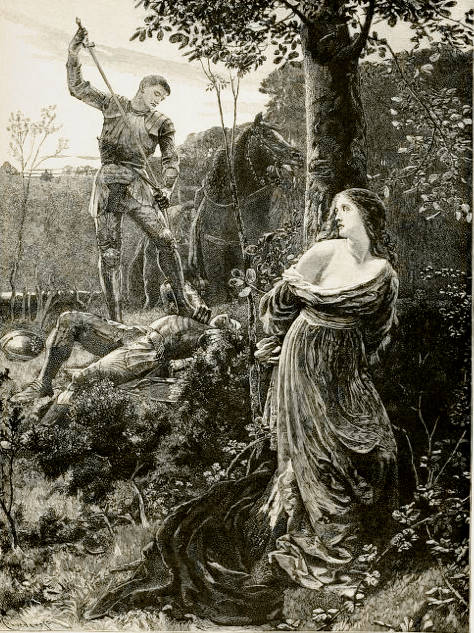
This ambitious painting, shown on the left in the 1885 Magazine of Art's "Current Art IV" (facing p. 467), despite now being regarded as one of Dicksee's major paintings, received very mixed reviews when it was shown at the Royal Academy that year. Many critics commented on the influence of Venetian High Renaissance painting. The Art Journal, for instance, remarked: "Mr. Dicksee's Chivalry (53) is a bold and successful attempt to acclimatise Venetian colouring and a mediaeval mysticism which pre-Raphaelites failed to revive, and it falls short" (258). The Builder found the work too theatrical: "Mr. Frank Dicksee's Chivalry (53) is very fine in colour, utterly unreal in its personages; an eminently theatrical work" (686). A critic for The Illustrated London News preferred the artist's earlier works: "Mr. Dicksee's Chivalry (53) … is a painful effort to revive Venetian colouring. A girl in a rich blue dress, half torn from her body, is bound to a tree, and at a little distance a knight in full armour is placidly wiping the sword with which he has just slain another knight who is lying on the ground. Through the trees a green mystic light struggles with the natural tint of the setting sun, throwing a very unearthly glamour over the scene. It is a pity that Mr. Dicksee cannot curb his somewhat exuberant fancy, and return to the ways where he won his spurs" (481).
Sidney Hodges in The Magazine of Art definitely admired the Venetian colouring of the work: "In this picture – though here again the subject was somewhat conventional – there was a return to the rich, harmonious colouring of the artist's earlier work. The effect of the knight in complete armour, in strong relief against the warm glow of the evening sky, was very striking, and the whole picture seemed instinct with the feeling of the Venetians" (219).
A later commentary in the Magazine of Art felt the painting was primarily decorative, an exercise in colour and tone:
Primarily a piece of decoration, an essay in colour and tone, the original of our frontispiece — Mr. Frank Dicksee's Chivalry — has been loudly discussed and persistently misunderstood. If the painter had professed to depict an episode from romance, an incident from the "Idylls of the King," for instance, little would have been heard of its allegorical character. As it is, his picture has been treated as an allegory pure and simple, an abstract representation of chivalry from the point of view of modern sentiment. Hence it is not surprising it has been generally censured. Allegory the picture is not, but merely a simple and intelligible presentment of circumstances typical of the age of chivalry. It needs no interpretative medium, no special sympathetic insight: only an eye for colour, only a feeling for the plastic qualities of the painter's material. Simple and direct in design, it is far otherwise in execution. The figures are merged in a golden-green light that irradiates the landscape, and this illumination produces a diaphanous effect almost suggestive of a painting on glass. There is a transparency and ethereal brilliancy in the colour which gives the picture a place apart from all others in the Academy. The tree to which the lady is bound, and the woodland scene about her, are more substantial in effect than the figures. These indeed lack something of vitality, of solidity, and character; the victorious knight is almost as void of expression as his foe, who is dead at his feet. He is but an accessory, like the horse, in the decorative scheme of the composition; only in the turned face of the lady, eager to scan her deliverer, have we a touch of the dramatic element needful. The charm of Mr. Dicksee's picture lies in its vague and tender harmonies, in its achievement of a daring and personal invention in colour. His knight has not the martial bearing and virility of the old conception of romance, such as Scott's, for instance; he is Perceval rather, as interpreted by Lord Tennyson and by Wagner, with a touch of Passionate-Brompton thrown in. The lady wants passion and humanity, and is far other than the gallant and fascinating heroines we read of in Percy and old balladry. She would probably involve her rescuer in a metaphysical discussion, as a modern girl might favour him with her views on esoteric Buddhism. [464-65]
F. G. Stephens in The Athenaeum found the work pretentious and lacking in inspiration:
One of the most pretentious pictures in Gallery I is Mr. F. Dicksee's Chivalry (53)… Chivalry might have been one of those early experiments of the modern British genius in romantic and picturesque design which were exhibited at Westminster Hall about forty years ago, while all the world was young enough to enjoy melodramatic allegories as if they were not puerile and unfit for treatment by artists, who in dealing with them must need face difficulties which even the highest powers can never vanquish. Mr. Dicksee has failed to add to his composition that one element indispensable to allegories of any kind, an element which is the salvation of the art of Mr. E. Burne-Jones, the living master of romantic allegory, and, however irregularly and imperfectly, inspires the studious fantasies of Mr. Walter Crane. There is no more poetry in Mr. Dicksee than his teachers have put into him. The nineteenth century tolerates no allegories or romantic visions without poetry which is new and masculine. Mr. Dicksee's forte is sentimental genre of that mild and graceful sort which will flourish so long as there are marriageable maidens in easy circumstances who have not long left school. Such art as his has its analogue in the sweet 'femininities' – the word is Spenser's – of Mr. E. Long … The highly respectable and cultured taste of Mr. Dicksee reflects the art of Sir F. Leighton, but it is less virile and searching; at the same time it is wholly free from the smooth dulness of gentility (which is vulgar at heart) we call commonness…. Mr. Dicksee has depicted a forest glade just after sundown, at the moment when a doughty knight has won victory over a villainous foe, who had, we suppose, insulted a beautiful maiden bound to a tree. The victor plants his foot on the breastplate of his prostrate foe, and he is in the act of sheathing his sword. Excepting the expression of the rescued lady's face, which is the only excellent element of the design proper, there's nothing to attract the visitor in this very conspicuous picture. It lacks inspiration and a raison d'être. [666]
A reviewer for The Portfolio again objected to the colour scheme: "Mr. Dicksee, A.R.A., is champion of the romantic school, and his large composition Chivalry, shows a lady, in blue robes, tied to a tree, and in the mystery of sunset glow behind, her victorious rescuer in full mail sheathing his sword beside the prostrate foe. It is a pity that a false scheme of colour, and a certain unreality of action, mar the well-conceived design and unity of sentiment in the picture" (124). A reviewer for The Magazine of Art felt Dicksee had abandoned those aspects that had previously made his art noteworthy: "Frank Dicksee, who began as the most precocious, the most premature of R.A.'s, has turned aside from his true path, and in his Chivalry goes far to approve himself a painter" (347). Harry Quilter, the critic of The Spectator, wrote he was sorry to see this work: "It is called "Chivalry" and represents a maiden in a blue gown tied to a tree, whilst in the background a knight in complete armour is sheathing his sword. By his feet lies his dead antagonist. The actual brushwork on the picture is good, and so is the drawing of the tree and its foliage; there praise must cease. The maiden wriggling away from the tree is conventional, insipid, and uninteresting; the very long knight trying to sheath a sword, which is too long even for him, is simply comic. The subject is as stale as could be well found, and there is a fatuity about its rendering which is very irritating. Damsel in distress, knight, landscape, even the sunset light behind them, all seem to be well-fed, proper, and comfortable" (784-85).
Bibliography
"Art. The Royal Academy." The Spectator LVIII (June 13, 1885): 784-85.
"Art Chronicle." The Portfolio XVI (1885): 124-25.
Beresford, Richard. Victorian Visions. Nineteenth Century Art from the John Schaeffer Collection. Sydney: Art Gallery of New South Wales, 2010. 88-89.
Blackburn, Henry Ed. Academy Notes XI. London: Chatto and Windus (May 1885): 5, 22.
Boyes, J. F. "The Private Art Collections of London: Mr. John Aird's, in Hyde Park Terrace." The Art Journal (1891): 138-9.
Christian, John. The Forbes Collection of Victorian Pictures and Works of Art I. London: Christie's (19 February 2003): lot 35, 238-43.

_____. The Last Romantics. The Romantic Tradition in British Art. London: Lund Humphries, 1989, cat. 116, 120-21.
_____. The Pre-Raphaelites and Their Times. Tokyo: The Tokyo Shimbun, 1985, cat. 34, 80-81.
"Current Art – I." The Magazine of Art VIII (1885): 346-50.
"Current Art.—IV." The Magazine of Art. 10 (November 1886-October 1887): 464-70. HathiTrust, from a copy in the Getty Research Institute. Web. 24 October 2014.
Dibdin, E. Rimbault. "Frank Dicksee, R.A. - His Life and Work," special issue of The Art Annual (1905): 9, 28, & 32.
Elzea, Rowland and Betty Elzea. The Pre-Raphaelite Era. Wilmington: Delaware Art Museum, 1976, cat 4-33, 82.
Forbes, Christopher. The Royal Academy (1837-1901) Revisited: Victorian Paintings from the Forbes Magazine Collection. New York: Forbes 1975 cat. 10, 38-39.
The Forbes Collection of Victorian Pictures and Works of Art II.London: Christie's (19 February 2003): lot 82, 104.
"Further Notes on Academy Pictures." The Builder XLVIII (16 May 1885): 686-87.
Hodges, Sydney. "Mr. Frank Dicksee, A.R.A." The Magazine of Art X (1887): 219.
Kestner, Joseph A. "The Male Gaze in the Art of Frank Dicksee." Annals of Scholarship VII, no. 2 (1990): 183, 188-9, 191, & 199.
Kavannagh, Amanda. "Frank Dicksee and Chivalry." Antique Collector, Victorian Pictures Supplement (March 1987): 25-32.
Mancoff, Debra N. The Return of King Arthur: The Legend through Victorian Eyes. New York: Harry N. Abrams Inc., 1995. 73.
Marsh, Jan. Pre-Raphaelite Women. London: Weidenfeld and Nicolson, 1987. 106-07.
"The Royal Academy." The Illustrated London News LXXXVI (9 May 1885): 481.
"The Royal Academy Exhibition." The Times (2 May 1885): 10.
"The Royal Academy Exhibition III – Figure Painters." The Art Journal New Series XXIV (1885): 257-58.
Smith, Alison. The Victorian Nude: Sexuality, Morality and Art. Manchester: Manchester University Press, 1996. 234-35.
Stephens, Frederic George. "Fine Arts. The Royal Academy." The Athenaeum No. 3004 (23 May 1885): 666-68.
Temple, Alfred George. The Art of Painting in the Queen's Reign: being a glance at some of the painters and paintings of the British School during the last sixty years. London: Chapman and Hall Ltd., 1897. 206.
Toll, Simon. Frank Dicksee 1853-1928, His Art and Life. Woodbridge: ACC Art Books, 2016, cat. no. FD.1885.1, 64-67 & 228.
Victorian & British Impressionist Art. London: Christie's (December 13, 2012): lot 11. https://www.christies.com/en/lot/lot-5631457
Wood, Christopher. The Pre-Raphaelites. London: Weidenfeld and Nicolson, 1981. 138-40.
Created 24 October 2014
Last modified 10 July 2026