

hen the question of Victorian animal painters arises, the answer is usually Edwin Landseer (1802-73). It is, however, salutary to remind ourselves that Jeremy Maas, in his now classic Victorian Painters (1969) found room for a few others in his section on animal painting, amongst whom J.F. Herring, William Huggins and, in the next generation, Briton Riviere (1840-1920) have some resonance yet. And, further, that Christopher Wood in his comparable 1995 publication (Victorian Painters) deemed sheep specialist Thomas Sidney Cooper (1803-1902) and the Queen’s favourite painter of dogs, Charles B. Barber (1845-94), worthy of mention. Many would nowadays take care to include also Lucy Kemp-Welch (1869-1958), who became identified with the subject of horses in the post-Landseer period, claiming that particular branch of animal painting for herself from the 1890s until well into the twentieth century.
Thinking specifically of the painting of horses, the practical barriers keeping women from this branch of figurative art before Kemp-Welch’s time were limiting, making the French artist Rosa Bonheur’s chef d’oeuvre, The Horse Fair (1853), on show in London in 1855, that much more impressive. One woman who was surely struck by this apparently unprecedented work is Jemima Blackburn (1823-1909, née Wedderburn), who declared in her memoirs, "What a dull place the world would be if there were not horses in it!" (127). While she has curiously little recognition in the present day, in 1858, one art critic could declare in the Spectator that “Mrs Blackburn stands almost at the very head of the corps of lady artists” (3 April 1858: 380), and another in the Saturday Review could describe her as “deservedly famous” (15 May 1858: 506), while well before her death she had become recognized as one of the foremost experts on bird forms and habits. Such encomia obscured her partiality for horses which is, however, clear from a close examination of her output and her own recollections of her life and work.
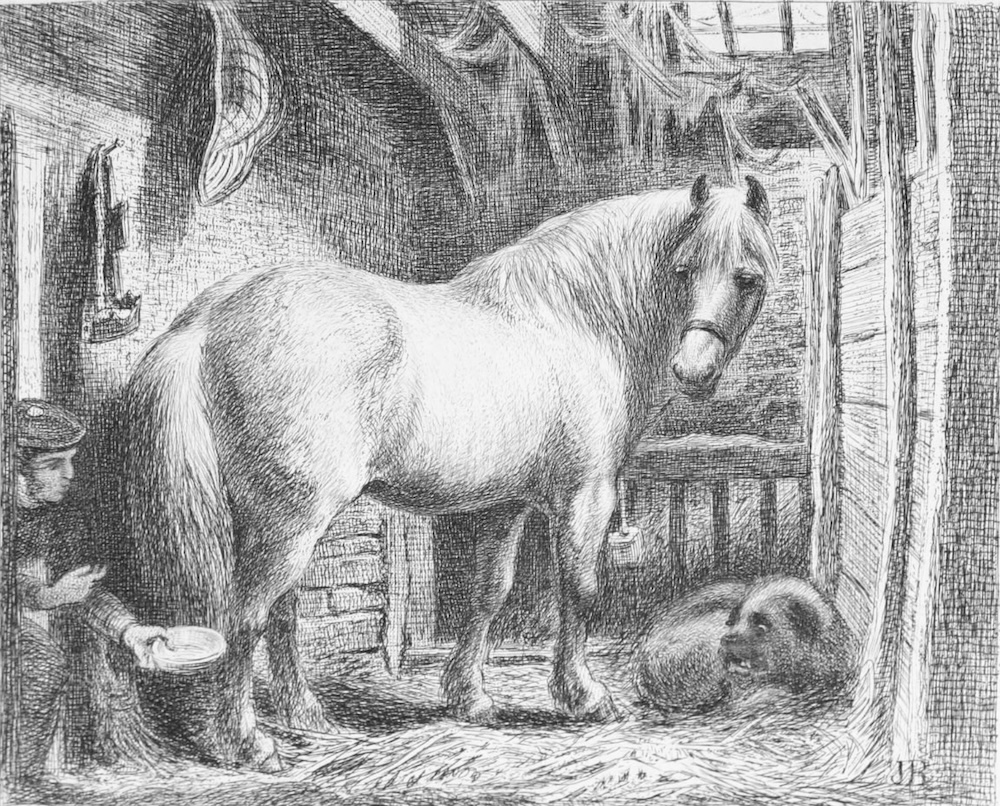
Jess in Her Stable, Blackburn's illustration in Brown, facing p.26.
Jemima Wedderburn began drawing and painting from an early age, and the work she produced in her teenage years testifies not only to her talent and her appealing temperament – often being witty and perceptive – but to the ever-present importance of the horse in early-Victorian life. This was not the privilege of the wealthy: while they might routinely own horses, middle- and working-class people also experienced the horse on a daily basis, as a working animal and for transport in both rural and urban settings. During Wedderburn’s early life, the horse was an invaluable element of labour, leisure or sport for almost all. Not by accident did it take pride of place in Thomas Bewick’s well-known A General History of Quadrupeds (1820), one of Blackburn’s talismanic reference-points.
In her memoirs, the elderly woman Jemima Blackburn recalled the girl Jemima Wedderburn as an instinctive and incorrigible animal-lover, but primarily a fool for horses:
The misses Aytouns used to take me out for drives. I enjoyed watching the horses trotting along but wondered how on earth one could ever draw their legs as the changed their shape at every movement…. A [favourite] book was True Stories of Ancient History, with pictures – the one I admire most was Curtius leaping into the chasm on a beautiful white horse with a long mane…. Professor Goodsir was teaching his students the anatomy of the horse, and remembering my taste for horses gave me private lessons in the college. My uncle John Clerk-Maxwell used to accompany me. I made drawings from the anatomies, then made sketches of horses in various attitudes with muscles coloured to show the action…. I was taken out to walk in Piccadilly but found it difficult to admire London as I have done since. I missed the stone houses in Edinburgh and did not at first even see the beauty of the Green Park and only cared for the fine cart horses…. [100, 101, 107, 117]
And this affinity manifested itself in her early abilities: “I could do a portrait of any horse I looked at in three minutes, recognizable to its owner or groom,” she recalled, recollecting her teenage years; “It surprised them, but it was quite easy to me” (115).
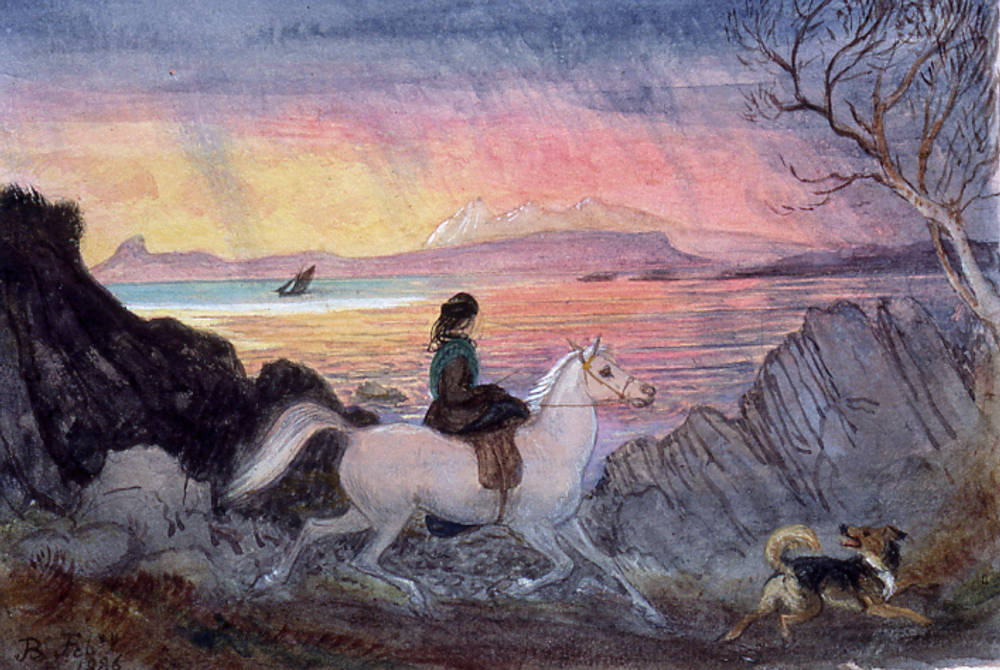
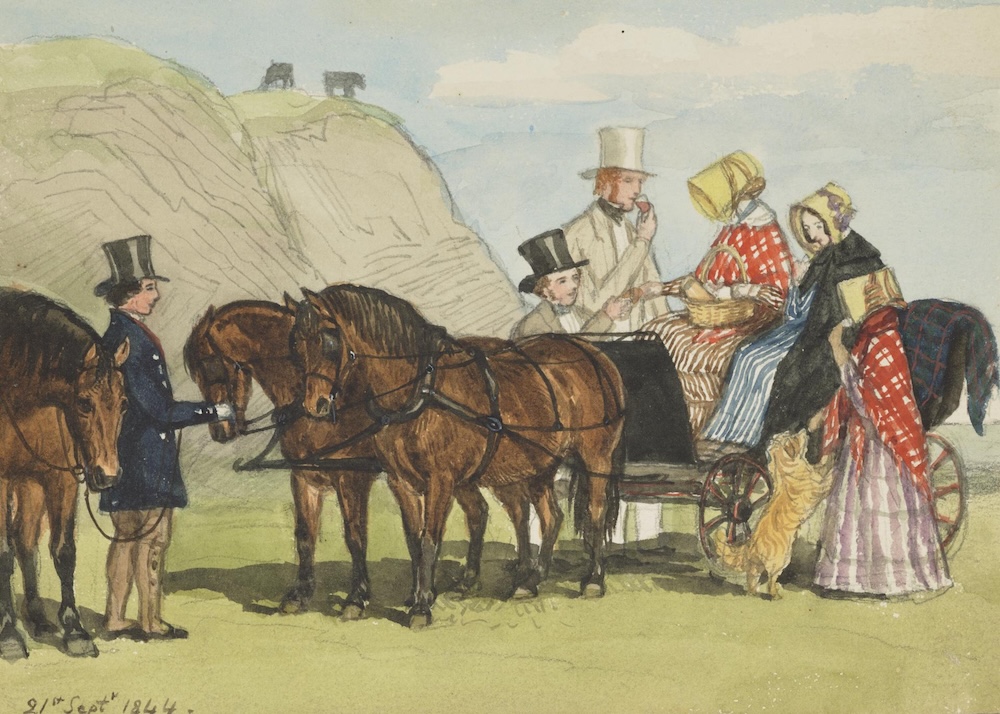
Watercolours featuring family and friends in Scotland. Left: Margaret Blackburn Riding at Forsay (attributed, undated). Right: On shore near Raeberry Castle/ Lady Katherine Douglas and Fanny Newdigate in pony carriage, Jemima Wedderburn standing at one side, Hon. Charles…, 1844.
This affection as well as the familiarity underlying it is vividly exposed in the holdings of Wedderburn/Blackburn’s work in the Scottish National Galleries: a series of sketches made from 1837 onwards give delightful insight into the valued presence of the horse in the Wedderburns' life. Visitors and their hosts go sightseeing on horseback, are enabled to visit neighbours and enjoy outings by riding or horse-drawn carriage, while mundane jobs on the estate are accomplished by the strength of obedient horses. As the work proceeds into the 1850s, it reveals the variety of equine companions in the artist’s life, a particular horse or pony for each member of the family and for every task or mission, depicted with evident appreciation that, for the most part, avoids sentimentality.
In 1849, the artist first sent an assorted batch of her work to John Ruskin for comment: the subject-matter of the oil-painting she included was “a pair of horses frightened by a steam-whistle” (Letters I (24 April 1849: 96). Ruskin’s characteristically no-holds-barred critique of it may explain why it is not known today. A year later, he was examining several further drawings: he liked best a horse-centred scene from Byron, saying, “I think the Mazeppa the best realization of the thing I have ever seen … a Horse Prometheus” (27 May 1850: 109).
Having already ventured into print, as described in Catherine Golden's biography, during 1854 Blackburn prepared for publication a series of drawings which could be linked with certain Bible episodes. Twenty plates depicted a variety of living creatures, each accompanied by an erudite text (by another, James Wilson) musing as much on the species in question as on the Biblical text illustrated. In Illustrations of Scripture by an Animal Painter, the horse occurred as a drowned corpse in “The Raven”, amongst other victims of the flood (see “Jemima Blackburn’s Art”), but came vigorously into its own in Pharaoh and his Hosts, as the Egyptian army floundered in the Red Sea. There was to be a notable boost to the equine presence in this work’s second edition, issued in 1886 as Bible Beasts and Birds: entitled Horses and Ships, a composition captioned with a quotation from The Epistle to James paid homage to Rosa Bonheur’s by then world-famous painting, the above-mentioned The Horse Fair (see “Jemima Blackburn’s Art”).
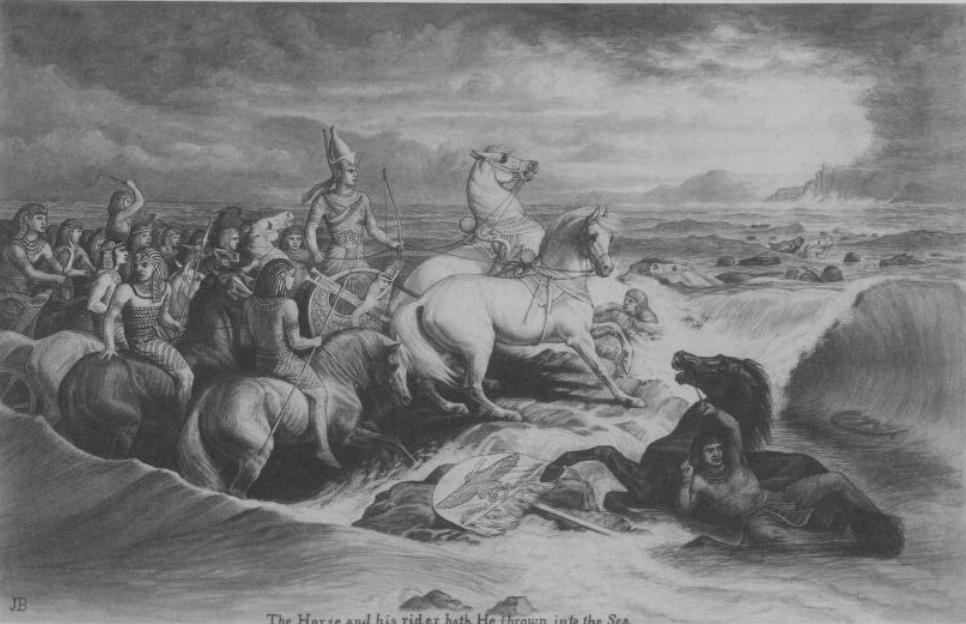
The Horse and his rider hath He thrown into the Sea — Pharaoh and the Egyptian hosts about to be swept away in the Red Sea, 1854.
To the first exhibition of the Society of Female Artists in 1857, Blackburn sent two oils whose main characters were equine. Phaeton was described in the Spectator as “a daring tour de force as regards the headlong action of the horses” (6 June 1857: 595), while A Scene on the Coast of Ayrshire was observed in the Illustrated London News to be “enlivened by a capital pair of plough horses” (6 June 1857: 545). The following year, foreshadowing the change in emphasis that would bring her the most enduring recognition, her submission was split between a scene of gulls (Sea-gull’s Nest, Moidart, Hunterian Museum) and another of equine heroism, The Defenders of Glasgow, in which the horse-drawn engines were shown charging through the city streets on their urgent mission. This latter work, although not now known, was typical of Blackburn’s Ruskinian belief in the capacity of fine art to connect with social issues and, more exactly, to do good in contemporary society. She described its aim thus:
Stewart and MacDonald’s warehouse [was] on fire. Next day I heard that a fireman had been killed and the newspaper said that there was no fund for the widows and children of firemen killed in duty (sic), only an allowance for the injured till they were fit to work again. I thought I would like to do something for them, so painted an oil picture of an engine starting for a fire. I did it in the engine house, and the men sat for me, and the horses. The white one had been in the Scots Greys and was a spirited animal; when the fire drum was tapped it began to prance and make ready to start at the gallop…”. [155]
Later that year, Scenes of Animal Life and Character was published (December 1858), emphasizing Blackburn as an all-round animal painter who had studied at the Zoological Gardens as well as at the circus and in everyday life, albeit one with a particular eye for horses. In The Turf, plebeian and aristocratic, Fox Hunting in Sport and The Force of Habit, the artist reflected the everyday presence of this particular animal in mid-century life while also pointing some morals and making some mockery. Appositely, in a design entitled “Difficulties of Animal Painting,” it as a painter of horses that she portrayed herself.
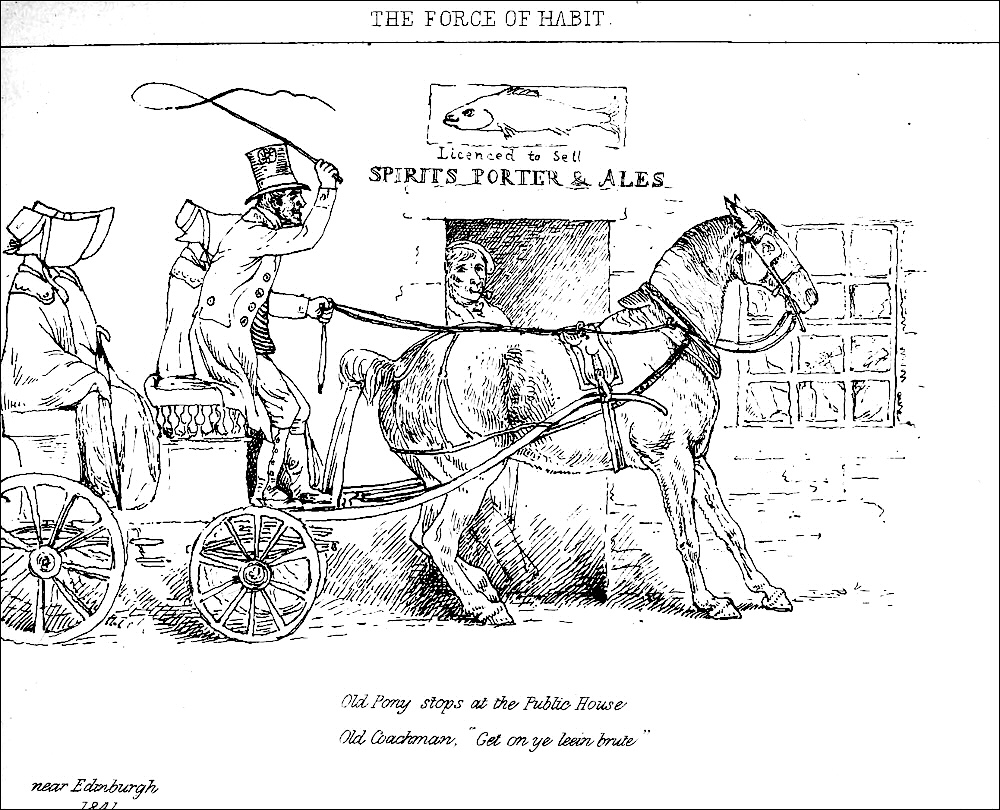
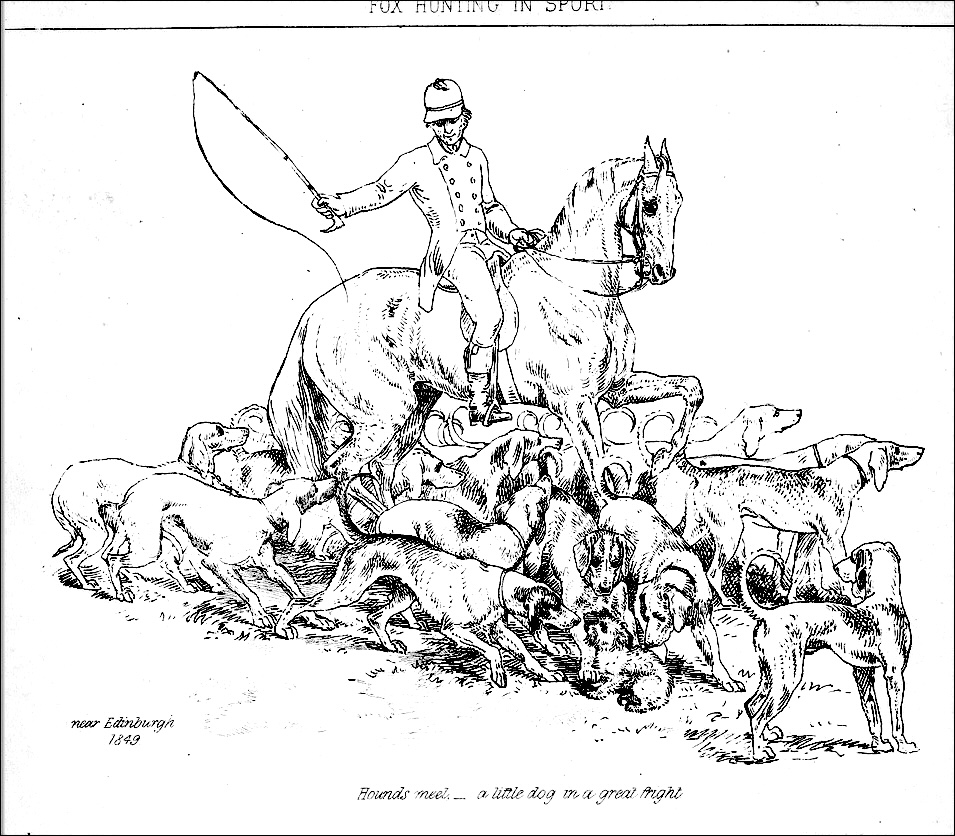
Two drawings from Scenes of Animal Life and Character. Left: The Force of Habit, 1847. Right: Fox Hunting in Sport, 1849.
Jemima Blackburn continued this rate of productivity as the years went by, despite her growing family, ongoing responsibilities as a landowner in Scotland and unquenchable thirst for travel. After her 1862 publication Birds from Nature (reissued in an expanded version six years later) she may have been known as a bird specialist, but her childhood preference was still in evidence up until that point. When she was recruited to the team to illustrate John Brown’s popular story Rab and his Friends in 1861, she was allocated the horse, Jess, and produced a composition in which the canine hero was put in the shade by his equine friend (“Jess in her Stable”), and when throughout that decade she came up with pictorial contributions to her friend Norman MacLeod’s Christian periodical Good Words, Blackburn’s gratuitous privileging of her favourite animal is easy to spot: visualizing the story of Philip and the Ethiopian for “Bible Records of Remarkable Conversions”, the two human actors are compositionally secondary to the pair of horses drawing the latter’s chariot; and illustrating the biography of St. Columba, she chooses to show him with the white horse that sustained his brotherhood’s island community (I, no. 5: 65, and I, no. 26: 401).
While Ruskin’s respect for Jemima Blackburn’s work would be an obvious way to argue her merit, it is a satisfaction to me to acknowledge her sister artists’ recognition of her achievement: “I want to add one name to the painteresses (sic) of animals in Miss Clayton’s list,” wrote Louisa Stuart, Lady Waterford, to her fellow amateur Eleanor Vere Boyle in 1875: “that of Mrs Blackburn, née Jemima Wedderburn: such a wonderful genius for animals; Landseer himself said so. She published various books of illustrations, and one of sea-birds is large and beautiful. She knows more about the action and attitude of every kind of animal than any one I ever knew” (qtd. in Hare 363).
Related Material
- Jemima Blackburn's Art (Her Animal Paintings)
- Blackburn as Watercolorist
- Blackburn as Book Illustrator
- Horses in the Victorian Age
- The Victorians and Animals, IV: Working Animals
Bibliography
Blackburn, Jemima. Jemima: The Paintings and Memoirs of a Victorian Lady. Edited with an introduction by Rob Fairley. Edinburgh: Canongate, 1988.
JB (Jemima Blackburn). Illustrations of Scripture by an Animal Painter. Hamilton Adams and co/Ackerman and co., 1854 (new edition under the main title of Bible Beasts and Birds. London: Kegan, Paul, Trench, 1886, available on the Internet Archive, from a copy in the Getty Research Institute).
JB (Jemima Blackburn), Scenes of Animal Life and Character. London: Griffith and Farran, 1858. Internet Archive, from a copy in Boston Public Library. Web. 16 May 2026.
Brown, John. Rab and His Friends. Edinburgh: David Douglas, 1883. Internet Archive, from a copy in the University of California Libraries. Web. 20 May 2026.
Clayton, Ellen. English Female Artists. London: Tinsley Brothers, 1876.
Fairley, Rob, ed. Blackburn’s Birds. Edinburgh: Canongate Press, 1993.
Hare, Augustus J.C. The Story of Two Noble Lives. London: George Allen, 1893.
Ruskin, John. Letters of Ruskin, 1827-1869. Edited by Edward Cook and Alexander Wedderburn. Vol. XXXVI. London: George Allen, 1909. Internet Archive, from a copy in the University of California Libraries. Web. 16 May 2026.
Stevens, Bethan. “Jemima Blackburn’ believed in nothing.’” In Nineteenth-century Women Illustrators and Cartoonists. Edited by Jo Devereux. Manchester: Manchester University Press, 2023.
Created 16 May 2026