
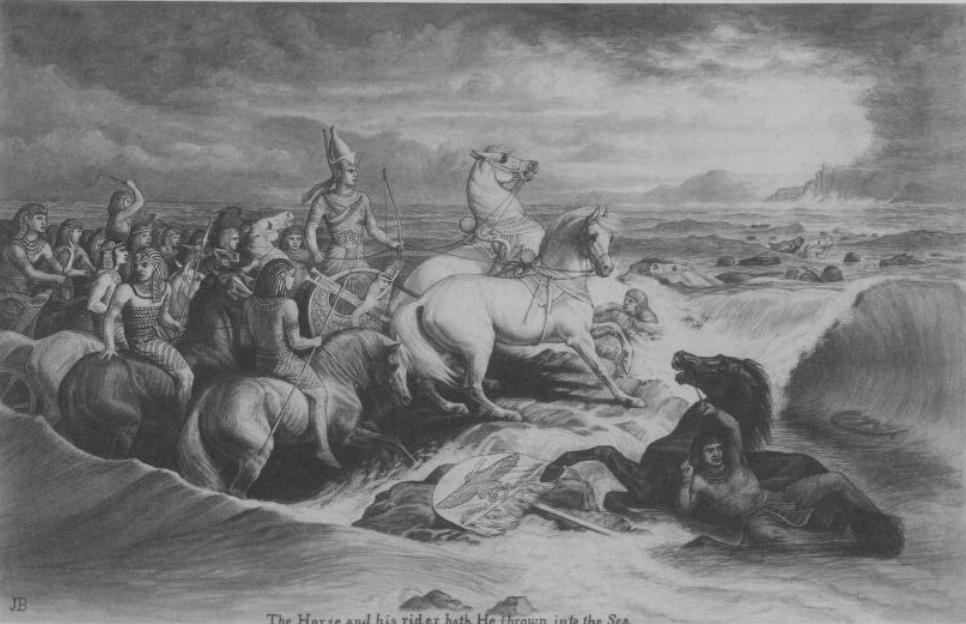
The Horse and his rider hath He thrown into the Sea by Jemima Blackburn (née Wedderburn) (1823-1909). Click on the image to enlarge it. 1886.“Photographed from the originals and printed in planotype.” From Bible Beasts and Birds (Hathi Trust online version of a copy in the Getty Research Institute). At the bottom of the picture the artist has inscribed the title given above, and, as is the formula in these pages, the illustration is followed by the scriptural text illustrated, together with the relevant passage (in this case, passages) from Paradise Lost. The episode is that of the crossing of the Red Sea, with the Old Testament version, taken from Exodus 14, ending (27-31), and 15 (verse 1):
And the Lord overthrew the Egyptians in the midst of the Sea.
And the Waters returned, and covered the Chariots, and the Horsemen, and all the Host of Pharaoh that came into the Sea after them; there remained not so much as one of them.
But the Children of Israel walked upon Dry land in the midst of the Sea; and the Waters were a Wall unto them on their right hand, and on their left.
Thus the Lord saved Israel that day out of the hand of the Egyptians; and Israel saw the Egyptians dead upon the Sea shore.
And Israel saw that Great Work which the Lord did upon the Egyptians:
And the People feared the Lord, and believed the Lord, and His servant Moses.
Then sang Moses and the Children of Israel this song unto the lord, and spake, saying,
I will sing unto the Lord, for He hath triumphed gloriously:
The Horse and his rider hath He thrown into the Sea. [qtd., p.13]
After this come two passages from Paradise Lost, the second of which (shown here) concludes with the lines used in Blackburn's title:
Thus with ten wounds
The River-dragon tam'd at length submits
To let his sojourners depart, and oft
Humbles his stubborn heart, but still as Ice
More hard'nd after thaw, till in his rage
Pursuing whom he late dismissd, the Sea
Swallows him with his Host, but them lets pass
As on drie land between two christal walls,
Aw'd by the rod of Moses so to stand
Divided, till his rescu'd gain thir shoar:
Such wondrous power God to his Saint will lend,
Though present in his Angel, who shall goe
Before them in a Cloud, and Pillar of Fire,
By day a Cloud, by night a Pillar of Fire,
To guide them in thir journey, and remove
Behinde them, while th' obdurat King pursues:
All night he will pursue, but his approach
Darkness defends between till morning Watch;
Then through the Firey Pillar and the Cloud
God looking forth will trouble all his Host
And craze thir Chariot wheels: when by command
Moses once more his potent Rod extends
Over the Sea; the Sea his Rod obeys;
On thir imbattelld ranks the Waves return,
And overwhelm thir Warr
[Paradise Lost, Ed. 1667, Book 10. 1082-1106, qtd., p. 15]
This illustration captures the drama of the situation much more vividly than the usual scene of the Israelites safely crossing between walls of waves. Here, the still purposefully advancing host, which includes many women among the riders, contrasts with the already floundering horse and rider about to be submerged by the curling wave in the right foreground. The Egyptian standard, sporting the mighty eagle, has already been felled, and lies in the foreground too. The horses' different reactions are all brilliantly evoked. The two closest of the advancing horses look towards the fallen one as if in recognition of their fellow's suffering, an acknowledgement that the riders themselves fail to make. The charioteer's other white horse rears in alarm at the stormy crossing ahead: the waves are returning, indeed, and soon "the Chariots, and the Horsemen, and all the Host of Pharaoh that came into the Sea after them," will perish. — Jacqueline Banerjee
You may use this image without prior permission for any scholarly or educational purpose as long as you (1) credit the Hathi Trust and the Getty Research Institute and (2) link your document to this URL in a web document or cite the Victorian Web in a print one.
Bibliography
Blackburn, Jemima. Bible Beasts and Birds: A New Edition of Illustrations of Scripture by an Animal Painter. London: Kegan Paul, 1886. Hathi Trust online version of a copy in the Getty Institute. Web. 19 May 2026.
Created 19 May 2026