
he Victorian era has been variously characterized as the age of progress, of industrialization, of change, and of social conflict. Viewed through another lens, it might be described as a time in which science flourished, democracy was established with the extension of the franchise, and imperialism came to the fore. Such generalizations are unstable, but underlying all of these cultural traits is a series of unchanging features. One of these is the persistent interest in looking, seeing, and the workings of the visual. In the words of Kate Flint, the Victorians were obsessed by the ‘visible, recordable world’ (2) and visuality was their ‘dominant [perceptual] mode’ (6). That focus on observation and understanding of what was shown informed all aspects of nineteenth-century life as it developed over the long years of Victoria’s reign.
During this period, science embraced a new intensity of vision in which knowledge was based on observation and nature was conceptualized in materialistic terms. In Darwin’s theories of evolution, for instance, his findings were driven by a meticulous inspection of species and their variations, evidence he recorded in his factual drawings. In society, likewise, there was an all-embracing belief in the capacity of the eye as a mode of categorization, postulating an idea of legible appearances – as codified in the pseudo-language of physiognomy – that the viewer could use to classify people according to their race, class, character and emotions. All one had to do in any arena of inquiry, to use John Ruskin’s terms, was to ‘read aright’ or, in our terms, to ‘see correctly’ and achieve insight.
The same tendency to meaningful display and visual interpretation was most strongly embodied, of course, in the arts and in what we would today call ‘the media.’ In painting, the Pre-Raphaelites presented a hyper-realism founded on an obsessive visual inspection, and in literature authors such as Wilkie Collins and George Eliot made use of ekphrastic, imagistic descriptions to create a visualized writing style that was known at the time as ‘painting in words.’
These modes of expression were matched, moreover, by numerous other forms of visual communication that sought to negotiate the teeming complexity of Victorian society. The provision of pictorial material was hugely expanded in illustrated books, newspapers and magazines, a development facilitated by the rise of new printing technologies and the adoption of wood-engraving; the invention of photography in 1840 brought images into the home; steel-plate engravings were sold to hang on the domestic wall; posters were commonplace in Victorian streets; consumables were issued in packages embellished with pictorial advertisements; illustrated handbills were passed around; and all sorts of visual devices, such as the magic lantern and stereoscope, became available. Pictorialized information was transmitted in all of these forms, so creating a cultural impetus to develop ever more challenging, interesting and entertaining ways to represent the visual, to look, to see, and to understand a changing world.
Within this epistemological imperative, it became inevitable that film should develop as a challenge to existing modes of visualization. All pictorial material produced before the 1890s was plastic in nature and configured as a spatial sign or series of signs. But the range of visual showing was hugely extended by the advent in 90s of ‘moving pictures’ – literally, pictures that could move, the progeny of pictures that could not: the static transformed into the temporal. This line of descent was always in place and from the beginning it was commonplace to view film, in the words of Rudolf Arnhein, writing in 1916, as ‘painting in motion’ (5).
At the same time, and despite the intermingling developments which framed and facilitated the rise of film, its birth was anything but straightforward. Its origins involved a complex interaction of art, technology and photography, and proceeded, we might say, from numerous sources and in multiple places both in and outside Victorian Britain; it had an international dimension, taking it from Europe to America; and it crossed the limiting barriers of ‘high’ and ‘low’ art (Vacche 3) to project a hybrid mode of communication with universal appeal as it dissolved the barriers of class.
These complexities have been analysed in a vast critical and historical literature. The aim here is far more modest: to outline the technologies which made moving pictures possible, and to trace the influence of Victorian art as a ready-made visual language that was adopted, synthesized and refigured by a series of film makers. That analysis foregrounds the notion of the interconnectedness of Victorian visual culture and the emergence of an artform usually associated with Modernism and the dynamics of the ‘modern experience’: a child of the new age, its parents were Victorian and its heritage in continuity with earlier developments. But how did filmmakers take up the opportunities of an emerging art? Of special interest is a small group of famous practitioners whose relationship with Victorianism, as Americans responding to British culture, is well-marked: the directors David Wark Griffith and Cecil Blount DeMille, Hollywood’s earliest auteurs, and the ‘special effects’ artists, Willis O’Brien and Raymond (or Ray) Harryhausen.
The Origins of Film: Cinema, Painting and Illustration
The primary consideration in the development of film is simple: how can still images be animated in time? Most of the solution to this problem lay in the invention of devices to capture movement, but visual art was equally important.
Painting had long modelled the concept of temporalized serial storytelling which focused on the change between one static frame and another. Montage was of course a well-established device in the broader traditions of Western art. Italian Renaissance painters made use of multiple compartments to represent stages in their biblical narratives, especially in the form of polyptych altarpieces, and the same division into temporal units, each showing a different scene or action, can be traced in fresco cycles such as Giotto’s series in the Scrovegni Chapel in Padua (1305).
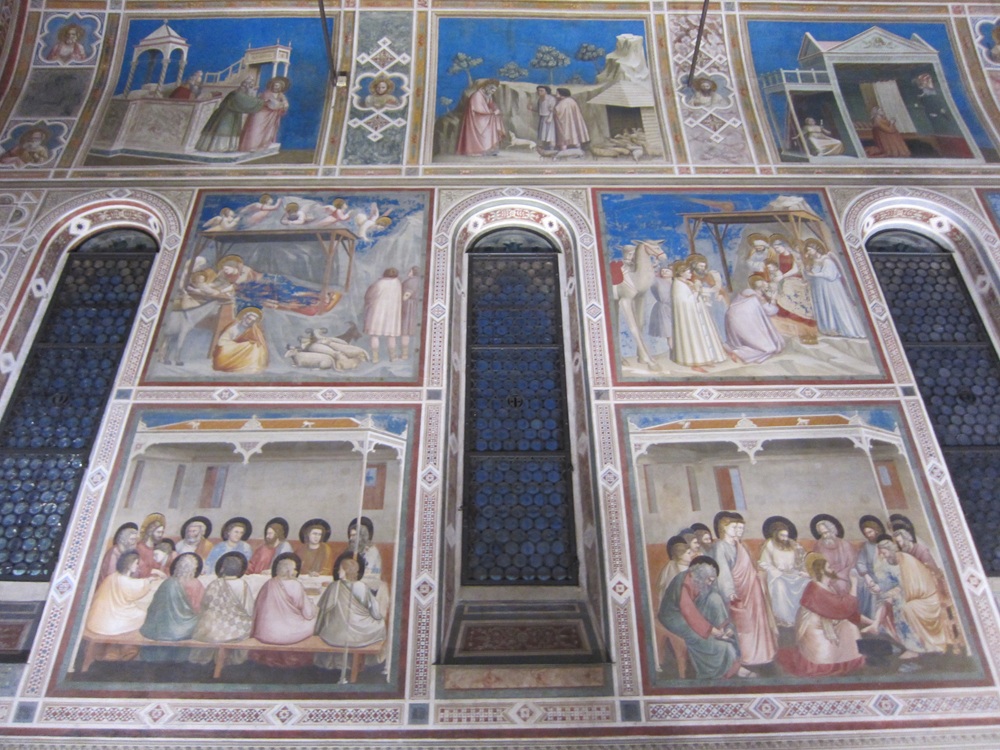
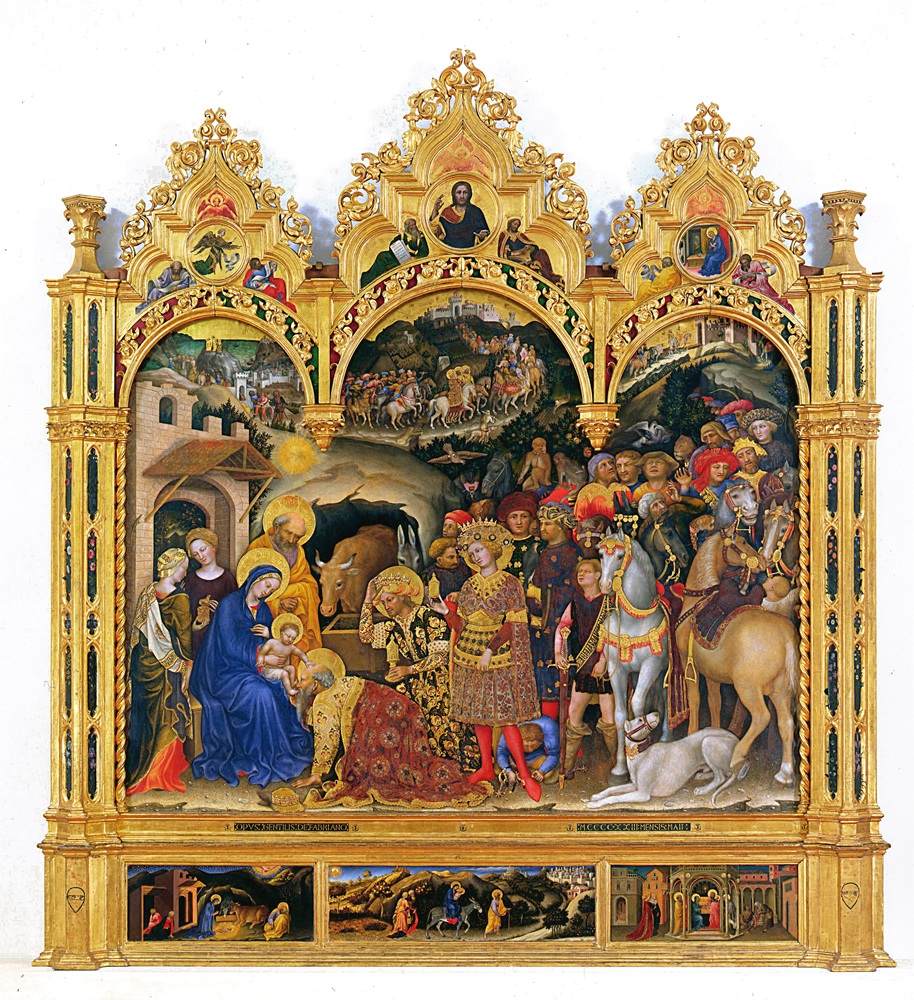
The representation of sequence in Italian art. Left: a view of some frames by Giotto in his fresco cycle in the Scrovegni (Arena) Chapel in Padua (1305). Right: Gentile da Fabriano’s The Adoration of the Magi, with the predella panels showing some of the previous events – notably the Flight into Egypt (Circa 1400, The National Gallery, London).
These prototypes suggested how consecutiveness could be used to propel a visual narrative; however, the more immediate influences on film and film making were Victorian painting and illustration. In fine art, several painters animated a story by dividing their work into linked canvases showing stages in the action. William Powell Frith deployed this method in his Times of the Day (1862, Private Collection), in which he shows scenes around London, from Covent Garden to Regent Street and Haymarket in the morning, noon and night. Collectively these told the story of a London day, although the focus was more often on the narrative of a single individual. In The Road to Ruin (1878), Frith presents a five-part series of paintings, later engraved, which maps a promising young man’s career from bright expectations to corrupting mistakes, ruination and suicide. Similarly, in Past and Present (1858, Tate Britain) Augustus Egg traces an unfaithful woman’s decline from bourgeois respectability to destitution. In both series, the compartmentalization of the events anticipates the framing of early film melodramas and prefigures their imagery.
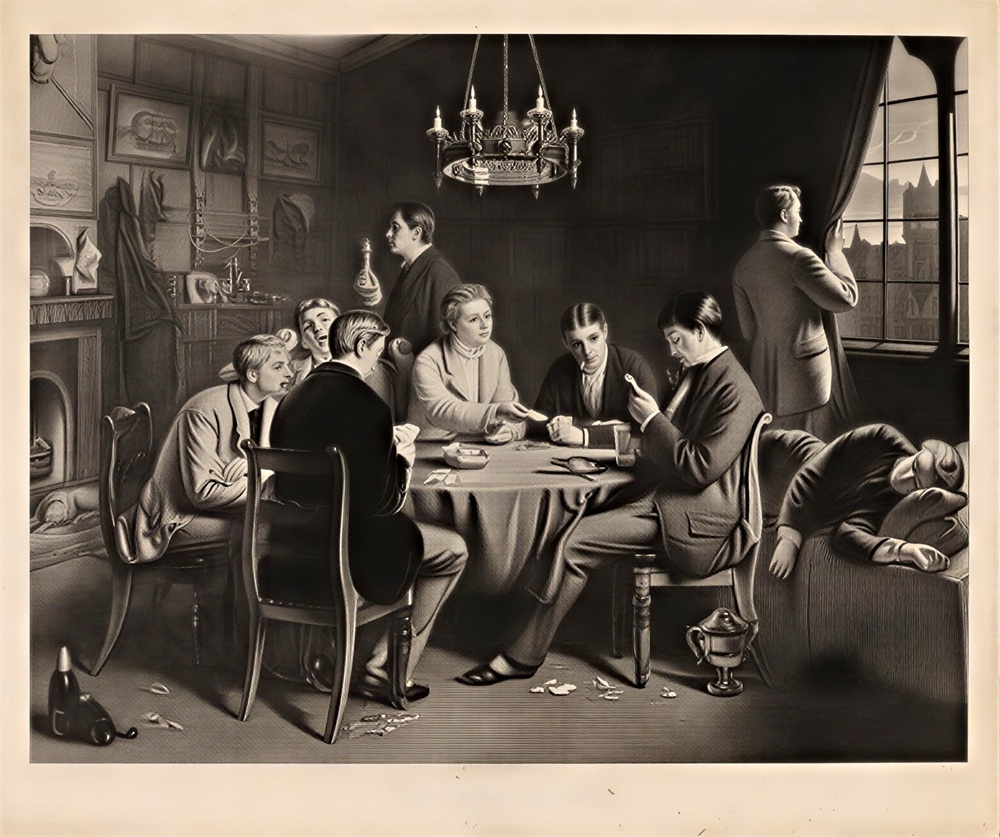
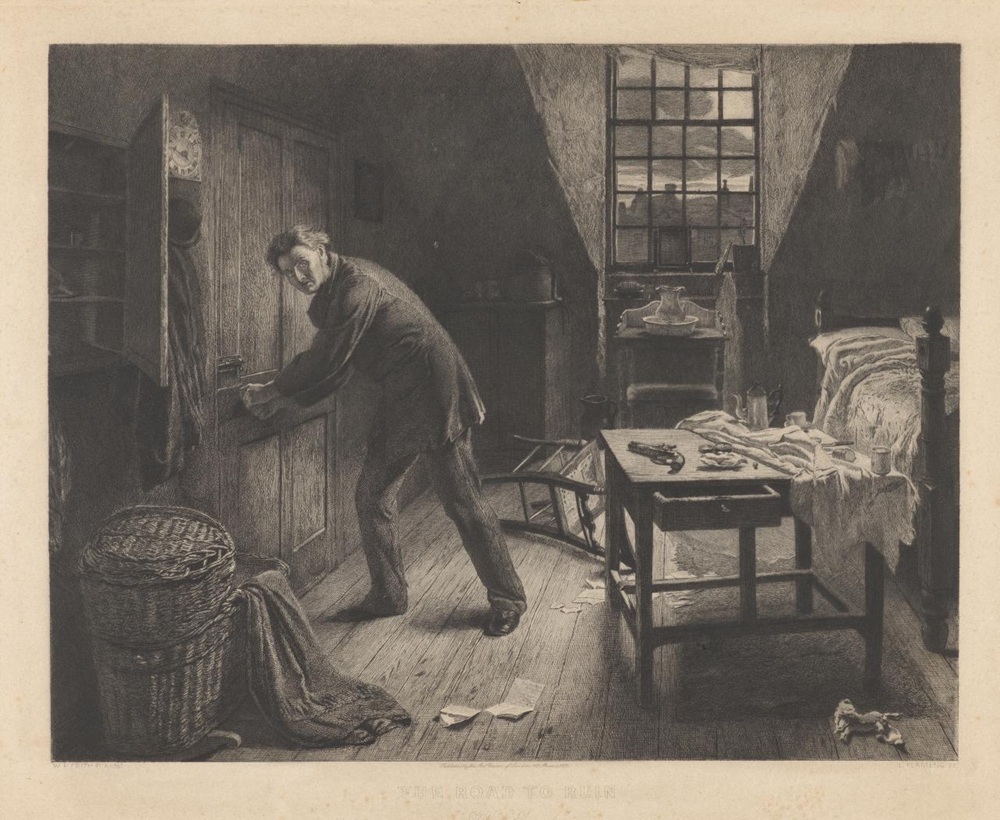
Stages 1 and 5 from Frith’s The Road to Ruin, etched prints of the original paintings, 1878. The first example shows the gentleman’s early years in college, enjoying the high life; the second the consequences of extravagance. Ruined, he is about to shoot himself (the pistol is clearly shown).
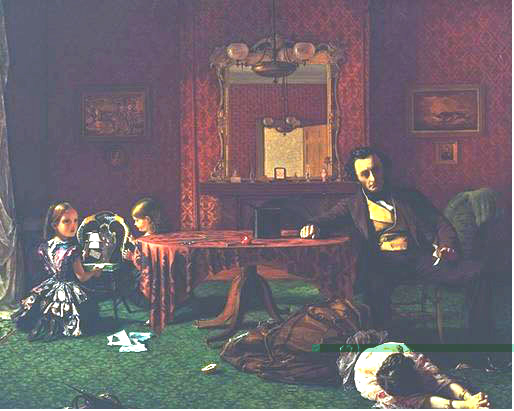
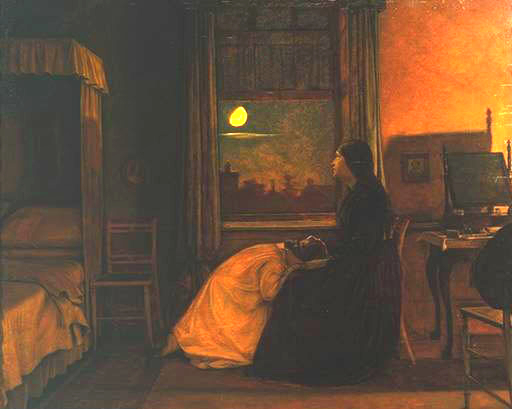

Egg’s narrative of Past and Present. Right, the paintings show the discovery of the middle-class woman’s infidelity; centre, her grown-up daughters, now living in poverty; and left, her final destitution, cradling her illegitimate child and about to commit suicide by throwing herself into the river. This sort of montage was a model for early filmic melodramas, a connection stressed by the static framing of those films in which the characters move, but the camera does not.
These images suggest ways in which narrative can be represented, implying movement from one frame to the next. The idiom was based on Hogarth’s moralizing series, especially The Rake’s Progress (1732–34). Hogarth’s art was also a significant influence on George Cruikshank’s illustrations, and these too provided a cinematic model by using the division into compartments. For example, in his designs for W. H. Ainsworth’s Jack Sheppard (1839–40), he represents the eponymous (anti) hero’s escape in a montage of consecutive actions that look like a series of cinematic shots depicting a sequence; he also uses framing in The Folly of Crime in his Table Book (1845), which shows, as it were, a speeded-up history of key events in the felon’s career. Such illustrations dissolve the plasticity of visual art and re-position it within a series of temporal schema. Indeed, Victorian book illustration as a whole provides a visual representation of change and process as images, inserted at key points in their texts, depict a narrative movement – a progression that could be viewed as a sort of proto-cinematic technique. In short, all of these developments in visual art are significant insofar as they introduce kinesis and the impact of time, compelling the viewer to experience more than a single moment, a sight that dissolves, as in cinema, in and through a series of frames in anticipation of the frames of a strip of film.


Cruikshank’s treatment of The Escape in three parts, making a total of ten frames, for Ainsworth’s Jack Sheppard. This arrangement is in absolute accord with the episodic nature of Ainsworth’s text.

Cruikshank’s The Folly of Crime from the artist’s Table Book.
Moreover, there were other types of art that prefigured the characteristics of film and cleared the philosophical ground for the development of cinema. One of these was panoramic painting and its variants. In its simplest form, this type of painting was figured as a wide, ‘letter-box’ format in which several groups of characters are presented, compelling the viewer, as it were, to move across the image, scanning each section in turn. This treatment was pioneered by Frith and reflects, once again, his interest in temporalized storytelling. In The Railway Station (1862, Royal Holloway, University of London), Derby Day (1858, Tate Britain), and Ramsgate Sands (1854, Royal Collection, London), he presents what are essentially compendia of action, distillations of movement and change that cannot be understood in a single glance. As a result, the spectator is compelled to study the picture as a compound of frames, so producing the changing montage of the movie screen.
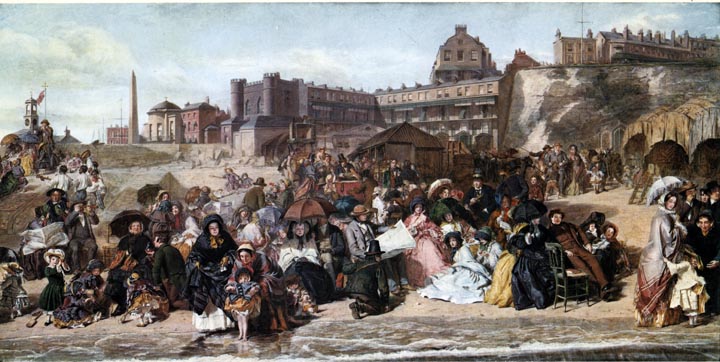
Frith’s Ramsgate Sands
.

Two scenes from the painting that act as discrete units within an ensemble.
Panoramic painting went even further in providing a cinematic model in its provision of a montage extended not over several inches but many feet. Originated in the late eighteenth century by Robert Barker, these visual ‘experiences’ presented land and cityscapes or versions of history and literary classics. They were configured as elaborate tableaux and viewed on a series of platforms, usually within a circular dome: as in the scrutiny of a large canvas, the effect of sequence was created by the movement of the viewer, not the image. But other panoramas took the notion of sequentiality much further by making the image itself undergo movement. These shows, which developed in the early part of the nineteenth century, involved a vast linear canvas being mounted on spools and cranked from one to the other to create the effect of an unrolling film of changing views. Moving panoramas, like the static ones, were hugely popular throughout the Victorian age, and featured not only in the capital but in the provinces, and on both sides of the Atlantic; in an age hungry for visual stimulation, they were the spectacular novelty-shows, the IMAX cinemas of their day. Few, however, have survived. One of the exceptions is a visualization of Bunyan’s Pilgrim’s Progress (1851, Saco Museum, Maine), which was produced in New York in 1851 by a number of artists, including the historical painter Henry Courtney Selous. This panorama is 850 feet in length and depicts a series of well-defined scenes in the story, providing vivid moving pictures of the text as it was wound out in front of its audiences.
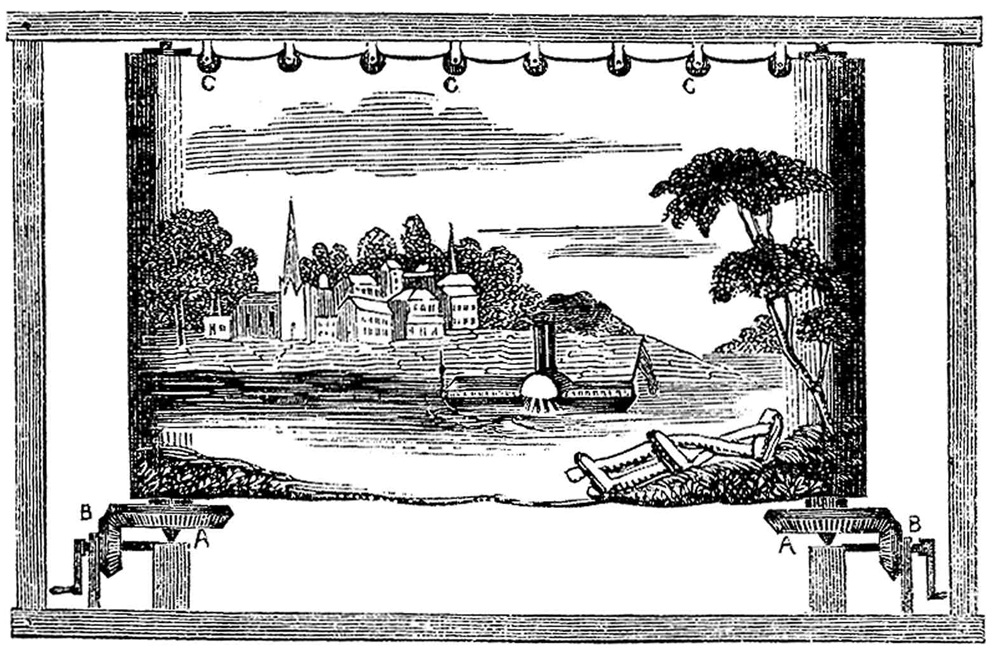

Left: The mechanics of a moving panorama, invented by the American artist John Banvard, from 1848; Right: Selous’s version of Bunyan’s The Pilgrim’s Progress.
The Rise of Cinema and Photographic Technologies
So moving images were prefigured by a series of overlapping developments in visual art. Critics such as Garrett Stewart have further suggested that Victorian literature was ‘proto-cinematic’ in its use of visual detail and deployment, as in Dickens’s Bleak House (1853), of multiple narrative threads which model filmic editing, intercutting and juxtaposition. Both art forms could be said, in short, to suggest the movement of time. But of course neither could represent movement itself. That development, of capturing action as it happened in ways that would have to be captured were cinema to emerge, was in the domain not of the expressive arts, as such, but in new photographic technologies.
Photography from its origins in the work of Henry Fox Talbot (1800-1877) and Louis Daguerre (1839–40) was notoriously static, with long exposure times that meant even the slightest movement would produce a blurred image. Fixed in time, early portraits, especially, seemed artificially arrested and stripped of vitality, waxworks rather than living flesh; notoriously, subjects could not smile and heads and arms were secured with a clasp to prevent the slightest twitch, with no smiling allowed. However, by the final years of the nineteenth century new experiments were enabling photography to capture the flux of movement. Eadweard Muybridge opened new ground with his work to record the consecutive movements of a galloping horse’s legs (1872) and show, in answer to a bet with the governor of California, how all four hooves were off the ground in the middle of the cycle. His images were made by running a horse in front of a series of cameras; the shutters were activated in sequence and the photographic plate registered each stage in the action. Muybridge went on the apply his technique to study the movements of diverse animals and human models in Animal Locomotion (1885), so providing clear evidence of the possibility of representing movement in a photographic medium. Muybridge’s invention was certainly influential in the development of moving pictures, but more important, perhaps, was the work of the French academic, Étienne Jules Marey. In Le Mouvement (1894), Marey presents a series of photographs which show the intermediate movements in a single frame, depicting the ghostly traces of each stage in time. That emphasis on transition is highly significant, enshrining movement in a visual flux; as Jacqueline Banerjee explains, Marey’s shots ‘make cinematography possible’ (‘Eadweard Muybridge’).
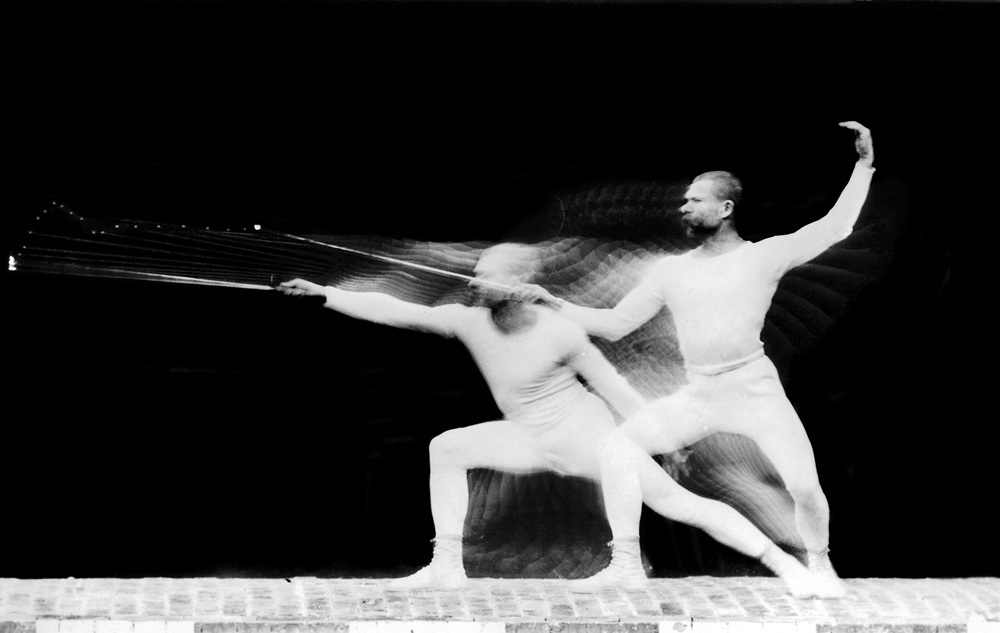

Left: Marey’s study of a fencer, showing the trace of intermediate movements; and Right: Muybridge’s encapsulation of a horse in motion.


Elephants and emus in motion, from Muybridge’s Animal Locomotion.
Muybridge went on to invent the zoopraxiscope, a rotating drum that could project moving images onto a screen. But the final stage in the process of developing motion film was enacted by several inventors working in parallel who made cameras capable of recording movement using the new flexible medium of celluloid or acetate film. In England William Freise-Green invented the ‘Chronophotographic’ camera (1889) that enabled him to capture film of crowds; in America Thomas Edison and William Dickson were working on a parallel device, the ‘Kinetograph’ (1889–92); and the American Latham brothers were working on similar lines, and came up with the ‘Eidoloscope.’ Most important of all were the experiments of the Frenchmen Auguste and Louis Lumière. The brothers filmed scenes of everyday scenes using what they called the ‘Cinematograph’ and in March 1895 projected moving pictures onto the screen to an audience. Theirs was not quite the first exhibition (the Lathams had preceded them by a few months), but the Lumières’ grasp on the new medium was more accomplished than their American rivals’: their camera was more efficient, as was their sprocket-and-hole projector; both inventions became the basis for what became the mechanical technology of cinema. In essence, the Lumières united the newly-discovered capacity of photographs to record movement with the magic lantern’s ability to project its images using light. The lantern had developed as early as 1720, but the brothers reached forward to present a dynamic way of representing the world and telling a story.
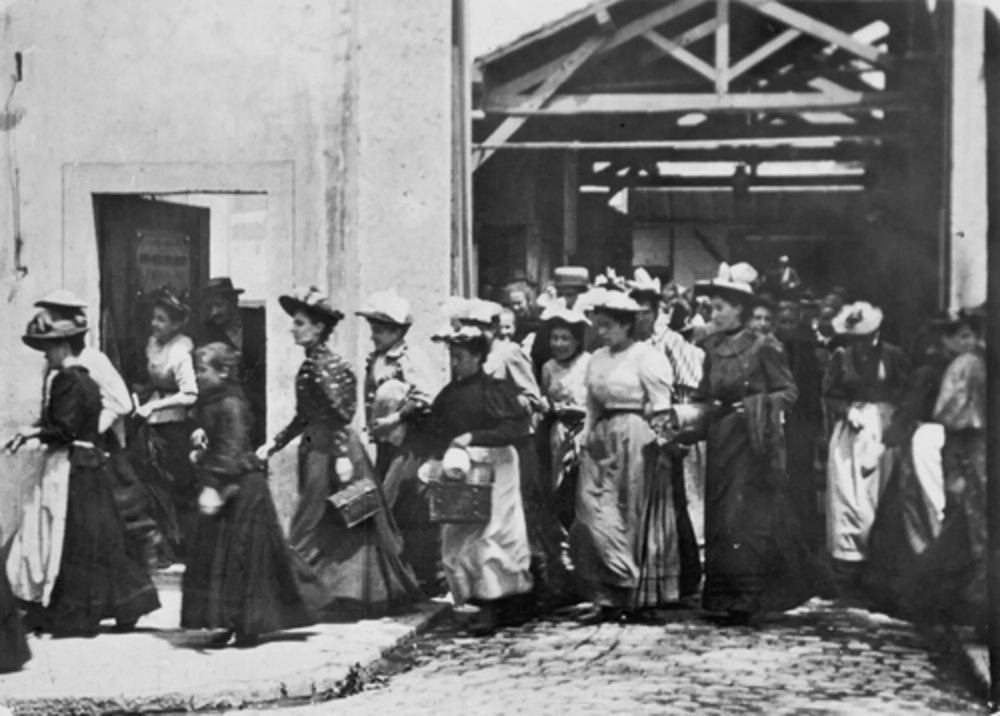
A shot from the Lumière brothers’ film of Workers Leaving the Lumière Factory (1895). The brothers established film’s documentary credentials as a form that could record the immediacy of everyday life.
The Pictorial Aesthetics of Early Film
The invention of cinema was of monumental cultural significance, but in the 1890s none of its progenitors was sure of its identity and usage. For the Lumierès it was a gimmick akin to a fairground attraction and the same attitude was adopted by George Méliès, their rival. None foresaw its importance as an art-form, though each promoted a distinctive pathway. The Lumierès, in line with the inventors of photography, mainly regarded their invention as yet another way of re-inscribing reality, although they did make what is probably the first situational comedy, L’arroseur Arose [‘The Sprinkler Sprinkled’]. For Méliès, in contrast, film could embody extended stories and act as a medium of fantasy, an interest most clearly expressed in his highly influential science-fiction film, Le Voyage dans la Lune (1902). This story-telling focus would become the dominant strand as early filmmakers saw the photoplay’s potential was a means of representing narratives.
There were nevertheless many questions surrounding the purpose and form of this new medium. Its potential for reaching a mass-audience was immediately realized, but its very hybridity – part-photography, part-theatre, part-novel – was confusing. As an emerging language, cinema was unsure of its modes or registers of expression: should it be a photographic record of a theatrical performance, or should it try to emulate the narrative modes of the novel? Should it just be a fingerprint of reality, a representation of the everyday? Or might it be a dream-imagery, akin to the phantasmagoria of the eighteenth century? Ultimately, it became all of these possibilities, but for cinema’s pioneers there was no obvious code to represent the content of their film. For that reason, they, like the first photographers, turned to the well-established tropes of pictorial design in which they could find models of composition, lighting, setting, and gesture; as Angela Dalle Vacche remarks, film artists looked to an established pictorialism ‘to shape or enrich the meaning of their work’ (my italics, 1).
Working in the first quarter of the twentieth century, pioneers such David Wark Griffith and Cecil B. DeMille and their contemporaries might have considered the emerging styles of Modernism, and to some extent that was true: for example, the German directors F. W. Murnau and Fritz Lang deployed a cinematic equivalent of German Expressionism as it was registered in painting and graphic art. In America, on the other hand, DeMille and Griffith turned not to the avant-garde but to exemplars that were more appropriate in reaching out to their mass-audiences, finding their models in Victorian paintings, prints and illustrations (Birchard 147). Indeed, their appropriation of Victorian art was a perfect choice: not only did the Victorians provide a well-formulated language, they also offered a legible language – one that was familiar to the cinemagoers of a new century and enabled those viewers to make sense of the moving pictures. By inserting their films into ‘broadly shared visual cultures’ (Vacche 3) filmmakers played a populist card while giving themselves and their studios a sense of artistic validation (Gunning 172; Simmon 34) as they forged a link between a nickelodeon art-form – so often derided by early twentieth century intellectual elites as vulgar – and the plangent traditions of the nineteenth century. Cinema was here to stay, but in order to be accepted as a serious medium it needed to get past its upstart reputation and display a pedigree.
In short, early American films were both culturally advanced and reactionary, looking forward and backward while postulating a situation in which ‘academic art of the nineteenth century was born again, gloriously, in a new medium, which it deeply influenced’ (‘Victorian Art’). In practice that allusiveness meant ransacking all sorts of paintings and pre-existing images. Most favoured was work by neo-classical painters such as Laurens Alma-Tadema, Edward Poynter, Edwin Long and Fred Leighton along with Victorian genre painters, the visionary designers John Martin and Gustave Doré, and science-fiction illustrations by Claude Shepperson. These artists’ works became the image-hoard, the language with which DeMille and Griffith and their successors were able to construct their dynamic new medium.
Griffith, De Mille and Victorian Visual Prototypes
Griffith and DeMille were open about their allusions to Victorian painting which, for them, ‘was a living form’ (‘Victorian Art’). DeMille, especially, repeatedly likened his film-making to the production of fine art, noting how he liked ‘to paint on a large canvas’ (Pratt 134) in imitation of Victorian epic painting. Both directors borrowed widely and used specific material as a reference.
In The Song of the Shirt (1908), Griffith drew on ‘a tradition of Victorian genre painting of impoverished seamstressses’ (Simmon 34). Inspired by Thomas Hood’s poem of the same title (1843), Griffith used painted prototypes by Frank Holl, Richard Redgrave and William Daniels to create a filmic equivalent of their social commentaries. His focus, as in the painters’ work, is on the seamstress’s exhaustion, a state of mind expressed in the same sort of melodramatic gestures as can be seen in Anna Elizabeth Blunden’s For Only One Short Hour (1854, Yale Center for British Art). Griffith’s star, Florence Lawrence, is also dressed in the rudimentary clothes of the painted characters and the director reproduces the poverty-stricken décor that appears in Holl’s treatment of the seamstress-theme (1875, Royal Albert Memorial Museum, Exeter). At the same time, Griffith uses the medium of film to stress the worker’s suffering by juxtaposing her poverty with scenes of middle-class luxury as the well-dressed characters enjoy the clothes she has made. He may have borrowed this technique from John Tenniel’s Punch cartoon The Haunted Lady (1863), drawing on graphic art to further enrich his appropriations from the canvas. Reaching back into the mid-nineteenth century, Griffith finds a mode of representation which, despite being old-fashioned in the early years of the twentieth century, still had currency in America.
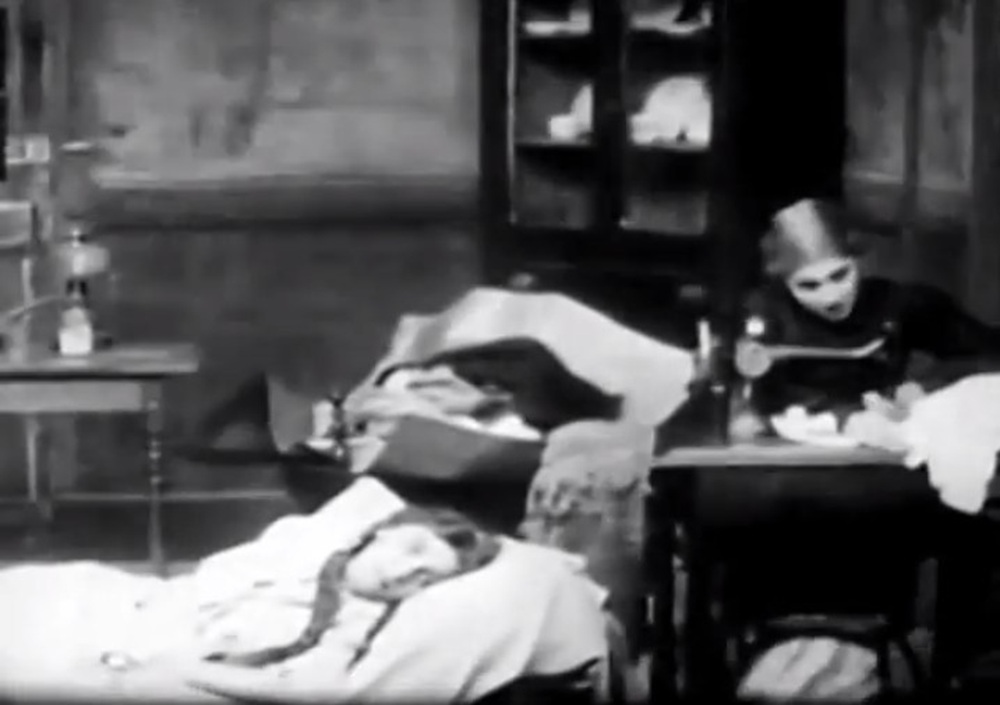
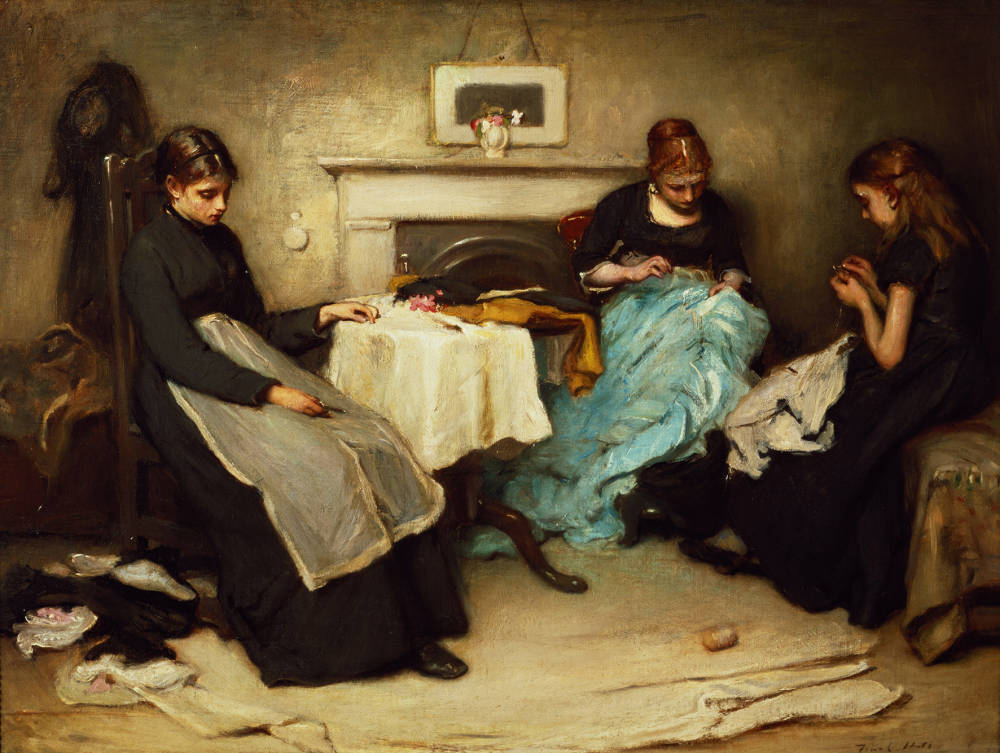
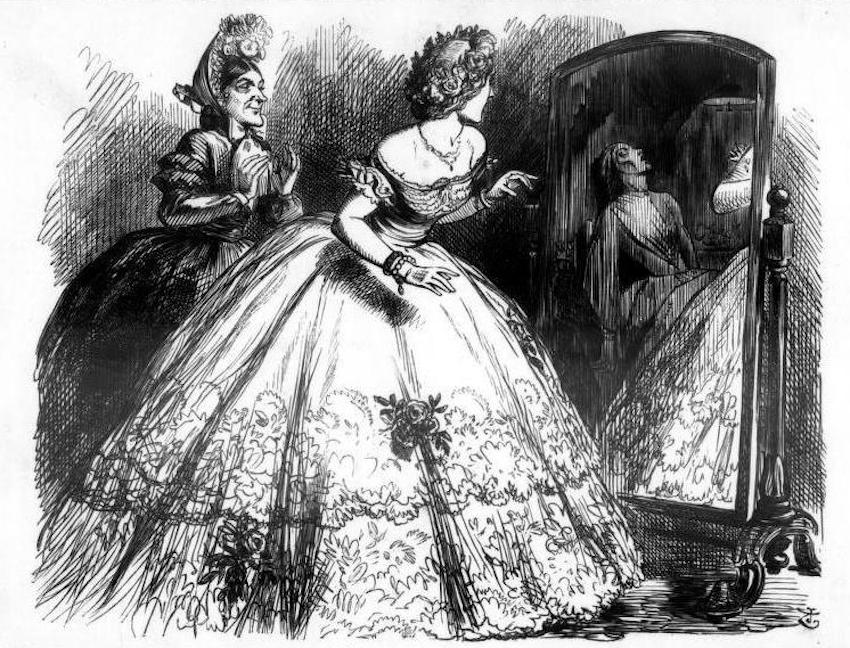
a) A still from Griffith’s Song of the Shirt, with the heroine wondering how she can support her sickly child; b) Blunden’s treatment of the seamstress theme; and c) Tenniel’s infamous showing of the vanity-glass haunted by the worker’s exhausted ghost.
These paintings support Griffith’s social realist films and the modern segment in Intolerance (1916). He similarly drew on nineteenth century painting to underpin his historical epics – this time exploiting the iconographies of Victorian neo-classicism. Works by Alma-Tadema, Poynter and Martin were his primary sources, which he probably saw in print form and in photographic reproductions in Victorian periodicals such as The Art Journal and The Portfolio. These powerful images were the source of a number of elements, visualizing the costumes, architecture, milling throngs and vast panoramas that Griffith would adapt to create his imaginative (and completely ahistorical) reconstructions of the ancient world.
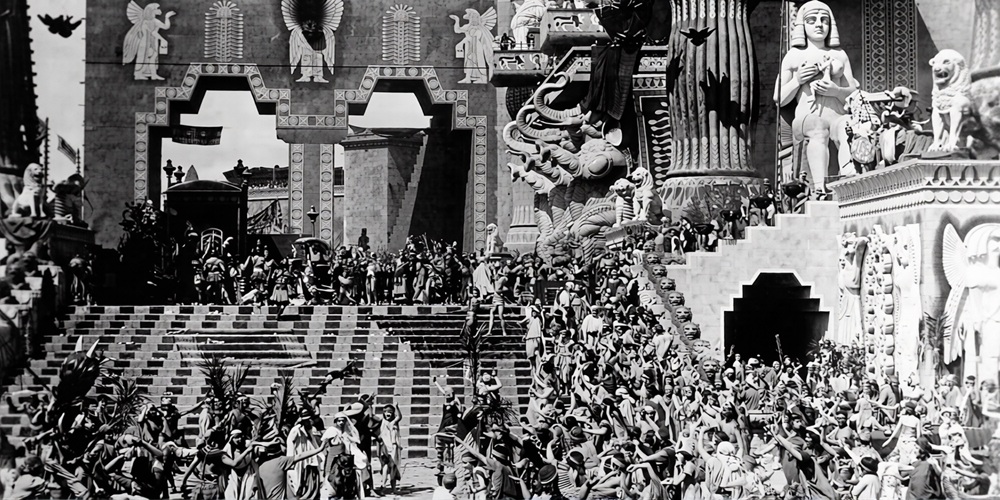
The Babylonian scene from Intolerance.
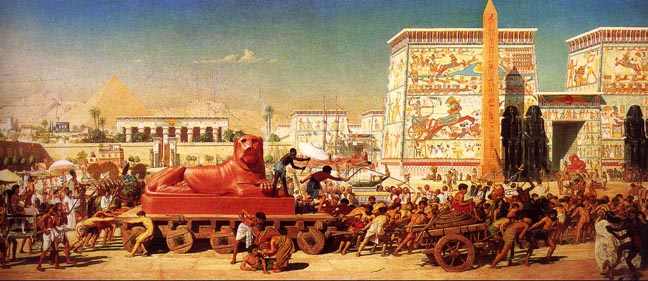
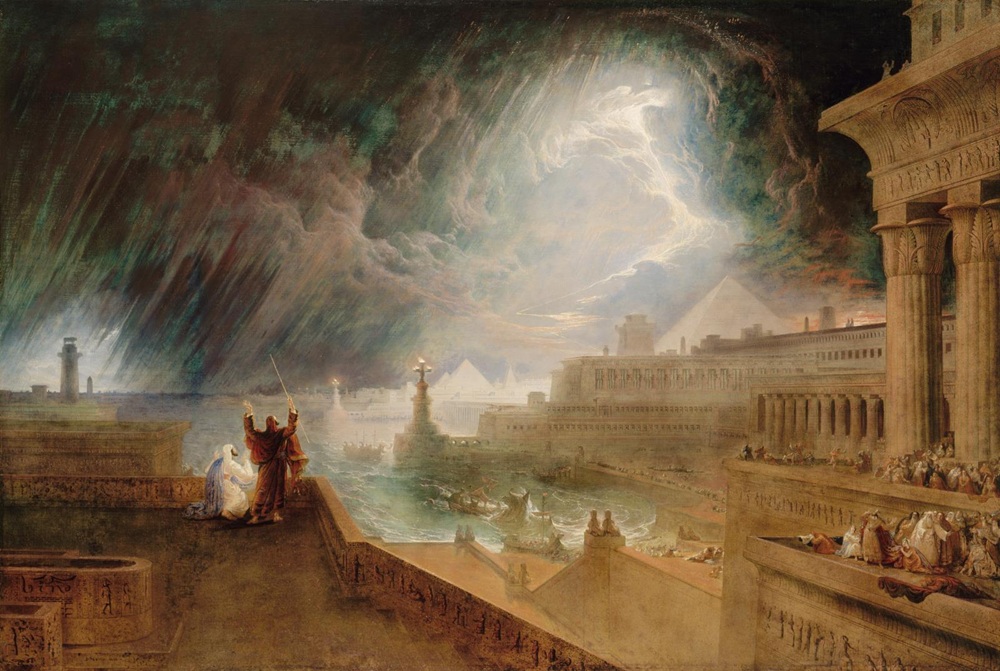
Two paintings of the sort that inspired Griffth’s epic vision. Left: Poynter’s Israel in Egypt; Right: Martin’s Seventh Plague of Egypt. Both show the vast disparities of scale that are carried over into Griffith’s film, with architecture as a metaphor for power.
Griffith was primarily interested in the ensembles of Victorian art and emphasised its epic scale. In the famous crane-shot of the Babylonian scene in Intolerance (1916), notably, he recreates the bird’s eye view of huge architecture and crowds that feature in pictures such as Poynter’s Israel in Egypt (1867, Guildhall Art Gallery, London) and Martin’s Seventh Plague of Egypt (1823, Museum of Fine Arts, Boston). These painters set out to enthral their audiences with spectacular panoramas, and Griffith aims for a parallel effect in his moving images in light and dark.
DeMille was equally committed to the impressive and overblown, openly proclaiming ‘I like spectacle’ (Blanke 61). In his two versions of The Ten Commandments (1923 and 1956) he extends Griffith’s focus on vast buildings and the visual contrast between their huge scale and tiny figures. For the first Commandments, DeMille constructed a gigantic set of the Pharaoh’s city and in several key sequences plays on these dramatic disparities in a way, once again, that recalls the compositions of Martin and Poynter. DeMille used a copy of Martin’s Illustrations to the Bible (1839) as a reference, and it also likely that he saw the artist’s version of Paradise Lost (1827). In both works Martin signals the power of the almighty by amplifying the architecture and diminishing the figures, a strategy DeMille employs to emphasise the authority of the Pharaoh. Martin’s evocation of sublimity and awe are in this way transferred to the moving screen – an effect further intensified in the second Commandments (1956) by the Cinemascope ratio of the image.
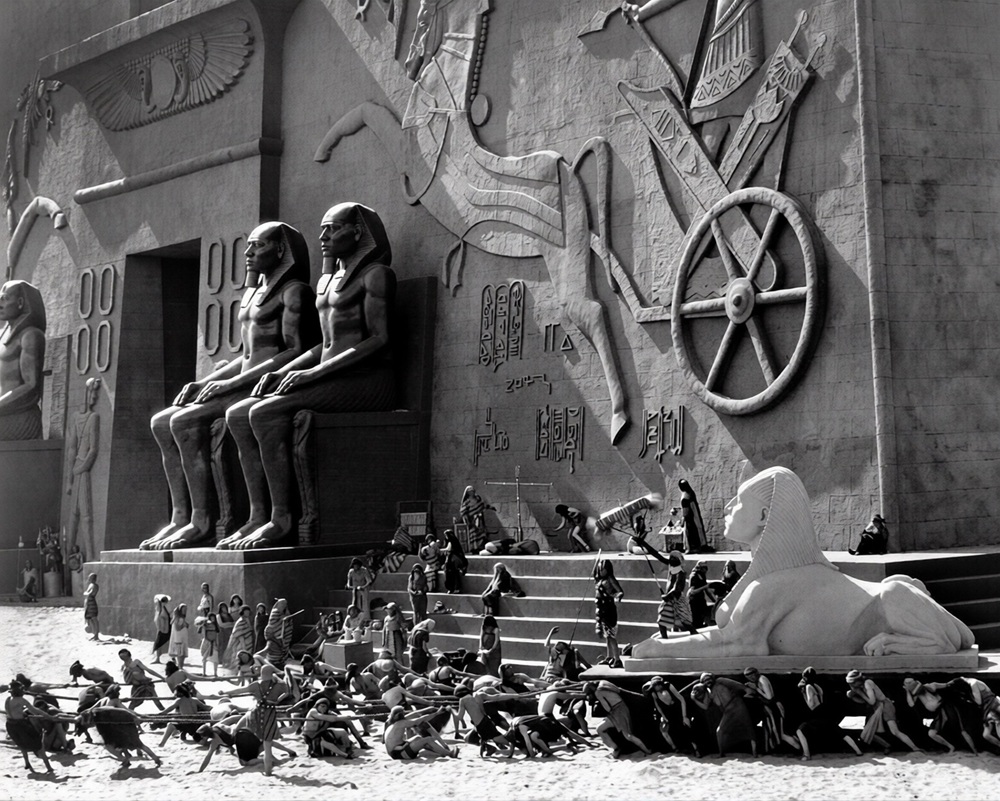

Left: The vast sets for De Mille’s silent version of The Ten Commandments; Right: Pandemonium, Martin’s vision of the spiritual world, a place of epic architecture and tiny figures in Paradise Lost, Plate 5.
For interiors, on the other hand, the director drew on Alma-Tadema’s treatments of domestic scene in ancient (Greek or Roman) cultures. These are composed as a combination of white marble architecture, elaborate, largely imagined costumes, and a bright palette; DeMille reproduces each of these elements, most notably, in his second Ten Commandments. The closest relationship between film and paint is registered in the visualization of female spaces. Alma-Tadema specialized in Aesthetic scenes of languid women bathing and talking, and we can trace precisely this sort of mildly erotic imagery in scenes from Cleopatra (1934) and in the colour Commandments. That relationship is clearly shown in the linkage between Alama-Tadema’s A Favourite Custom (1909, Tate Britain) and in DeMille’s version of Nefretiri (played by Anne Baxter) bathing with her handmaidens. As in the painting, so in the film we have a titillating display of shapely female flesh (though without the nudity), and as in canvas the director emphasises the sensuousness of the water and the interplay of colours. Alma-Tadema presents a luxurious image, a territory also exemplified by Love in Idleness (1891, Laing Art Gallery, Newcastle), and DeMille, using the vivid, brightly-lit palette of Technicolor, creates a parallel display.

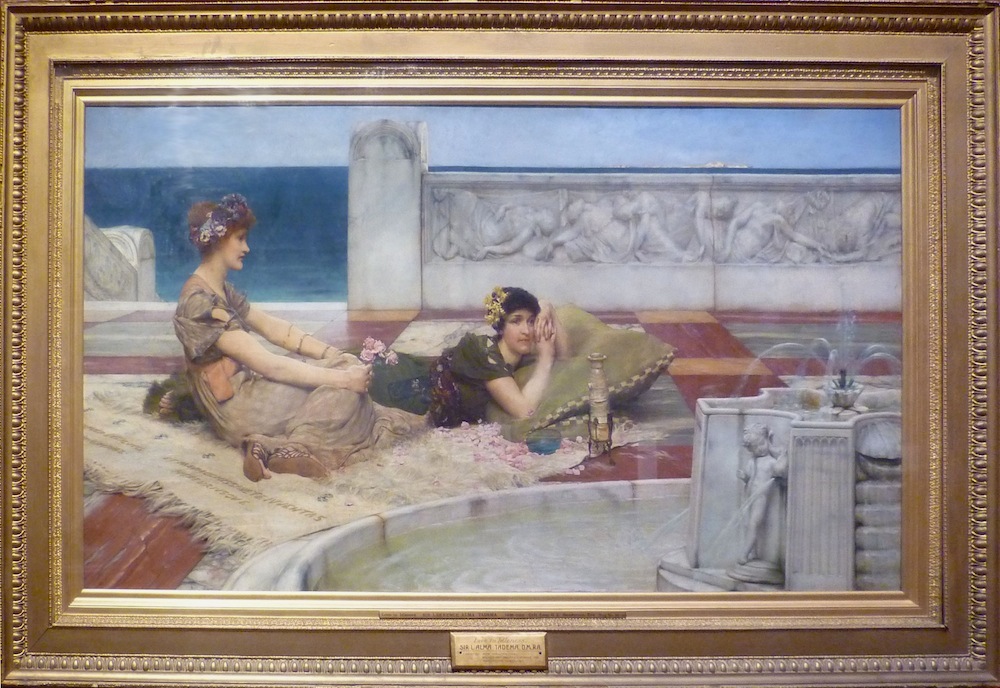
Two sources of bathing beauties in a neo-classical idyll. Left: Alma-Tadema, A Favourite Custom. Right: The same artist’s Love in Idleness.
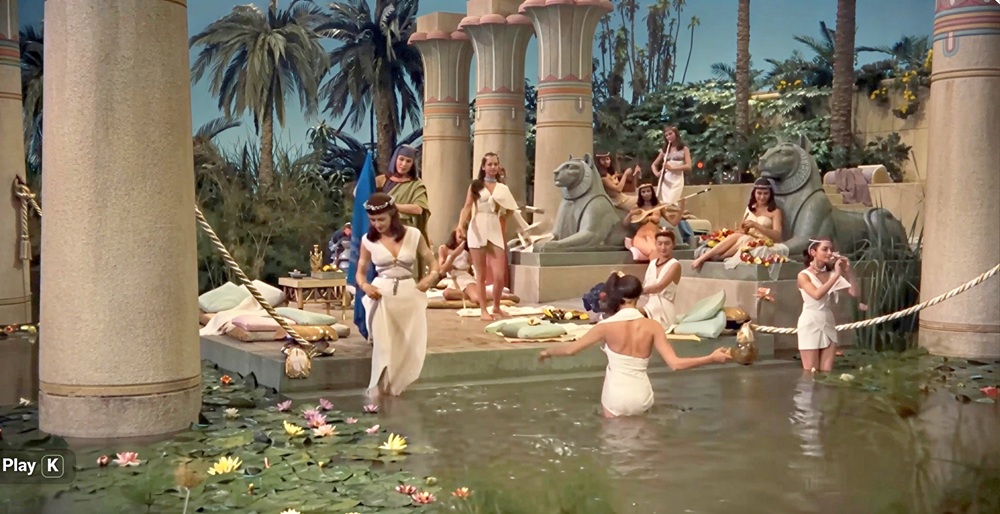
DeMille’s treatment of the ancient Egyptians’ decadent lifestyle in The Ten Commandments (1956). Nefretiri and her handmaids enjoy the high life.
Indeed, the saturated colours of De Mille’s film recreate the palettes of Alma-Tadema, Edwin Long, and Aesthetic painting as a whole. One of the key encounters between Moses (Charlton Heston) and Rameses (Yul Brynner) exemplifies the director’s manipulation of Victorian chromatics and the same is true of practically every shot applied to the mapping of the Egyptians’ ostentatious wealth. This intensity is especially evident in the filmic treatment of jewellery and costumes.
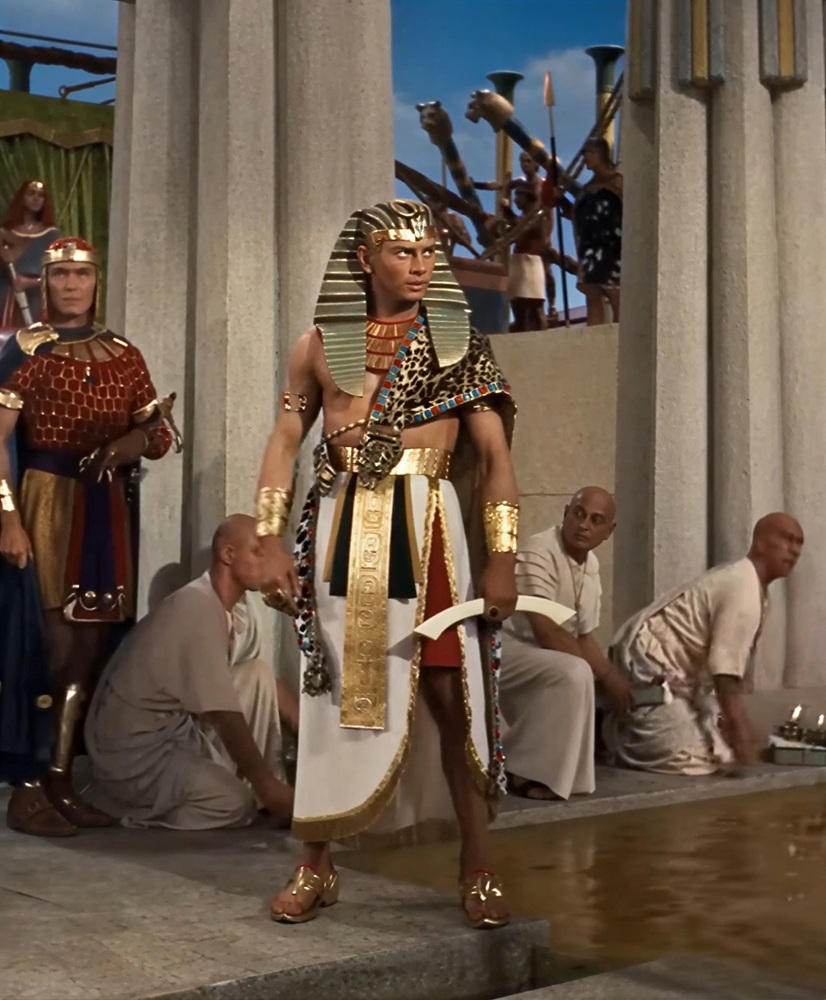
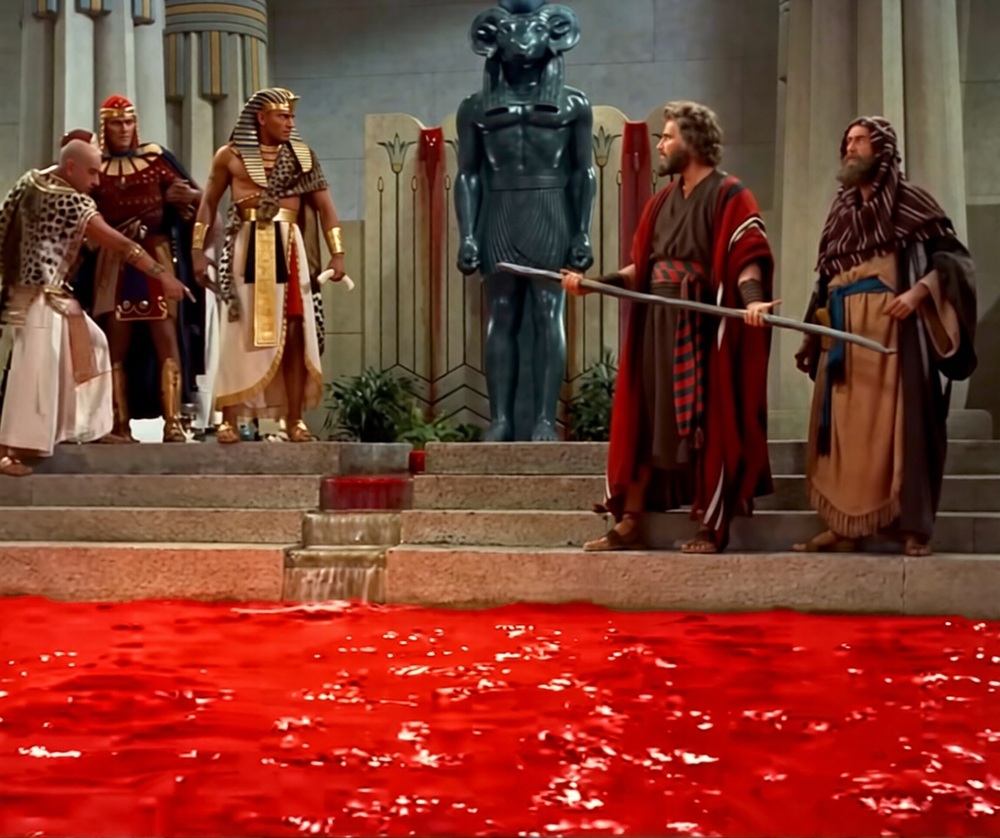
Technicolor dreams: the enamel-like brilliance of DeMille’s palette in The Ten Commandments. Left: The extravagant costumes used in the film. Right: Moses turns the waters of the Nile into blood.
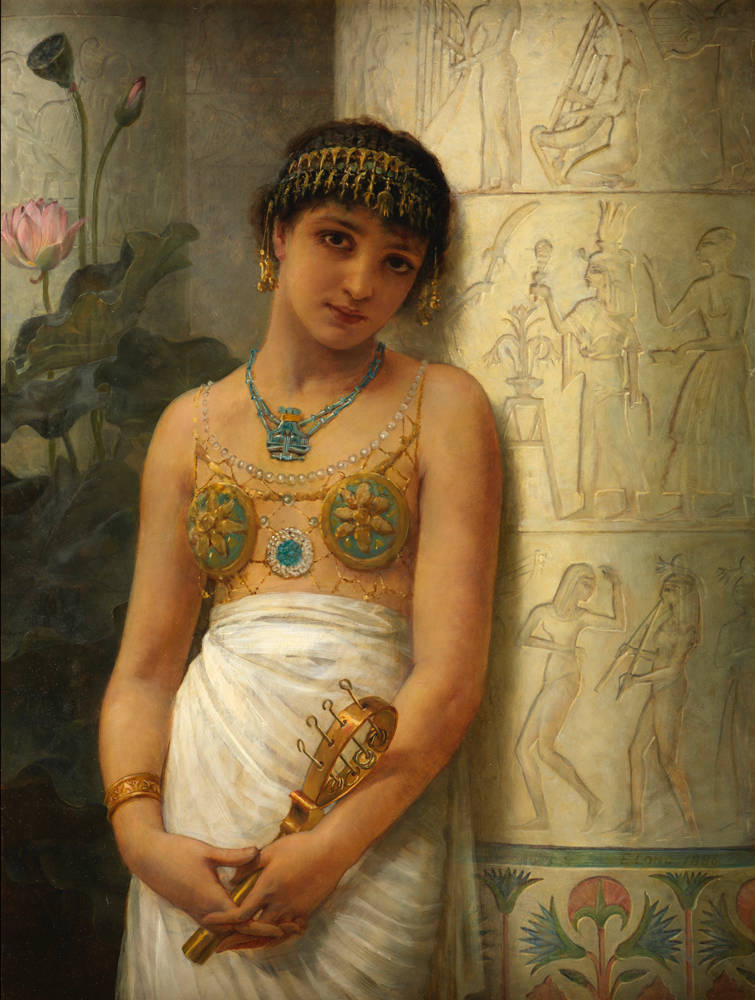

Some examples of the lush palette used in Victorian neo-classicism: Left: Long, An Egyptian Girl with a Sistrum (1886); Right: The same painter’s The Mandolin Player (1886)
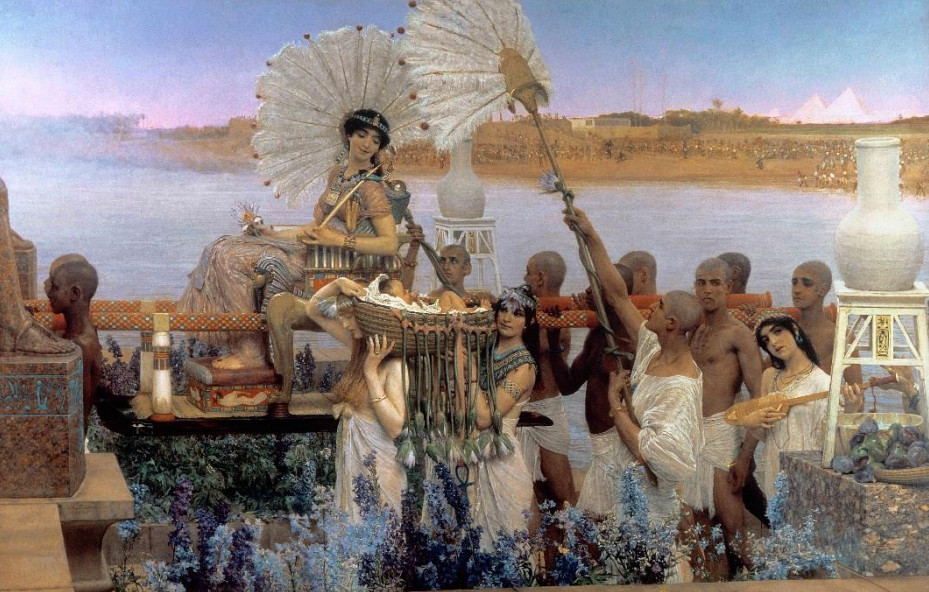
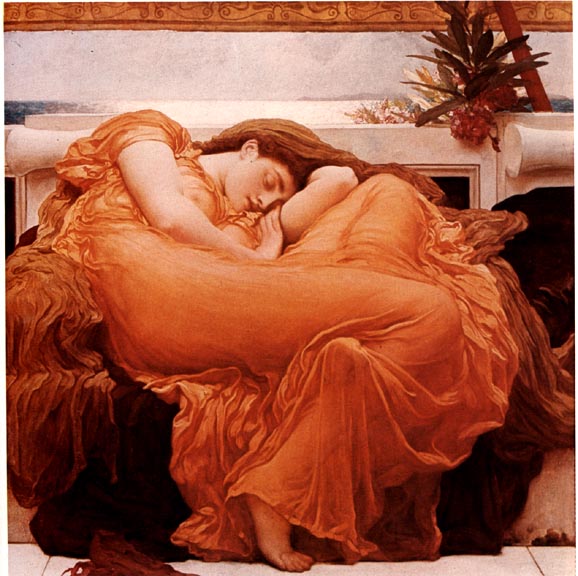
Some more examples of the self-consciously beautiful palettes of Victorian neo-classicism, which aim to offer the viewer an intense sensory experience. Alma-Tadema, The Finding of Moses (Private Collection, 1904); Leighton’s Flaming June (1895).
DeMille’s pictorial palette in this colour film and throughout his colour-work is matched by his use of dramatic groupings and compositions, which were also borrowed from visual art. His source, this time, was the black-and-white illustrations of Doré and the prints of Martin. DeMille’s favourite artist was Doré. According to Harryhausen, the French artist was an ‘immense’ influence not only on DeMille but on other early film makers, arguing that Doré was
a motion picture art director born before his time … His imagination and his talent for dramatic composition is typified by his unique way of focusing light onto the centre of the picture, by creating a dark foreground and background and highlighting the central action … The director Cecil B. DeMille was so impressed by Doré that he borrowed groupings from Doré’s biblical images for use in several of his films. [‘Art of Ray Harryhausen.’]
Harryhausen’s comments are astute and even a limited inspection of DeMille’s films reveals a ‘deliberate pictorial posing’ (Gunning 276) of his figures, placed in light against darkness, that is closely linked to Doré’s work in his Bible Gallery (1866) and in his visualization of Milton’s Paradise Lost (1866). That connection is exhibited in DeMille’s first version (1923) of The Ten Commandments, which presents numerous pyramidal compositions with the emphasis on a central figure surrounded by others in shade or semi-darkness; the same sort of arrangements are deployed in The Sign of the Cross (1932).
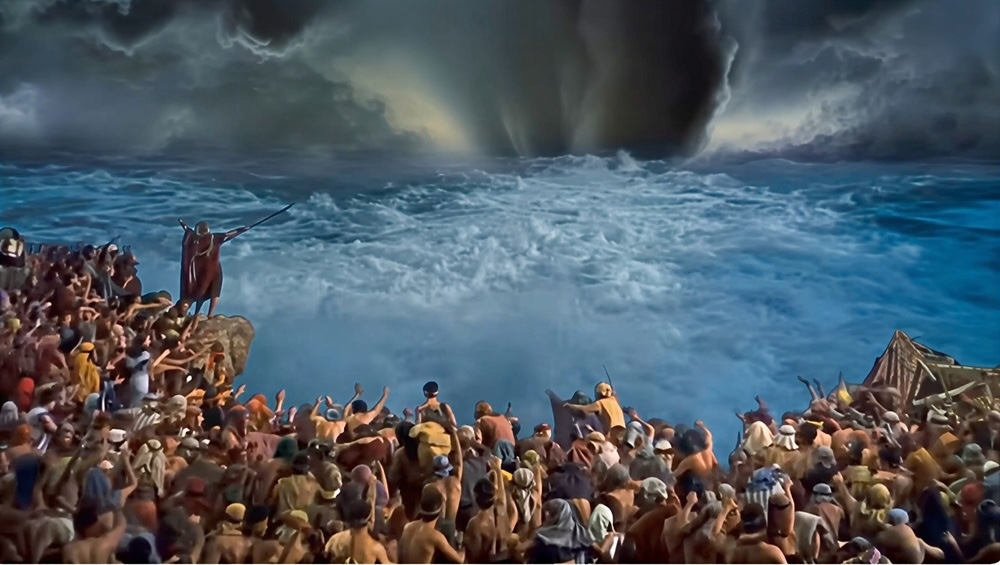

Left: DeMille’s Technicolor representation of the parting of the Red Sea. Right: Martin’s mezzotint version of a similar scene, DeMille’s inspiration.
DeMille’s most striking sequences, depicting the parting of the Red Sea, were derived from Martin. The director visited the scene twice – in his first and second version of The Ten Commandments – and based his composition on Martin’s Moses Destroying the Pharaoh from the artist’s mezzotints of the Bible (1839). DeMille reproduces the two main elements in Martin’s fevered design – the placing of Moses, surrounded by the Israelites, and the thrashing sea. Gifted with the capacity to show movement, the director takes the artist’s dynamic image one stage further, showing the waters parting and then crashing down on the Egyptian enemy. The effect was ingeniously achieved by pouring a vast quantity of liquid into a gigantic tank, and then reversing the film; seen on the ‘big screen,’ its impact, especially in the Cinemascope version, is both sublime in the Burkean sense of the term, and poetic.
At first glance such spectacles seem entirely the domain of cinema. But, as we have seen, this cinematic language was firmly based on a series of visual prototypes and inspirations, an expressive ‘storehouse’ (Hollander 428) of signs that were borrowed, manipulated, and refigured by America’s pioneering directors. Like all previous visual artists, they drew on the findings of others, creating an interpictorial link between pictures and moving pictures. In so doing they established ways of depicting the ancient world that were carried forward in the many ancient history or ‘sandal epic’ movies of the 1950s and 60s, which, like their silent forebears, pay homage to nineteenth century art. William Wyler’s Ben-Hur (1959), Stanley Kubrick’s Spartacus (1960), Henry Koster’s The Robe (1953) and Joseph L. Mankiewicz’s Cleopatra (1963) could all be described as neo-Victorian as much as neo-classical. Mankiewicz’s film is particularly redolent of Victorian spectacle, most of all in the sequence showing Cleopatra’s arrival in Rome: resplendent and overblown, its kitsch vulgarity extends its Victorian inspirations into a new domain of visual hyperbole.
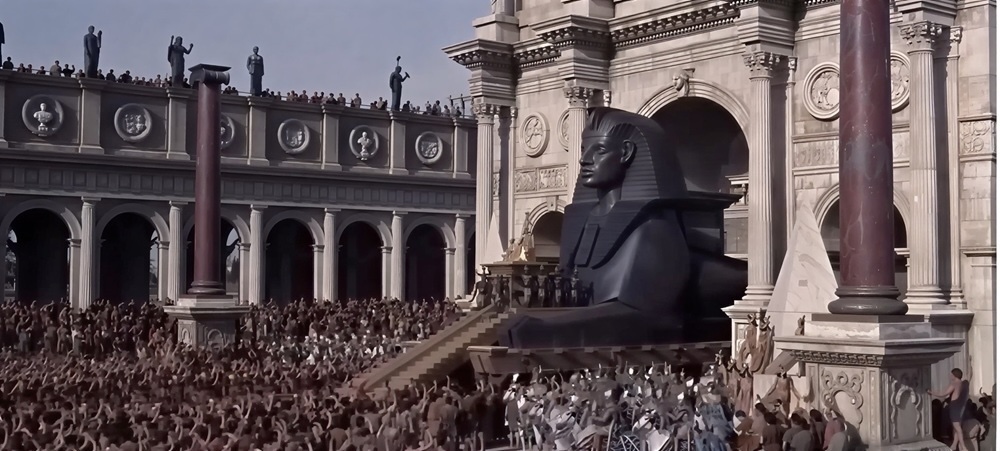
Mankiewicz’s epic version of Cleopatra’s entry into Rome; Elizabeth Taylor, incongruously, is the queen.
Victorian Art and Fantastic Cinema
Victorian art sometimes had unexpected applications, and none is more surprising than its influence on fantasy cinema. Of course, the ‘sandal epic’ was essentially fantastical while pretending to be historically valid, but other films exploited the nineteenth century image-hoard to visualize the strangest of adventures. Of special note are the ‘monster movies’ created by the ‘special effects’ artists and art-directors, Willis O’Brien and Ray Harryhausen, both of whom were immersed in Victorian traditions. Their prime influences, as in the case of DeMille and Griffith, were Doré, Martin, and the neo-classicists.
O’Brien, Merian C. Cooper’s art director at work on King Kong (1933), was a pioneering film-maker whose creation of the gigantic primate was important insofar as it stretched the visual language of cinema, showing how the relatively new medium could make the impossible live. His animation of Kong was successfully achieved through the medium of stop-frame technology – a method later developed, in the form of ‘Dynamation,’ by Harryhausen; but O’Brien also needed to find a visual source for his character’s lair and for his monstrous adversaries.
The designer reconfigured Doré’s American forests and vistas in François-René de Chauteaubriand’s Atala (1863), using its huge vistas and gloomy bowers as reference for Kong’s jungle and craggy mountains; one of Doré’s plates, of a fallen tree crossing an opening, became the model for the tree the unfortunate sailors climb over before they are shaken off by an infuriated Kong (‘The Art of Ray Harryhausen.’). O’Brien also drew more generally on ‘nineteenth century images of fantasy landscapes’ and exploited Doré’s ‘illustrations of purgatories, hells, and wild’ outlandish settings (Rony 181) as they appeared in the the Inferno and Paradise Lost. Martin was a source of parallel imagery and taken together these artists provided a template for many scenes in the wilderness of Kong’s island.
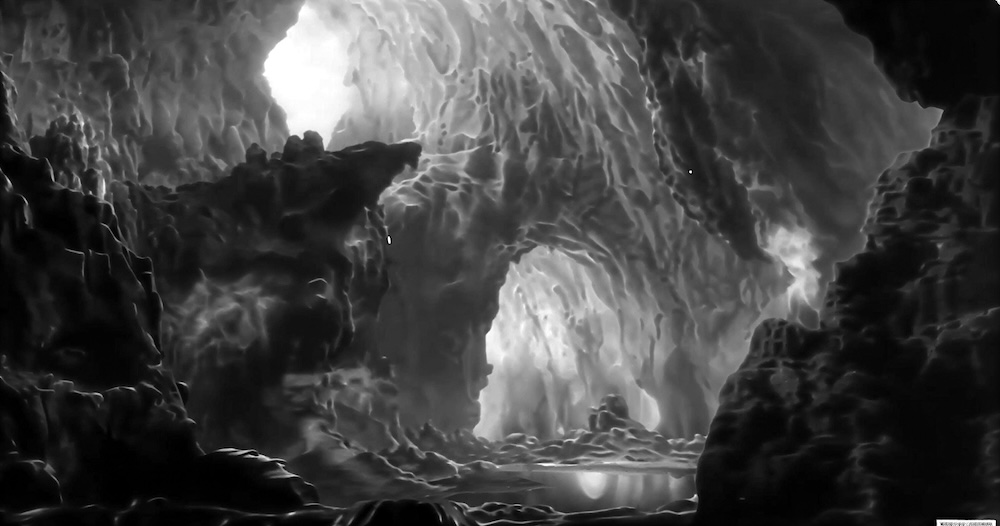

Left: O’Brien’s subterranean lair. Right: Martin’s The Expulsion of Adam and Eve from Milton’s poem.
The connection between O’Brien’s sets – which were of course miniatures – and their Victorian models is most clearly displayed in the similarity between the ape’s cavernous home and Doré and Martin’s gloomy undergrounds and crepuscular skies. Dark but illumined by zones of light playing over ragged rock-formations and penetrated by mysterious openings and subterranean tunnels, the imagery of these artists’ illustrations is taken up by the art-director to create an overpowering sense of menace and strangeness, of unlimited space and sublime fearfulness. In O’Brien’s hands the convulsive Romanticism of the two Victorians is refigured and given an extra, surreal intensity.
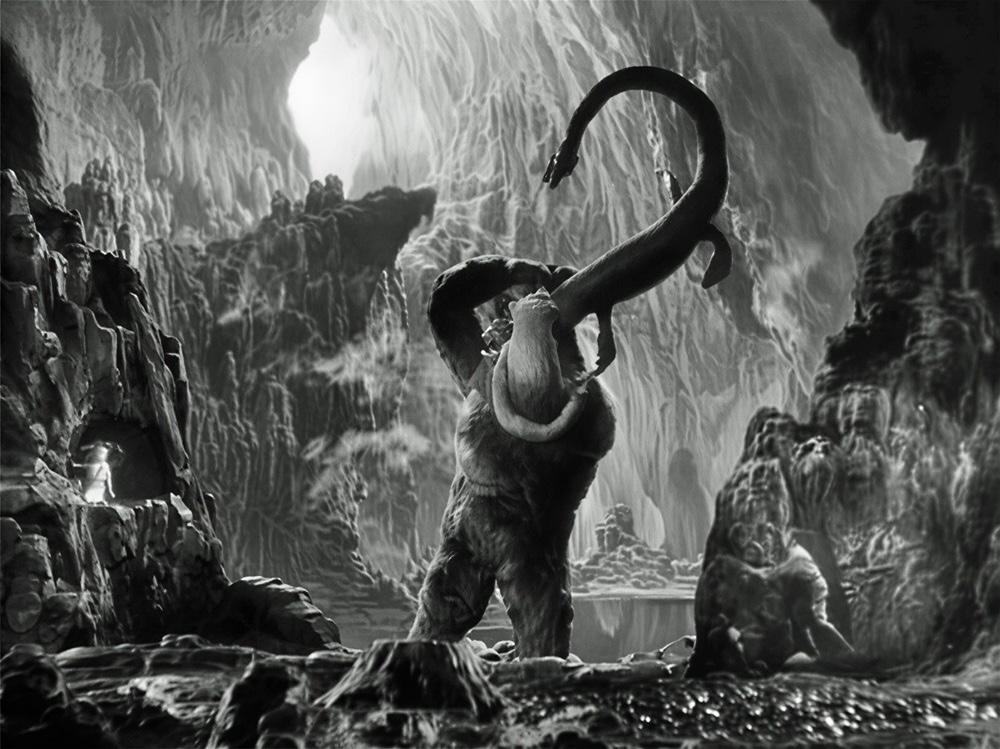
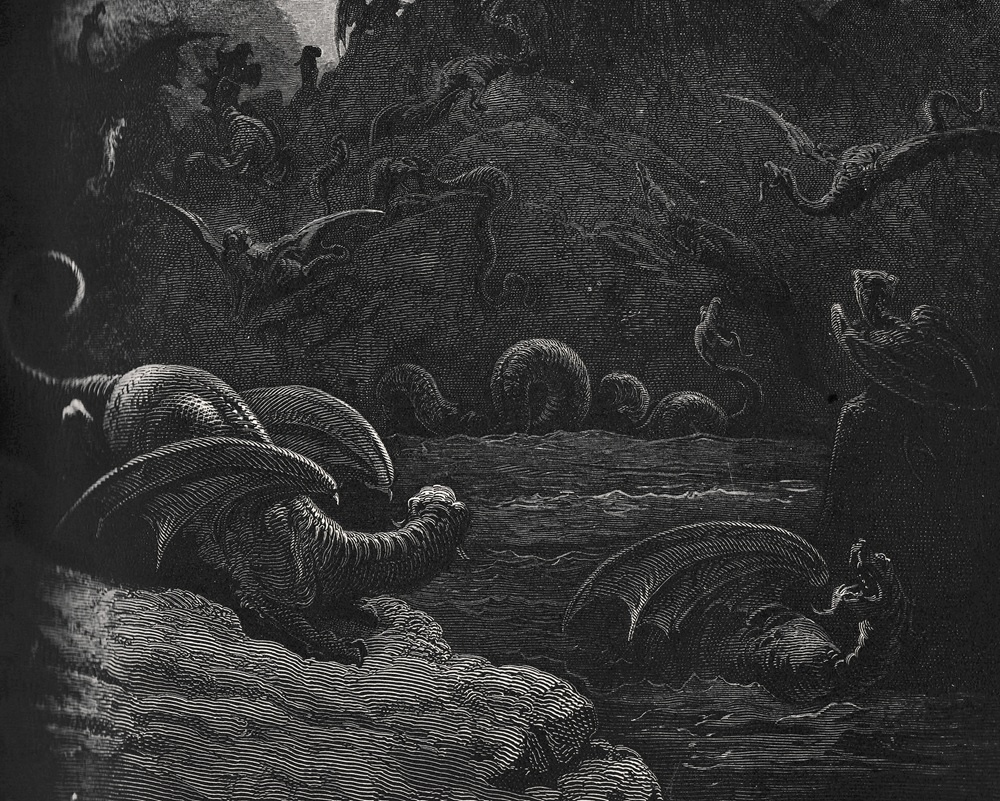
Left: Kong grapples with a Doré-esque reptile, part snake, part lizard, all coils and teeth, and thoroughly repulsive. Right: A detail showing Doré’s horrible prototypes in his treatment of Milton’s poem./
O’Brien was similarly influenced by Doré’s representation of monsters. Kong is accosted by dinosaurs and weird imaginary reptiles, and so are the sailors who go in pursuit of Anne Darrow (Fay Wray). The film’s more grotesque creatures were almost certainly based on a terrifying scene on Doré’s Gorgons, and Hydras, and Chimeras Dire from Paradise Lost. In the illustration the expelled angels look down on horrible, coiling animals of indeterminate identity, and in King Kong the creatures, or at least their filmic equivalents, are brought to life.
Harryhausen’s film-making develops out of his association with O’Brien, who was this mentor and with whom he worked on another ‘ape movie,’ Mighty Joe Young (1949). Harryhausen openly acknowledged his debt to Victorian masters; as we have seen, he viewed Doré as a sort of ‘original motion picture art director’ (Webber 25), and his borrowings from this artist and others were eclectic and imaginative.
His backgrounds are primarily a mix, again, of motifs from Doré and Martin. Harryhausen possessed a collection of prints by Martin (‘Ray Harryhausen,’ Tate Shots), and these and images by the French master provided a template for his rocky, fantastical landscapes in films such as Mysterious Island (directed by Cy Endfield, 1961). Harryhausen was similarly influenced, like O’Brien, by Doré’s monstrosities. The hydra in Jason and the Argonauts (Don Chaffey, 1963) and the Medusa in Clash of the Titans (Desmond Davies, 1981) recall the wormy slitheriness of the creatures in Paradise Lost and the behemoth depicted in The Destruction of Leviathan (Doré’s Bible). Likewise, the fighting skeletons in Jason must surely be a homage to Doré’s The vision of the valley of dry bones (Bible), and it is quite possible that the bat-like harpies in Jason are modelled on the same artist’s treatment of Satan, with his grotesque, hooked wings, in Paradise Lost.
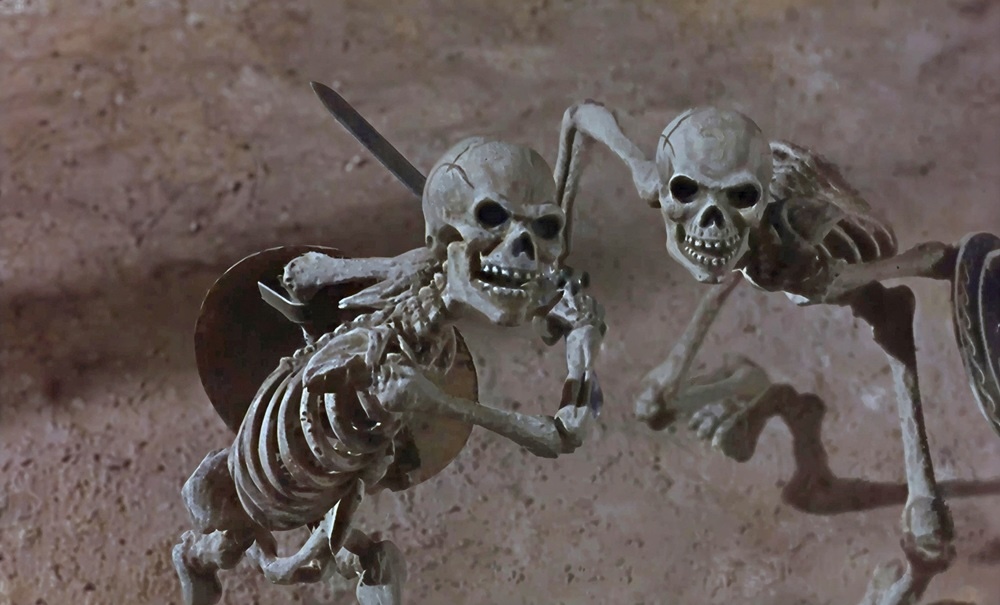

Left: Harryhausen’s grinning, re-animated skeletons for Jason and the Argonauts. Right: Doré’s The vision of the valley of dry bones, where the dead escape the grave.
But Harryhausen’s borrowings were not confined to Doré and Martin. He looked further afield to Claude Shepperson’s illustrations for H. G. Wells’s The First Men in the Moon (1900–1901, The Strand, and as a single volume). Though little known, Shepperson’s designs are a highly distinctive treatment of elements in Wells’s story, and Harryhausen used the illustrations as a source-material for his work in Nathan Juran’s film version of the text. Two of the original pictures are of most prominence: the Selenites’ leader and the space-capsule. Shepperson’s drawings are in themselves dynamic, unsettling designs, and the filmmaker pays homage to their dramatic power by making the figures move.
We can see, in short, how Harryhausen exploits the lexicon of Victorian arts, modernizing its visual semiologies for a contemporary audience. In this respect he – and all of the filmmakers discussed here – establish a link of continuity with the pictorialism of the nineteenth century. Many would anticipate a connection between film and Victorian theatre – which is acknowledged in the deployment of the acting styles of early movies – and a relationship between film and the Victorian novel, as evidenced in the photoplay’s use of extended narratives. But in the end it is the pictorial culture of Victoria’s age that counted most as directors and art-directors aligned film with the grammar of visual art, establishing new modes of expression as they endowed pictures with the expressive possibilities of movement.
Filmography
DeMille, Cecil B. Cleopatra. Paramount Pictures, 1934.
——. The Sign of the Cross. Paramount Pictures, 1932.
——. The Ten Commandments. Paramount Pictures, 1923 [silent version].
——. The Ten Commandments. Paramount Pictures, 1956.
Griffith, David Wark.Intolerance. Wark Producing Corporation/Majestic Motion Picture Co., 1916
——. The Song of the Shirt. Columbia–Emi–Warner, 1979.
Lumière, Auguste and Louis. L’arroseur Arose . (1915)
——Workers Leaving the Lumière Factory (1915).
Méliès, George. Le Voyage dans la Lune (1902).
Films with special effects by Ray Harryhausen
Chaffey, Donald. Jason and the Argonauts. Columbia Pictures, 1963.
Davis, Desmond. Clash of the Titans. . Metro-Goldwyn-Mayer, 1981.
Endfield, Cyril (Cy). Mysterious Island. Columbia Pictures, 1960.
Juran, Nathan. The First Men in the Moon. Columbia Pictures, 1964.
Films with special effects by Willis O’Brien
Cooper, Merian C. King Kong. RKO, 1933.
Schoedsack, Ernest B. Mighty Joe Young. RKO, 1949.
Modern Films Influenced by Victorian Neo-Classicism
Koster, Henry.The Robe. Twentieth Century Fox, 1953.
Kubrick, Stanley. Spartacus. Universal Pictures, 1960.
Mankiewicz, Joseph L. Cleopatra. Metro-Goldwyn-Mayer, 1959.
Wyler, William. Ben-Hur. Metro-Goldwyn-Mayer, 1959.
Bibliography
Primary
Ainsworth, W. H. Jack Sheppard. 3 Vols. Illustrated by George Cruikshank. London: Richard Bentley 1939.
Alighieri, Dante. Inferno. Illustrated by Gustave Doré. Paris: Hatchette, 1857; English editions from 1861.
Arnheim, Rudolf. Film as Art. 1916; Berkeley: University of California Press, 1957.
’The Art of Ray Harryhausen.’ National Museums of Scotland blog. https://www.nationalgalleries.org/art-and-artists/features/art-and-ray-harryhausen [Accessed 12 May 2026].
Banerjee, Jacqueline. ‘Eadweard Muybridge, 1830–1904.’ The Victorian Web. https://victorianweb.org/photos/muybridge/bio.html [Accessed 15 May 2026].
Birchard, Robert S. Cecil B. DeMille’s Hollywood. Lexington: University of Kentucky Press, 2004.
Blanke, David. Cecil B. DeMilles, Classical Hollywood, and Modern American Mass Culture. London: Palgrave, 2016.
Cruikshank, George. George Cruikshank’s Table Book. London: Punch Office, 1845.
de Chauteaubriand, François-René. Atala. Illustrated by Gustave Doré. Paris: L. Hatchette et Ce, 1863.
Dickens, Charles. Bleak House. London; Bradbury & Evans, 1953.
Flint, Kate. The Victorians and the Visual Imagination. Cambridge: Cambridge University Press, 2000.
Gunning, Tom. D. W. Griffith and the Origins of American Narrative Film. Urbana: University of Illinois Press, 1994.
Hollander, Anne. Moving Pictures. New York: Knopf, 1989.
The Holy Bible with Illustrations by Gustave Doré. London: Cassell, Petter, and Galpin, 1866.
Marey, Étienne Jules. Le Mouvement . Paris: G. Masson, 1894.
Martin, John. Illustrations to the Bible. London: Tilt, 1839.
Milton, John. Paradise Lost. Illustrated by John Martin. London: Prowett, 1827
——. Paradise Lost. Illustrated by Gustave Doré. London: Cassell & Co, 1866–67.
Muybridge, Eadweard. Animal Locomotion. Philadelphia: University of Pennsylvania, 1887.
Pratt, George C. ‘Forty-Five Years of Picture Making: An Interview with Cecil B. DeMille.’ Film History. 3 (1989): 134–145.
‘Ray Harryhausen on John Martin.’ TateShots. https://www.tate.org.uk/art/artists/john-martin-371/ray-harryhausen-on-john-martin [Accessed 11 May 2026].
Rony, Fatima Tobing. The Third Eye: Race, Cinema, and Ethnographic Spectacle. Durham, NC: Duke University Press, 1996.
Simmon, Scott. The Films of D. W. Griffith. Cambridge: Cambridge University Press, 1993.
Stewart, Garrett. ‘Curtain Up on Victorian Popular Cinema; Or, The Critical Theater of the Animatograph.’ BRANCH: Britain, Representation and Nineteenth-Century History. Ed. Dino Franco Felluga. Extension of Romanticism and Victorianism on the Net. Web. [Accessed 15 May 2026].
Vacche, Angela Dalle. Cinema and Painting. Austin: University of Texas Press, 1996.
’Victorian Art and Cinema.’ mardescortésbaja.com.https://www.mardecortesbaja.com/2007/03/29/victorian-art-and-the-cinema/ [Accessed 18 May 2026].
Webber, Roy P. The Dinosaur Films of Ray Harryhausen. Jefferson, NC: McFarlane, 2004.
Wells, Herbert George. ‘The First Men in the Moon.’ The Strand Magazine (1900–1901). Illustrated by Claude Shepperson.
Created 12 June 2026