
Introduction to Wilde's Poems, 1907
Richard Le Gallienne, "Introduction," in Poems, The Complete Writings of Oscar Wilde (London and New York: A. R. Keller & Co., 1907), pp. 11-28. In the next item below Le Gallienne denies responsibility for editing this unauthorised edition of Wilde's works and claims that his "sole connexion" lay in the writing of this introduction. He may have also persuaded Keller to make some form of payment for the edition towards Wilde's children.
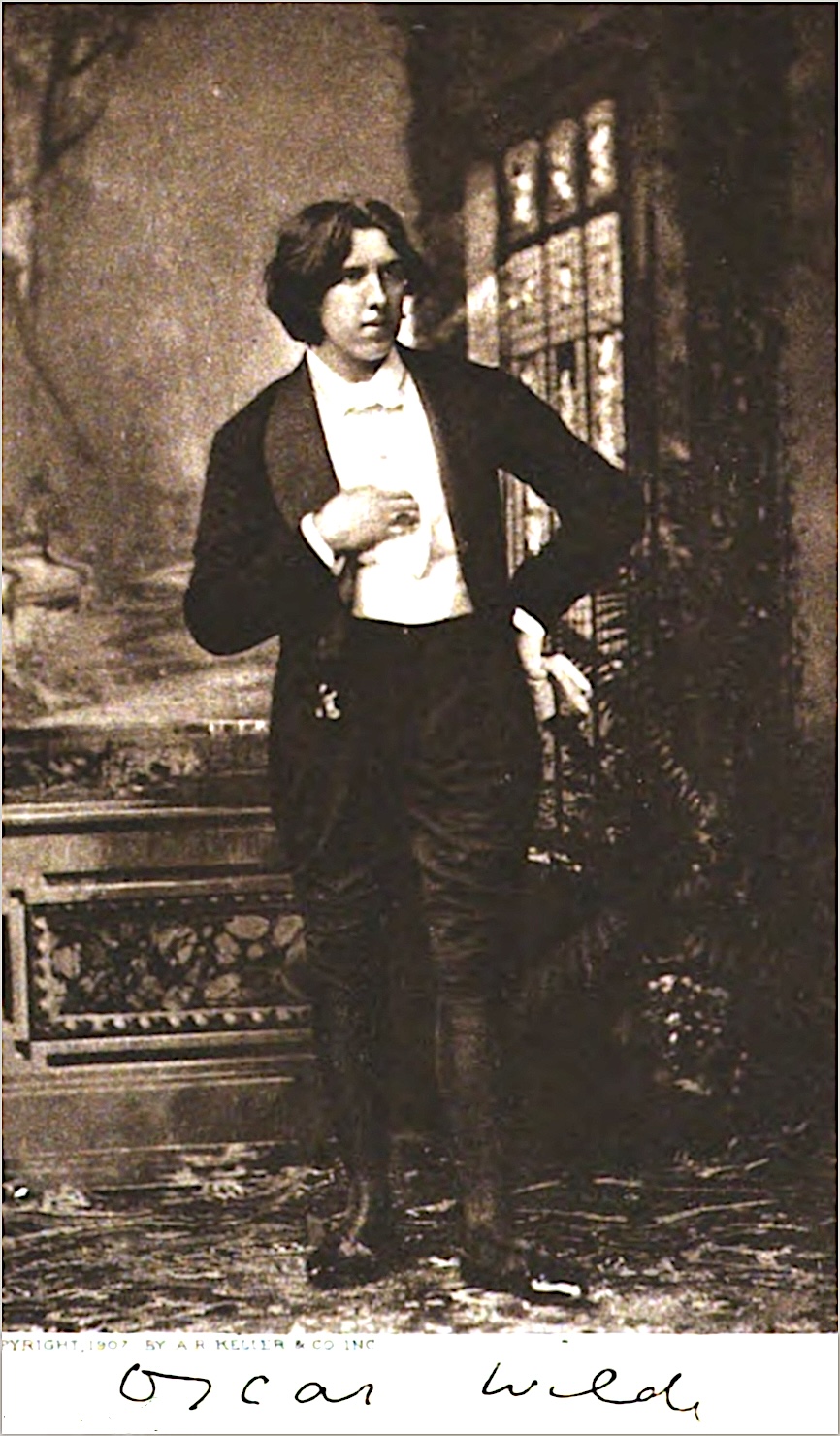
The writings of Oscar Wilde, brilliant and even beautiful as they are, are but the marginalia, so to say, of a striking fantastic personality. Some writers seem to be all writer. As with a silkworm, we forget them entirely in what they produce. They themselves have no personal existence or interest for us. With Oscar Wilde it was precisely otherwise, as he himself hinted when he said that he gave his talent to his writingsóbut kept his genius for his conversation. A certain very great Norwegian, happily still alive, once said to me of Ibsen: "He is only a pen!" Perhaps one might imagine a worse fate than to be only a pen such as Ibsen; but there is no need to emphasize what the speaker meant. Perhaps the really great writers are only pensóscriveners of the universe and humanity, rather than human beings, with [11/12] personal lives of their own. At all events, in the case of Oscar Wilde, the pen was but one of the various media by means of which he chose to present to the world the one work of art with which alone he was concerned to impress itóhimself. If the pen is mightier than the sword, in his case the tongue was mightier than the pen, as he himself, as I have just quoted, preferred it should be; and as anyone who ever heard him talk will admit was a true self-judgment.
Yet now, when "the great silent talker makes no sign," we naturally turn to those writings which, sometimes, according to his whim, he would affect to treat lightly, as though they were really hardly worth mentioning, mere trifling accidents of the true colossal greatness which wasóhimself; and sometimes, would affect to treat with a portentous solemnity all his own. What he really meant he least of all cared to know. Indeed, he was one of those natures who find an unfading fascination in not being able to understand themselves. I believe that, if Oscar Wilde had for once understood himself, he would have committed suicide out of sheer ennui.
With him the questions were not so much [12/13] "Am I a great poet?" "Am I a great playwright?" "Am I a great wit?" but rather: "Am I — Oscar Wilde?" That is: "Have I written my name, stamped my personality, across the face of this world?"
Blue china, sunflowers, knee-breeches, Æstheticism, green carnations, poetry, prose, or playsóor even tragic scandal — all these were indifferently used as means towards the making of the legend of himself. He wished to be known — not as the poet Oscar Wilde, or the playwright Oscar Wilde; but merely as — Oscar Wilde. It was a superb egoism, the superbest egoism of our time. But, whatever Wilde really thought of his own writings, whether or not he did them, as Stevenson used to say, "just for fun," the fact remains that he was a true poet, a maker of lovely fairy tales, a critic of society whose epigrams had a singular dynamic, disintegrating, power, and easily the most brilliant and distinguished playwright of his time. He was also, in spite of his Gallic vagaries, an exceedingly sane critic of literature, having not only the temperament, but no little of the equipment of the scholar; if his prose was a little "plush," yet he wrote many pages that haunt the memory; and [13/14] — peace to the soul of Whistler! — he was the greatest wit of his day.
When one recalls the man himself, one sees clearly why the inevitably became the modern master of paradox; for his love of paradox was but a reflection of his own nature. He himself was his own supreme paradox. And that, of course, was just as he would have chosen. "The artist never does the same thing twice," I remember his once saying; and he lived up to his own dictum in the manner in which, when one of his moods, or poses, had exhausted its interest for him, he abandoned it instantly and completely, as though it had never been his at all — abandoned it often for its exact opposite; as when, for instance, the long-haired Æsthete of the knee-breeches and sunflowers suddenly emerged upon London as the most conventional of modern dandies. These sudden transformations, though he affected to take them with great solemnity, gave him quite a boyish delight; for there was in all his poses a masquerading boyishness, which enabled him to laugh at himself ail the time — or perhaps I had better say most of the time — while the onlooker was taking him in such deadly earnest. To startle and shock [14/15] the bourgeoisie was an amusement of which he never tired. He delighted to watch for the "Do you really mean it, Mr. Wilde?" look on the face of some guileless or stupid listener. I remember being at a dinner-party on one occasion when he gravely propounded the theory that missionaries were the divinely provided food for those desolate cannibal islands where other food was scarce. "O are you really serious, Mr. Wilde?" said an innocent young thing at his side. Anything more profoundly serious than Wilde's expression in answer cannot be conceived.
While he would sometimes be thus deliberately whimsical, many of his most famous mots were not so much meant to be witty as to be true. To tell the truth in a world that has so little courage to tell it, to think for oneself in a world that has always let others think for it, by sheer contrast, is one of the most effective forms of wit. To sayóto take one of Wilde's most notorious mots — that you are disappointed with the Atlantic seems nothing but a huge joke, a pose, to a world which is accustomed to go into false raptures over nature, and to speak of the Atlan-[15/16]tic and Niagara as it speaks of the classics it never reads. I believe that Wilde was genuinely disappointed with the Atlantic, as many another of us, crossing it monotonously in those vulgar sea-going hotels we call liners, have surely been; and he said so quite simply to the interviewers as he landed. I know that to attribute anything like simplicity to the great apostle of pose may seem far-fetched, but those who knew him were well aware of that quality in him, alongside of his elaborate affectations; for he was a poet, and in a poet's soul, however overlaid it may be with surface insincerities, there is always something left of the child. It was the essential sincerity of Wilde's nature which gave force even to his insincerities and all the vagaries of his fantastic career.
Intellectual sincerity was certainly his, and the power of his best epigrams lies in the strong brainwork behind them. It used often to be said that anyone could make them, that they were merely proverbs turned upside down, and, of course, that was often the ease — though, even so, the effect of turning the proverb upside down had a decidedly novel effect of truth. A great deal [16/17] depends on your choice of the proverb for the purpose. This, however, is not true of Wilde's more serious epigrams, which often compress into one seed-like phrase a whole philosophy of life. Take, for example, the apparently flippant remark "We will not go to war with France — because her prose is perfect." Said so, it is apparently a trivial jest, and yet, when you ponder it a little, you see behind it a recognition of that spiritual unity of mankind, which, if more generally recognized, would preserve the peace of nations. Carlyle meant the same thing when he said that England would give up India before she would give up Shakespeare. Of course, it is only a poet's dream, and yet the day may some day come when the sentiment of a spiritual gratitude between nations — as, for example, towards Greece, for having been Greece; towards Italy, for having been Italy — may mitigate somewhat their savage rivalries. Of the purely amusing qualities of Wilde's epigrams, who that has seen his plays need be told? But here again the humour came of their truth; and society, that loves nothing better than to laugh at itself, laughed mainly because [17/18] they were so true. Truth, even more than brevity, is the soul of wit. I have said that Wilde was his own supreme paradox. Of course, it is in the nature of the poet to be a paradox, for it is not so much his business to be a consistent self, like real human beings, but to be the "wandering voice" that expresses and interprets all the various feelings and moods of his fellow-men. Hence, he is so often accused of contradicting himself, when he is merely speaking for others, nature having made him a multiplex being just for that purpose. You might as well ask an actor to play one part all his life as to ask a poet to be always the same thing. Of course, some poets areóand a little of them goes a long way.
Few writers, however, have illustrated this Undine quality of the artist to such a degree as Oscar Wilde. To minds unfamiliar with the transformations of the artist, simple straight-cut minds that cannot understand how such poets as Villon and Verlaine, side by side with their disreputable external lives, could write poems not only of true beauty, but of sincere piety — to such minds it will, no doubt, seem bewildering that the same man should have written so diversely as in the various volumes [18/19] which follow: that he who wrote that exquisitely tender "Requiescat" —
"Tread lightly, she is near
Under the snow,
Speak gently, she can hear
The daisies grow.
could, likewise, have written "The Sphinx," that strange, fascinating poem, so subtly and so learnedly charged with the lust of the ancient world, and written — was that another ironical paradox? — in the metre of "In Memoriam"; or, again, that he who, in his young days, used to luxuriate in over luscious imitations of Keats should end with a poem of such tragic strength as "The Ballad of Reading Gaol." Again, to many it may seem strange that the cynic of the comedies, the novelist of "Dorian Gray," should have written such tender pure-hearted fairytales as "The Happy Prince," or that beautiful letter about children in prison. But, of course, there is nothing contradictory in all this. Wilde, more than most artists, was remarkably many-sided, and lived up to his own dictum that [19/20] "the artist should never do the same thing twice." One might amend his dictum, and say that the artist cannot do the same thing twice, even if he tries; for his work marks and records a continuous spiritual progression, and he can no more control it than he can control the development of his spirit.
The two main characteristics of Wilde's writings, as of his own nature, to be found there in unusual juxtaposition, are the love of beauty, and the sense of comedy. The flamboyant methods by which Wilde chose first to announce his evangel of Æsthicism made the world for a long while look upon him as a sort of quack of the beautiful; but, before he had set out upon his mission of the sunflower, he had published a volume of poems, which was earnest enough of his sincerity. "Spirit of beauty," ran some lines of one of the poems, lines which he had painted in gold along the frieze of his Tite Street drawing-room —
"tarry still a-while,
They are not dead, thine ancient votaries,
Some few there are to whom thy radiant smile
Is better than a thousand victories." [20/21]
The volume was full of echoes, as the volumes of all young poets are sure to be, echoes of Milton, Wordsworth, Keats, Matthew Arnold, as well as of Swinburne and William Morris, — but, as one reads the young book again to-day, one has to admit that they were such fine and forceful echoes as can only be made by an original talent. All poets, great or small, more or less echo each other — that is what we call the poetical tradition! — and we could hardly afford to lose such an echo, if echo it be, as that noble sonnet (Wilde wrote some of the best sonnets of his time) to "Liberty," with its poignant close, foreshadowing the seriousness of his essay on "The Soul of Man under Socialism" —
"Those Christs that die upon the barricades,
God knows it I am with them, in some things."
Then "Ave Imperatrix," and "Panthea," in which, so to say, the pantheistic immortality of the body is expressed with such rare beauty —
"So when men bury us beneath the yew,
Thy crimson-stainèd mouth a rose will be,
And thy soft eyes lush blue-bells dimmed with dew, [21/22]
And when the white narcissus wantonly
Kisses the wind its playmate some faint joy
Will thrill our dust, and we will be again fond maid and boy."
And, again, that fine concluding poem in which he bids farewell to youth, and laments his unworthiness of loveó
"I have made my choice, have lived my poems,
and, though youth is gone in wasted days,
I have found the lover's crown of myrtle
better than the poet's crown of bays."
It comes to seem a strangely prophetic first volume, when one recalls this epilogue, and still more so when one reads over again the opening sonnet "Hèlas" —
"To drift with every passion till my soul
Is a stringed lute on which all winds can play,
Is it for this that I have given away
My ancient wisdom and austere control?
Methinks my life is a twice-written scroll
Scrawled over on some boyish holiday [22/23]
With idle songs for pipe and virelay
Which do but mar the secret of the whole.
Surely there was a time I might have trod
The sunlit heights, and from life's dissonance
Struck one clear chord to reach the ears of God:
Is that time dead? lo! with a little rod
I did but touch the honey of romanceó
And must I lose a soul's inheritance?"
Here thus early is the genuine cry de profundis, the spiritual cry which is to be heard like an undertone of anguish in almost all Wilde's writings —
"And must I lose a soul's inheritance?"
How tragically it rings out, for example, in the closing lines of "The Sphinx" — a poem written while Wilde was still at Oxford, but not published till many years after —
"Get hence, you loathsome mystery! Hideous animal get hence!
You wake in me each bestial sense, you make me what I would not be.
You make my creed a barren sham, you wake foul dreams of sensual life, [23/24]
Till Atys with his blood-stained knife were better than the thing I am.
False Sphinx! False Sphinx! By reedy Styx old Charon, leaning on his oar,
Waits for my coin. Go thou before, and leave me to my crucifix,
Whose pallid burden, sick with pain, watches the world with weary eyes,
And weeps for every soul that dies, and weeps for every soul in vain."
Just by the way in regard to "The Sphinx," though, as I said, it was not published till years after it was written, Wilde used to be fond of reciting it to his friends, in his wonderfully cadenced voice, a voice which I have been told made even publishers afraid to do business with him, so great was its charm. On one occasion after he had recited it, a friend asked him why he did not publish it? "No," he answered gravely, "it would destroy domesticity in England."
Like most poets with — or even without — beautiful voices, Wilde loved to say over and over again beautiful lines or phrases that had caught his fancy, anybody's lines or phrases, [24/25] not, by any means, always his own. Of his own work, I think he cared most. for his prose, for the rhythmical prose of "The Decay of Lying," or "The Dialogue on Criticism," the piled up luxurious sentences, the strange, skilfully used learning, and the beautiful strange words. I well remember the boyish delight with which one afternoon he paced his study declaiming a sentence from "The Decay of Lying," which had particularly taken his fancyóa sentence from one of the most beautiful and characteristic passages of his prose: "She hath hawk-faced gods that follow her and the centaurs are seen running at her side." In this, of course, as I said, Wilde was much the same as other poets — with the difference that he had a voice, which, as I said, snake-charmed even publishers, and prompted his friends now and again to ask him to recite for them the Greek of Homer and Theocritus.
As for Wilde's sense of human comedy, it is too well known to playgoers all over the world to need comment. A rare combination, as I said — so devoted a love of beauty, and so unerring an eye for comedy; as though Keats and Sheridan had been reincarnated in one man. [25/26] One might add Beau Brummell, and one gains a rough generalization of the complexity that was Oscar Wilde. Keats, Sheridan and Beau Brummell. Not that he was so eminent as any one of these in their own special characteristic ; but it was the combination of all three in one man, plus his own extraordinary individuality, that made him so original a figure, that made him, as I said at the beginning — Oscar Wilde.
As for his plays, while there have been contemporary English dramatists more serious, more original in plot, more painstaking in observation, yet I think Wilde's plays stand a chance of out-lasting them all, by virtue of two qualities, their wit, and perhaps even more, that great antiseptic against timeówhich is style. Sheridan lives as much by his style as by his wit, and no one since Sheridan has brought to the English drama that combination of wit and style except Oscar Wilde. I am speaking, of course, of his comedies. His poetical dramas strike me as having comparatively little value. Of all his work they are least original. "Salomé," the most conspicuous of them, is merely imitation Maeterlinck, and Wilde, with all his originality, was very assimilative. It [26/27] has, too, in my opinion, the disadvantage of treating a sacred subject in a distasteful manner. This wilful importation of sensuality into sacred stories — as, for example, some writers have chosen to treat the story of Christ and the Magdalen — is, to say the least of it, vulgar; and, with all his style, those who knew Wilde did not miss a marked element of vulgarity in his nature alongside so much that was fine and even exquisite. For Wilde's prose I confess a partiality, though I am well aware of its Corinthian faults, its gaudy effects, its over-decoration. Yet, at its best, it combines two qualities seldom found together in prose: the beauty of an arabesque, and eloquence of rhythm. The passage from "The Decay of Lying" to which I have already referred is a good example of it, and in Wilde's fairy-tales, particularly in The House of Pomegranates, there are many pages of the same beautiful prose.
Speaking of Wilde's prose, that famous phrase of his in his essay on Wainwright, the poisoner, might almost be used as Wilde's own epitaph: "The fact of a man being a poisoner is nothing against his prose." Whatever were Wilde's sins against society, he paid for them [27/28] by a tragedy hardly equalled in that history of literary men, which Carlyle compared to the Newgate Calendar. He paid his debt to society, and — now that he is deadósociety is gracious enough to forgive him, mentions his name again and reads his books, and possibly wishes that the legend of his not being dead at all were true: for, there is no one to take his place, no one to write his plays, though a hundred small playwrights do their best to imitate him, no one to amuse the world as he amused it any more —
The dead man sleeps, his aching heart
Aches now no more, the world has passed
Out from his eyes and ears; he sleeps,
He is at peace, at last.
The Times Literary Supplement (London), 3 October 1907
Richard Le Gallienne, "An American Edition of Oscar Wilde's Works," The Times Literary Supplement (London), Thursday, 3 October 1907, p. 299. This letter is a reply to Robert Ross, "An American Edition of Oscar Wilde's Works," The Times Literary Supplement (London), Friday 28 June 1907, p. 206, which comments on the American publisher's prospectus, notes the presence of two works that Ross says Wilde never wrote, and refers to the preparation of an authorized edition of Wilde's works by Methuen. Le Gallienne's letter was also reprinted (with minor differences likely due to copy-editing) as "Mr. Le Gallienne Denies Responsibility for Wilde Edition," New York Times Saturday Review of Books, Saturday, 5 October 1907, p. 603, where it was introduced by noting that the following letter had been sent to the editor of The London Times Literary Supplement.
Sir, — I have only just read a letter printed in your columns on June 28, signed "Robert Ross." In this letter Mr. Ross attributes to me the editorship of an American edition of Mr. Oscar Wilde's writings. He speaks of "Mr. Le Gallienne's edition."
Now, having extended to Mr. Ross the courtesy of publishing an error, you will not, of course, refuse to me the courtesy of publishing a correction of that error.
My sole connexion with Messrs. A. R. Keller and Co.'s edition of Mr. Wilde's writings is the writing of an introduction of 3,000 words. I have had absolutely nothing to do with the editing, and am entirely unresponsible for the contents of the edition. At this moment I am still ignorant of what they are. Nor had I seen any prospectus of the edition till after reading Mr. Ross's letter. In that prospectus it appears that the statement was made that I was Mr. Wilde's "college chum" at Oxford — a statement which gives Mr. Ross the opportunity of some cheap satire at my expense — as if I could possibly have been responsible for it. I need hardly say that I am still too young to have made such a mis-statement. Even the editor of the Academy, in no friendly comment upon Mr. Ross's letter, refers to "the fact that Wilde was twenty years older than Mr. Le Gallienne" — a statement which, I think, is, chronologically, a little unfair to his friend.
Mr. Ross also seems to have discovered the fact, which has never been made known widely enough to please me, that I was born in Liverpool.
I am proud to have been a friend of Mr. Wilde's; but, of course, I was never so near to him as Mr. Ross or the gentleman who, I am told, now edits that beautiful old Academy of many distinguished memories, not least that of another of its editors, a Fellow of one of the greatest colleges in the world (I am not referring to Liverpool College), a gentle scholar beloved by all who know him, and not least by Robert Louis Stevenson.
But, to return to Mr. Ross, I hope that I may be allowed to say how much I have admired his loyalty to a wonderful, disastrous friend; and I very well understand why he should still go on fighting for him. He is not the only man who has fought for his friend, but, certainly, no one has fought better. All the same, when a man is fighting, it is as well that he should know what he is fighting about. Mr. Ross does not seem to know.
Finally, I would say, in regard to the general ethics of this question of so-called American "piracy," that there are laws even in America — copyright laws — and that if English writers and publishers do not take advantage of those lawsówell, it is but natural that American publishers will take advantage of their carelessness. I, too, I may add, have been in Arcady.
So far as I can see, Mr. Wilde does not seem to have been protected by any English publisher except Mr. John Lane — till after he was dead.
Personally, I find no fault with Mr. Wilde's American publishers. They have published his books in good faith, and are just as anxious as Messrs. Methuen may be to do right by Mr. Wilde's memory and his heirs.
They — Messrs. A. R. Keller and Co., Brunswick-building, Fifth-avenue, New York City — would be glad to know to whom they can pay a royalty on their edition. Perhaps Mr. Ross would be kind enough to inform them in the interest of Mrs. Wilde's children, or, shall I say, his "executor"?
Note: The editor of The Academy from 1907 to 1910 was Lord Alfred Douglas (1870-1945). James Ashcroft Noble (1844-1896), Le Gallienne's Liverpool-based mentor, who was also a supporter of Robert Louis Stevenson, while not the senior editor of The Academy, nevertheless played an important advisory role.
Related Material
- Introduction to Le Gallienne's Reviews of Wilde, with contents list
- Le Gallienne's (and others') reviews of Wilde's The Sphinx
Created 13 November 2026