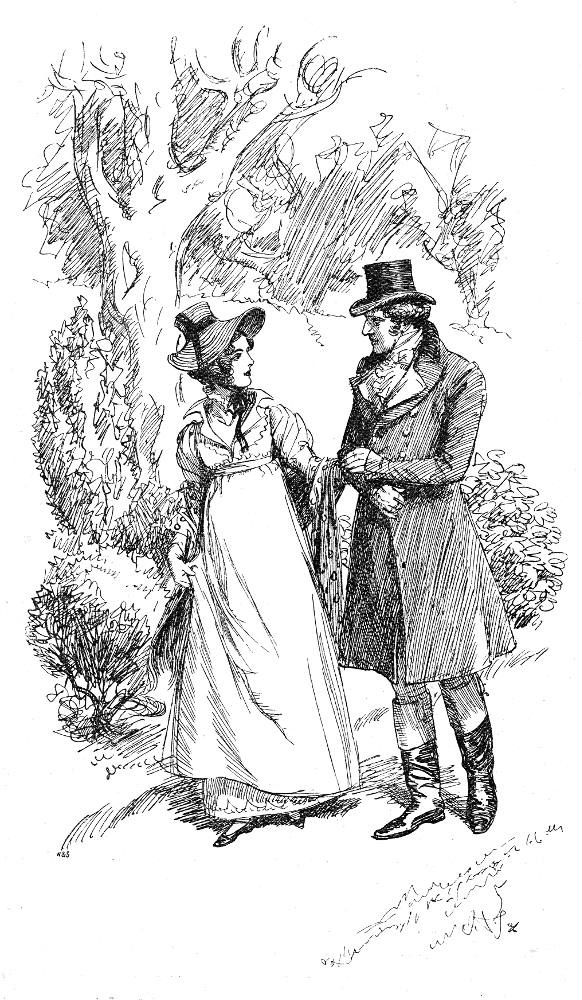
He stopped to look the question.
Hugh Thomson
1905
Photomechanical reproduction of a pen-and-ink drawing
13.7 by 8 cm (5 &frac5; by 3 ¼ inches), vignetted
Jane Austen, Emma, facing page 386.
Scanned image and text by Philip V. Allingham.


[Victorian Web Home —> Jane Austen —> Visual Arts —> Illustration —> Hugh Thomson —> Next]
He stopped to look the question.
Hugh Thomson
1905
Photomechanical reproduction of a pen-and-ink drawing
13.7 by 8 cm (5 &frac5; by 3 ¼ inches), vignetted
Jane Austen, Emma, facing page 386.
Scanned image and text by Philip V. Allingham.
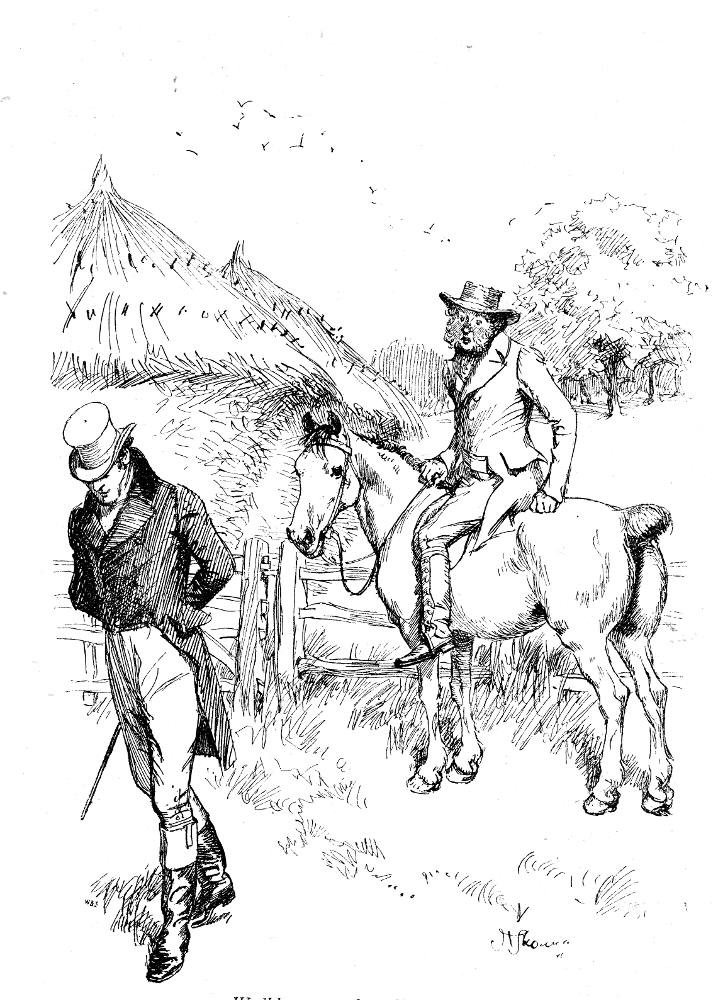

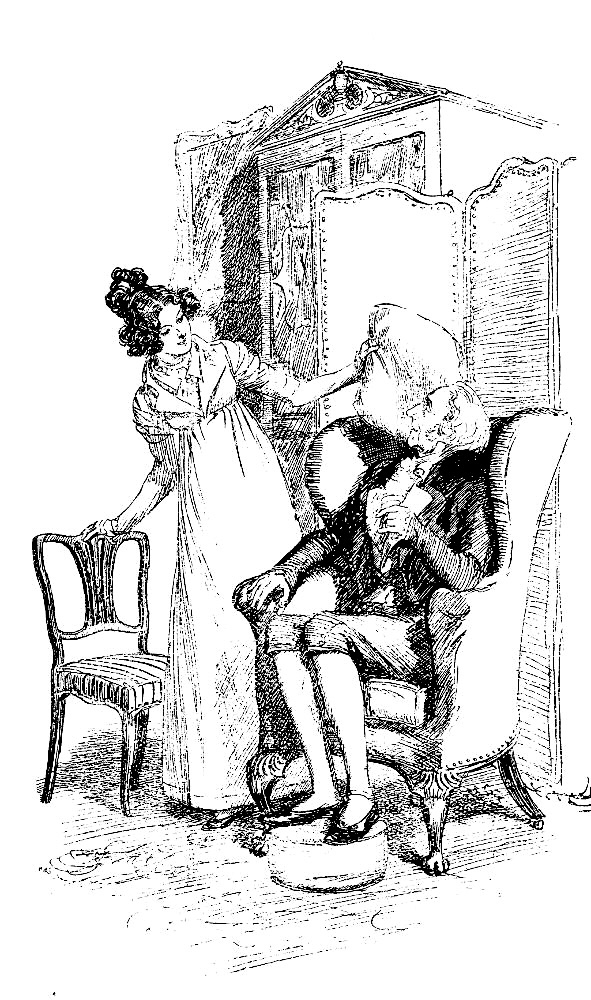

Above: The remaining four plates provide either humourous or sentimental scenes for the dénouement: Walking away from William Lawkins; ‘Such a dreadful broiling morning’, Emma hung about him affectionately, and It passed to Mrs. Cole, Mrs. Perry, and Mrs. Elton..
Tell me, then, have I no chance of ever succeeding?'
He stopped in his earnestness to look the question, and the expression of his eyes overpowered her.
'My dearest Emma,' said he, 'for dearest you will always best, whatever the events of this hour's conversation, my dearest, most beloved Emma — tell me at once. Say "No" it is not to be said.' She could really say nothing. [Chapter XLIX, 386]
The final sequence of Thomson illustrations realises the impending marriage proposal by Mr. George Knightley and its consequences — as Mr. Woodhouse is originally much opposed to the marriage, believing that it will entail Emma’s leaving him to live with Knightley on the Donwell Abbey estate. This is on the other side of the village of Highbury in Surrey, two miles away from the village of Hartfield. The union of Emma Woodhouse and George Knightley effectively means the unification of the smaller and larger estates. The solution to Mr. Woodhouse’s objections is that Knightley will move to Hartfield rather than Emma to Donwell Abbey. The first scene in this sequence, He stopped to look the question in Chapter XLIX shows Knightley, seventeen years older than his companion, in the garden of Hartfield, sounding out Emma on the notion of their marrying. He has paid this rushed call, catching Emma getting some air after a day’s rain, because he fears losing her to the dashing, younger Frank Churchill. We may justly regard the scene and its illustration as the novel’s climax. Ironically, when he encounters Emma in the garden shrubbery, she mistakenly believes that he is about to declare his intention to marry her young friend Harriet. He in fact announces that Harriet has accepted the marriage proposal of Mr. Martin, a twenty-four-year-old tenant-farmer at Abbey-Hill Farm on the Donwell estate, a socially more appropriate marriage for a girl of modest means and social connections such as Harriet.
The garden setting in Thomson’s realisation of the half-hour conversation seems wholly appropriate to the Age of Sentiment, and emphasizes their isolation: no maid or other visitor is likely to overhear or interrupt the proposal. The couple are in almost archaeologically correct Regency walking attire (her hat and shawl his topcoat, boots, and hat), and the couple’s facial expressions are rapt as well as charmed. The pen-and-ink drawing shows Emma caught in the action of suddenly turning her head as if to study Knightley’s face. Their holding hands suggests an intimacy that has revealed itself over the course of their walk. What she sees in his expression confirms the earnestness of his proposal. Suddenly their misunderstandings have vanished as his visit to Hartfield has accomplished much more than the announcement of the impending marriage of Jane Fairfax and Frank Churchill. She is no longer content merely to be George Knightley’s friend and sister-in-law. But now they must somehow find a way to reconcile Mr. Woodhouse to the notion of Emma becoming “Mrs. George Knightley.” “She was now his own Emma, by hand and word, when they returned into the house” (390). Asten leaves her broaching Knightley’s proposal to her father until Chapter LIII, with an illustration intervening in the Macmillan edition. The reader is left pondering the implicit question, "However will they reconcile Mr. Woodhouse to Emma's moving to Donwell Abbey?"
C. E. Brock offered a more sentimental rendering of this proposal scene in his full-page colour plate "Most beloved Emma — tell me at once, say, 'No' if it is to be said." (Vol. 2, 1898).
Austen, Jane. Emma. Ed. Austin Dobson. With forty pen-and-ink illustrations by Hugh Thomson. The Novels of Jane Austen. London: Macmillan, 1896, rpt. 1905.
Austen, Jane. Emma. Ed. R. Brimley Johnson. With coloured illustrations by C. E. Brock. The Novels and Letters of Jane Austen. 2 vols. New York & Philadelphia: Frank S. Holby, 1906.
Austen, Jane. Emma. Ed. George Justice. 4th edition. New York: W. W. Norton, 2011.
Austen, Jane. Emma: An Annotated Edition. Ed. Bharat Tandon. Cambridge, Mass., and London: Belknap Press of Harvard U. P., 2012.
Last modified 8 June 2026