
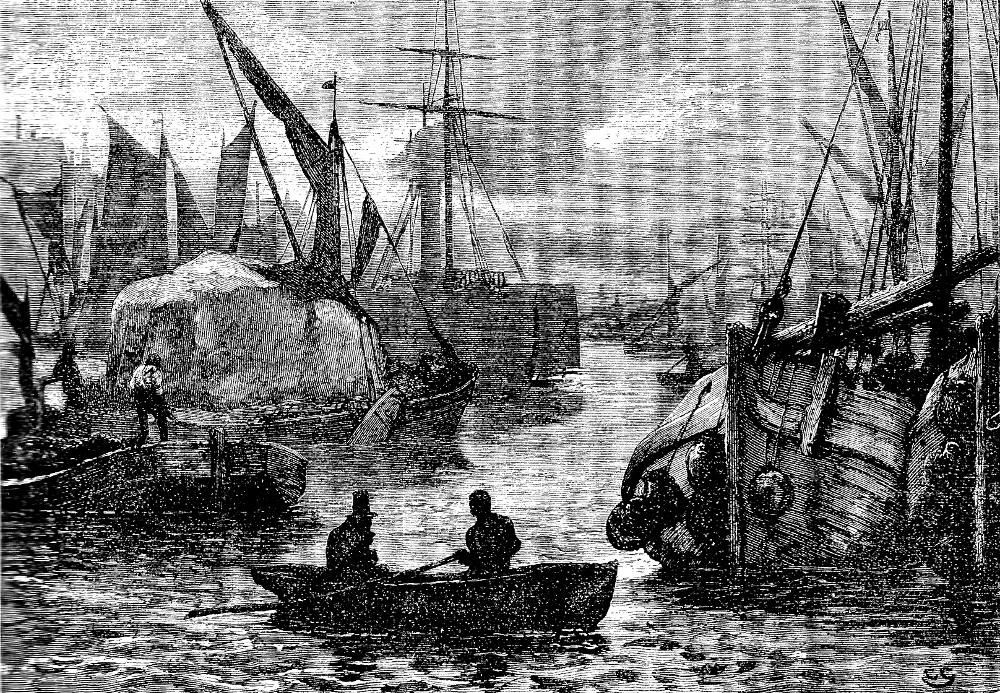
Daniel Quilp sat himself down in the wherry to cross to the opposite shore — Chap. V by Charles Green. 1876. 9.5 cm high by 13.7 cm wide (3 ⅝ by 4 ⅞ inches). Dickens's The Old Curiosity Shop, in the 1876 British Household Edition, Chapter IV: 21. [Click on the image to enlarge it.]
Passage Recalled: "Quilp is a devil for the industrial age" (Conrad, 108)
It was flood tide when Daniel Quilp sat himself down in the ferry to cross to the opposite shore. A fleet of barges were coming lazily on, some sideways, some head first, some stern first; all in a wrong-headed, dogged, obstinate way, bumping up against the larger craft, running under the bows of steamboats, getting into every kind of nook and corner where they had no business, and being crunched on all sides like so many walnut-shells; while each with its pair of long sweeps struggling and splashing in the water looked like some lumbering fish in pain. In some of the vessels at anchor all hands were busily engaged in coiling ropes, spreading out sails to dry, taking in or discharging their cargoes; in others no life was visible but two or three tarry boys, and perhaps a barking dog running to and fro upon the deck or scrambling up to look over the side and bark the louder for the view. Coming slowly on through the forests of masts was a great steamship, beating the water in short impatient strokes with her heavy paddles as though she wanted room to breathe, and advancing in her huge bulk like a sea monster among the minnows of the Thames. On either hand were long black tiers of colliers; between them vessels slowly working out of harbour with sails glistening in the sun, and creaking noise on board, re-echoed from a hundred quarters. The water and all upon it was in active motion, dancing and buoyant and bubbling up; while the old grey Tower and piles of building on the shore, with many a church-spire shooting up between, looked coldly on, and seemed to disdain their chafing, restless neighbour. [Chapter IV, 20: emphasis added to show the original caption]
Commentary: The Devilish Quilp as a Species of Household Hobgoblin

Left: Green's closeup of the dwarf's sadism: "I'll beat you to a pulp, you dogs" (1876).
[Sir Walter] Scott also notes [in Letters on Demonology and Witchcraft in 1830] that kobolds or hobgoblins have a habit of "carrying off children, and breeding them as beings of their race," and this, although Dickens never says so, might be Quilp's creepy motive for stalking Nell. Alberich, the malignant demon king in Wagner's tetralogy, begets a son with a human bride; Nell's demise saves her. Other scattered elements in Scott's Letters on Demonology and Witchcraft add up into a preliminary sketch of Quilp. His yelping and screeching ape the "tricks and fits of mimicry" and "contortions. strange sounds and other extravagances" which Scott records as symptoms as symptoms of demonic possession. At home Quilp reigns as "the small lord of creation"; Scott says that in folktales the Foul Fiend insists on being addressed as Lord, requires "ceremonious attention from his votaries" and — anticipating what Nicholas calls the "dastardly cruelties" of Squeers at Dotheboys Hall — behaves like a schoolmaster who enjoys beating his pupils. [Conrad 109]
We cannot be certain that Dickens actually read Scott's Letters on Demonology and Witchcraft (1830) — and he certainly would not have been aware of the first sequence in Wagner's operatic epic Der Ring des Nibelungen (1869, 1876), and therefore of the dwarf Mime and the demon King Alberich. However, at least as archtypes Conrad implies a connection between these sinister figures and the devilish and lascivious dwarf of Dickens's Old Curiosity Shop (1841). Quilp is similarly hairy, mischievous, and grotesque.
Related Material
- Dickens's The Old Curiosity Shop — Some Discussions
- George Cattermole (13 plates selected)
- Hablot Knight Browne (61 wood-engravings)
- Felix O. C. Darley (4 photogravure plates)
- Sol Eytinge, Jr. (12 wood engravings)
- Thomas Worth (54 wood engravings)
- W. H. C. Groome (8 lithographs plus engraved title)
- J. Clayton Clarke ("Kyd") (13 lithographs from watercolours)
- Harry Furniss (31 lithographs plus engraved title)
- Harold Copping (2 chromolithographs selected)
Scanned images and text by Philip V. Allingham. [You may use the images without prior permission for any scholarly or educational purpose as long as you (1) credit the person who scanned them and (2) link your document to this URL in a web document or cite the Victorian Web in a print one. The top image is reproduced courtesy of The Charles Dickens Museum, 48 Doughty Street, London WC1N 2LF.]
Bibliography
Conrad, Peter. "Devilkins." Dickens The Enchanter: Inside the Explosive Imagination of the Great Storyteller. London and Oxford: Bloomsbury Continuum Press, 2025. 101-118.

Dickens, Charles. The Old Curiosity Shop in Master Humphrey's Clock. Illustrated by Phiz, George Cattermole, Samuel Williams, and Daniel Maclise. 3 vols. London: Chapman and Hall, 1841; rpt., Bradbury and Evans, 1849.
Dickens, Charles. The Old Curiosity Shop. Illustrated by Charles Green. The Household Edition. XII. 22 vols. London: Chapman and Hall, 1876.
Dickens, Charles. The Old Curiosity Shop. Illustrated by Harry Furniss. The Charles Dickens Library Edition. V. 18 vols. London: Educational Book, 1910.
Created 1 May 2019
Last modified 14 April 2026