

“To the guillotine, all aristocrats!”
Arthur A. Dixon
1905
Watercolour as lithograph
11.9 cm high by 8 cm wide (4 ⅝ inches by 3 ⅛ inches), framed
Twelfth illustration for Collins Illustrated Pocket Edition, facing p. 448.
Book III, "The Track of a Storm," Ch. 15, "The Footsteps Die Out For Ever," Penguin edition p. 401. Oxford World's Classics edition p. 461. Carton and the little seamstress rumble off to their deaths in a tumbrel escorted by Jacobins.
Scanned image and text by Philip V. Allingham.

Passage Realised: No Nemesis here as Carton and the Seamstress face execution.
On the steps of a church, awaiting the coming-up of the tumbrils, stands the Spy and prison-sheep. He looks into the first of them: not there. He looks into the second: not there. He already asks himself, “Has he sacrificed me?” when his face clears, as he looks into the third.
“Which is Evrémonde?” says a man behind him.
“That. At the back there.”
“With his hand in the girl’s?”
“Yes.”
The man cries, “Down, Evrémonde! To the Guillotine all aristocrats! Down, Evrémonde!”
“Hush, hush!” the Spy entreats him, timidly. [Book III, "The Track of a Storm," Chapter 15, "The Footsteps Die out For Ever," p. 451]
Commentary: The Ironic Caption Underscores the Historical Injustice
Innocent and guilty alike are caught up in the infernal machinery of French Justice, which in this case is hardly “Poetic.” The reader must consider the situational irony of attorney Carton and the little seamstress being executed as if they were members of the privileged class responsible for the age-old sufferings of the people: “Down, Evrémonde! To the Guillotine all aristocrats! Down, Evrémonde!” again underscores the uncanny facial resemblance of Carton for Darnay which again rescues Darnay from an unjust sentence.
Like Fred Barnard (1874), Arthur Dixon for Book the Third, “The Track of a Storm,” Chapter XV, “The Footsteps Die out Forever,” shows Carton, disguised as the last representative of the infamous Evrémondes, calmly, tenderly taking the hand of the little seamstress whom he met in Chapter XIII. His gesture is intended to give her courage, even as the blood-thirsty mob of "patriots" surrounding the cart vilifies them. The guillotine looms above them, upper left. However, as is the case in most of Dixon's illustrations, the emphasis is on the two (oddly matched) central characters, innocent victims of the new regime here brought together by the rising tide of the Revolution.
Relevant Illustrations from Other Illustrated Editions: 1859, 1867, 1874, and 1910
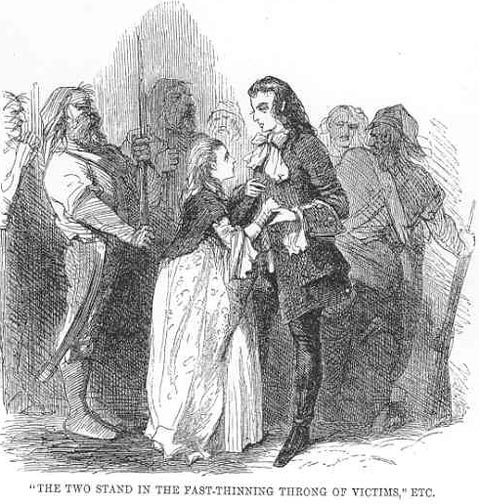

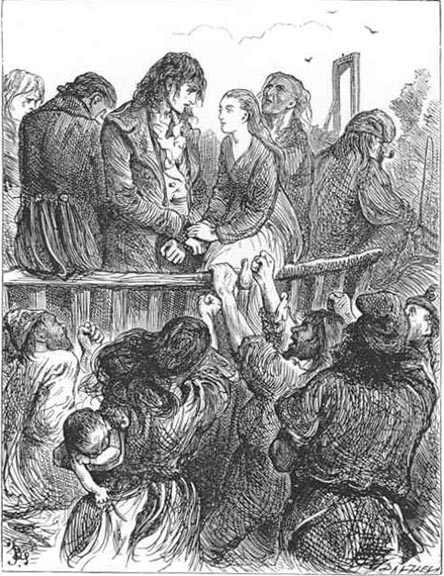
Left: McLenan's 3 December 1859 depiction of Carton's comforting the little seamstress on the scaffold, The two stand in the fast-thinning throng of victims. Centre: A slightly later American interpretation of the intimarte scene on the scaffold, Sol Eytinge, Junior's sentimental dual portrait which serves as the frontispiece for the Diamond Edition, Sydney Carton and the Seamstress (Vol. XIII, 1867). Right: Fred Barnard's version of the tumbrel scene in the Household Edition: The Third Tumbrel (1874).

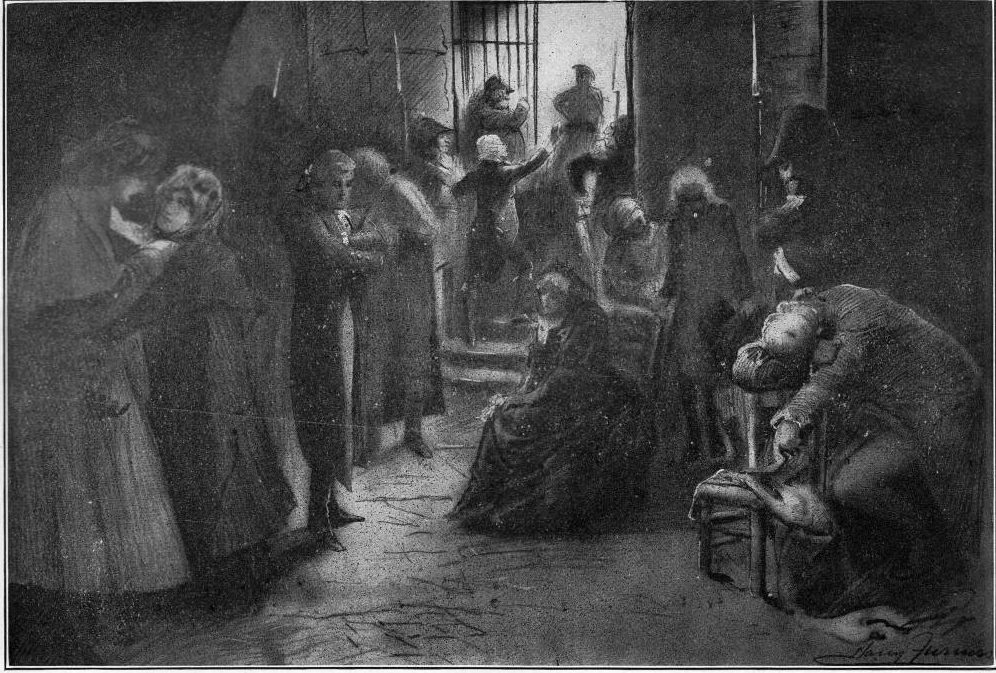
Right: John McLenan's headnote vignette from Harper's Weekly for 3 December 1859 depicting the harpy-like knitters at the foot of St. Guillotine (Bok III, "The Track of the Storm," Chapter 15, "The Footsteps Die out Forever."). Left: Harry Furniss's atmospheric dark plate of the scene inside the prison in the Charles Dickens Library Edition, Book Three, Chapter Thirteen, Sydney Carton and the Little Seamstress (1910).
Related Materials
- A Tale of Two Cities 1859 — the last Dickens's novel "Phiz" Illustrated
- How did Victorian critics define the historical novel?
- Images of the French Revolution
- A Tale of Two Cities (1859): A Model of the Integration of History and Literature
- Costume Notes on A Tale of Two Cities
Bibliography
Allingham, Philip V. "Charles Dickens's A Tale of Two Cities (1859) Illustrated: A Critical Reassessment of Hablot Knight Browne's Accompanying Plates." Dickens Studies. 33 (2003): 109-158.
Dickens, Charles. A Tale of Two Cities. Illustrated by John McLenan. Harper's Weekly: A Journal of Civilization, 7 May through 3 December 1859.
Dickens, Charles. A Tale of Two Cities. Ilustrated by Hablot Knight Browne. London: Chapman and Hall, 1859.
Dickens, Charles. A Tale of Two Cities and Great Expectations. Diamond Edition. Illustrated by Sol Eytinge, Junior. Boston: Ticknor and Fields, 1867.
Dickens, Charles. A Tale of Two Cities. Illustrated by Fred Barnard. The Household Edition, 22 vols. London: Chapman and Hall, 1874. Vol. VIII.
Dickens, Charles. A Tale of Two Cities. Illustrated by A. A. Dixon with an engraved title by Harry Furniss. London: Collins, 1905. (From the personal collection of George Gorniak, Editor of The Dickens Magazine.)
Dickens, Charles. A Tale of Two Cities, American Notes, and Pictures from Italy. Illustrated by Harry Furniss. Charles Dickens Library Edition. 18 vols. London: Educational Book Company, 1910. Vol. XIII.
Created 2 November 2013
Last updated 31 August 2026