
Edward Dalziel (1817–1905) established the family engraving firm in partnership with his brother George in 1839 and played an active part in the cutting of blocks and in the management of the company’s team of ‘woodpeckers.’ He was also one of the Dalziel artists, the others being his brothers Thomas and George and his son, Edward Gurden. All four exhibited paintings at the London exhibitions (Graves 71), and each produced a significant number of engravings in books published by the company.
Edward was less prolific than either his brother Thomas or his son, but still contributed to a number of gift books of the 60s and 70s, including William Cullen Bryant’s Poems, Dalziels’ Arabian Nights, Picture Posies, and others. In each case, he provides a visual response that is at least an efficient visualization of his subject; though not an outstanding artist, his work is far from anonymous and embodies a number of key interests.
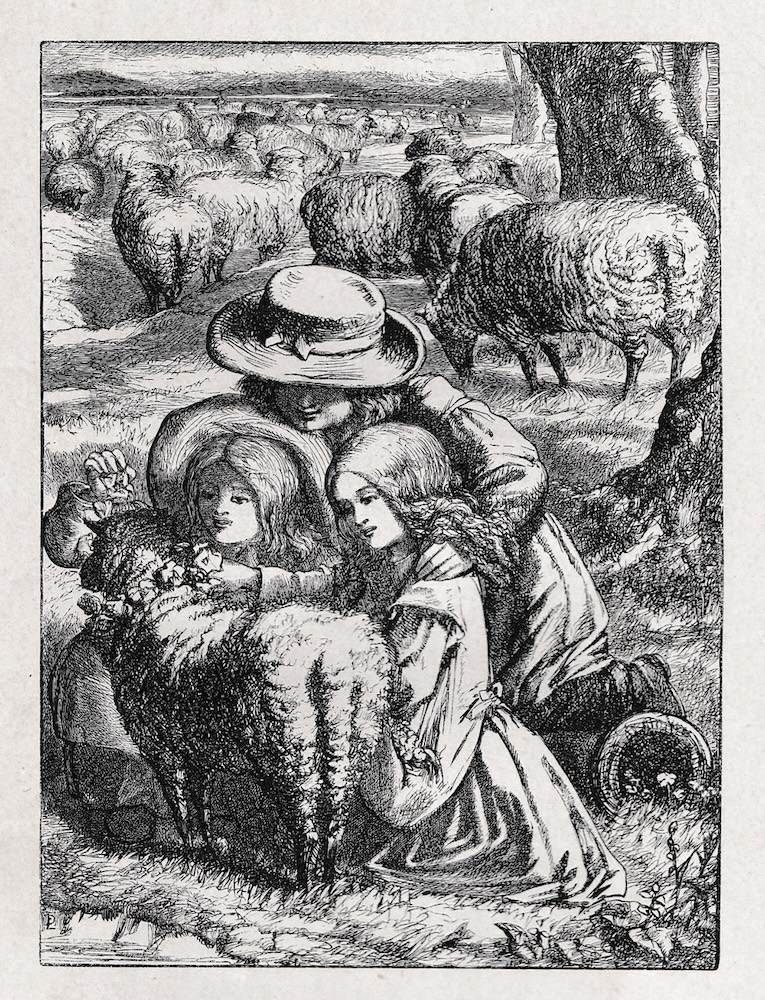
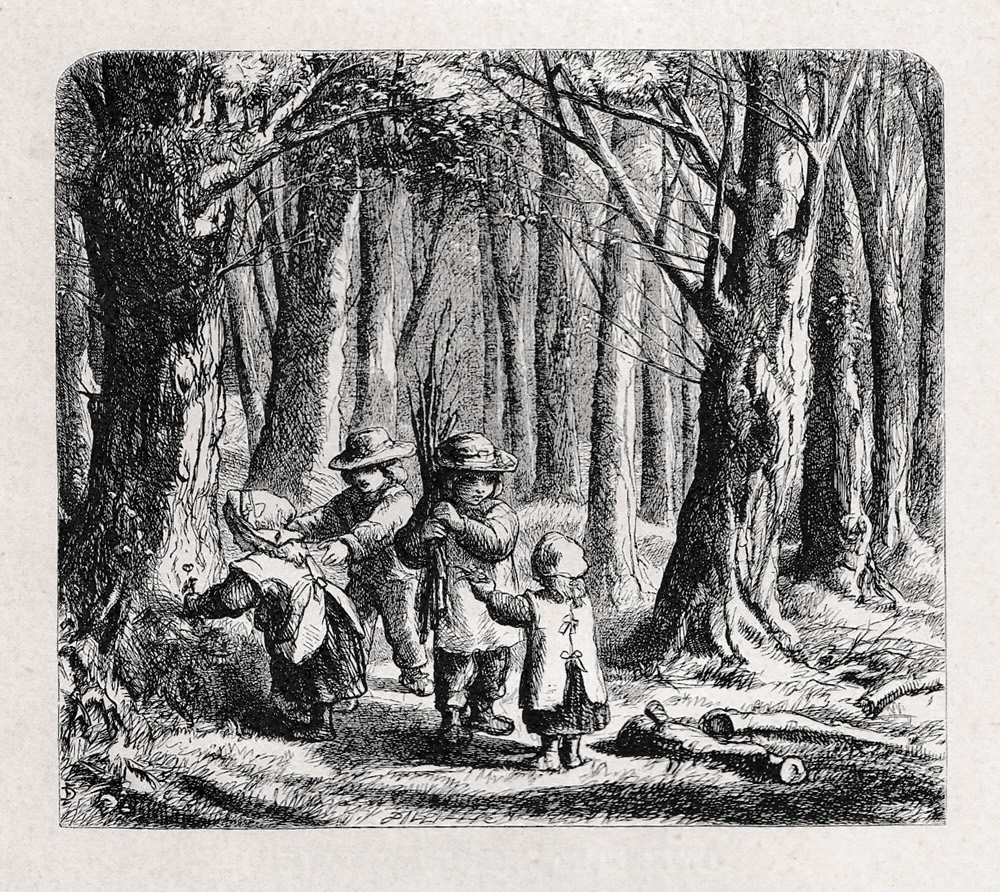
Dalziel’s conception of English rural life to match equally sentimental poems. Left: The Battlefield; Right: The Voice of Autumn.
Dalziel excels, Forrest Reid observes, in the representation of children, whom he visualized in idealized pastorals. In The Battlefield in Bryant’s Poems (1860) he presents an image of ‘Wordsworthian naturalism,’ showing two girls and a shepherd boy ‘decking a sturdy young lamb with a necklace of cowslips’ (252). Reid considers this design to be ‘free from mawkishness’ (252) though modern viewers would surely regard it as sentimental; and the same judgment can be applied to another illustration for Bryant, The Voice of Autumn. Such idealism is primarily generated by Dalziel’s insistence on the robustness of the figures and the prettiness of their pastoral costumes, projecting a notion of the rural idyll in which shepherding and gathering wood are Romantic (and romanticised) activities. Dalziel’s perspective is this sense very much the view of a middle-class metropolitan, of English country life as somehow innocent. Reid compares his work to that the rural pictures of William Mulready (252) and another link might be made with the paintings of William Collins.
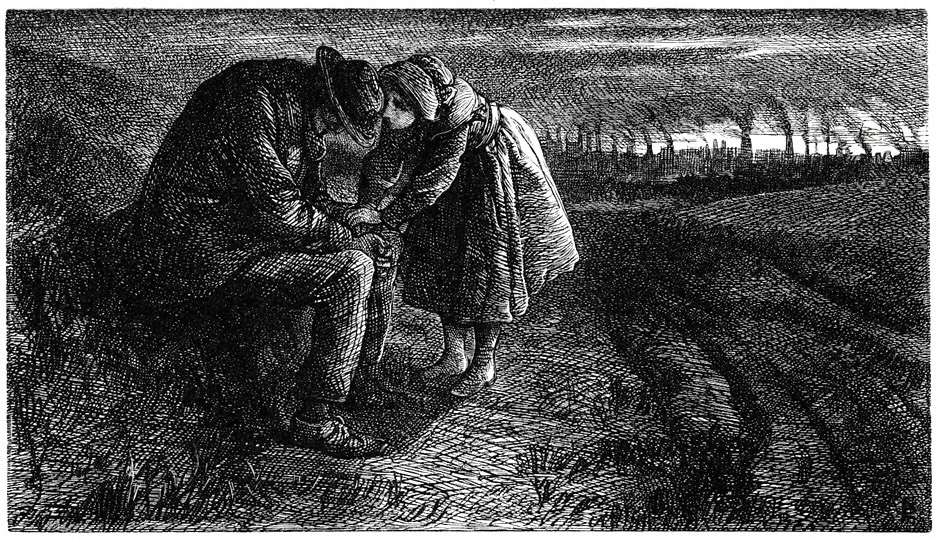
Dalziel’s illustration of rural poverty and despair in Beaten.
Nevertheless, Dalziel was capable of a genuine depth of feeling, and sometimes displays a greater social awareness. In Beaten in Picture Posies (1874), he depicts a child reassuring her exhausted and despairing father, who is ‘overweighted’ with ‘ceaseless toil and strife’ (20). The illustration was produced for another text, but Dalziel’s image perfectly matches the lines’ melancholy, focusing on the bent figure of the parent and the daughter’s holding of his hands. In contrast to most of the artist’s depictions of rural life, this image resonates with an awareness of poverty and its psychological implications. He intensifies the emotional effect by enveloping the scene in a crepuscular light which signifies literally, and as a metaphor for the man’s despair.
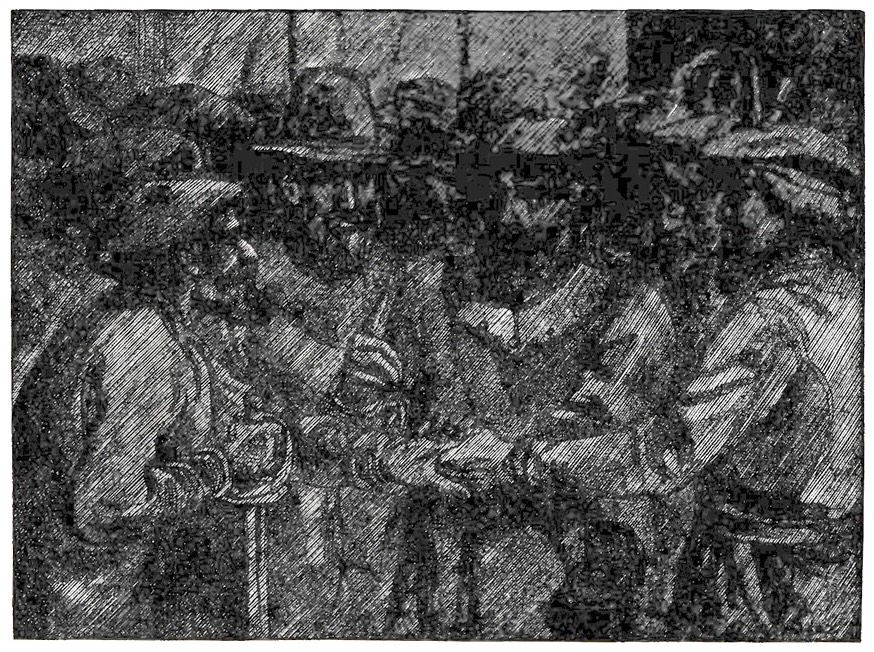
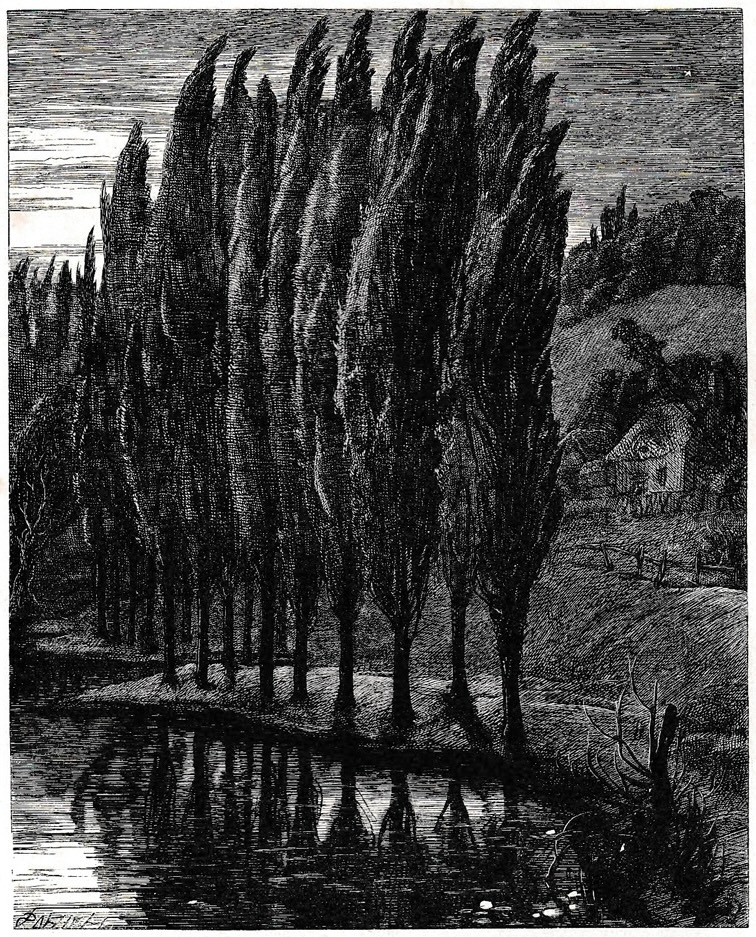
Left: Dalziel’s treatment of Buchanan’s battle, The Battle of Drumliemoor; Right: his poetic treatment of poplars for Ingelow’s ‘Supper at the Mill.’
He uses the same sort of double signification in several of his other designs, notably in his illustration for Robert Buchanan’s ‘The Battle of Drumliemoor’ (North Coast, 1868). Dalziel represents the grim winter’s day but at the same time uses the light to suggest the combatants’ anguish by immersing them in a heavy darkness, the visual showing of ‘the eyeless gloom of Hell’ (78). The psychological effects of chiaroscuro are given another dimension in the image of ‘the poplars high’ in Ingelow’s ‘Supper at the Mill’ Poems, 1867, 56). In this design Dalziel renders the trees in dark tones, but he also manipulates the light of the sky to suggest a sort of gentle sadness.
Edward Dalziel might thus be seen as more than a simple journeyman. His best work embodies a sentimental ruralism, and occasionally strikes a deeper, more resonant note. Some of his drawing is of variable quality, but his illustrations are often evocative and are invariably poetic in tone.
Bibliography
Primary
Bryant, William Cullen.Poems. London: Richard Griffin, 1860.
Buchanan, Robert.North Coast and Other Poems. London: Routledge, 1868.
Dalziels’ Illustrated Arabian Nights. London: Ward & Lock [1865, 2 vols. rpt. In 1 vol, 1870].
Ingelow, Jean. Poems. London: Longmans, Green, Reader & Dyer, 1867.
Picture Posies. London: George Routledge, 1874.
Secondary
Graves, Algernon. A Dictionary of Artists Who Have Exhibited Works in the Principal London Exhibitions from 1760 to 1893. London: Henry Graves, 1895; Rpt. Bath: Kingsmead, 1970.
Reid, Forrest. Illustrators of the Eighteen Sixties. 1928; reprint, New York: Dover, 1975.
Created 24 August 2026