
He had been Tim's blood horse all the way from church
Charles Edmund Brock
1905
14 x 9.3 cm, vignetted
Dickens's A Christmas Carol, frontispiece.
[Click on the images to enlarge them.]
Scanned image and text by Philip V. Allingham.


[Victorian Web Home —> Visual Arts —> Illustration —> Charles Edmund Brock —> Charles Dickens —> Next]
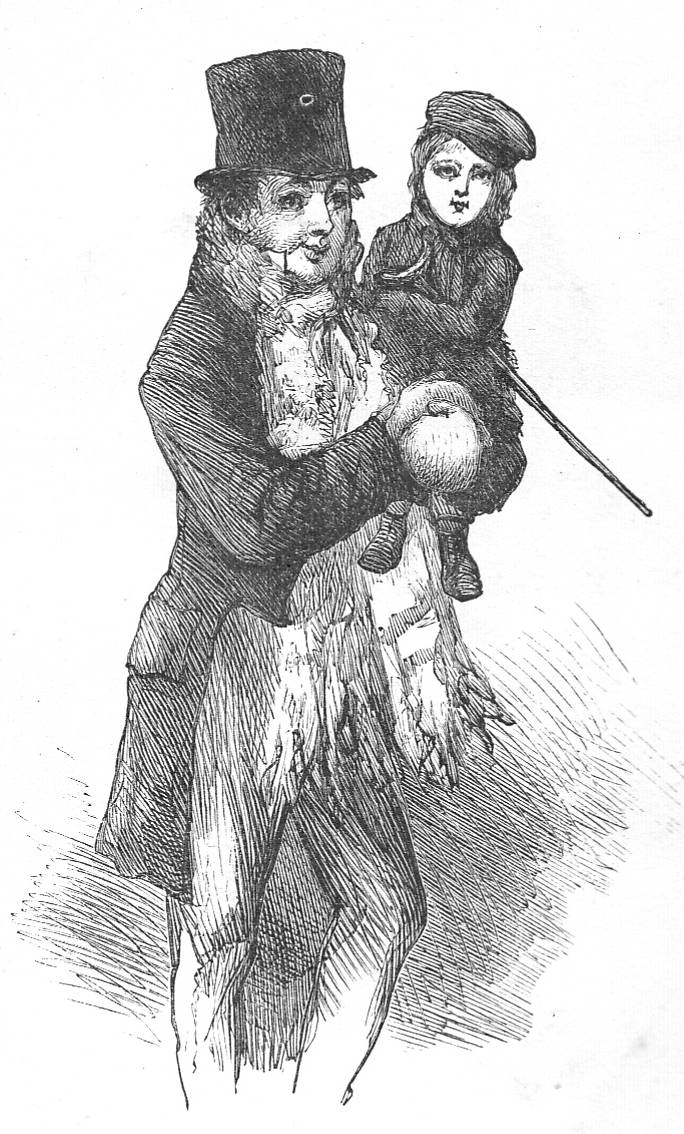
He had been Tim's blood horse all the way from church
Charles Edmund Brock
1905
14 x 9.3 cm, vignetted
Dickens's A Christmas Carol, frontispiece.
[Click on the images to enlarge them.]
Scanned image and text by Philip V. Allingham.
"Why, where's our Martha?" cried Bob Cratchit, looking round.
"Not coming," said Mrs Cratchit.
"Not coming!" said Bob, with a sudden declension in his high spirits; for he had been Tim's blood horse all the way from church, and had come home rampant. "Not coming upon Christmas Day!"
Martha didn't like to see him disappointed, if it were only in joke; so she came out prematurely from behind the closet door, and ran into his arms, while the two young Cratchits hustled Tiny Tim, and bore him off into the wash-house, that he might hear the pudding singing in the copper.
"And how did little Tim behave?" asked Mrs Cratchit, when she had rallied Bob on his credulity, and Bob had hugged his daughter to his heart's content.
"As good as gold," said Bob, "and better. Somehow he gets thoughtful sitting by himself so much, and thinks the strangest things you ever heard. He told me, coming home, that he hoped the people saw him in the church, because he was a cripple, and it might be pleasant to them to remember upon Christmas Day, who made lame beggars walk, and blind men see." [Stave Three, "The Second of the Three Spirits," 56-57]
The novella's original illustrator, John Leech, describes only Bob among the extended Cratchit clan (and does so, moreover, in a mere thumbnail at the conclusion of the story). Subsequent illustrators, however, beginning with the Ticknor-Fields house artist Sol Eytinge, Junior, have realised how important to the story at so many levels are Bob Cratchit as Scrooge's foil (a devoted father and supportive husband) and the crippled Tiny Tim as a member of that "Surplus Population" to which Ebenezer Scrooge callously alludes to in the opening scene. Although E. C. Brock probably had the opportunity to study neither the Ticknor-Fields Diamond Edition volume of The Christmas Books (1867) nor that same publisher's amply illustrated single-volume version of A Christmas Carol (1868), both of which feature realisations of Bob carrying his son home from church on Christmas Day, Brock would certainly have seen the 1878 Household Edition's frontispiece by Fred Barnard, He had been Tim's blood-horse all the way from church, and had come home rampant (see below).
Bob Cratchit in the Brock colour lithograph is not the young, handsome father of Fred Barnard's illustration; Brock's Bob Cratchit is clearly past forty years of age, but is still vigorously making his way through the busy streets of Camden Town on Christmas Day. Affluent passersby regard the father and son with pleasant expressions, but the overall effect of the composition is more muted and less upbeat than Barnard's, to which Brock is likely responding. As opposed to the large, public buildings and open space that forms the backdrop of the Barnard illustration, Brock has more realistically chosen the close streets of the district which was then a mixture of commercial buildings (as suggested by the green shutters on Jones's business, probably a grocer's, in the background) and urban housing, as suggested by the elegant late-eighteenth-century doorway. Dressed in their Sunday best as they, too, return from church, the middle-class walkers in their pace and clothing appropriate to the cold weather, contrast with Bob, whose short trousers suggest that the cuffs have been turned several times to keep the garment viable. At the apex of the composition is the small, warmly dressed Tiny Tim, his little crutch tucked under his arm. The watercolour is less energetic and less sharp than Fred Barnard's frontispiece for The Christmas Books (1878) in the Household Edition, but nevertheless depicts Bob's active parenting in a social context, unlike the initial examination of this moment, Sol Eytinge, Jr.'s Tiny Tim's Ride, vignette for Stave 3 (see below). Although the Brock illustration tells readers something about the area in which the Cratchits live, it lacks the embedded visual commentary of the area railing in the Eytinge illustration which separates the living on the street and sidewalk from the dead in the cemetery — whom the sickly child (implies the illustrator) will shortly join unless Scrooge intervenes on the child's behalf to get him medical treatment. Brock's Tiny Tim may be small, but his faces lacks the deathly pallor of Eytinge's or the fragility of Barnard's boy. Finally, and perhaps most significantly, Brock's Bob does not pause in his haste to regard his son affectionately, as Barnard's young father does.

Left: Eytinge's first scene of Bob carrying Tiny Tim, Bob Cratchit and Tiny Tim, frontispiece to the 1867 anthology. Right: Leech's interpretation of the employer entertaining his employee, Scrooge and Bob Cratchit, or The Christmas Bowl (1843).


Left: Barnard's heart-warming realisation of a scene not actually in the novel, He had been Tim's blood-horse all the way from church, and had come home rampant (1878). Right: Barnard reworked this same scene for his 1885 photogravure plate Bob Cratchit and Tiny Tim for his compilation of character studies from Dickens.
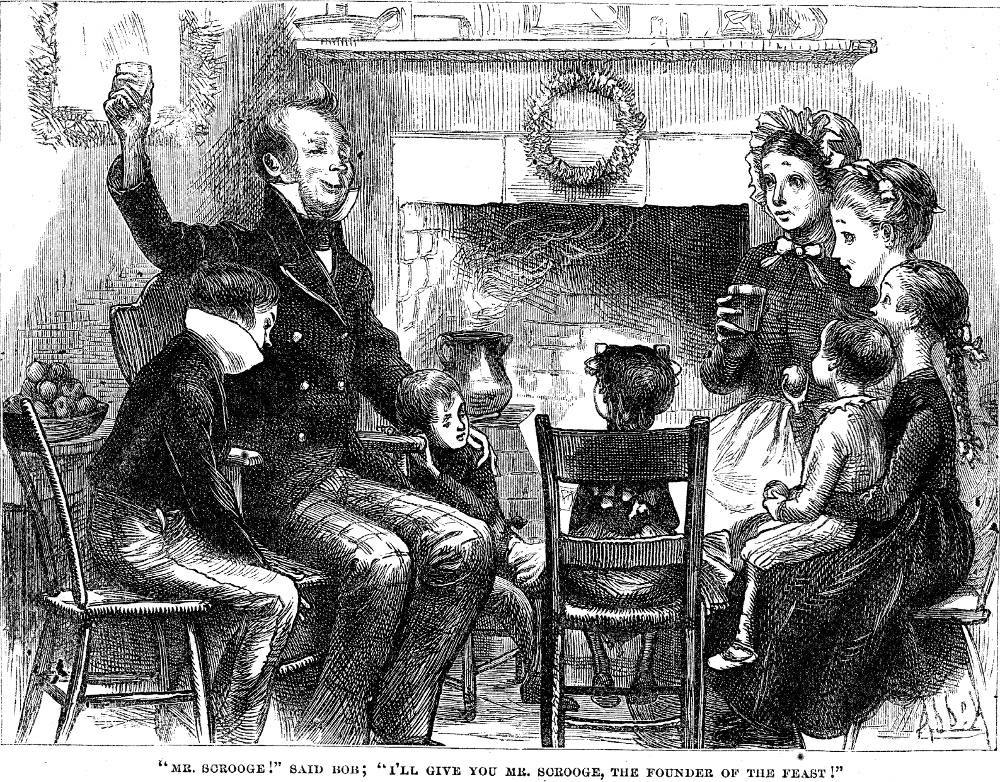
Above: Abbey's scene of the thankful family ironically toasting Bob's parsimonious employer as "the founder of the feast," "Mr. Scrooge!" said Bob; "I'll give you Mr. Scrooge, the Founder of the feast!" (1876).
Barnard, Fred (illustrator). Bob Cratchit and Tiny Tim. Character Sketches from Dickens. London and New York: Cassell, 1885.
Dickens, Charles. Christmas Books. Illustrated by Sol Eytinge, Jr. The Diamond Edition. Boston: Ticknor and Fields, 1867.
_____. Christmas Books. Illustrated by Fred Barnard. Household Edition. London: Chapman and Hall, 1878.
_____. Christmas Books. Illustrated by A. A. Dixon. London & Glasgow: Collins' Clear-Type Press, 1906.
_____. Christmas Books. Illustrated by Harry Furniss. The Charles Dickens Library Edition. London: Educational Book, 1910.
_____. A Christmas Carol in Prose, Being a Ghost Story of Christmas. Illustrated by John Leech. London: Chapman and Hall, 1843.
_____. A Christmas Carol in Prose: Being a Ghost Story of Christmas. Illustrated by Sol Eytinge, Jr. Boston: Ticknor & Fields, 1868.
_____. A Christmas Carol and The Cricket on the Hearth. Illustrated by C. E. [Charles Edmund] Brock. London: J. M. Dent, 1905; New York: Dutton, rpt., 1963.
_____. A Christmas Carol. Illustrated by Charles Green, R. I. London: A. & F. Pears, 1912.
_____. A Christmas Carol. Illustrated by Arthur Rackham. London: William Heinemann, 1915.
_____. A Christmas Carol in Prose, Being A Ghost Story of Christmas. Illustrated by John Leech. (1843). Rpt. in Charles Dickens's Christmas Books, ed. Michael Slater. Hardmondsworth: Penguin, 1971, rpt. 1978.
_____. Christmas Stories. Illustrated by E. A. Abbey. The Household Edition. New York: Harper and Brothers, 1876.
Guiliano, Edward, and Philip Collins, eds. The Annotated Dickens. New York: Clarkson N. Potter, 1986. Vol. 1.
Hearn, Michael Patrick, ed. The Annotated Christmas Carol. New York: Avenel, 1976.
Created 12 May 2015
Last modified 31 March 2026