
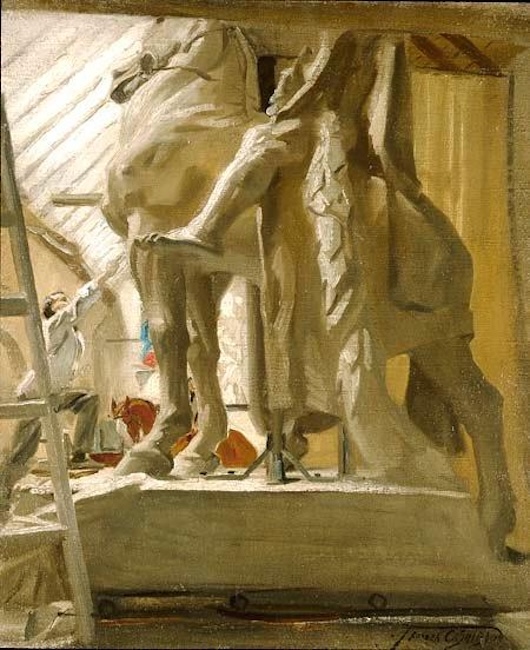
Gilbert Bayes at Work on the Plaster for War 1918 by Frank Owen Salisbury (1874-1962). 1918. Oil on canvas. 61.50 cm x 51.00 cm. Private Collection. By kind permission of Peter Nahum at the Leicester Galleries.
This is a spectacular painting by the well-known portraitist of a fellow-artist at work on an enormous equestrian statue. "When you go into his [i.e. Bayes's] studio you are struck by the variety of materials and the wide range in scale, from the miniature to the colossal," wrote his contemporary Charles Marriott (102). Unfortunately, Marriott also said at that time, "Not more than passing reference can be made to the work of Mr. Bayes on the colossal scale; to his Maharajah of Bickaneer and the equestrian figures of War and Peace for the New South Wales Art Gallery; because reduced illustrations do not really give an opportunity for judging work in which scale is a factor" (112). But Frank Salisbury compensates wonderfully for Marriott's omissions by providing a view of the sculptor, a diminutive figure, stretching up almost balletically to work on this larger-than-life statue for the Sydney gallery.
Nearby in the huge barn of a studio stands the horse, on which, partly, this work must have been modelled — though the main inspiration was acknowledged to be the Elgin Marbles. The difference in size helps to assert the scale of the work being undertaken.
Salisbury was best known as a portraitist, but he did on occasion paint both himself and other people engaged in their creative work, as well as a variety of other subjects. Perhaps he felt what most viewers must feel on encountering such a scene — the peculiar fascination of the onlooker in the presence of the artist, who might sometimes be completely dwarfed by the scale of his production. Other examples of paintings of sculptors are John Ballantyne's Sir Edwin Landseer, in which the well-known animal artist is working on one of the lions for Nelson's Column, and Ralph Hedley's John Graham Lough in his Studio, depicting the sculptor at work on his early Milo of Croton, complete with the hole that was made in the ceiling to accomodate its height. Hedley's painting shows a couple of onlookers, but in Salisbury's painting of Bayes there are none. The result is a gain in focus and immediacy: we are given privileged access to the studio where Bayes is quite alone, totally absorbed in his huge project, and, unusually for an artist, in strenuous action. — Jacqueline Banerjee

Related Material
Peter Nahum Ltd, London has most generously given its permission to use in the Victorian Web information, images, and text from its catalogues, and this generosity has led to the creation of hundreds of the site's most valuable documents on painting, drawing, and sculpture. The copyright on text and images from their catalogues remains, of course, with Peter Nahum Ltd.
Readers should consult the website of Peter Nahum at the Leicester Galleries to obtain information about recent exhibitions and to order their catalogues. [JB]
Bibliography
Gilbert Bayes at Work on the Plaster for War. Peter Nahum at the Leicester Galleries. Web. 9 March 2026. https://www.leicestergalleries.com/browse-artwork-detail/MTcwMjU=
Marriott, Charles."The Recent Work of Gilbert Bayes." The International Studio Vol.63 (1917-1918): 100-112. HathiTrust, from a copy in Harvard Univeristy. Web. 9 March 2026.
Created 10 March 2026