
With thanks to Michael Riley for the two photographs that inspired this introduction.

ornelius Jabez Hughes (1819-1884) and Gustav Mullins (1854-1921) went into partnership in 1883. Hughes was already a very well-established photographer. He had trained as a daguerreotypist under John J.E. Mayall, latterly at his studio in the Strand. The early 1850s found him working as a photographer in Glasgow, but in 1855 he came back to the Strand studio again, before Mayall left to open a new studio in Brighton. Hughes was now fully immersed in his craft, publishing an instruction book, The Principles and Practice of Photography, Familiarly Explained... in 1861. It turned out to be popular. In the preface to the eight (revised) edition of 1868, Hughes wrote, "The progress that has been made by photography is mainly due to the interchange of knowledge among those who practise the art, and, imbued with the same feeling, the larger the circle becomes, the greater will be the security that this fascinating art will arrive at still higher degrees of advancement" (iv).
Either because business was not as good as he had hoped, or because he wanted to branch out beyond London, in 1862 he bought another studio in the Royal Victoria Arcade, off Union Street, Ryde on the Isle of Wight — like Brighton, a popular holiday location. Here, he became a favourite of the royal household at Osborne House. He was now able to have a new studio built at nearby 60 Union Street. Royal patronage continued: the Queen was always keen to record the family and their gatherings, and he also provided photographs for the use of the artist Edwin Landseer in his royal commissions. He moved to the new studio, aptly called Regina House, in 1866, proudly displaying the words "Royal Photographers" over the rather grand entrance. The firm received its official royal warrant in 1885.
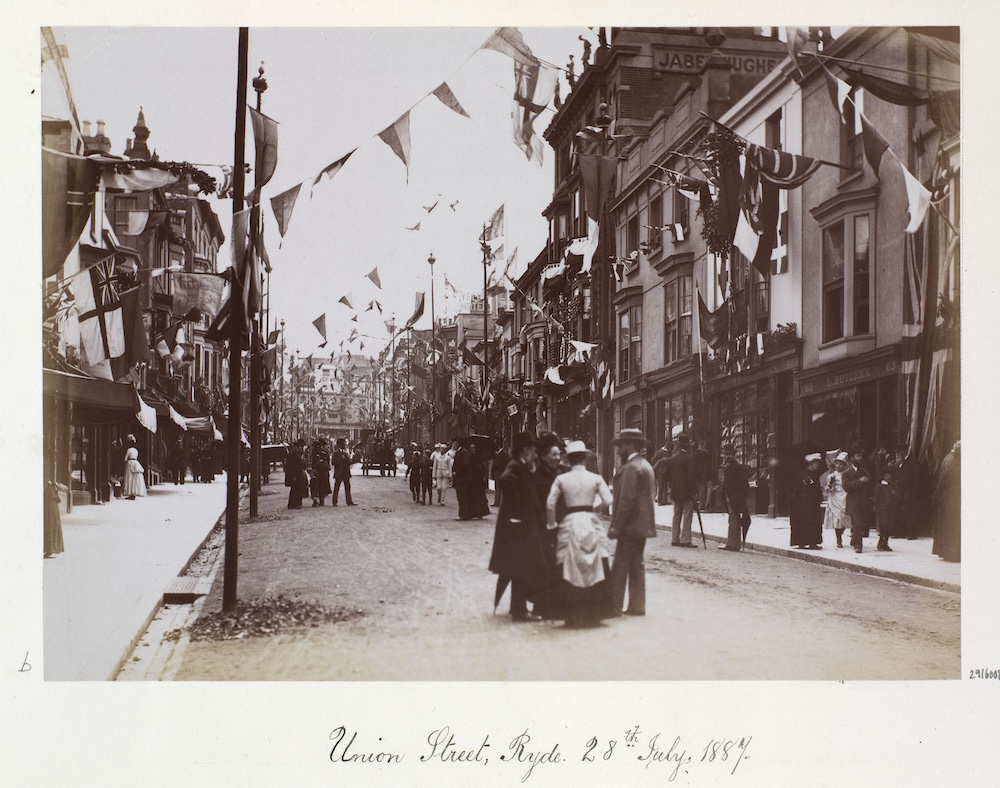
Photograph of Union Street, Ryde, taken by Hughes & Mullins on 28 July 1887, when decorated for Queen Victoria's Golden Jubilee visit. The photographers' studio, Regina House, is the tall building on the right, with statues along the roofline. Albumen print, 15.7 x 22 cm (whole object), RCIN 2916008 © Royal Collection Enterprises Limited 2026 | Royal Collection Trust, by kind permission. [Click on this and the following images for larger pictures and sometimes for more information about them.]
Hughes had a talented apprentice, William Robert Hogg, who was popular at Osborne House, but who eventually gave up the career and became a tobacconist. In 1883, perhaps concerned about the future of the firm after the death of his son in 1878, Hughes took into partnership his assistant, a young local photographer, Mullins. As the son of a photographer in Jersey, in the Channel Islands, Mullins was born into the business: not quite thirty when he became a partner, he too found favour with the Queen. Work credited to the new partnership can be found even before Hughes entered into the formal arrangement.
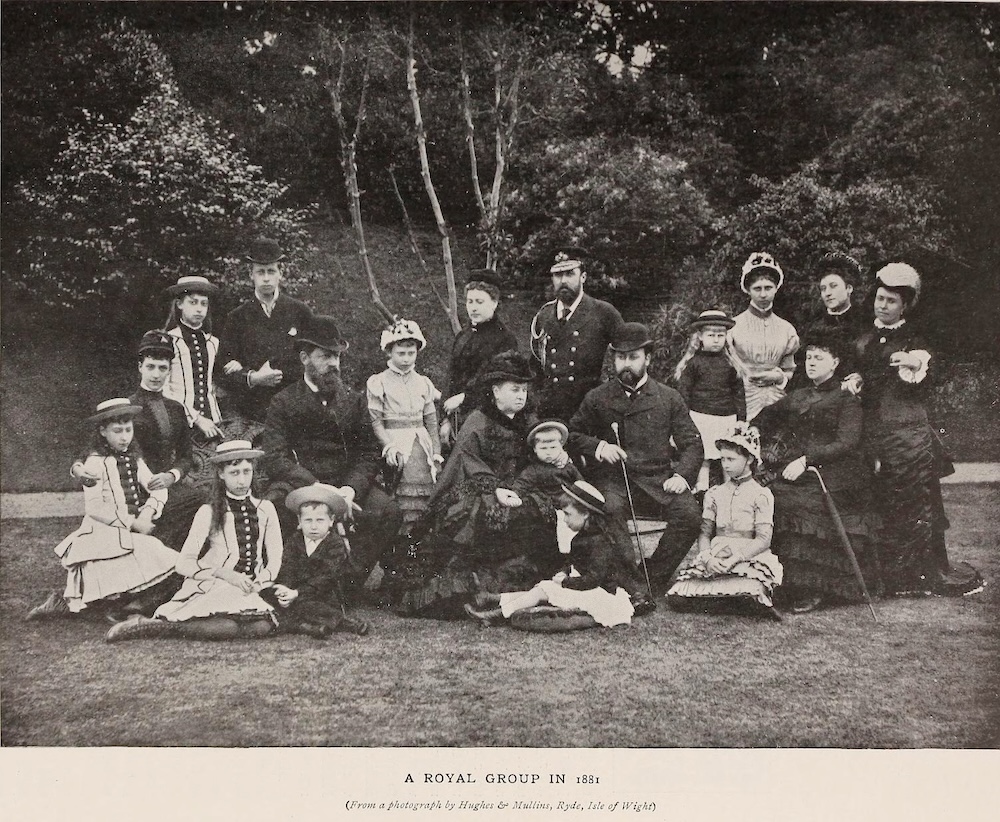
This "royal group" at Osborne in 1881 was first reproduced by J.E. Vincent in his 1902 book about Edward VII, From Cradle to Crown (facing p. 186). On 11 August that year Queen Victoria had noted in her journal, "A fair morning. — Heard from Mr Gladstone. — Had a letter from Philip Coburg [Prince Philip of Saxe-Coburg-Gotha], with the sad details of his dear father's death. — We were all photographed together, in a group, by Hughes, 20, in all, viz: Louise, Beatrice, & I, Bertie, Alix ,& their girls, who had come over on purpose, Fritz, Vicky, Henry & the 3 girls, Affie, Marie, & their children. I held the dear little baby, & Ducky sat at my feet." Vincent's book proved popular, and was reprinted with some additional text after Edward's death, retitled The Life of Edward VII. This is the source of the illustration above (facing p. 213).
Updating was important: among Hughes & Mullins's more specialised tasks was the preservation of earlier photographs of the royal family by re-photographing them.
After Hughes's death, Mullins worked under the old partnership name until 1910. In that year, the very year the Edward VII died, he opened a smaller studio of his own nearby, still in Union Street. It was the end of an era which the firm had helped to record for posterity.
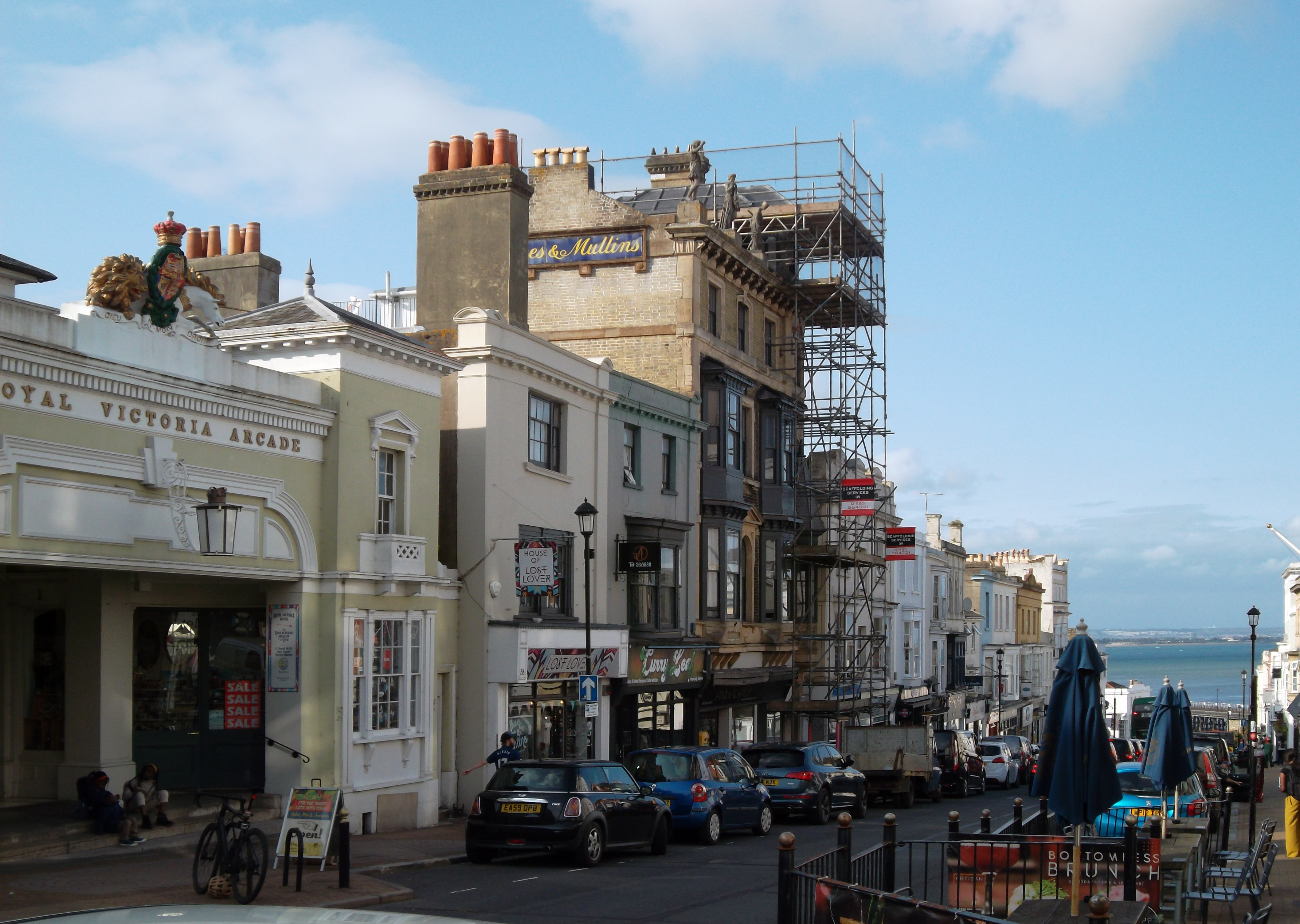
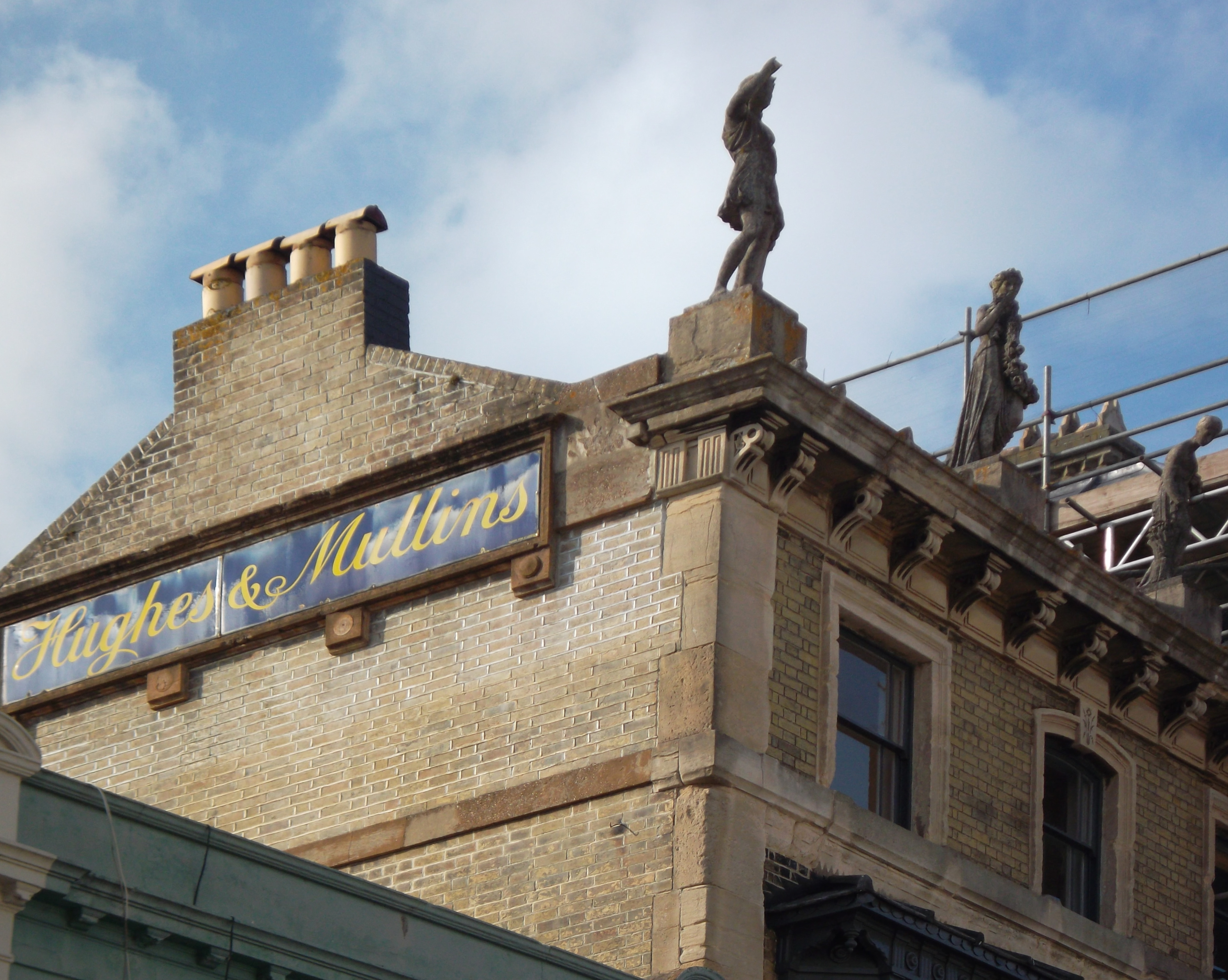
Left: The Royal Victoria Arcade on the left, with the building that once housed Hughes and Mullins's Union Street Studio further down towards the sea (at the time of the photograph, in 2024, under restoration). A glimpse of Ryde Pier can be seen at the end of the street. Right: Close-up of the photographer's sign, and part of the roof-top statuary. Photographs © Michael Riley. [You may use the photographs without prior permission for any scholarly or educational purpose as long as you (1) credit the photographer and (2) link your document to this URL or credit the Victorian Web in a print document.]
It might be said that the firm's work was simply representational. Roy Flukinger, for instance, writes that although their photographs of tableaux at royal entertainments were very attractive, by their very nature as "costumed figures frozen in moments of great drama or beauty," they were "subject to little personal interpretation or style; they exist as documents of the entire scene and of the costumed princesses and courtiers engaged in this royal diversion" (124).
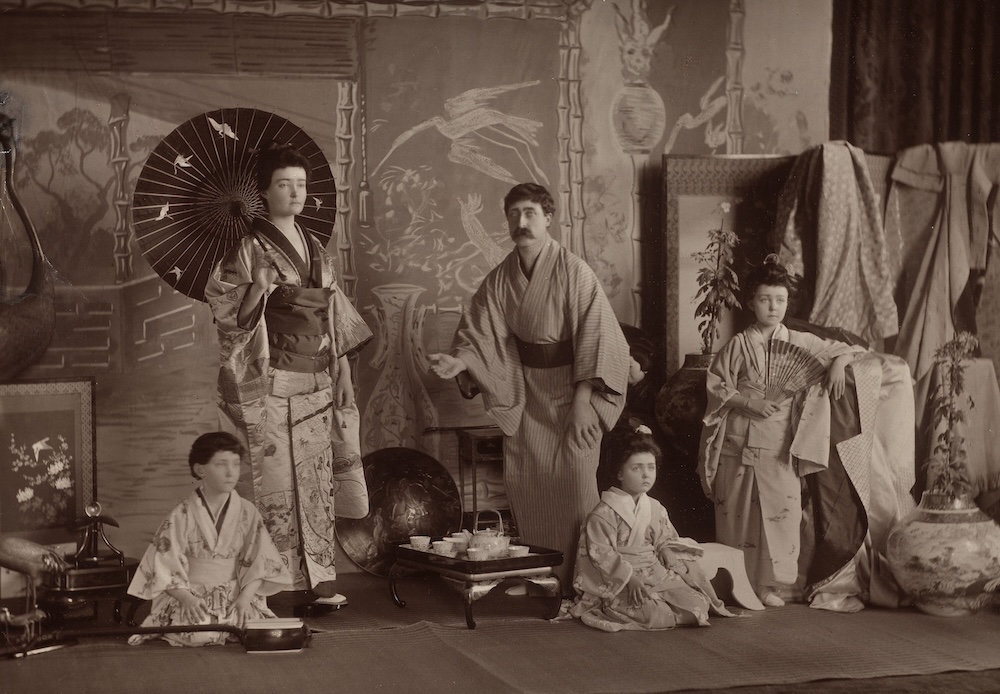
This "Japanese Scene" shows the Queen's third son, Prince Arthur, the Duke of Connaught, with his family in one of seven tableaux vivants performed for the Queen at Osborne on 8 January 1891. Carbon print, 16 x 22.8 cm (whole object), RCIN 2810107 © Royal Collection Enterprises Limited 2026 | Royal Collection Trust, by kind permission.
But in portraiture generally there was much scope for delicate character-work, light effects, setting and so on. Hughes himself cautioned that "to take a portrait well is one of the most difficult in photography," advising beginners to try practising first on still-life objects like plaster casts or statuettes, "being prepared for many failures arising from your ignorance and clumsiness, before you attempt portraiture" (11). Group portraits would have been particularly demanding. The amount of technical knowledge required, detailed carefully step-by-step in his book, indicates the full complexity of early photography. But so too does the satisfaction that comes with success. Most of Hughes's instructions are redundant now, but his general advice – to take pride in acquiring new equipment, read up about the skills required, and "keenly" enjoy attending photography exhibitions — still rings true today (38).
Works
Bibliography
Flukinger, Roy. The Formative Decades: Photography in Britain, 1849-1920. Austin: University of Texas Press, 1985.
Gernsheim, Helmut. A Concise History of Photography. 3rd revised ed. Mineola, NY: Dover, 1986.
Hughes, C. Jabez. The Principles and Practice of Photography, Familiarly Explained.... London: Jabez Gughes and T.T, Lemare, 1861. Google Books. Free to read. https://www.google.co.uk/books/edition/The_Principles_and_Practice_of_Photograp/a2IDAAAAQAAJ?hl=en&gbpv=1
"Hughes and Mullins, Royal Photographers." M.P. Osborne. Web. 28 January 2026. https://mposborne.com/hughes-and-mullins-royal-photographers/
"IOW Photographers — Hughes." Web. 28 January 2026. http://www.iowphotos.info/studios/hughes.htm
A Japanese Scene. Royal Collection. Web. 28 January 2026. https://www.rct.uk/collection/exhibitions/japan-courts-and-culture/the-queens-gallery-buckingham-palace/japanese-scene
Queen Victoria's Journals - Princess Beatrice's Copies (Thursday 11th August 1881). Access provided by UK National Access Account. Web. 29 January 2026. https://www.proquest.com/qvj/
"Union Street, Ryde, 28 July 1887." Royal Collection. Web. 28 January 2026. https://www.rct.uk/collection/2916008/union-street-ryde-28-july-1887
Vincent, J.E. The Life of Edward VII. London: George Newnes, n.d. (1911?). Internet Archive, from the Pratt Collection — University of Toronto. Web. 28 January 2026. Facing p. 213.
Created 28 January 2026