
Photographs by the author (with thanks to English Heritage for permitting photography) unless otherwise noted. You may use the images without prior permission for any scholarly or educational purpose as long as you (1) credit the photographer or the Library of Congress and (2) link your document to this URL or cite it in a print document [click on all the images to enlarge them]. Special thanks to Michael Riley for the introductory paragraph, for information about the sequence of the construction, and for the photograph of the boar at the entrance to the Household Wing.
 n 1843, seeking a suitable seaside escape for their growing family, the Prime Minister Sir Robert Peel recommended the Osborne estate on the Isle of Wight. The royal couple first leased the existing Georgian house and grounds from Lady Isabella Blachford in 1844. Delighted with the location and privacy it afforded, Victoria and Albert decided to buy the property a year later, using their private funds. The original house was considered too small for their needs, so they commissioned Cubitt to construct a new, larger house. The only part of the original Georgian house which remains today is the arched doorway, which was moved to form the entrance to the walled garden, still accessible to visitors.
The Main Wing and Clock Tower
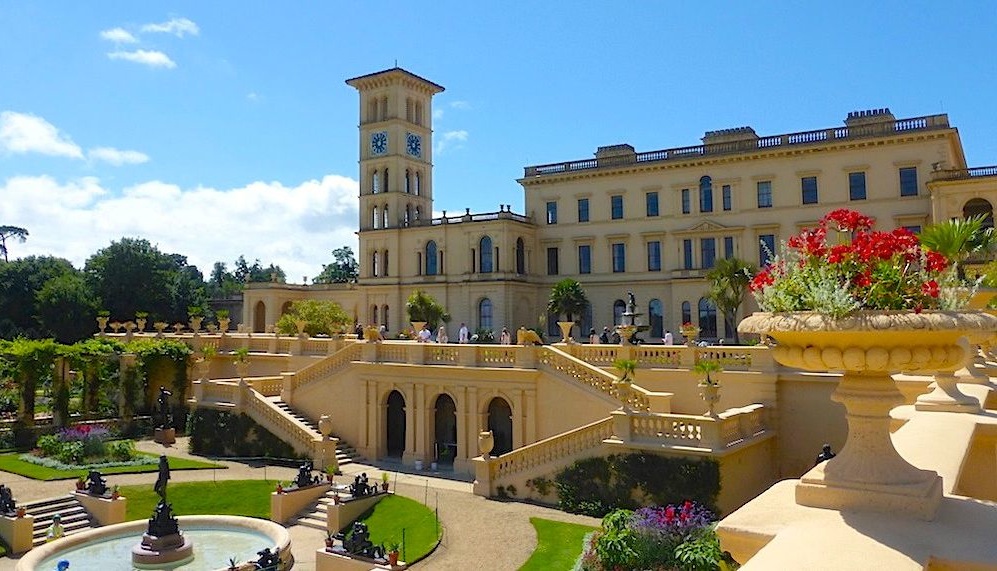
Osborne House, designed by Thomas Cubitt (1788-1855), with Prince Albert (1819-1861), and built 1845-51, with the important later addition of the Durbar Wing, 1890-91, by John Randall Mann (1828-1918). This Grade I listed building is of brick, with a warm-coloured cement render or stucco that makes it look like stone. Shown above is the nine-bay Main Wing and adjacent clock tower, with the lower terrace gardens and Andromeda Fountain (by John Bell) below. This wing, providing the grand frontage for the house, was actually the second part of it to be completed, dating from 1847-51.
The Household Wing

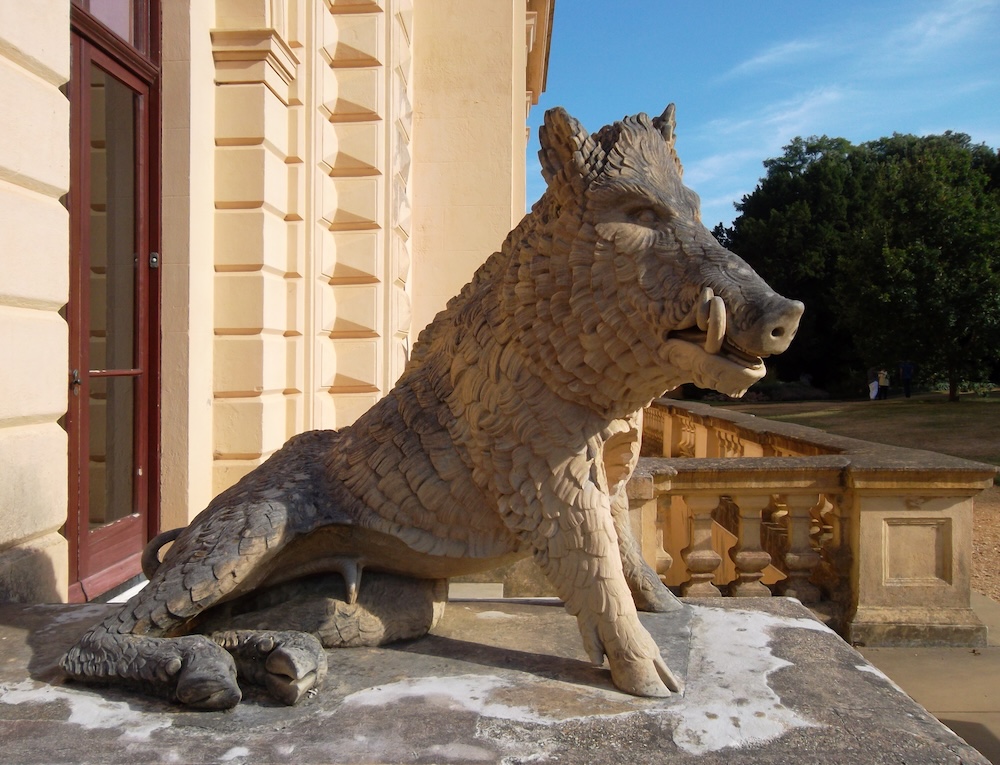
Left: "Boar and hound" entrance to the Household Wing. Right: Close-up of the boar [photograph by Michael Riley].
As its name suggests, the Household Wing was for the household retinue and everything concerned with the running of the house. The Calydonian Boar at its main entrance replaces one destroyed in 1918 (Turner 3). The Grand Corridor linking it to the Main Wing more than lives up to its name because it serves also as an impressive sculpture gallery, with niches, cabinets, busts and so on. Just off this Corridor are the Queen's Audience Room and the large Council Room, where her Privy Council would meet; the latter was also used for entertainments.
The Pavilion


Left: The Pavilion with the flag tower, which has an observation room at the top, seen here at the far end of the Household Wing. Right: This view, taken a little closer to the clock tower, shows the part of the terrace below that is being used as a restaurant.
The Pavilion was constructed after the original Georgian mansion on the site was purchased, and was thus the first part of Osborne House to be built, the very heart of the house with the family's private rooms. Sporting that important marker of royal residence, a flag tower, it was completed in 1846 — at which point the old house was demolished to make way for the next wing.
The process was a long one, and one in which Prince Albert fully participated. He "preferred Royal Engineers and builders to architects" (Turnor 86) for such projects, most probably for the very reason that he could have more control over the planning. He and Cubitt got on well together: the Prince "provided the vision and exercised a strong influence on the house's design and construction in an Italian Renaissance palazzo style. The house was clad in the builder's Belgravia fashion, which conformed to the 'client's brief'" (Stewart 75).

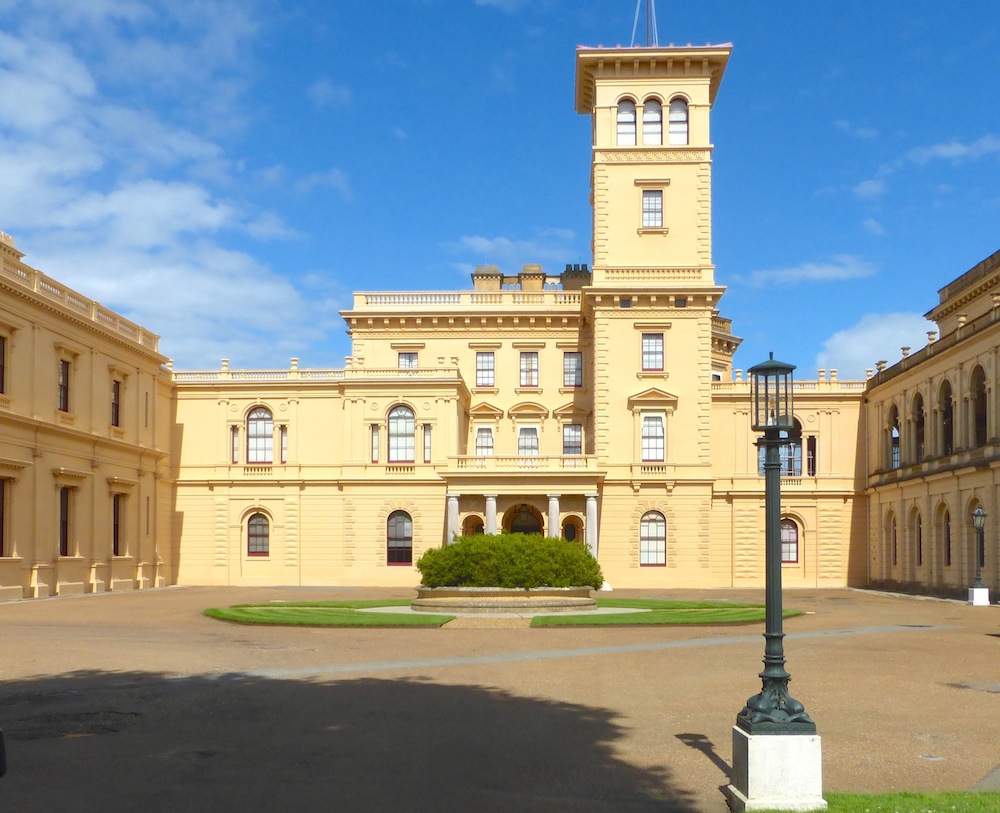
Left: The Pavilion with its bays facing the gardens on two sides. Right: The Pavilion frontage on the west, facing the carriage ring, with the grand entrance.
On the right, the bays of the Pavilion belonged to the drawing room on the ground floor, the Queen's sitting room on the first floor, and above that, the nursery bedroom. The bays facing the fountain were the windows of the dining room, with Queen Victoria's bedroom on the first floor, and, on the third floor, the nursery sitting room. The west front of the Pavilion faces the carriage drive, and has the main entrance with a small flight of steps and a columned, Portland stone porch. Prince Albert had originally planted heather in the raised circular cement flowerbed in the middle of the drive (Turner 5, 3). Note the lamp-post which has dolphins at the base, in acknowledgement of the house's closeness to the sea.
The Durbar Wing

The Durbar wing on the left of the Pavilion, was added later by Queen Victoria.
The Durbar wing was added to the original L-shaped complex in 1890-91. Standing opposite the Grand Corridor linking Household Wing, the Main Wing and the Pavilion, it forms another side to the courtyard here. Mann, who had served his apprenticeship with Cubitt, and was now Clerk of Works here, designed the new wing very much on the lines of the rest (see Lloyd and Pevsner 202, 205). The interior, however, is a different matter. This was decorated in an exuberantly exotic style by Bhai Ram Singh and John Lockwood Kipling.
In recent years the house has been beautifully restored, and now looks very much as it did in the nineteenth century (see adjacent photograph). Inside, too, much has been done to redecorate and restore the rooms and also the grounds to their original appearance (see Turner 52).

Photomechanical print, photocrom colour, c. 1890-1900, from a series of "Views of England" (Library of Congress image collection, ref. LC-DIG-ppmsc-08987).
Related Material
- Osborne House: Interior of Pavilion
- Osborne House: Interior of Household Wing and Main Wing
- Osborne House: Interior of Durbar Wing
- Osborne House: Terraces and Grounds
- Sculpture of Eos on the Pavilion terrace
- Walled Garden, Osborne
- Swiss Cottage, Osborne
- Summer house / Children's toolshed, Osborne
- Children's museum, Osborne
- Children's Victoria Fort and Albert Barracks, Osborne
- Queen Victoria's bathing machine at Osborne beach
Bibliography
"The History of Osborne House: A Glimpse into the History of a Royal Palace." English Heritage. Web. 11 April 2012 (the website has since changed).
Lloyd, David W., and Nikolaus Pevsner. Isle of Wight. Buildings of England series. New Haven & London: Yale University Press, 2006.
"Osborne House, East Cowes." British Listed Buildings. Web. 11 April 2012.
"[Osborne House, Isle of Wight, England]." Library of Congress. Web. 11 April 2012.
Stewart, Jules. Albert: A Life. London & New York: I. B. Tauris, 2011 [Review].
Turner, Michael. Osborne. Rev. reprint. London: English Heritage, 2016.
Turnor, Reginald. Nineteenth Century Architecture in Britain. London: Batsford, 1950.
York, HRH The Duchess of, with Benita Stoney. Victoria and Albert: Life at Osborne House, London: Weidenfeld and Nicolson, 1991.
Created 11 April 2012
Last modified 31 March 2026