
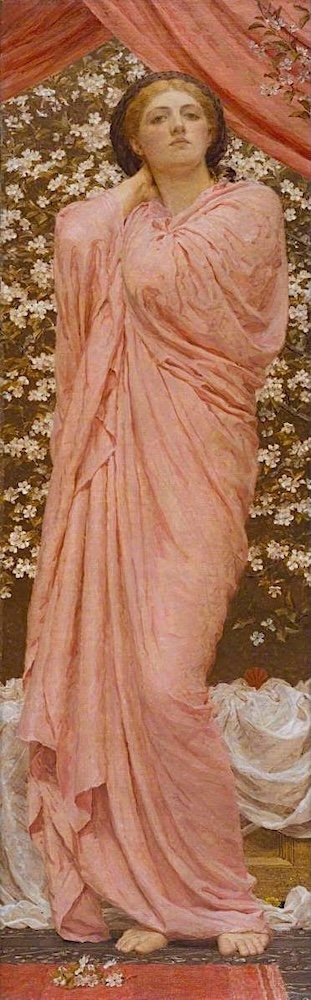
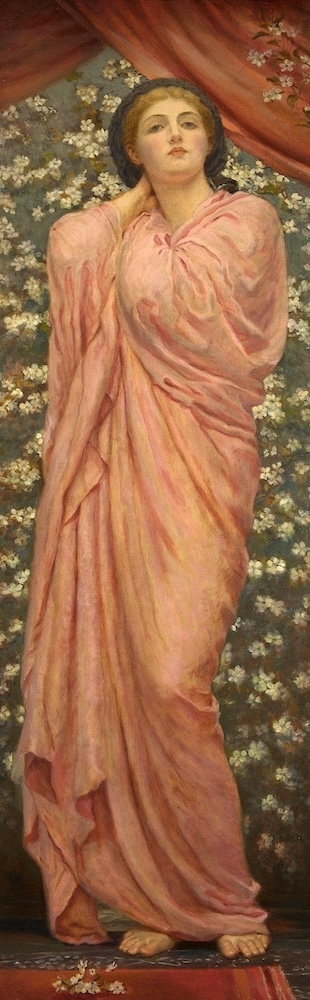
Left: A Blossoms by Albert Joseph Moore, ARWS (1841-1893). 1881. Oil on canvas. Left: 58 x 18 1/4 inches (147.3 x 46.4 cm). Collection of Tate Britain, accession no. NO1549. Image courtesy of Tate Britain under the terms of the Creative Commons Attribution-NonCommercial-NoDerivatives licence (CC BY-NC-ND). Right: 57 3/8 x 17 3/4 inches (145.7 x 45.2 cm). Collection of the Russell-Coates Art Gallery and Museum, Bournemouth, accession no. BORGM 00034. Image courtesy of the Russell-Coates Art Gallery and Museum under the terms of the Creative Commons Attribution-NonCommercial-NoDerivatives licence (CC BY-NC-ND). Click on both images to enlarge them.
Moore exhibited the Tate version of Blossoms at the Grosvenor Gallery in 1881, no. 137. It once again shows the influences of classical art in the statuesque female figure and of Japanese art in its delicate colouring and decorative floral background. A.L. Baldry has described the composition and its importance within Moore's oeuvre, rating it very highly, unlike many of his contemporary critics:
It is again a single figure of a girl, but here she is standing posed in an easy position with her hands raised and clasped on her right shoulder. The long, large folds of her pale rose-coloured robe fall in simple lines from her neck to her feet. Her head is thrown back, so that the face is a good deal foreshortened, and she wears a black head-dress. Behind her is a dark ashy-grey wall, half hidden by a lace-like net-work of white cherry blossoms, which makes, as it were, a screen of flowers; and a low seat covered with white drapery stands on the black and grey floor. At her feet is a red rug, and above her are too small crimson curtains which fill the upper corners of the panel. The masterly painting of the delicate rose pink drapery, with its warm shadows and glowing reflections; the admirable composition of the long gentle curves; the happy suggestion and dainty handling of the diapering of flowers across the background; all combine to make this production one of the most conspicuous successes of Albert Moore's life. With it he attained almost his highest technical level, and displayed his appreciation of colour, and of the finest qualities of true decoration, in a manner which in after years he only occasionally surpassed. Among his pictures of single figures, Blossoms may almost be pronounced the masterpiece. [51-52]
The version now in the Russell-Coates Museum was commissioned directly from Moore by his friend and patron Merton Russell-Coates. The two versions of Blossoms are similar, the principal differences being that in the replica the wall that the cherry blossoms are placed in front of is a more of a green-grey than brown-grey colour and the low seat is missing from the foreground, allowing the cherry blossoms to extend the full length of the wall. Robyn Asleson has noted that the use of the cherry blossoms has replaced Moore's usual fabric background hangings, pointing out that this is a work "that exemplifies his sensitivity to the abstract decorative patterns of nature. The floral screen functions in precisely the same fashion as the botanically designed fabrics that appear in other paintings, such as Topaz, exhibited at the Grosvenor Gallery in 1879, in which the flat, decorative backdrop reinforces the reading of the picture as a two-dimensional design. As in Moore's stained glass, the filigree pattern of the background provides a lively counterpoint to the slow, rhythmic swags of the figures' drapery folds" (150).
There is an oil study for Blossoms in the collection of the Fogg Museum, Harvard Art Museums (object no. 1943.199).
Contemporary Reviews of the Painting
F.G. Stephen in The Athenaeum spent more time discussing Moore's other contribution to the Grosvenor exhibition, Forget-me-nots, feeling that Moore did injustice to his gifts by not cultivating more fully his conceptions and his taste: "Blossoms (137) is a larger study in the same mode. It has the same shortcomings and the same felicity. In it a lady, in deep rose colour and white, is posed before a mass of apple, or pear, blossoms. Within a narrow range, Mr. Moore changes his tints in a new scheme of colour, and we do not remember a new vein of thought of his" (629).
A reviewer for The Builder again preferred Moore's other contribution to the exhibition: "Mr. Albert Moore re-appears with his usual class of subjects, but we hardly think he is at his best. His largest work, Blossoms, is less beautiful in the kind of sensuous beauty which this artist portrays than usual, and the attitude of the figure is somewhat contorted and awkward; and unless pictures of this class are thoroughly graceful they are nothing, for there is no intellectual meaning in them. The smaller work in the West Gallery, Foget-me-nots, is more perfectly successful in its aim" (562). A critic for The Illustrated London News also preferred Forget-me-nots: "A larger female figure by this artist is inferior and reminds one too much of previous works" (602). The Saturday Review merely mentions Blossoms in passing: "in the next room is to be found a very complete example of the style (137) by Mr. Albert Moore" (689).
Bibliography
Asleson, Robyn. Albert Moore. London: Phaidon, 2000. 150.
Baldry, Alfred Lys. Albert Moore: His Life and Works. London: George Bell and Sons, 1894. 51-52.
Blackburn, Henry. Grosvenor Notes IV London: Chatto and Windus (May 1881): 43.
Blossoms (Tate version). Art UK. Web. 2 October 2026.
Blossoms. Blossoms (Russell-Coates version). Art UK. Web. 2 October 2026.
"Fine Art. Grosvenor Gallery Exhibition." The Illustrated London News LXXVIII (18 June 1881): 602.
"The Grosvenor Gallery." The Builder XL (7 May 1881): 562-63.
Lambourne, Lionel. The Aesthetic Movement. London: Phaidon, 1996. 82-83.
"The Picture Galleries." The Saturday Review LI (28 May 1881): 689-90.
Stephens, Frederic George. "Fine Arts. The Grosvenor Exhibition." The Athenaeum No. 2793 (7 May 1881): 629-30.
Created 2 October 2026