
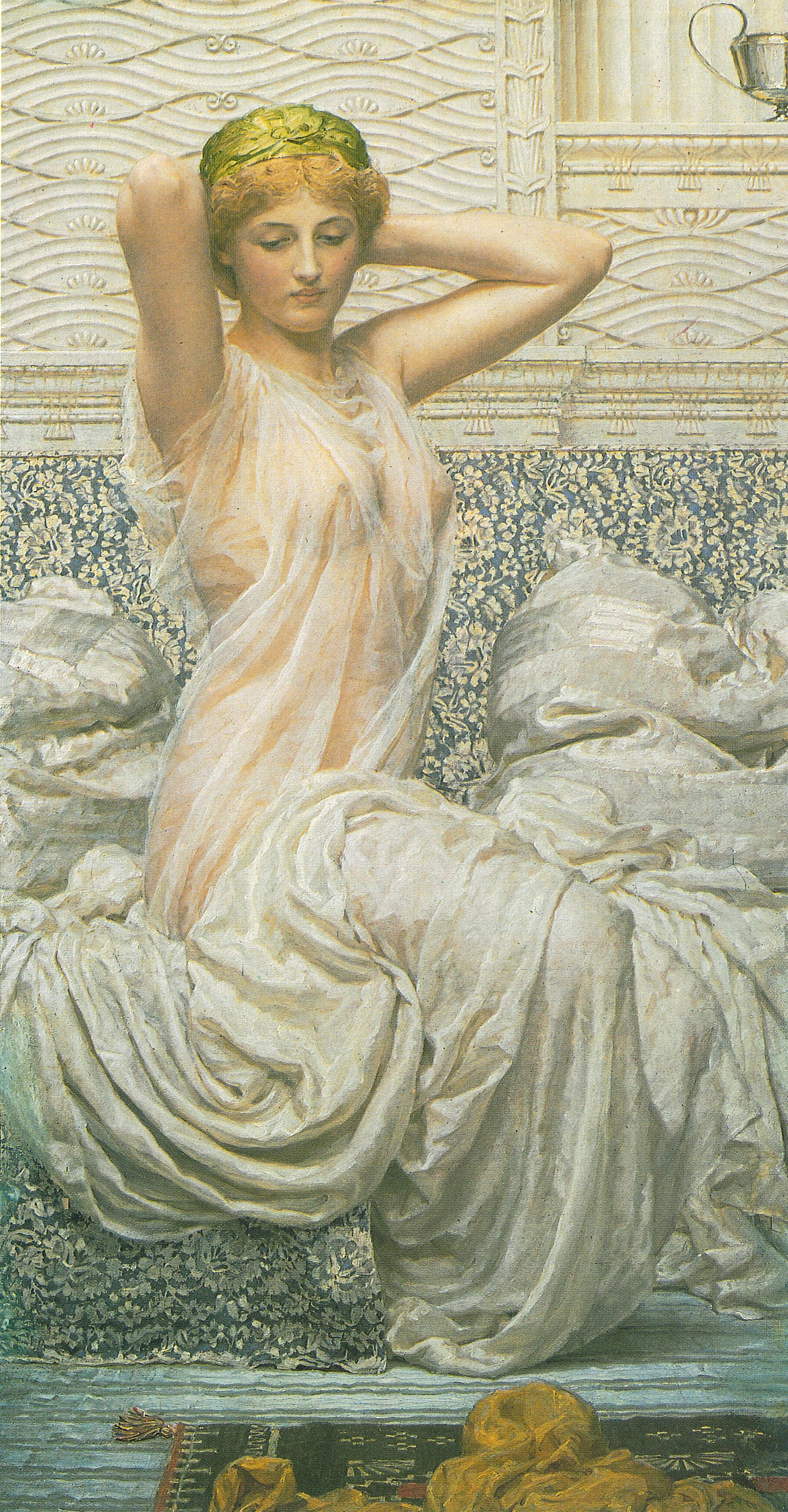
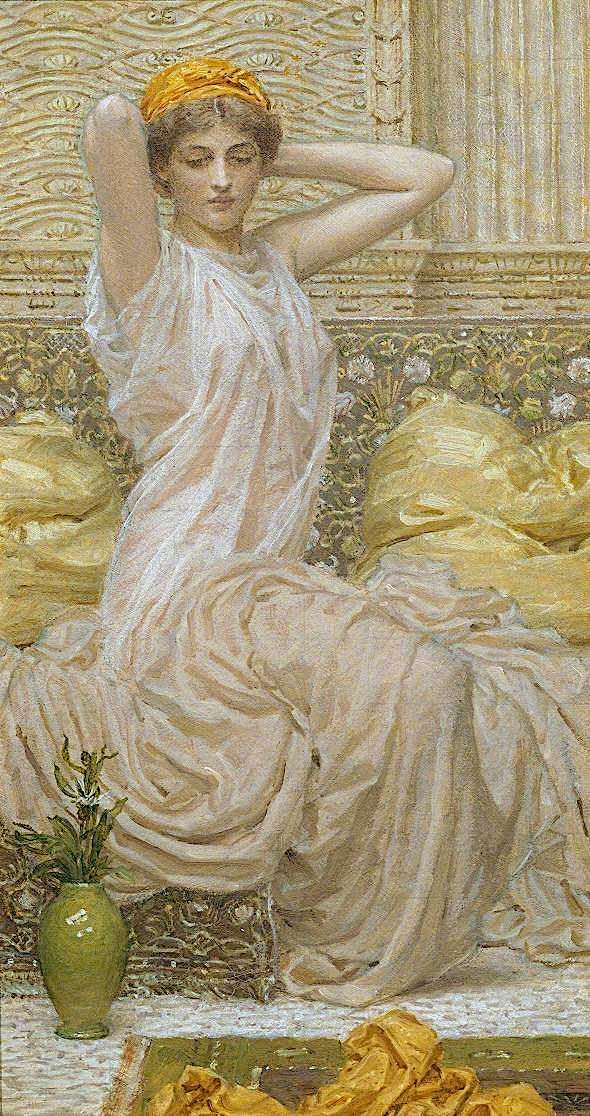
Left: Silver, 1886. Oil on canvas. 45 x 24 inches (63.5 x 119.5cm). Private collection. Source: Wikimedia Commons, identified as being inthe public domain. Right: The Toilette. 1886. Oil on canvas; 16 1/2 x 9 1/4 inches (41.9 x 23.5 cm). Collection of the Tate Britain, accession no. NO5876. Image courtesy of the Tate Britain under the terms of the Creative Commons Attribution-NonCommercial-NoDerivatives licence (CC BY-NC-ND).
This composition is known in a number of variants in both oil and watercolour. Silver, the principal version in oil, was shown at the Royal Academy in 1886, no. 372. The Toilette was not exhibited until 1893 when it was shown at the Moore memorial retrospective held at the Grafton Gallery. According to A. L. Baldry Silver grew out of an elaboration from one of the preliminary studies for the figure to the far right in Moore's later painting Summer Night (59). Siver shows a young woman in thin transparent white drapery seated on a sofa, her hands raised behind her head to tie her green cap. The sofa on which she is sitting is draped with white lace over a blue fabric. The background is of white marble carved in low relief with various geometric wavy patterns, including stylized "shell" symbols, similar to the Greek anthemion device Moore used as his signature. In a niche in the wall to the far right can be seen a silver cup with a handle that gave the painting its title. In the foreground is a dark grey rug again with anthemion devices in pale yellow worked into its pattern. The rug is partly obscured by a pile of bright orange fabric.
La Toilette has the same general composition as Silver but differs in significant details, particularly in its colour harmonies of green, white, and yellow. The model is in the same pose, but her fabric is not as transparent and her cap is orange rather than green. The fabric covering the sofa is not merely in different colours but an entirely different pattern and the throw cushions are yellow rather than white. An olive-green vase with a white flower and green leaves is in the left foreground. The floor mat is a similar green colour and the fabric lying on it is orange to match the colour of the maiden's cap. The background is similar except that the fluted niche continues all the way down to the dado. These two works epitomize how Moore could achieve two successful works of art by maintaining the same basic composition and simply modifying their colour arrangements and varying the accessories.
Contemporary Reviews of Silver
A reviewer for The Artist praised Moore's contribution to the section of decorative painting at the Royal Academy, both for its colour and technical expression:
There is much more of the decorative instinct and a far better use of the decorative method in Mr. Albert Moore's Silver. This artist, naturally possessed of a colour sense of unusual subtlety, has been able to reduce the laws of colour juxtaposition into something approaching scientific completeness. To this he has also added the system of line composition, which has much of the simplicity and dignity that characterises Greek art; and as a consequence his work is never devoid of beauty of the highest and noblest kind. This picture, Silver, a study of a single seated figure, is an excellent example of his art, and further shows favourably enough his power of technical expression. [197]
The Artist also reported on other periodicals' opinions on Moore's painting. The Building News reported "Silver is a well-known London actress in a diaphanous textile." St. James's Gazette was fulsome in praise of this picture:
Silver is one of those purely artistic things about which it is very difficult to write. When a painter takes line, tone, and colour, and combines them into a thing of coherent beauty, the c'est bien dit of the Frenchman says all that there is to say. But description is left to us. In Mr. Moore's picture a girl of five-and-twenty or so sits erect on a couch, her hands clasped behind her head, and her body draped in soft transparent lawn. The background is a silvery white, and a silver cup stands in a niche. Mr. Moore's composition has never been finer, his draperies never better hung, his colour never more delicately harmonious than here. [qtd. The Artist, 205]
A critic for The Art Journal merely commented: "Albert Moore's full-length female figure, affectedly called Silver (372), is a beautiful piece of decoration" (222). F.G. Stephens in his first notice on the Royal Academy Exhibition in The Athenaeum simply wrote "Mr. A. Moore's Silver (372) depicts a damsel in a white dress binding her hair" (589). He expands upon this in his third Royal Academy notice, however: "Silver (372) is one of Mr. A. Moore's best exercises with materials he has often used. A Greek virgin, whose forms and proportions almost justify the designation, rises from a citron-coloured couch clad in a white semi-tissue such as Mr. Moore has long affected, and gracefully as well as unaffectedly binds her hair under a green cap" (683).
Bibliography
Asleson, Robyn. Albert Moore. London: Phaidon, 2000. 185, 226n.173 and 228n.36.
Baldry, Alfred Lys. Albert Moore. His Life and Works. London: George Bell and Sons, 1893. 59-60.
Blackburn, Henry. Academy Notes XII. London: Chatto and Windus (May 1886): 10.
"Collated Opinions on the Royal Academy." The Artist VII (1 June 1886): 205.
"Exhibition of the Royal Academy." The Art Journal XLVIII (1886): 221-22.
Green, Richard. Albert Moore and his Contemporaries. Newcastle Upon Tyne: Laing Art Gallery, 1972, cat. nos. 68 and 69, 27.
Important 19th Century Pictures & Continental Watercolours. London: Christie's (25 March 1988): lot 125.
"Oil Paintings at the Royal Academy." The Artist VII (1 June 1886): 194-197.
Stephens, Frederic George. "Fine Arts. The Royal Academy." The Athenaeum No. 3053 (1 May 1886): 589-91.
Stephens, Frederic George. "Fine Arts. The Royal Academy." The Athenaeum No. 3056 (22 May 1886): 683-84.
La Toilette. Art UK. Web. 4 October 2026.
Created 4 October 2026