
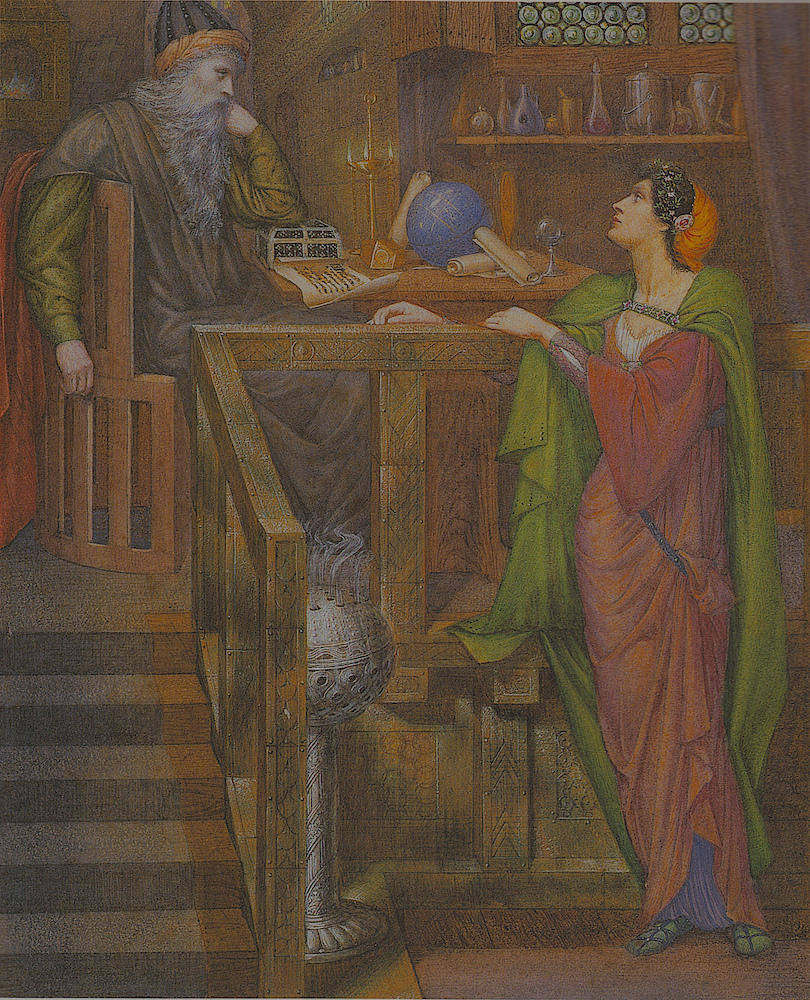
Merlin and Vivien by Sidney Harold Meteyard (1868-1947). 1907. Watercolour and gouache on paper. 18½ x 11¾ inches (47 X 29.8 cm). Private collection. Image courtesy of the Maas Gallery, London. [Click on this and the following image for larger pictures.]
Meteyard's subject is derived from Arthurian legend, in this case in the version told by Alfred Lord Tennyson. In "Merlin and Vivien," from Tennyson's Idylls of the King, Merlin, the magician and advisor in the court of King Arthur, is beguiled by the beautiful but evil Vivien [Nimue]. Vivien had been the mistress of Arthur's enemy, King Mark of Cornwall, and was sent to Camelot by him, to use her devious charms to promote disquiet in the court by spreading scandalous rumours and causing other forms of disruption, Vivien manages to gain the now aged Merlin's favour, and asks him to reveal to her the spell that can entrap someone and render them invisible to all but the enchanter's eyes:
Ye have the book: the charm is written in it:
Good: take my counsel: let me know it at once:
Eventually, Merlin and Vivien set off in a small boat and come ashore in Brittany, where, in the forest of Broceliande, Vivien uses the spell on Merlin himself, trapping him in a hawthorn tree — a scene familiar from Edward Burne-Jones's The Beguiling of Merlin of 1872-74, now at the Lady Lever Art Gallery in Port Sunlight.
The subject of Meteyard's watercolour, taken from earlier in the story, shows Vivien, clad in a red dress and green cloak, standing and holding on to a wooden railing while looking up at Merlin who is seated on a higher level in the type of tub chair frequently favoured by Edward Burne-Jones in his Arthurian scenes. Such chairs, for instance, are featured in Burne-Jones's design for the Holy Grail Tapestries, specifically, The Knights of the Round Table Summoned to the Quest by a Strange Damsel. Merlin, in rapt concentration, with his left hand tucked under his lower jaw and his right arm hanging down the back of his chair, looks down on Vivien; he has been consulting an illuminated manuscript on his desk and is surrounded by the various paraphernalia useful in his role as a wizard. The watercolour illustrates the lines from Tennyson's "Merlin and Vivien":
And yielding to his kindlier moods, the Seer
Would watch her at her petulance, and play,
Even when they seemed unloveable, and laugh
As those that watch a kitten; thus he grew
Tolerant of what he half disdained, and she,
Perceiving that she was but half disdained,
Began to break her sports with graver fits....
The model for Vivien was Kate Eadie, Meteyard's pupil, who would become his second wife years later in 1940. Eadie would have been twenty-eight at the time she modelled for Vivien. In Meteyard's study for the head of Vivien the angle of her head is slightly more pronounced than in the finished watercolour.
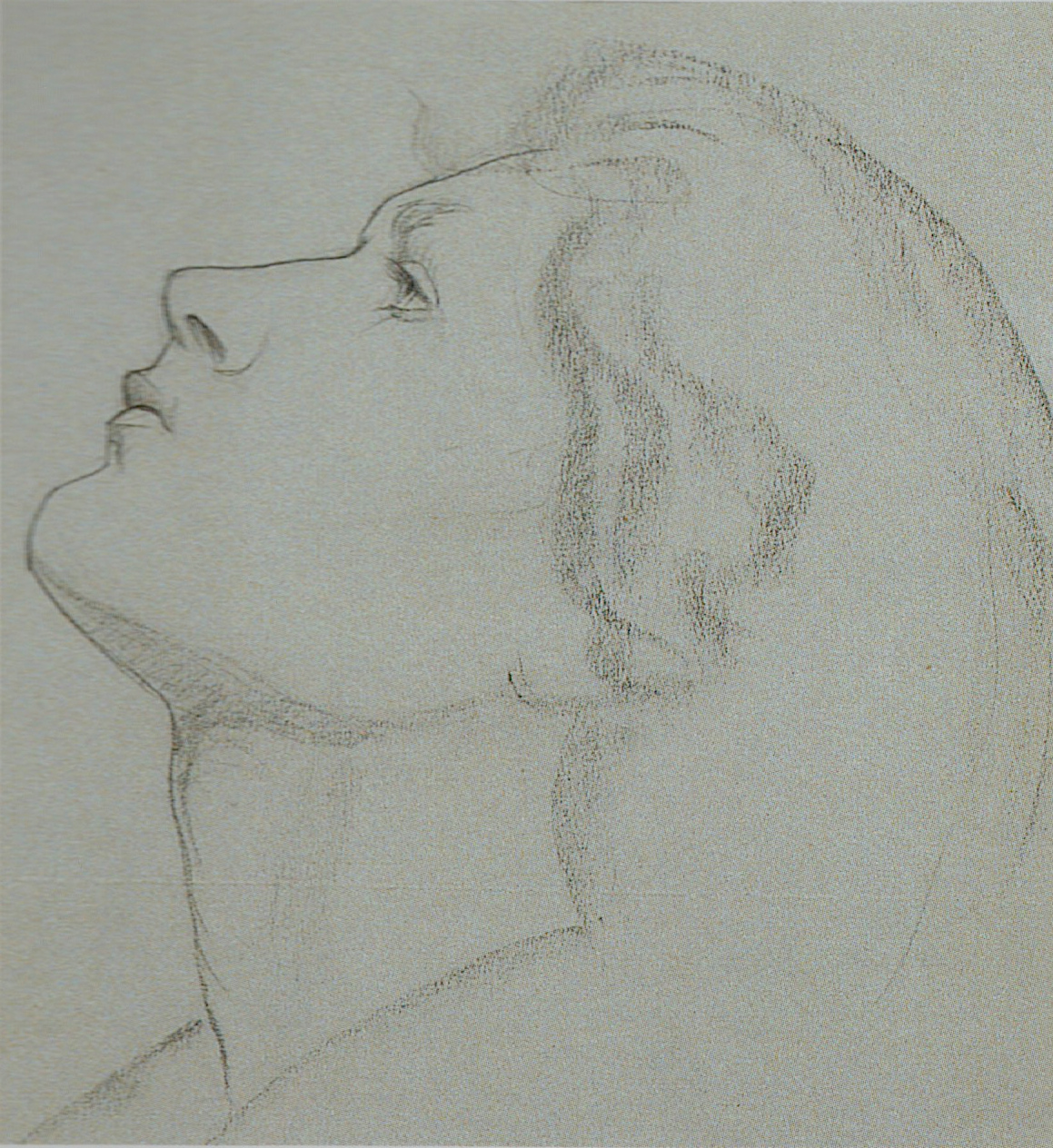
Study for the head of Vivien for Merlin and Vivien, pencil on grey paper, 13 1/4 X 11 1/8 inches (33.5 x 28.2 cm) - sight. Private collection, image courtesy of the author.
The most famous Victorian depictions of the story of Merlin and Vivien are by Edward Burne-Jones, including his mural for the Oxford Union Debating Hall of 1857, and his early watercolour Merlin and Nimue of 1861, in the collection of the Victoria and Albert Museum, as well as the most famous one mentioned above. Another well-known version of this story is Julia Margaret Cameron's photograph of Vivien and Merlin (1874). Meteyard's drawing is reminiscent of D.G. Rossetti's study for the head of Joan of Arc and J. W. Waterhouse's study of the head of his 1905 version of Lamia (Royal Academy, 2009, cat. 46).
Bibliography
British Pictures 1840-1940. London: Maas Gallery, 1998, cat. 52, 46-47.
J.W. Waterhouse. The Modern Pre-Raphaelite. London: Royal Academy of Arts, 2009, cat. 46, 162-63.
Created 29 March 2026