
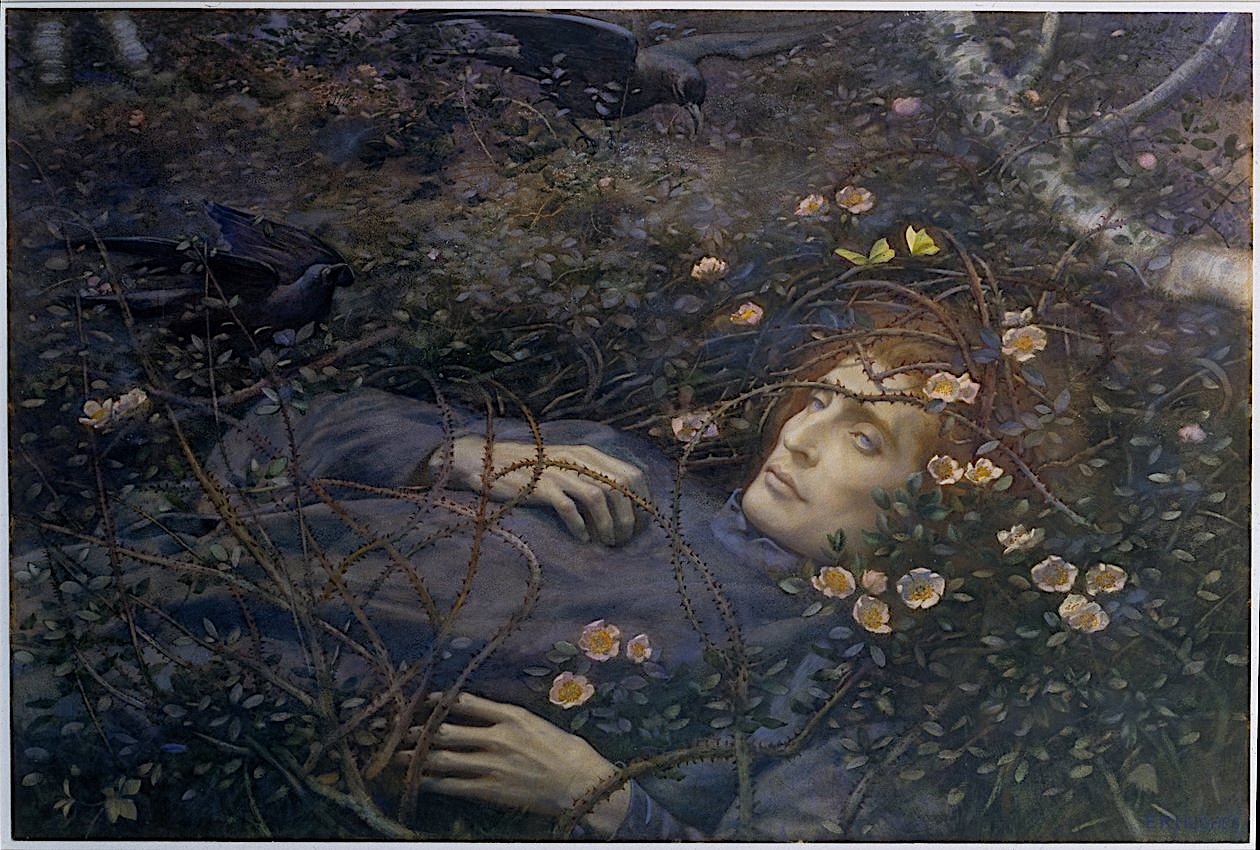
"Oh What's That in the Hollow," by Edward R. Hughes (1851-1914). 1893. Watercolour and gouache on paper. 24 7/8 x 36 3/4 inches (63.2 x 93.3 cm). Collection of the Royal Watercolour Society, Diploma Work, accession no. H0198. Image courtesy of the Trustees of the Royal Watercolour Society via Art UK, identified as being in the public domain. [Click on the image to enlarge it.]
Hughes exhibited this rather macabre painting of a male corpse clad in blue, with his open and yet unseeing eyes, and lying in a hollow with wild roses twisting around his body, at the Royal Society of Painters in Water Colours in 1893, no. 30. Likely because Hughes felt it would have inspired little commercial interest, he donated it as his Diploma work for that institution in 1895. It was later exhibited at the first International Art Exhibition in Venice in 1895, no. 156.
John Christian has pointed out that the painting was inspired by
Christina Rossetti's poem "Amor Mundi," whose theme was the transience of earthly life and the inevitability of death, in which two lovers, pursuing the easy downhill path of worldly pleasures, encounter warning portents, including a corpse:
"Oh, what's that in the hollow, so pale I quake to follow?
Oh, that's a thin dead body which waits the eternal term."
When published in the Shilling Magazine in 1865 the poem was accompanied by one of Frederick Sandys' most famous illustrations [Amor Mundi]. [95]
The picture can definitely be considered a symbolist work as it is full of symbolic references, but it also shows the influence of earlier Pre-Raphaelite paintings. The background and the placement of the corpse is reminiscent of the drowned Ophelia in Millais's famous painting Ophelia of 1851-52. Christian has suggested the blooming dog roses and brambles "may owe something to Burne-Jones' Briar Rose paintings, exhibited to great acclaim in 1890" (95). In terms of symbolic references, the two scavenging black crows hovering over the corpse's body represent the decay of the mortal body after death. Interestingly, however, Hughes introduces a hopeful sign in the two yellow brimstone butterflies which may be symbolic of the soul's resurrection, transformation and immortality. Victoria Osborne has interpreted the symbolism of the wild roses depicted:
In the language of flowers, dog roses, with their sharp, tenacious thorns and soft blooms, carry particular associations with the pleasure and pain of love. As they twine around and envelop the body they suggest a close, even symbiotic relationship not only between pleasure and pain, but between love and death…. In fact, however, the relationship between the wild roses and the corpse is crucial to the watercolour's potency as an image…. This ambiguous fascination with death and decay, with sinister sweetness, connects Hughes's watercolour to the preoccupation with decline and mortality that pervades so much of Symbolist art. [78-79]
Osborne has also pointed out that this watercolour represented "the beginnings of a shift (though one that was to be neither immediate nor total) in his exhibited subject pictures towards compositions in which narrative becomes less important than the evocation of mood and atmosphere" (82).
Contemporary Reviews of the Painting
Not surprisingly, this painting proved controversial when it was exhibited at the Royal Society of Painters in Water Colours. A critic for The Whitehall Review called it "the most dreadful sight in the gallery" (qtd. in Osvborne 76). A reviewer for The Morning Post couldn't understand what justification there could be for Hughes's depiction of such a dead body: "No story whose tragic import might necessitate the introduction of such an object is suggested by the picture" (qtd. in Osbporne 78). The most extensive review was given by F. G. Stephens in The Athenaeum who felt this picture, despite the technical expertise demonstrated, would be hard for a collector to live with:
Mr. E. R. Hughes has painted several memorable figure subjects, but some of them have betrayed symptoms of bad judgment, and certainly he committed a signal error when he devoted his rare technical skill to depicting at life size and with all too painful veracity the pallid corpse (No.30) of a young man lying in a brake in open daylight. Neither in the way of effect nor of colour is anything introduced to excite the sympathy of the visitor. It is an illustration of a poem of Miss Rossetti's, and, like the poem, it is a trifle morbid and hysterical. However fine the skill and learning of the artist may be, he ought to have compassion on that possible "client" who would have to live with such a work. [813]
Note
Although the work was exhibited with the line from the Christina Rossetti poem as its title, the inclusion of the two birds makes one think of the old Scottish poem "The Twa Corbies," which was the inspiration for paintings by Briton Riviere and Campbell Lindsay Smith, and for illustrations by Jessie M. King (see her Twa Corbies), Arthur Rackham and Morris Meredith Williams. — Scott Thomas Buckle
Bibliography
"Art Notes: Royal Society of Painters in Water Colours – First Notice." The Whitehall Review (9 December 1893): 9.
Christian, John. The Last Romantics. The Romantic Tradition in British Art. London: Lund Humphries, 1989, cat. 48, 95.
Clair, Jean and Pierre Theberge, Eds. Lost Paradise; Symbolist Europe. Montreal: Montreal Museum of Fine Arts, 1995, cat. 166, 514.
Cruise, Colin. Pre-Raphaelite Drawing. London: Thames & Hudson, 2011. 186, 200-201.
"Oh What's That in the Hollow". Art UK. Web. 2 May 2026.
Osborne, Victoria Jean. "A British Symbolist in Pre-Raphaelite Circles: Edward Robert Hughes RWS (1851-1914)." M.Phil. thesis, University of Birmingham, 2009. 75-82.
Prima Esposizione Internazionale d'Arte della Città di Venezia. Venice: Esposizione d'Arte di Venezia, 1895, cat. 156, 100.
"The Royal Society of Painters in Water Colours." The Morning Post (11 December 1893): 3.
Stephens, Frederic George. "The Society of Painters in Water Colours. Winter Exhibition of Sketches and Studies." The Athenaeum No. 3450 (9 December 1893): 813-14.
Created 2 May 2026