
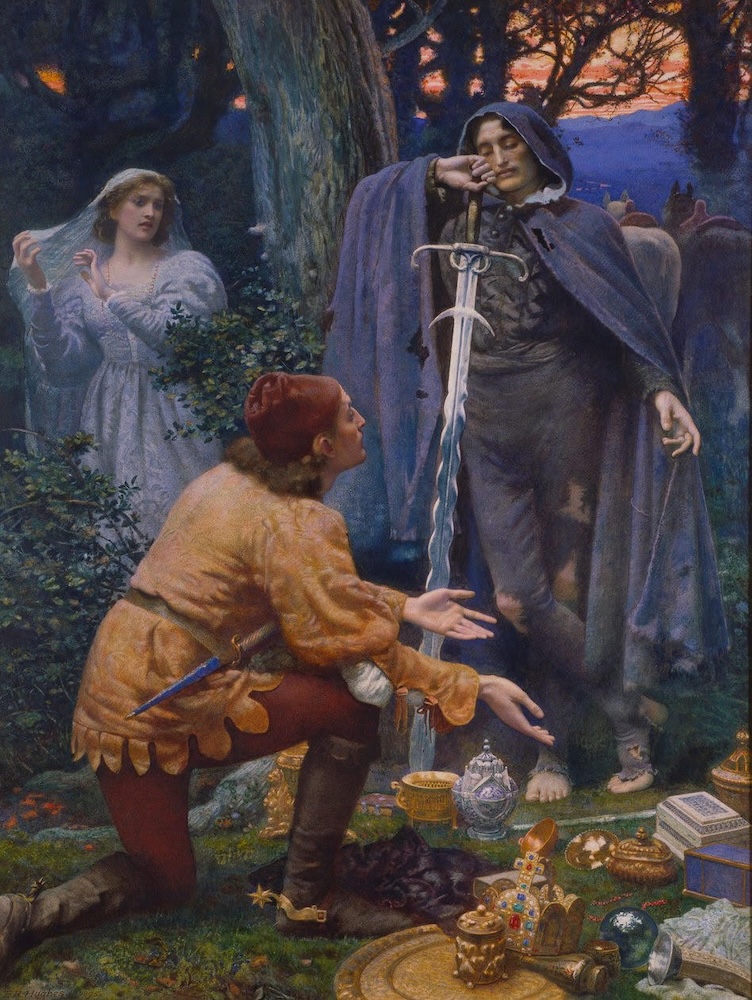
Bertuccio's Bride, by Edward R. Hughes (1851-1914). 1895. Pencil and watercolour with scratching out. 39 ½ x 30 inches (101.6 x 76.2 cm). Private collection of Lord Lloyd Webber. Image courtesy of Peter and Renate Nahum. [Click on the image to enlarge it.]
Hughes exhibited this watercolour at the Summer Exhibition of the Royal Society of Painters in Water Colours in 1895, no. 59. Hughes had written an explanation of this picture, taken from a story by Giovanni Francesco Straparola, on an old label on the verso of the frame:
Bertuccio's Bride. Bertuccio ransoms with part of his inheritance the body of a gentleman from his murderers and with the residue frees from robbers a maiden who unknown to him is a princess. She is soon reclaimed but before leaving makes a contract of bethrothal with Bertuccio. By the aid of a mysterious knight he meets, and with whom he changes clothes, he brings her home as his bride, and they meet the knight. Bertuccio is about to divide with him, according to their pact, the wedding gifts, when everything is given up by the knight who proves to be the grateful spirit of the murdered gentleman. [The Nights of Straparola, trans. W.G. Waters, p.214 ff., as summarised and added by E.R. Hughes.]
What exactly Hughes's painting represents is controversial, as discussed in a contemporary review by F. G. Stephens in The Athenaeum in 1895. Does it show Bertuccio da Trino kneeling and offering to give part of his riches to a bandit in order to ransom the corpse of the murdered gentleman, or does it show Bertuccio offering to divide the wedding gifts with the spirit of the dead knight who is standing and leaning on an elaborate sword that he holds in his right hand? The almost spectral appearance of the standing figure suggests to me that the latter is the more likely. The knight is clad in poor clothing only because he had previously exchanged his rich garments with Bertuccio when they met on the road to Novarra where Bertuccio was travelling in an attempt to win the hand of the princess. The riches shown, including a bridal casket, are much more likely to be the wedding presents given to a princess, because Bertuccio's father Xenofonte had left his son only three hundred ducats. Bertuccio had paid the thief eighty ducats to claim the body of the dead gentleman and then he paid another twenty ducats to have the murdered man's body honourably buried in a nearby church, and to have sacred offices and masses said for the repose of his soul. Bertuccio later paid two soldiers two hundred ducats to release a maiden they had captured, not realizing she was a princess. In gratitude, Tarquinia, the daughter of Crisippo, King of Novarra, resolves to have only Bertuccio as her future husband. Bertuccio's bride is shown dressed in white in the midground to the left of the two men. The time is twilight, which is the time of day Hughes appeared to have greatly favoured in his compositions.
Hughes had been commissioned to illustrate Waters' translation of the Nights of Straparola, published by Lawrence and Bullen, which first appeared in 1894. Hughes produced seventeen designs in grisaille which were reproduced in photogravure. The illustration upon which the watercolour of Bertuccio's Bride is based was used as the frontispiece for Volume II of the book. He subsequently developed several of his illustrations into independent watercolours. In 1895 Hughes exhibited another of these Straparola watercolours, Biancabella and Samaritana, her Snake Sister, at the Royal Society of Painters in Watercolours and at the first Venice Biennial.
Edward Burne-Jones gave his opinion of the success of Hughes's designs in 1898 in conversation with his studio assistant T. M. Rooke: "Edward Hughes has done another of those Italian Story Books and has had more fun. But as for the stories I don't care for them" (qtd. in Lago 172). Peter Nahum felt that Bertuccio's Bride has some reminiscences of Burne-Jones's image of medieval honour and chivalry, The Merciful Knight (1863), in its treatment of a supernatural subject. Burne-Jones's painting had recently been shown at his retrospective exhibition at the New Gallery in the winter of 1892-1893.
When this watercolour sold at Christie's in 1991 one of their experts, likely John Christian, wrote:
The picture illustrates a story by Gian Francesco Straparola, a writer of whom little is known except that he was born in Caravaggio and died about 1557... his most famous work is Le piacevole notte, a collection of novelle published in Venice 1550-3. In form this closely resembles Boccaccio's earlier and more familiar collection, the Decameron. Boccaccio's stories are told by a group of young men and women who have retreated to Fiesole to escape the plague-ridden city of Florence, Straparola's by a party which has gathered on the island of Murano during the Venetian carnival; they are led by Ottavino Maria Sforza, bishop-elect of Lodi, and include, among other notabilities, Pietro Bembo himself. The originality of the stories lies in the inclusion of many oriental folk tales and the use of animal fables - among them the famous tale of "Puss in Boots," which Straparola seems to have invented. The stories are often rabelaisian, and many have priests as protagonists. This was considered offensive to Counter-Reformation sensibilities, and the book was placed on the Index in 1624. The popularity of the stories led to many editions and translations. The first English translation, however, did not appear until 1894, when it was undertaken by the Italian scholar art-historian W.G. Waters. E.R. Hughes provided eighteen illustrations, of which the present watercolour is one…. Bertuccio's Bride illustrates the second story told on the eleventh night. The hero is the simple, trusting son of a notary who has inherited money from his father, and the moral is that good deeds are rewarded.
Contemporary Reviews of the Picture
When this picture was shown at the Royal Society of Painters in Water Colours exhibition in 1885, it was, in general, not extensively reviewed. The critic for The Art Journal merely noted: "Mr. E. R. Hughes' Bertuccio's Bride is an excellent example of a rising painter" (192). A reviewer for The Magazine of Art thought Hughes had previously done more interesting work: "We have seen more interesting work from Mr. Edward R. Hughes than Bertuccio's Bride, an incident from Mr. W. G. Waters' translations of The Nights of Straparola, the subject being one that will hardly appeal to the general public" (358). For The Times this watercolour exemplified "the common English excess of literature over art; enormous pains taken to tell a story which is entirely unintelligible unless one has the key" (qtd.in Osborne, 26).
F. G. Stephens in The Athenaeum gave it an extensive but very mixed review, ending with the thought that the subject was not worth painting. He also appears to have misinterpreted the subject of the painting:
Another capital piece of accomplished art, but neither so well digested nor so harmonious, worthily occupies that place of honour in this gallery which is generally conceded to a work by one of the most distinguished of the younger members of the Society, who may or may not be on his promotion. This is Mr. E.R. Hughes's second illustration in colours of a subject which he found in the Nights of Straparola. Called Bertuccio's Bride (59), it is intended to represent Bertuccio ransoming, at the cost of part of his fortune, the body of a gentleman from his murderers. He kneels before a ragged warrior (who is leaning on a stupendous, two-hand sword), and offers to the impassive ruffian a large collection of gold and silver, bric-a-brac and jewels, among which we recognize with surprise the crown of Charlemagne, a French or Italian bridal casket, a German hanap, ciboria, censers, and other objects of immense value. Mr. Hughes has, it seems, bestowed on Bertuccio this boundless store of precious objects, which were pleasant and easy to paint,... Nevertheless, it is possible to be liberal overmuch, and in this picture our artist has proved this. Painted with immense care and accomplishment, irreproachably drawn, and massive in colouration and tonality, this picture suffers from an awkward composition, while its design lacks spontaneity and verve. The lady who wrings her hands in the background is merely an ordinary actress; the gloomy knight is not impressive, and his trousers look as if they had been torn with a view to stage effect rather than to indicate the rough lives of banditti who live in caves and holes of the rock. An illumination which is not true to nature, and errs in the blackness of its shadows, does not help the honourable intentions of the artist, who has more than once wasted extraordinary resources and amazing industry on subjects such as this, which, even if it were paintable, is not worth painting. [542]
Peter Nahum Ltd, London has most generously given its permission to use in the Victorian Web information, images, and text from its catalogues, and this generosity has led to the creation of hundreds of the site's most valuable documents on painting, drawing, and sculpture. The copyright on text and images from their catalogues remains, of course, with Peter Nahum Ltd.
Readers should consult the website of Peter Nahum at the Leicester Galleries to obtain information about recent exhibitions and to order their catalogues. [JB]
Bibliography
"Art Notes and Exhibitions." The Art Journal LVII (1895): 191-92.
Huish, Marcus Bourne. British Watercolour Art. London: A. & C. Black, 1904. 140.
Lago, Mary Ed, Burne-Jones Talking. London: John Murray, 1981. 172.
Morgan, Hiliary. Burne-Jones, The Pre-Raphaelites and their Century. London: Peter Nahum, 1989, Vol. I, cat. 155, 157.
Nahum, Peter. Bertuccio's Bride. Leicester Galleries. Web. 2 May 2026.https://www.leicestergalleries.com/browse-artwork-detail/MTY0OTM=
Osborne, Victoria Jean. "A British Symbolist in Pre-Raphaelite Circles: Edward Robert Hughes RWS (1851-1914)." M. Phil. thesis, University of Birmingham, 2009. 25-26.
Stephens, Frederic George. "Fine Arts. The Society of Painters in Water Colours." The Athenaeum No. 3522 (27 April 1895): 542-43.
Straparola, Giovanni Francesco. The Nights of Straparola. Trans. W.G. Waters. London: Lawrence and Bullen, Vol. II, 1894. Internet Archive. Web. 2 May 2026.
"The Royal Society of Painters in Water-Colours." The Magazine of Art XVIII (1895): 357-58.
"The Royal Society of Painters in Water Colours Exhibition." The Times (20 April 1895): 8.
Victorian Watercolours. London, Christie's (29 October 1991): lot 15, 20-21. Web. 2 May 2026. https://www.christies.com/en/lot/lot-2911636
Created 2 May 2026