
This article has been peer-reviewed under the direction of Kristen Guest (University of Northern British Columbia) and Ronja Frank (Memorial University, St John's, Newfoundland). It forms part of the Equine Breed and the Making of Modern Identity project, funded by the Social Sciences and Humanities Research Council of Canada.

riting in 1894, Lady Beatrice Violet Greville observed that in the equestrian field, women "have rushed in where their mothers feared to tread." Though she chalked the increased number of horsewomen up to riding's positive physical and moral effects, Lady Greville was in fact witnessing a deeper social change: the emergence of the middle-class female rider (Greville). In the mid-to-late Victorian period, expanded financial means and leisure time allowed middle-class women to participate in what had previously been an activity primarily limited to the upper classes (Bailey 8-9). Simultaneously, horses and equestrian accessories grew more accessible and horse sport thus became an outlet for conspicuous consumption, providing opportunities for women to demonstrate taste and discernment via access to an exclusive social sphere (Murphy). Although women's growing participation in equestrianism did cause gendered and classed anxieties, riding was generally considered to be both a suitable accomplishment and source of wholesome exercise for the delicate sex (Greville; Murphy; David 180-81). Ultimately, however, it also offered new freedoms and allowed women to reshape understandings of equestrian sport as a predominantly male domain.
For Victorian women, equestrianism was one of the most popular and visible new forms of leisure. Adding to its appeal was the manner in which Victorian equestrian discourse cultivated the idea of riding as a feminine accomplishment. As early as 1829, the anonymously authored Manual of Elegant Recreations, Exercises, and Pursuits suggested that riding was a "suitable amusement for young ladies" (McCrone 7-8). Over the course of the nineteenth century, hunting on horseback had shifted from the exclusive preserve of the gentry to a sport available to the affluent middle classes (Murphy; Greville). Hunting in general was seen as the primary setting for, and test of, women's riding by contemporaries like Alice Hayes and Lady Beatrice Violet Greville (Hayes vii; Greville). Leisure riding also gained popularity in settings like London's Rotten Row in Hyde Park, as a fashionable form of exercise that improved "physical well-being" (Greville).
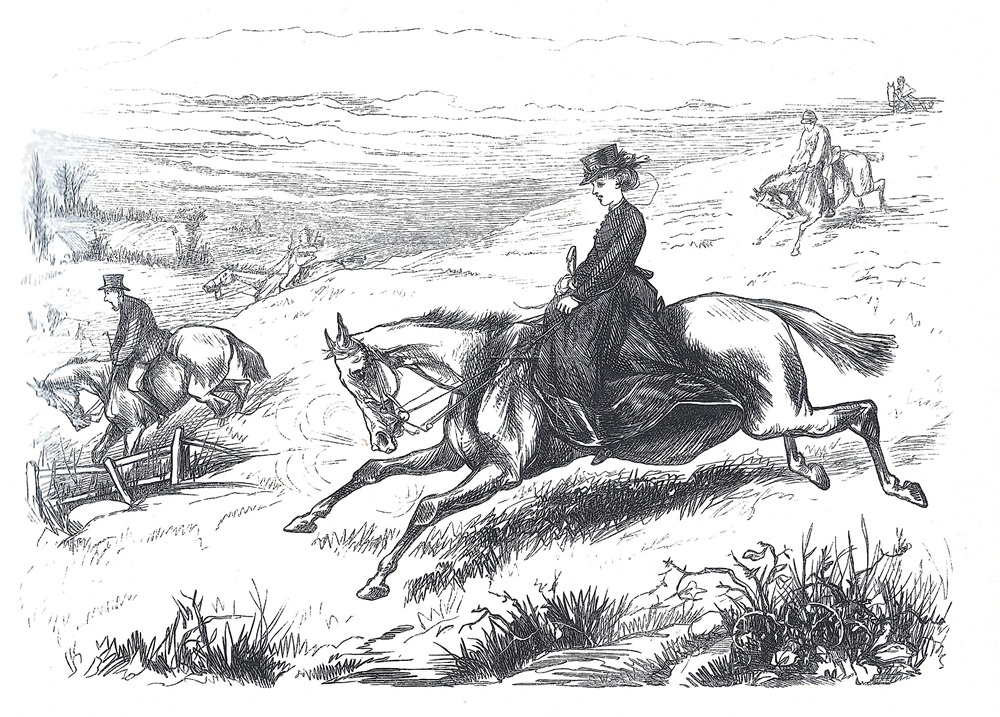
Georgina Bowers's depiction of horses in gallop in her wood engraving "A fast thing across country" (1868). Photograph by Simon Cooke.
For the newly wealthy middle classes, then, the growth of equestrianism demonstrated elevated social position and gender identity in a visible way. Because equestrian pursuits required a substantial investment in horses, their accessories (saddles, bridles, riding crops, carriages), and accoutrements (fashionable riding habits), they extended opportunities for public displays of wealth and status. Owning a well-bred hunter, distinguished carriage horse, or a pedigreed pony allowed the middle classes to demonstrate their "appreciation for taste and discernment" in a sport previously restricted to the wealthy elite (Murphy). Buying related equine consumer goods further heightened this display, as did the horse shows that first became popular in mid-Victorian England and Ireland. These drew large crowds of spectators, many of whom were women eager to participate in the experience of "spectacle, sport, social display, and consumerism" (Murphy).
To help middle-class horsewomen navigate the unfamiliar space of equestrian-focused leisure, the genre of the riding manual—and especially the riding manual for ladies—developed over the course of the nineteenth century. The first guide that included instruction for female equestrians was published in 1772, with others quickly following. What these earlier riding manuals lacked, though, was first-hand experience related to riding in a side saddle as this was a technical skill foreign to men; as Alice Hayes noted, "the great difference between men and women is that the former ride the horse; the latter, the saddle" (1). In 1857 this changed when Mrs. J. Stirling Clarke published the first riding manual written for women by a woman. Other female writers followed in Stirling Clarke's footsteps: Nannie Power O'Donoghue's Ladies on Horseback, first published in 1881, went through five editions by the end of the decade; Lady Beatrice Violet Greville's Ladies in the Field: Sketches of Sport appeared in 1894 and included articles by women on a range of horse sports, from Australian kangaroo hunting to team and tandem driving (Greville; Jenkins; Thompson); in 1893, Alice Hayes published The Horsewoman: A Practical Guide to Side-Saddle Riding with a revised follow-up over five hundred pages long released in 1903 (Hayes). As they evolved, riding manuals for ladies covered a broader range of topics, including tack, hunting, difficult horses, and equine external anatomy.
Many of the women writing these manuals were the wives of cavalry officers, and thus had access to horses through their husband's profession (David 181). Colonial modes of life also changed British women's relationships to sport and physical exercise. Lady Greville, for example, noted that "Everyone rides in India, for in many places it is the only means of transit." Horses were often less expensive in the colonies than in England, meaning that more women could afford to ride, expanding their access to and interest in horse sport (David 200). Such contexts allowed women to develop new expertise, and as more women accompanied Britain's colonial expeditions and expansions their experiences came to influence norms in England. Some like Alice Hayes and Lady Greville even wrote comparatively about riding in India, Ireland, and England. Both at home and abroad, then, riding was an acceptable, sometimes necessary, extension of woman's presence into the public sphere.
Reaching across class boundaries, manuals thus encouraged women outside of the gentry to participate in horse sports, giving them the knowledge required to do so. The literature also advocated indirectly for women's social independence, stressing the importance of relying on oneself rather than on grooms and servants. Stipulations that a woman should be able to mount a horse by herself reversed advice given out by men in earlier riding manuals for women, showing the impact a woman's perspective could have on the future capabilities of developing female riders (Munkwitz, Women, Horse Sports and Liberation 150). Manuals by women were thus an important element in middle-class Victorian women's riding journeys, as they improved women's understanding and practice of equestrianism using lived experience.
Perhaps most notably, women pioneered technological changes in the side saddle, making riding safer and more accessible for women. The modern redesign of the traditional side saddle began near the end of the eighteenth century with the addition of a second pommel. Earlier side saddles had a horn near the centre of the saddle, around which a woman hooked her left leg for balance; however, this design was insecure for the rider and precluded athletic jumping or galloping. This design was replaced in the early nineteenth century by the two-pommel saddle, which created a U-shape at the front through which a lady could wedge her right leg while her left leg balanced in the stirrup. While this design provided greater security and improved control, however, the second pommel also created a different safety hazard by preventing the rider from dislodging herself in case of a fall (Munkwitz, Women, Horse Sports and Liberation 48-49). Subsequent designs attempted to solve this problem, and some of the most notable innovations were produced by women. In 1893 Alice Hayes submitted a patent application for an adjustable ladies' side saddle, while in 1895 Parisian rider Elvira Guerra patented a mechanism allowing women to adjust the girth without dismounting. Such designs created a way for women to ensure their saddles remained secure, meaning they no longer needed to rely on male attendants for aid while mounted (idem, "Designing Diana," 753-754).
Although Victorian horsewomen increasingly found in sport a sense of physical liberation from some of the "entrenched and pervasive" elements of Victorian femininity (McCrone 2), equestrian pursuits nonetheless remained tethered to traditional gender norms. As Mrs. J. Stirling Clarke asserted, "A lady's hand, when well tutored, is always light, and elastic, and this, united to their gentleness, and the constant habit of petting their horses, frequently enables them to render perfectly quiet, even high-spirited animals, that men have sometimes failed to subdue" (48). While Clarke extends woman's sphere beyond the home and into the stable, she does so by insisting on essentialized views of femininity that made riding feel less threatening to social norms. Similarly, Greville suggests that women subdue their horses with "good terms" rather than spurs or physical force. Women were also limited in which horses they were supposed to ride. Alice Hayes stipulated that a woman's horse should be well tempered, sound, safe, clever, and no younger than seven; moreover the horse should have hunted for at least two years and have been trained by a groom to be accustomed to a woman's habit and side saddle, and free from vice (8-18). Unlike Victorian men, who were assumed to be capable of training and taming horses, Victorian women were meant to ride horses whose characters complemented their own gentle demeanor. Good horsewomen were thus not only required to ride well, but to continue exemplifying the virtues of their gender through their equestrian practice and their choice of mount.

John Leech's wood engraving, "The correct mode of riding in Rotten Row," included in Punch. The University of Toronto Library, Internet Archive.
So long as they exemplified their gender in sport, middle-class women received less pushback on behalf of their femininity than they did on behalf of class. Leisure was a relatively unstructured sphere, and riding was a way for the nouveau riche to emulate their social betters in shared spaces such as Rotten Row or country hunting circuits. In riding, the bourgeois woman was thus unsettling the barrier between bourgeoisie and aristocracy (Bailey 13; David 181). The most severe judges of new female riders were accordingly not men, but rather upper-class women. Lady Greville complained of new riders, noting that "the specimens one often encounters riding crookedly [...] bumping on the saddle like a sack of potatoes [...] are sufficient to create a holy horror in the minds of reasonable spectators." Though she does not comment specifically on class, the focus of Lady Greville's criticism accentuates differences grounded in the luxury of inherited access and experience. Hayes, herself a middle-class woman and comparative outsider, was more sympathetic: "I have heard female voices audibly ‘picking holes' in a lady's mount, which is very unkind; for their poorer sister was doubtless riding the best horse she could get" (352). While middle-class women accessed new social spaces through equestrianism, then, it did not mean that the elites wanted them there, or embraced the result of class mixing through equestrian culture.
Horses thus provided women with social freedom beyond the home, and potentially, beyond their class. With the increased accessibility of female technical equestrian knowledge and cultural acceptance of riding as a pastime, moreover, middle-class women were increasingly able to engage in more challenging equestrian pursuits from the mid-Victorian period onward. Both in the hunting field and the show ring, women riders achieved recognition for their skills, and by the early twentieth century these women were active participants in what would eventually become fully unisex equestrian sport (Burke 34). As military associations' influence over equestrian sport decreased in the twentieth century, moreover, women became serious and successful participants in leisure riding, competitive equestrian sport, and the equestrian economy as trainers and teachers (Dashper 216). The adoption of horse sports as a popular form of leisure in the Victorian era therefore laid the groundwork for subsequent generations of women and girls who today comprise more than 80% of England's equestrian community ("State").
Related Material
Bibliography
Bailey, Peter. "‘A Mingled Mass of Perfectly Legitimate Pleasures': The Victorian Middle Class and the Problem of Leisure." Victorian Studies 21, no. 1 (1977): 7–28.
Bowers, Georgina. A Month in the Midlands. London: Bradbury & Evans, 1868.
Burke, Jackie C. Equal to the Challenge: Pioneering Women of Horse Sports. New York: Howell Books, 1997.
Dashper, Katherine. "Together, yet Still Not Equal? Sex Integration in Equestrian Sport." Asia-Pacific Journal of Health, Sport and Physical Education 3, no. 3 (2012): 213–25.
David, Alison Matthews. "Elegant Amazons: Victorian Riding Habits and the Fashionable Horsewoman." Victorian Literature and Culture 30, no. 1 (2002): 179–210.
Greville, [Beatrice] Violet, ed. Ladies in the Field: Sketches of Sport. London: Ward & Downey, 1894. Hathi Trust. Web. Accessed July 19, 2026.
Hayes, Alice M. The Horsewoman: A Practical Guide to Side-Saddle Riding. 2nd ed. San Bernardino, CA: Ulan Press, 2016.
Jenkins, [Beatrice M.]. "A Kangaroo Hunt." In Ladies in the Field: Sketches of Sport, ed. [Beatrice] Violet Greville, 233-43. London: Ward & Downey, 1894.
John Leech's Pictures of Life and Character from the Collecton of Mr. Punch. London: Bradbury, Agnew, & Co., 1886.
McCrone, Kathleen E. Sport and the Physical Emancipation of English Women, 1870–1914. London: Routledge, 1988.
Munkwitz, Erica. "Designing Diana: Female Sports Entrepreneurs and Equestrian Innovation." The International Journal of the History of Sport 35, no. 7 (2018): 745–66.
--. Women, Horse Sports and Liberation: Equestrianism and Britain from the 18th to the 20th Centuries. London: Routledge, 2023.
Murphy, Sherra. "Victorian Horse Shows: Spectacle, Leisure, Commodity." Journal of Victorian Culture Online (blog), June 18, 2020. Accessed April 23, 2026.
"Rotten Row—Hyde Park." The Illustrated London News, May 24, 1851.
"State of the Nation Report 2023." British Equestrian. Web. Accessed April 23, 2026.
Stirling Clarke, J. The Habit and the Horse: A Treatise on Female Equitation. London: Day & Son, 1857.
Thompson, Rosie Anstruther. "Team and Tandem Driving." In Ladies in the Field: Sketches of Sport, ed. by [Beatrice] Violet Greville, 105-41. London: Ward & Downey, 1894.
Created 10 August 2026
Last modified 27 August 2026