
This article has been peer-reviewed under the direction of Kristen Guest (University of Northern British Columbia) and Ronja Frank (Memorial University, St John's, Newfoundland). It forms part of the Equine Breed and the Making of Modern Identity project, funded by the Social Sciences and Humanities Research Council of Canada.
hen women's sports and horse-riding activity changed in the nineteenth century, so did their clothing. Ladies' riding habits evolved several times over the course of the nineteenth century to accommodate safety and more athletic riding practices. Riding begins with the necessary equipment — specifically the bridle and saddle — and by the eighteenth century, changes in saddle design empowered women to ride more effectively. The new side-saddle allowed women of the wealthier classes to take control of their riding and engage in more collaborative horsemanship, which inspired experienced riders as well as encouraged others to begin the practice. The increasing number of female riders thus initiated changes in riding clothes to accommodate both their social placement and their ability to ride horses well. Modified riding habits, along with evolving social, gender, and sporting ideals, thus enabled women to have a more athletic role in equestrian activity and granted them greater agency.
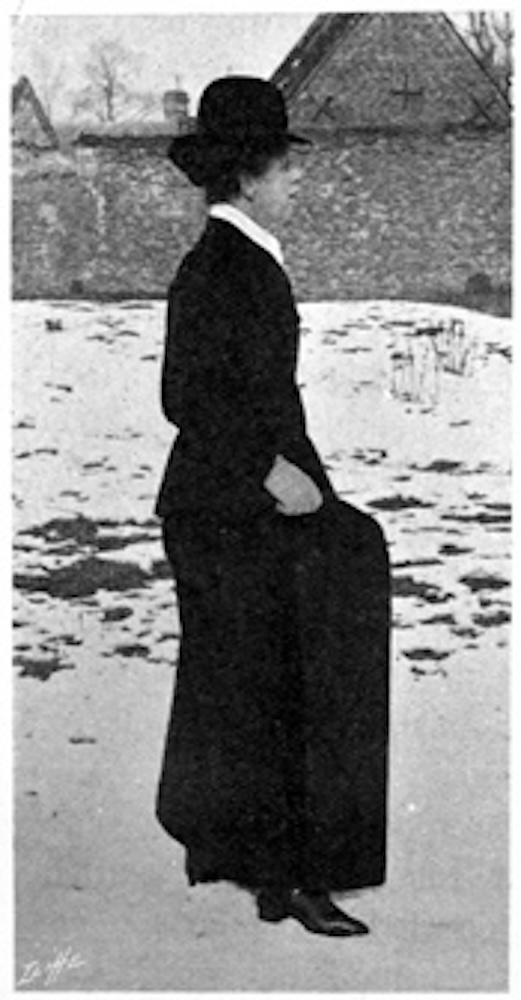
Many nineteenth-century novels reference habits commonly worn by horsewomen. Sir Walter Scott's Rob Roy (1817) features Diana Vernon, whose name is indicative of the common nickname given to horsewomen to identify them with the Roman goddess of the hunt (Munkwitz, "Designing Diana," 745). When readers meet Diana, she is described wearing "a coat, vest, and hat, resembling those of a man, which fashion has since called a riding habit [...] Her long black hair streamed on the breeze, having in the hurry of the chase escaped from the ribbon which bound it" (Scott, 5). In Jane Eyre (1847), by contrast, Blanche Ingram's more decorative "purple riding-habit almost swept the ground, her veil streamed long on the breeze" (chp. 17). Similarly, in Mary Elizabeth Braddon's Lady Audley's Secret (1862), Lady Audley appears in a "long blue cloth habit" that flatters her figure, but is a "timid horsewoman, and utterly unable to manage the animal she rode" (110). These three women are all representative of horsewomen—both fashionable and athletic—of the nineteenth century, and all are depicted wearing some variation of a riding habit, which consisted of a fitted coat or vest, a hat, and a long, full skirt.
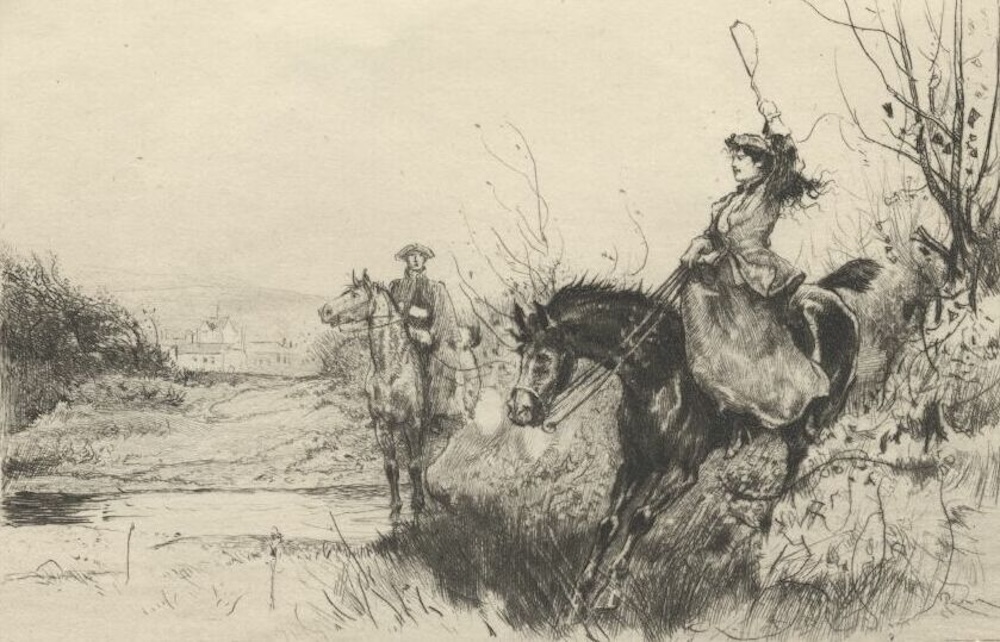
Diana Vernon from Sir Walter Scott's Rob Roy, Connoisseur Edition, 1893.
Over the course of the Victorian era, many horsewomen incurred injuries because of how dangerous their skirts were. Most commonly this occurred when a woman was dragged by her horse if she fell off and her skirt got caught in the saddle. In Anna Sewell's Black Beauty (1877), Lady Anne falls off her horse, Lizzie, after the mare gets spooked and bolts. When Black Beauty and his rider, Blantyre, chase after them, Black Beauty describes "the green habit flying on before us. My lady's hat was gone, and her long brown hair was streaming behind her. Her head and body were thrown back, as if she were pulling with all her remaining strength, and as if that strength nearly exhausted" (109). After falling off of Lizzie, Lady Anne is found "motionless among the heather, with her face to the earth" (Sewell 109). Cases like this were a real threat to equestrian women and were often the result of the long and full riding costume. These early riding garments limited women's participation in sports, while at the same time, motivated them to demand safer and more practical riding clothing.
In the early nineteenth century, riding habits became established pieces of many women's wardrobe as equestrian activities became more widespread among the wealthier classes. Through these earlier years, riding habits were simple but formal and were not used just for riding but also for traveling and walking. As riding became a standard accomplishment for affluent women around mid-century, habits became fashionable class signifiers but also incorporated practical changes that allowed the freedom and control required for more strenuous riding. In the late nineteenth century, women's riding habits evolved significantly as skirts were redesigned for safety purposes, eliminating excessive length and providing more ease in the saddle. Although new styles were not perfect, these more practical riding habits led to the advancement of female sporting activity by making it possible for women to gallop and jump with more athleticism. By the end of the century, some women abandoned the side-saddle and riding habit altogether, leading the way for what would become the norm in equestrian sports.
As riding skill became a desirable accomplishment over the course of the nineteenth century, it became important for women to look the part. The hunting field became "a place of performance, where these new sportswomen were able to prove their social standing" (Munkwitz, "Angels and Amazons," 512). As Alison Matthews David suggests, "the essence of the horsewoman's garb was a lean, understated, and almost masculine simplicity. She represented the epitome of cultivated elegance and cut a fine figure in her tailored habit and silk top hat. Clad in her severe attire, the horsewoman became a center of visual attention in Victorian England" (179). As early as the 16th century, women's riding habits had been modelled on male clothes, with sharply tailored jackets and details such as frogged closures and military-inspired headgear. Women originally had to get their habits made by experienced tailors, but during the Victorian era publications such as The Lady's Monthly Museum or The Taylor's Complete Guide began to include patterns that made fashionable versions more broadly available to consumers. With this increasing market, there were even manufactured habits with matching breeches produced to sell as a pair (Arnold 22-3).
While the habit functioned as a gendered signifier of class, the hunting field was also a place for women to "break out of the traditional class and gender-based hierarchies of the time," (Munkwitz, "Angels and Amazons," 512). By the end of the nineteenth century, the more athletic modern horsewoman represented a "turning point" in female dress that favoured function over fashion (David 179). As Bailey's Magazine noted in 1878, "Ladies who hunt have emancipated themselves by abandoning the dangerous long habit, which caused many accidents" (Munkwitz, "Angels and Amazons," 519). This evolution granted women a new type of social and physical freedom, and it led to the development of athletic garments for other sports including shooting and yachting for the wealthy, and croquet, archery, golf, hockey, and cricket among the middle classes (Nunn). The growth of women's participation in equestrian sport over the nineteenth century thus contributed to the evolution of other women's sports clothing and women's public sports in general which continued to develop into the early twentieth century.
Victorian conduct books and riding manuals were a common way for women to learn how to ride and what to wear. As Munkwitz notes, the purpose of these books was to "illustrate proper, respectable, and admirable behaviours" that equestrian women would be expected to fulfil (Women, Horse Sports, and Liberation, 99). As participation in equestrian sport increasingly expanded among elite women early in the nineteenth century, men began sharing their expertise by publishing riding manuals for ladies. When riding expanded out of the upper class and was considered a valuable accomplishment of all Victorian women, however, it was experienced horsewomen who began publishing guidebooks to share their firsthand knowledge. These guidebooks prioritized teaching women both how to ride as properly and safely as possible and how to choose and wear proper riding clothing.
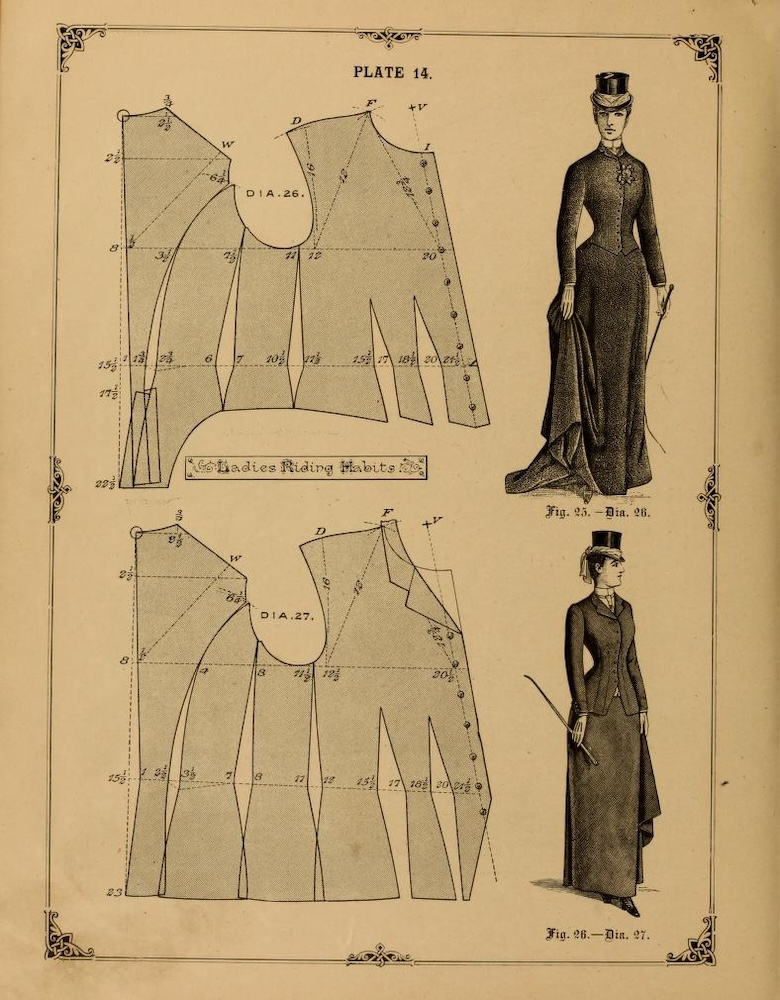
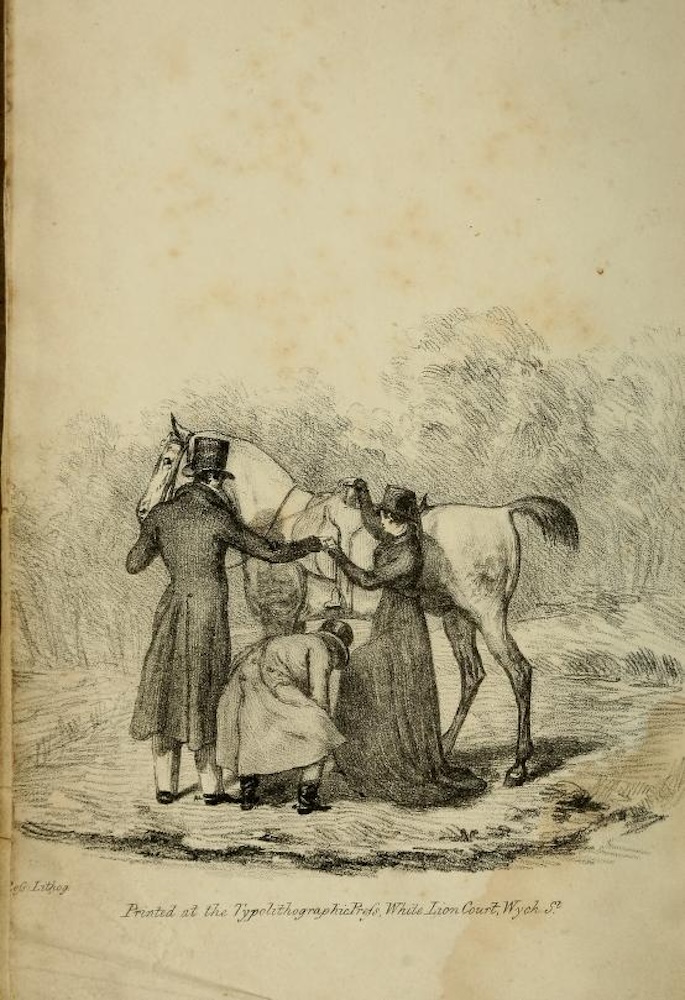
Left: Patterns for ladies' riding habits in The Cutters' Practical Guide to the Cutting of Ladies' Garments (1892) by W.D.F. Vincent. Plate 14. Right: Illustration from Edward Stanley's The Young Horsewoman's Compendium of the Modern Art of Riding (1827). Frontispiece. [Click on the images to enlarge them.]
Manuals published in the early nineteenth century, such as Edward Stanley's The Young Horsewoman's Compendium of the Modern Art of Riding (1827), were often detailed and took a how-to approach to teaching women to ride. The preface to Stanley's book explains that horsemanship was "considered essential in a Lady's education," and because of this, he wished "greatly to assist Ladies in the acquirement of a sufficient knowledge of Riding for the common purposes of exercise" (iii-iv). Alongside riding techniques, Stanley makes sure to instruct his readers on how to properly manage their habit. As a lady is helped onto the saddle by a man, "care must be taken, that no part of the Habit is under the Lady's foot when placed in the man's hands; as it acts as a check, and prevents her taking a sufficient spring" (5). Once on the saddle, "it will be advisable to take hold of the Habit and under garments with the right hand, close to the right knee, to ease them up, in order to allow sufficient room for the knee to come quite down in the crutch, where it must remain perfectly stationary" (7). Most importantly, "great care must be observed, that the Habit and under garments are particularly full and easy, in order that the Lady may be at perfect liberty, and not, in the most trifling degree, confined by them" (8). Stanley stresses meticulous placement of the habit to ensure that the rider has absolute control of it both while mounting the horse and while actually riding. By including these specifics, Stanley aimed for inexperienced women to learn quickly and skillfully.
As equestrian sports became a more standard accomplishment for women by mid-century, industrialization and economic growth made it possible for the middle classes to participate. More guidebooks began being published to a wider demographic, and they became more accessible to middle class and rural women. Willis P. Hazard, in The Lady's Equestrian Manual (1854), states:
those who have the time and the money to spare may well take a few general lessons from a teacher; but to the many who have neither, yet wish to be able to ride with comfort and elegance, and particularly to those in the country, and small towns, where the lessons of a teacher are not to be had, yet where it is a necessary accomplishment, this volume must undoubtably prove a welcome addition (7-8).
Hazard intentionally published his book for those who did not have the time, money, or proximity to take proper lessons. Since riding on horseback was considered "one of the most graceful, agreeable, and salutary of feminine recreations," it became important that riding manuals reach as many women as possible (Hazard 9).
Women's riding habits at mid-century were ideally fitted on top and full on the bottom, with the rider's hair pulled away from the face and adorned with some type of headpiece. It was essential for habits to be both practical and presentable. In learning equestrian sport, ladies therefore also learned how to maintain a composed appearance. Hazard cautioned against "all that is gaudy, needless, or even elaborate, is vulgar." He argued instead for functional elegance: "the habit should fit the bust, without a crease: but beneath the waist, it ought to be, not only long, but, somewhat full and flowing. Its color should be dark as possible, without being positively black" and "the hair should be plaited; or, if otherwise dressed, so arranged and secured, that it may not be blown into the rider's eyes; nor, from exercise, or the effect of humid weather, be liable to be so discomposed, as to become embarrassing" (Hazard 34). He concluded that "a hat, or neat undress military cap, is indispensable to the female equestrian" and "a veil is the reverse of objectionable, provided it be of moderate length, and safely tied to the hat or cap; which, it is proper to state, should have no other ornament or appendage" (34-35).
Other mid-century guidebooks promote similar sentiments. Mrs. Stirling J. Clarke's The Ladies' Equestrian Guide (1857), the first equestrian manual written for women by a woman, reflects the firsthand knowledge that experienced horsewomen sought to share. "As a woman," Clarke asserted, "I write exclusively for the guidance of my own sex," noting that "although many books have been published which successfully impact a knowledge of riding to gentlemen, not one has appeared that can be regarded as a sufficiently comprehensive treatise for ladies" (iii-iv). Because male equestrians had never ridden side-saddle in a woman's habit, many women found a lack of adequate guidance in the books they were reading. Experienced women riders such as Clarke observed that beginners often felt helpless or uncomfortable around horses. To address this issue, Clarke wrote a thorough riding manual that she hoped would help beginner riders learn proper techniques.
Clarke emphasized that proper equestrian attire "should be perfectly exclusive, distinct from every other, and resembling nothing by itself. Its chief characteristics should be simplicity, and elegance, with everything masculine carefully avoided;" she further notes that "nothing may be neglected that can add ease or grace to such an exquisite costume" (17-8). To achieve this, the body of the jacket should fit carefully around the woman's bust and waist, the sleeves should fit comfortably around the arms, and the skirt must flow gracefully without being too long (18-20). While the habit should usually be made of cloth, a lighter material called "cachmerette" was admitted for use in the warmer months, though dark colours were always preferred (20). Clarke included other details such as appropriately braided hair, thick collars, and small white cuffs to ensure an elegant appearance (21). Clarke's instruction drew on firsthand knowledge that helped equestrian women craft a flawless image that communicated both upper-class standards and an ideally feminine quality.
More equestrian guidebooks and manuals written by women were published into the late nineteenth century, with a second wave hitting after 1880. By this time, objections to ladies' participation in equestrian sports had mostly disappeared and horsewomen were becoming increasingly skilled. This second wave of female-authored manuals also coincided with the rise of the New Woman and associated desire for increased freedom and movement in women's clothing. With this shift, feminized mid-century habits were replaced by more functional, pared down styles.
Nannie Power O'Donoghue, an outstanding Irish horsewoman in her time, published Ladies on Horseback in 1881 after retiring from her career as a journalist. In the introduction, O'Donoghue explained that she was inspired to write her book (originally papers published in the columns of The Illustrated Sporting and Dramatic News) because among women in Dublin and London "the style of riding was bad; the style of dressing was incomparably worse" (viii). O'Donoghue's riding manual thus addressed sporting activities and appearance: "men write very well for men," she notes, "but in writing for us ladies they cannot, however willing, enter in to all the little delicacies and minutiæ of our tastes and feelings, and so half the effect is lost" (1-2). Central to the endeavour was O'Donoghue's belief that women to learn proper riding techniques and appearance were best taught by other, more experienced women.
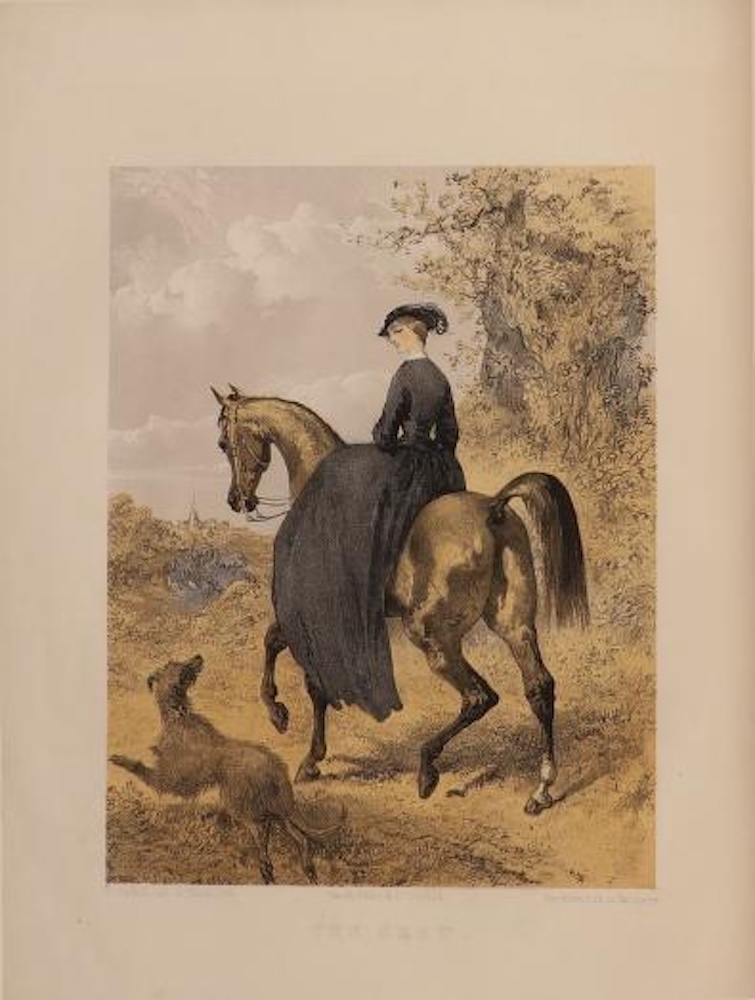
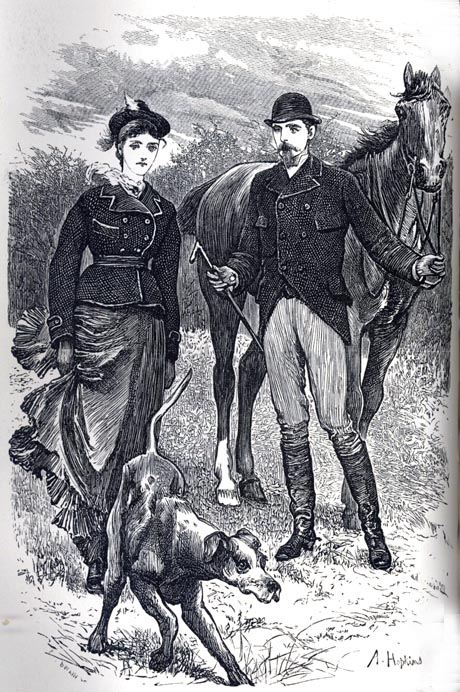
Left: J. Burkill, "The Seat," Smith, Elder & Co, Day & Son. Lithograph as seen in Clarke's book. Right: "Flinging himself from his horse, he took the bridle in his hand and turned towards home." Wood engraving by Arthur Hopkins. Scanned by Philip V. Allingham. [Click on the images to enlarge them.]
On the question of clothing, O'Donoghue advises that women first learning wear "a pair of strong well-made boots [...] strong chamois riding-trousers [...] a plain skirt of brown holland [...] and any sort of dark jacket" (11-2). Once the lady is ready to appear in public, she will need "a nice well-made habit of dark cloth [with a] [s]kirt to reach six inches below the foot [...] without one inch of superfluous cloth; jacket close-fitting [...] sleeves perfectly tight [...] No braiding nor ornamentation of any sort [...] A small neat linen collar, upright shape, with cuffs to correspond" (44-55). Well-made riding uniforms that were practical but attractive were O'Donoghue's priority. Her first-hand experience allowed her to convey which clothing would be the most functional, and also to provide tips for her readers, such as avoiding long veils that cover the mouth and become inconvenient on wet and frosty days; investing in easily cleanable leather gloves; avoiding pins just in case they come undone and cause discomfort; and using a piece of elastic to secure the hat during vigorous activity (47-54). She also advertises celluloid for collars, cuffs, and shirt-fronts — an "invaluable" material that resembled fine linen but did not spot, crush, become limp, or require washing (53). O'Donoghue also advises that hair be "left flowing, for no matter how well you may fancy you have it fastened, the motion of the horse will shake it and make it feel unsteady, and the very first hairpin that drops out, up will go your hand to replace it, and your reins will be forgotten" (12). These details, along with her functional approach, rendered O'Donoghue's riding manual notable for containing useful knowledge that would help women gain confidence and independence on horseback.
As the functionality of women's riding habits was increasingly prioritized in the late nineteenth century, horsewomen such as Alice Hayes also continued to develop safer and more practical styles. In her reissued guidebook, The Horsewoman, published in 1893 and updated in 1903, Hayes explained that the first edition "was the result of seven years' experience of riding hundreds of horses in India, Ceylon, Egypt, China and South Africa; the most trying animals being those of which I was the rough-rider at my husband's horse-breaking classes." She continued:
Since that edition came out, I have hunted a good deal, chiefly, in Leicestershire and Cheshire, and have taught many pupils, both of which experiences were of special advantage to me in preparing this new edition; because English ladies regard riding, principally, from a hunting point of view, and the best way to supplement one's education, is to try to teach (vii; vol.1).
Hayes placed particular emphasis on the material best suited for riding clothing, suggesting that "Melton is by far the best material for riding habits which are intended for hard wear, as in hunting [...] for a good Melton habit lasts for several years" (89; vol. 2). The colour, she went on, should be an "inconspicuous tint," such as dark blue, which does not fade or turn green like black (90; vol.2). Hayes's opinions on material and colour did not change between her two editions, suggesting that a dark blue Melton habit remained the best style in which to invest through the end of the nineteenth century and into the twentieth.
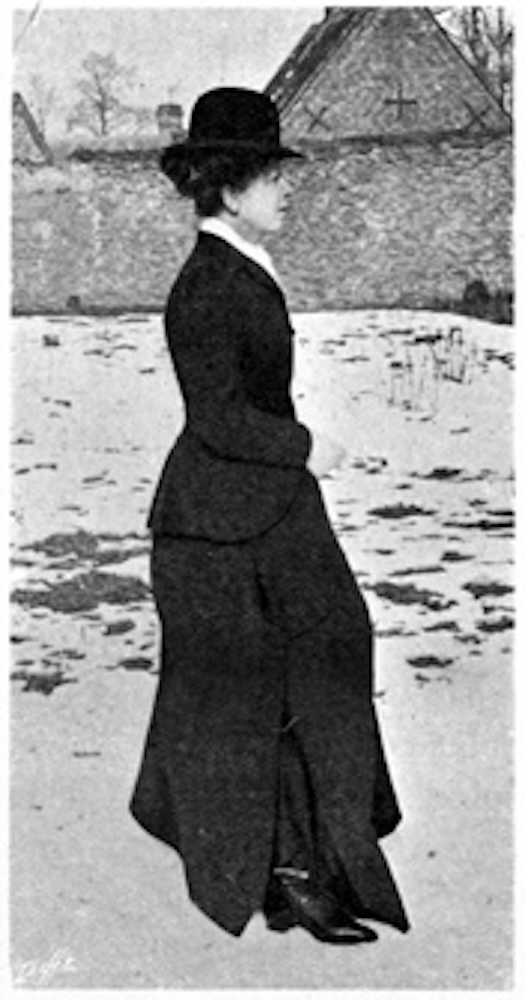
Hayes is most notable for her extensive commentary on riding skirts and her development of a new pattern that became the modern standard. She explains that while in India in 1885, the skirt she was encouraged to purchase for the hot weather was "a failure, for the skirt flapped about like a sheet in the wind, and the marks of perspiration [...] looked most unsightly" (92; vol.2). Her central concern, however, was the danger posed by women's riding skirts: "[S]afety in the saddle is the first consideration, and as no article of riding dress has proved such a deathtrap as the skirt, no lady should ride in one of the old-fashioned, dangerous pattern" (92-3; vol.2). To address this issue, Hayes developed her own style of a shorter safety skirt that she initially discussed in the first edition of her book:
I found the plan of connecting the skirt to the under and outer part of the right leg of the breeches, just above the knee by two buttons, about 1 ½ inches apart, to be an easy and effective method for obviating the risk of the skirt being caught on the crutches; for the right leg, in the event of a fall, will then carry the skirt out of the angle formed by the upper crutch and the saddle. The buttons, which should be large and flat, should be sewn to the breeches, and the buttonholes made through the skirt, so that the rider may have no difficulty in undoing the buttons when she dismounts; and vice versa. This idea of mine has certainly the great recommendation of costing but little to put into practice. I may point out that the buttonholes in the skirt will not be seen when the wearer is walking, as she will hold that portion of her skirt in her hand (40; vol.1).
 .
.
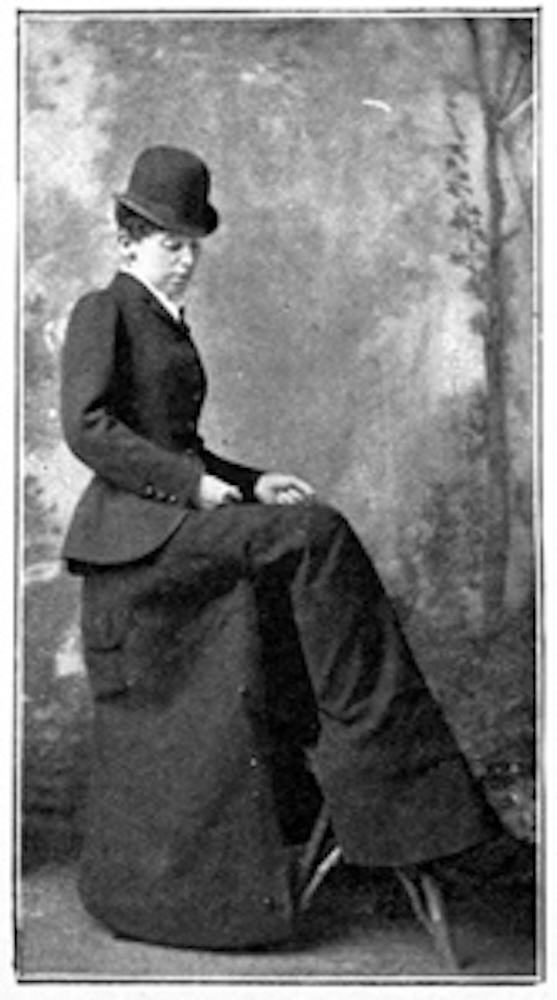
Left: The Hayes' Safety Skirt open for mounting. Hayes, vol 2. Figure 52. Center: Off side of The Hayes' Safety Skirt. Hayes, vol 2. Figure 53. Right: The Hayes' Safety Skirt closed for walking. Hayes, vol 2. Figure 54. [Click on images to enlarge them.]
Although this was practical, Hayes was "by no means satisfied with it," so she continued to develop her safety skirt to ensure "absolute safety in the saddle, and a decent covering for… limbs when out of it" (94; vol.2). Her second attempt resembled an apron skirt, in which there is "a side opening, from which the cloth near the crutches is cut entirely away" so that the skirt can be open while on the saddle but closed while walking (Hayes 94-5; vol.2).
Across both editions, Hayes stressed the importance of having habits that were well-fitted but allowed for movement, and using material that ensures women appeared presentable and confident, while also remaining practical for British weather. She pointed out that it was historically difficult for women to get properly fitted riding breeches to wear under skirts because no correct measurement would be taken, but this was solved by providing women with female fitters who carefully took the measurements needed (Hayes 110; vol.2). Through the early years of the twentieth century, women began to wear breeches without a skirt, and the shift to riding astride, as men did, commenced.
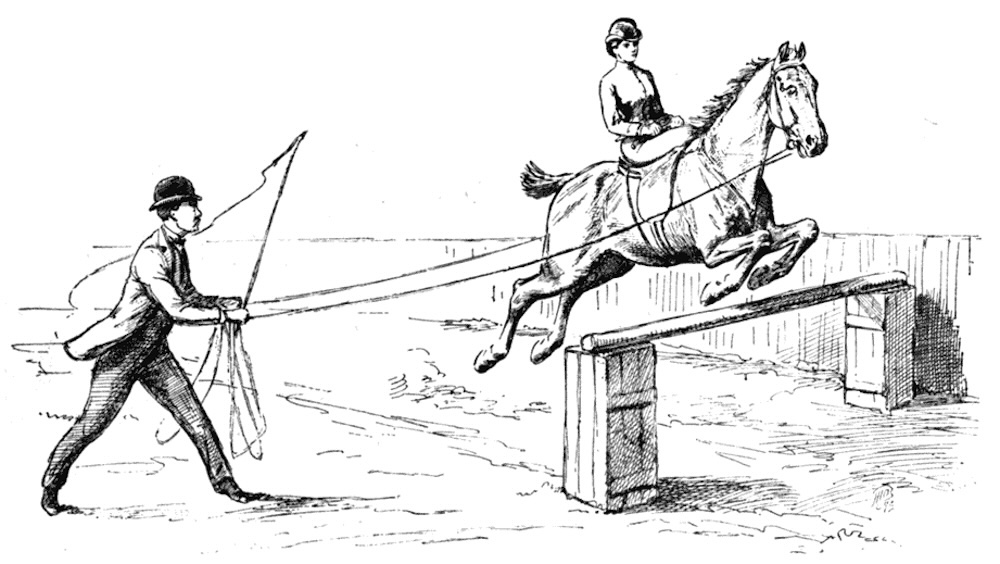
Driving horse over jumps. Hayes, vol 2. Figure 105.
As horsewomen in the nineteenth century began to participate in more athletic forms of riding, their riding habits changed significantly. The long and voluminous riding skirts that were popular through the beginning and middle years of the century were transformed into shorter, minimal skirts, and finally into the innovative safety and apron styles that were developed by horsewomen such as Alice Hayes at the end of the Victorian era. Fabrication also changed, from heavy meltons to lightweight cachmerette and practical celluloid. At the same time, key components of riding costume — such as fitted jackets in conservative colours — remained largely consistent, producing a sense of tradition associated with the taste and social position of the established upper- and upper-middle classes. This harmonization of continuity and change in clothing normalized the turn to more athletic forms of riding by women.
Related Material
Bibliography
Arnold, Janet. "Dashing Amazons: The Development of Women's Riding Dress, c.1500-1900." In Defining Dress: Dress as Object, Meaning, and Identity, edited by Amy de la Haye and Elizabeth Wilson, 10-29. Manchester: Manchester University Press, 2000.
Braddon, Mary Elizabeth. Lady Audley's Secret. 3 vols., 1862. Edited by Russell Crofts and Jenny Taylor. London: Penguin Books, 1998.
Brontë, Charlotte. Jane Eyre: An Autobiography. 1847. London: Service & Paton, 1897. Project Gutenberg. Accessed August 10, 2026.
Clarke, Stirling J. The Ladies' Equestrian Guide: The Habit and the Horse: A Treatise on Female Equitation London: Day & Son, Ltd., 1857. Internet Archive. Web. Accessed 20 August 2026.
David, Alison Matthews. "Elegant Amazons: Victorian Riding Habits and the Fashionable Horsewoman." Victorian Literature and Culture 30, no.1 (2002): 179-210.
Hayes, Alice M. The Horsewoman, A Practical Guide to Side-Saddle Riding. 1st ed. London: W. Thacker & Co., 1893.
--. The Horsewoman, A Practical Guide to Side-Saddle Riding. 2nd ed. San Bernardino, ULAN Press, 2016.
Hazard, Wiilis P. The Lady's Equestrian Manual: in which the Principles and Practice of Horsemanship for Ladies are Thoroughly Explained, to Enable Every Lady to Ride with Comfort and Elegance: with Fifty Illustrations. Philadelphia: Kite & Walton, 1854.
Munkwitz, Erica. "Angels and Amazons: Fox-Hunting and Sporting Emancipation for Women." The International Journal of the History of Sport 35, no. 6 (2018): 511-29.
--. "Designing Diana: Female Sports Entrepreneurs and Equestrian Innovation." The International Journal of the History of Sport 35, no. 7-8 (2018): 745-66.
--. Women, Horse Sports, and Liberation: Equestrianism and Britain from the 18th to the 20th Centuries. New York: Routledge, 2021.
Nunn, Joan. "Victorian Fashion and the Growth of Sporting Activities, 1850-1900." The Victorian Web.
O'Donoghue, Nannie Power. Ladies On Horseback: Learning, Park-riding, And Hunting, With Hints Upon Costume, And Numerous Anecdotes. London: W.H. Allen & Co., 1881. Hathi Trust. Accessed August 10, 2026.
Scott, Walter. Rob Roy. 1817. Edited by Andrew Lang. Boston: Estes and Lauriat, 1893. Project Gutenberg. Accessed 10 August 2026.
Sewell, Anna. Black Beauty: His Grooms and Companions. An Autobiography of a Horse. Edited by Kristen Guest. Peterborough: Broadview Press, 2016.
Stanley, Edward. The Young Horsewoman's Compendium of the Modern Art of Riding; Comprising a Progressive Course of Lessons; Designed to give Ladies a Secure and Graceful Seat on Horseback; at the Same Time, so Effectively to Form the Hand, That They May, in a Short Time, Acquire Perfect Command of their Horses. London: J. Ridgway, 1827. Internet Archive. Accessed August 10, 2026
Created 10 August 2026
Last modified 28 August 2026