
Introduction
The Dalziel brothers Edward and George are best known as the foremost wood engravers of the nineteenth century, but they were also directly engaged in the commissioning of artists and the production of fine books. As Bethan Stevens has shown in her voluminous study of the Dalziel archive, their output was vast, involving the production of everything from printed advertisements to famous publications such as Lewis Carroll's Alice books.

The unsigned binding of the Dalziels’ epic album.
Their magnum opus was the Dalziels’ Bible Gallery (1880–81), a monumental, elephant folio album of wood-engraved illustrations printed from the original blocks, with 69 epic designs telling the stories of the Old Testament; it was also issued as a series of prints in a portfolio. Though it never enjoyed much success in its own time, the book compares with two notable publications making use of wood engravings, the famous ‘Pre-Raphaelite Tennyson’ published by Edward Moxon in 1857, and S. C. Hall’s pioneering The Book of British Ballads (1842–44). All three were intended to showcase the best in British illustration and the skill of its engravers, and each underwent a convoluted development.
The Dalziels’ motivations in publishing the volume were multifaceted. The Bible Gallery was conceived 1860–63, and was largely intended as an assertion of the engravers’ prominence in the field of ‘wood-pecking’; in a highly competitive market, the Dalziels wanted to tighten their grip. Astute businessmen (it seemed), profit was always a primary consideration. The project was also nuanced, as Stevens and Cooke have observed, by considerations of class and status. At the beginning of the 1860s the Dalziels were positioning themselves as connoisseurs of the arts, and the Bible Gallery was a perfect means of demonstrating a gentlemanly status that went beyond an artisanal standing and positioned the brothers as middle-class professionals rather than craftsmen (Cooke, ‘Dalziels’ Bible Gallery,’ 61–62). Tired of being treated as technicians by at least some of their artists, the brothers sought to establish their bourgeois credentials through an act of artistic creation. The book was intended, furthermore, as an expression of the family’s Evangelicalism, offering the public a sort of Old Testament bible (with pictures but no text) in an age when knowledge of the scriptures was universal and illustrated bibles were commonplace. In short, virtue merged with vanity and the profit motive.
The immediate inspiration was Schnorr von Carolsfeld’s Bilderbibel, a book of wood-engraved designs, this time accompanying the text, which was published in Germany in 1852 and issued in English as Bible Pictures in 1855 and 1860. Von Carolsfeld’s dramatic illustrations provided the Dalziels with a sort of template, a model as to how painterly illustrations could be applied to the representation of an epic theme. The Dalziels aimed to emulate this prototype and, more especially, exceed it: like S. C. Hall, the editor of The Book of British Ballads (Cooke, ‘Ballads,’ 6), they wanted to show how British arts and crafts were superior to their German equivalents. This nationalistic motivation fused with the other considerations to impel a work that embodied Victorian book design at the high point of the ‘boxwood age.’
That audaciousness was projected in the Dalziels’ commissioning of the most outstanding artists of the age, an approach that exactly parallelled Moxon’s strategy in mounting his illustrated edition of Tennyson’s Poems (1857). Their list was impressive: Frederic Leighton (who received top billing on the title-page), William Holman Hunt, William Dyce, Edward Poynter, Simeon Solomon, Fred Sandys, G. F. Watts, J.E. Millais and Edward Burne-Jones were all approached in the early years of the 60s, as were William Small, A.B. Houghton and Frederick Brewtnall. These artists had at least some experience in visualizing biblical themes in paintings and illustrative work, and all were well-known to the public.
Agreements were quickly reached and at first the project seemed viable, a continuation of the process the brothers had applied in making their many other gift books. However, almost immediately problems began to appear, and frustrations emerge. In their Record, the Dalziels reflect on the obstacles they encountered (Dalziels 98–101). One difficulty was the finding of an editor to coordinate what was always going to be a complex project. Sir George Grove was approached, but declined the offer (Dalziels 260), and, worse, Leighton revealed that he was already working on biblical designs for a rival publication by Cundall. The Dalziels overcame this issue by coming to an agreement with the rival publisher. But the main problem was the unreliability of the other contributors. Some designs were delivered and engraved in the early part of the 60s, but many were not. Millais, so very busy with lucrative painting commissons, promised, but did not complete his commissions (Dalziels 98), and others, such as William Dyce and Edward Armitage, were similarly unreliable (manuscript material, author’s collection). Benighted by this difficult behaviour, the Dalziels paused the project in 1863, put it to one side, and delayed its publication for almost two decades until the end of 1880. Their decision to proceed at this moment was paradoxically a rushed affair: Doré’s Bible Gallery was re-released in the early part of 1880, and the brothers probably believed that their book would have greater appeal than Doré’s and would demonstrate, once and for all, the superiority of their work.
It was a miscalculation, and one mired, once again, in uncertainty. The choice of title – a gallery to challenge Doré’s – was a craven last-minute piece of competitive labelling to make up lost ground in the marketplace, but the long delay in publication was damaging and completely changed the book’s appeal and cultural orientation. It was first planned as a flagship, a bold representation of the high period of wood engraving; but by 1880 wood engraving was being replaced by photomechanical techniques, and the Bible Gallery could only be seen as a swansong, a remembrance of a way of making illustrated books that was already in decline. The Gallery was made as appealing as possible as a connoisseur’s piece – being sold in a limited edition of 1000 alongside a portfolio issue – but public interest in this sort of art had already waned. Nor was it helped by the heterogeneity of the visual styles, with the mid-Victorian neo-classicism of Leighton and Watts contending with the Pre-Raphaelitism of Madox Brown and Solomon and the Germanic outlines of Pickersgill, while also including the Aesthetic scene-making of Poynter. Like Moxon’s version of Tennyson’s Poems (1857), it seemed like a jumble hurriedly assembled, despite its long gestation. Priced at 5 guineas for the book and 10 for the portfolio version, it was, to put the final nail in the coffin, far too expensive – even bearing in mind its epic format as a series of prints taken from the original blocks. The Dalziels report it was a ‘dead failure’ (256) with only 200 copies being sold. Yet, despite being a monumental flop in economic terms, it is still a book of extraordinary power, impact, and interest. While not setting out to be comprehensive, the following sections set out to navigate its brilliant unevenness by investigating a series of key issues.
Narrating the Old Testament
The Dalziels discussed the choice of subject with their artists, usually offering a number of alternatives from which they could choose (Dalziels 248). Their lack of prescriptiveness is typified by their dealings with Ford Madox Brown, in which they offered him six subjects from which he was to select three. But their suggestions were anything but binding: ‘if they do not suit you then we must think of more or perhaps you can suggest what you would like to do’ (Letter, 19 November 1863, Victoria and Albert Museum, quoted McCulloch 125). Such an approach seems fair, but as a strategy it encourages dilatoriness and unevenness in the completed work, a situation not helped by the absence of a guiding editorial hand. This lack of firm direction exactly mirrored Moxon’s difficulties in rounding up and motivating the artists at work on his edition of Tennyson’s verse.
Indeed, the Dalziels’ planning of the book was confused. Their approach, it seems, was to gather a variety of subjects representing key moments, and choose what appealed to them. It was, it seems, a selection made on the basis of aesthetics – and what happened to have been completed – rather than the rational organization of a narrative. Madeline Hewitson has argued in a detailed essay that the Dalziels focused on Exodus, but the other books are covered to varying degrees, with little evidence of logic and many omissions.
It is especially noticeable that the first plate, by Leighton, is Cain and Abel. This seems a curious (and pessimistic) point at which to open Genesis, but the Dalziels had to make do with it as they had no other material to present. They had commissioned Burne-Jones to produce a Creation series of drawings (now in Birmingham City Art Gallery and Museum) which they turned down as incongruously at odds with the style of the other contributors; and Jones also offered an Adam and Eve that was never completed (Dalziels 254). The same could be said of J. E. Millais’s promise of the same subject but the artist ‘never made the drawing [or] went so far to as to make even the slightest sketch’ (Dalziel 98). In short, there were no drawings of God making the world, the Creation of Adam, the Creation of Eve, the Temptation, or the Expulsion. Not done, not produced, or not included: it was a difficult situation, and left the book with a glaring lacuna in the opening sections that contemporaries undoubtedly compared with the brisk comprehensiveness of Doré’s rival tome.
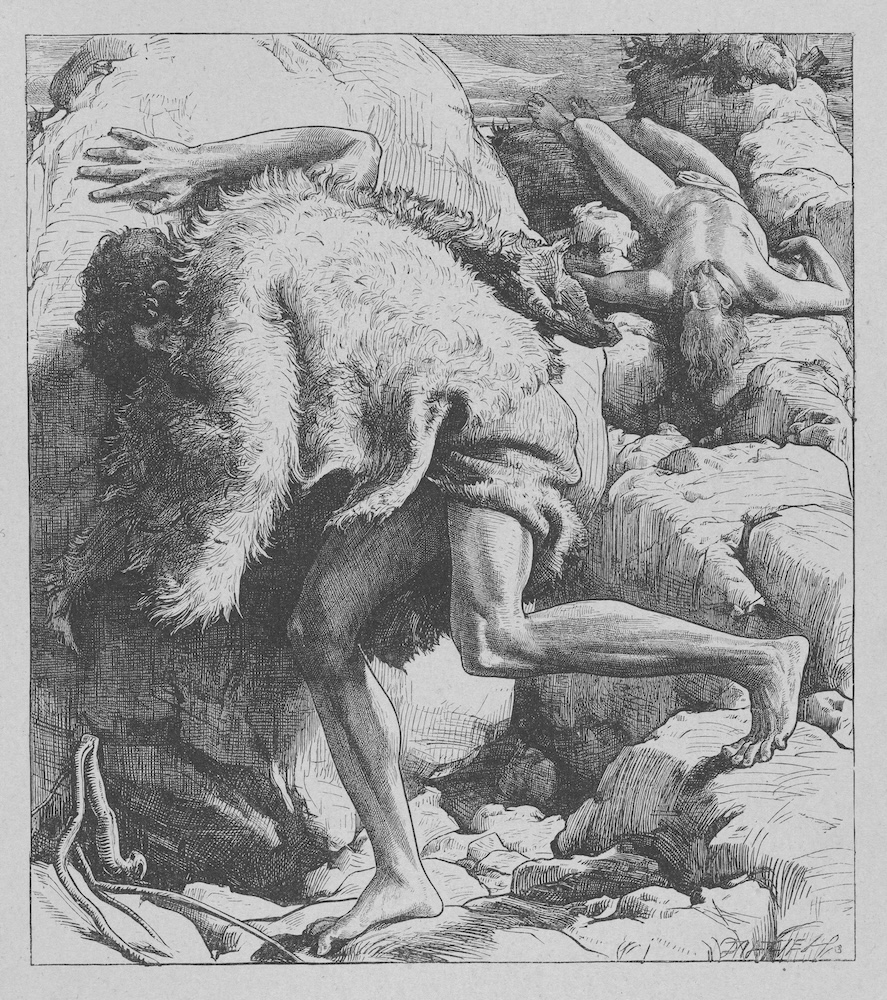
Leighton’s tragic and disturbing treatment of Cain and Abel, imbuing Cain with a guilt-ridden conscience that he does not display in the original text.
Furthermore, this type of omission carries on throughout. The end result is a telling of the Old Testament which is very incomplete, with a seemingly random focus on some of the major scenes and characters and on events and minor players that must have been relatively unknown even to the scripturally literate among the original audience. However, the Dalziels do seem to have made some efforts to rectify this situation by including some plates to strengthen the narrative links. These were Thomas Dalziel’s illustrations, which take the form of a single page of two images and provide a forward interlinking flow. In the narrating of the story of Noah, for instance, Dalziel’s two designs, The Deluge and The Ark upon the Waters are positioned between Watts’s representation of Noah girding his loins as construction of the Ark begins, and his sacrifice of animals after the Flood has subsided. The story of Abraham is similarly strengthened by the use of these dual images, and the same approach is used within the stories of Abraham, Joseph and Jacob.
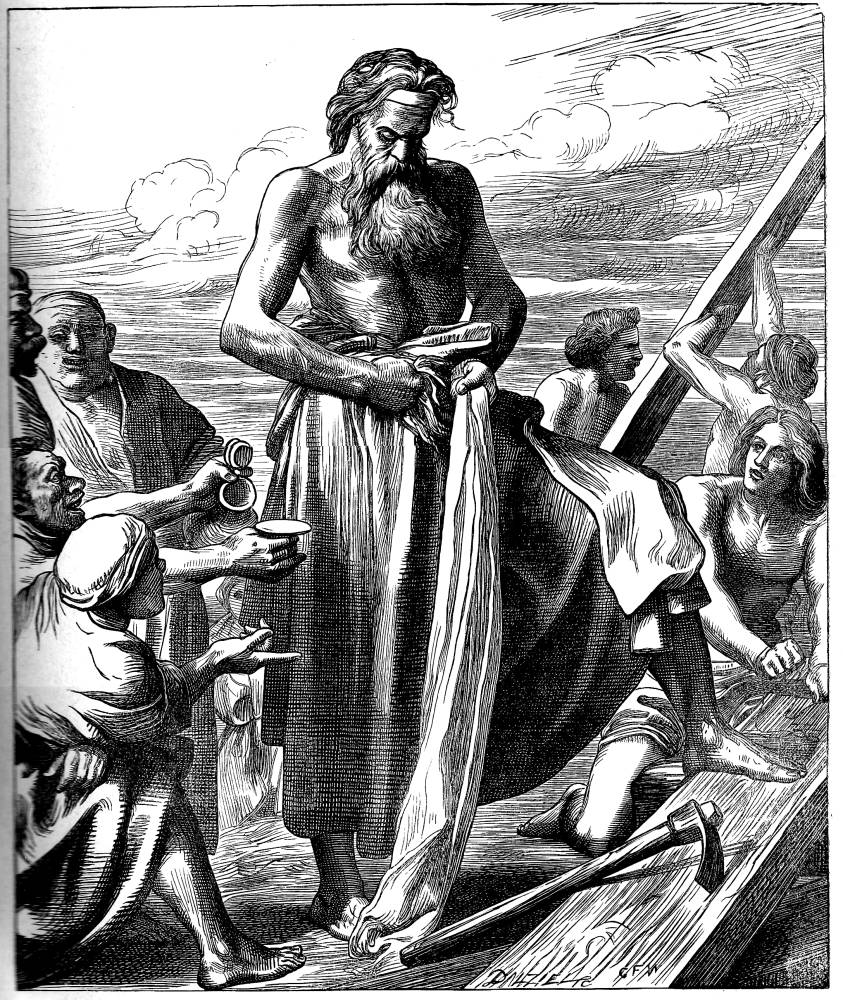
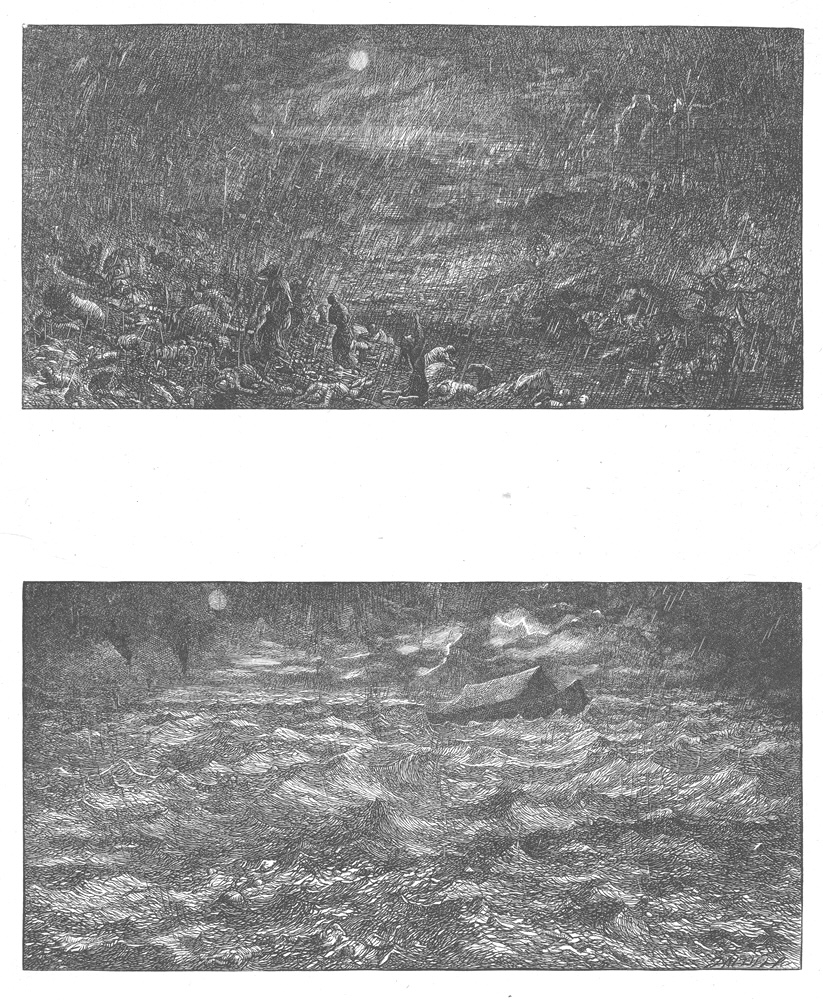

Structuring the narrative: Left: Watts’s Noah and the Ark’; middle: Thomas Dalziel’s The Deluge and The Ark upon the Waters; right: Watts’s The Sacrifice of Noah.
Despite these narrative illustrations, the Bible Gallery principally conveys the events of the Old Testament through the medium of vivid, heroic and highly dramatic images which act as a series of distilled glimpses at the biblical material rather than an attempt at consistent storytelling. Gordon N. Ray describes the book as a ‘noble residue’ (95) of wood engraving of the Sixties, and it could also be described as a fragmentary relic of the Old Testament.
Lessons in History and Geography
How, then, to capture the milieu of the ancient world? Victorian history painters often drew on contemporary research, and the artists working on the Bible Gallery were similarly interested in materializing the ‘look’ of the biblical past, with efforts being made to represent the costumes and buildings as accurately as possible – even if the landscapes were problematic.
Madox Brown was obsessively concerned with the historical validity of his designs; as McCulloch observes, ‘Brown approached religious compositions in the same fastidious way as his paintings of English history’ (132). This strategy was especially pronounced in his work on the costumes and setting of The Death of Eglon. Brown did not visit the Middle East, but based his design’s details, Donald Esposito demonstrates, on ‘published sources, in particular … the wood-engraved illustrations dotted throughout [Austen Henry] Layard’s Nineveh and its Remains’ (280), which was published in 1853. As Esposito further explains, the ‘dagger heads protruding from Eglon’s ample girth are likely to have been taken from Layard’s work,’ while ‘the decorative frieze behind Eglon is composed of honeysuckle interspersed with other motifs … as illustrated from a pattern by Layard from Nineveh.’ Other details have the same source, with the ‘side-table’ being based on ‘an example ‘from the Northwest Palace at Nimrud’ (299), and McCulloch has also suggested that Eglon’s jewellery is derived from Layard’s researches (134).
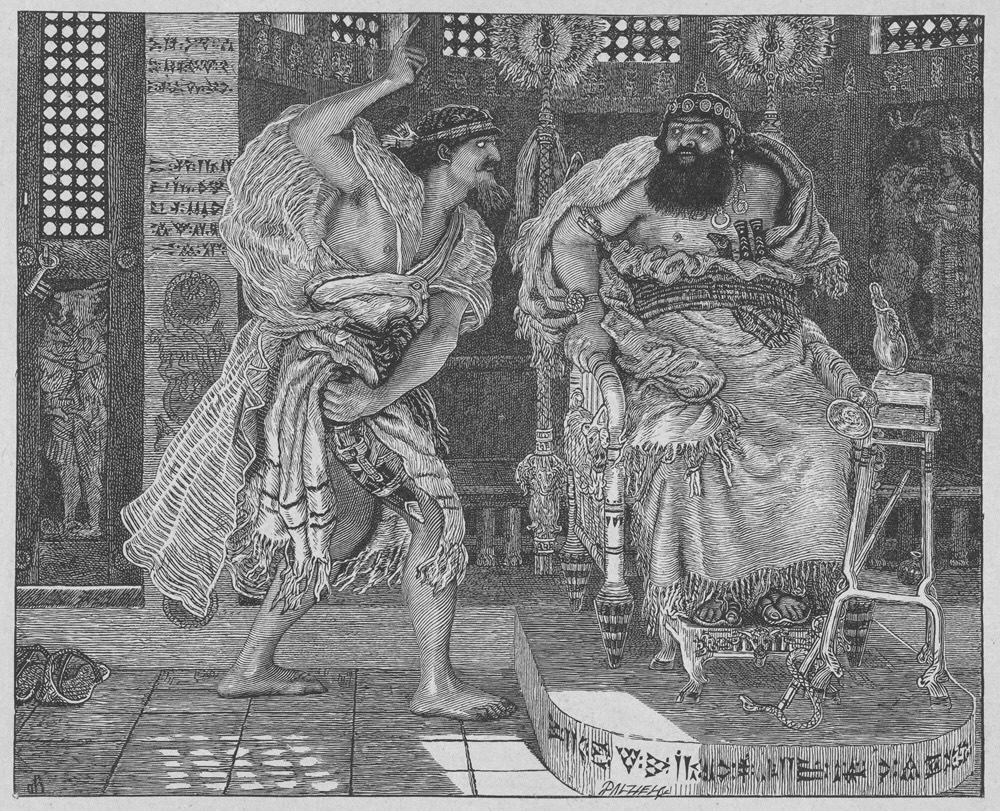

Left: Madox Brown’s antiquarian image of The Death of Eglon: Right: Murch, The Flight of Adrammelech.
Drawing on archaeological sources was repeated by other artists. For The Flight of Adrammelech, Arthur Murch copied the imposing lion’s head from Assyrian sculpture in the British Museum, and in all of the designs featuring ancient interiors Edward Poynter exploited contemporary knowledge of Egyptian architecture and costumes, presenting his interiors as elaborate tableaux of richly reported detail.


Some Egyptian scenes by Poynter. Left: Joseph Before Pharaoh; Right: Joseph Presents his Father to Pharaoh.
These approaches rooted the biblical scenes in a plausible milieu, converting the Old Testament into an historical reality. There were nevertheless many inconsistencies and anachronisms. Although Madox Brown was scrupulous in reproducing contemporary costumes in his Elijah and the Widow’s Son (McCulloch 132), most artists dress their characters in generic clothes, many of which seem more like the costumes of nineteenth century Palestinians than those of the ancients; much is probably imagined.
England or the Middle East? Pickergill’s plasterboard
backdrop in The Passage of the Jordan.
The landscapes, likewise, are far from universally accurate: figured as a mishmash of generalized mountains and deserts, the overall effect is theatrical and unconvincing. Pickersgill’s, for example, look like painted backdrops, with little detail and no sense of regional geography. It is even the case that some of the settings look more like Britain than the Middle East, as in Simeon Solomon’s Abraham and Isaac, which is apparently set in a verdant English meadow, with English flora, and an added mountain in the background. Such inaccuracies sit oddly with some of the artists’ attempts at historical veracity, adding another layer of inconsistency to the book’s rich heterogeneity.
Thematic Patterns: Heroism and the Relationship with Jehovah
Weakened by the lack of a consistent programme as to what should be included, the Dalziels still managed to produce a montage that embodies the theological essentials of the Old Testament in a crystallized form. Several elements are privileged and structured within a series of distinctive visual fields. Of special significance is the epic treatment of the characters who engage with and obey the word of God, and equally important are scenes representing divine power as it is applied to punish the unfaithful and reward the compliant; significant too are representations of the quieter moments of benediction, when family life is foregrounded; and a further domain is focused on women.
The Dalziels clearly intended to embrace the vast range of the original texts and taken as a whole the emotional and psychological scope is extremely broad – from the passions of murder, through various acts of violence and destruction, to feelings of guilt, contemplative wonder, love, and tenderness. Though focused on Man’s relationship with God, the emphasis is always on human drama, with the divinity remaining the invisible, motivating power, and the inchoate team working on the Bible Gallery achieves a degree of coherence by emphasising such tangible experience.
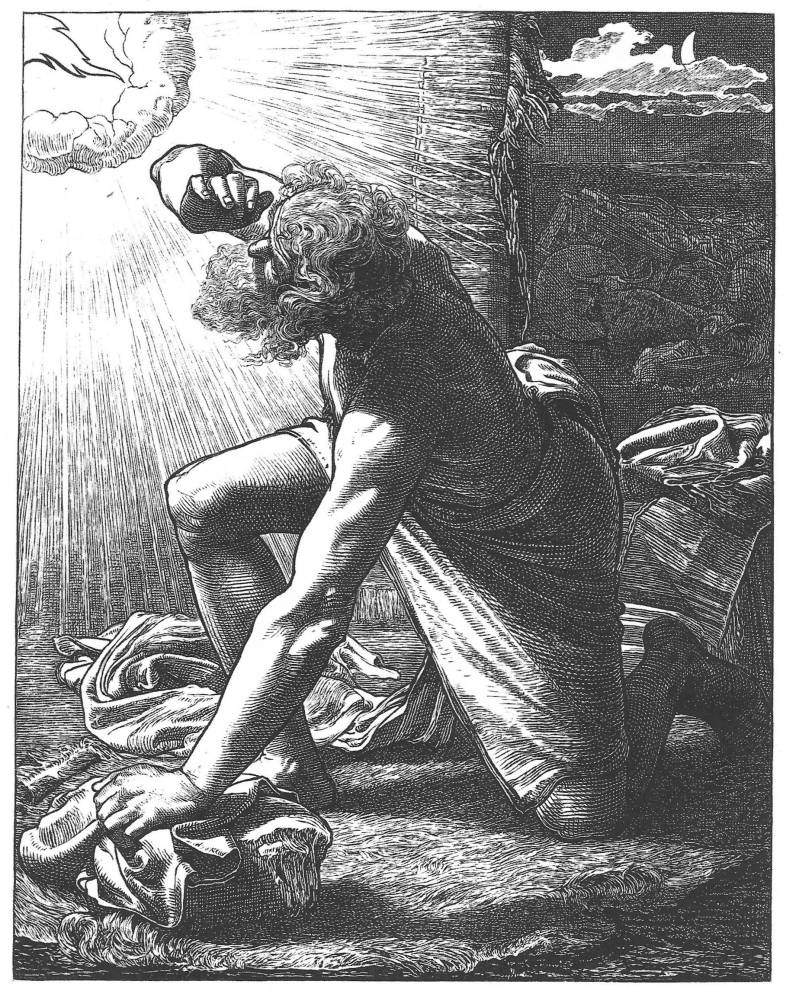

Left: Sandys’s Jacob. Right: Walker’s Elijah
The Victorian fascination with heroism is powerfully conveyed in illustrations which represent the Biblical leaders as epic, muscular, neo-classical titans. Watts’s treatment of the patriarch in Noah building the Ark exemplifies this approach; Fred Sandys’s Jacob is similarly muscle-bound and so is Francis Walker’s Elijah, despite being half-starved. The Old Testament constantly stresses the strength of these mortals, as superhuman types of humanity, and that focus is amplified by Leighton, whose illustrations materialize the athletic masculinity of his heroic Samson. In Samson and the Lion, Samson carrying the gates and Samson at the Mill the artist endows the character with a colossal musculature, most notably in the scene of his killing of the lion when Samson, possessed by the ‘Spirit of the Lord [and] tore the lion in pieces as one tears a young goat’ (Judges 14: 5–5). Samson’s epic scale is exaggerated to the point of caricature, and the whole figure is enlarged so as to occupy most of the picture-plane, with the lion being reduced in size to accentuate Samson’s epic scale.
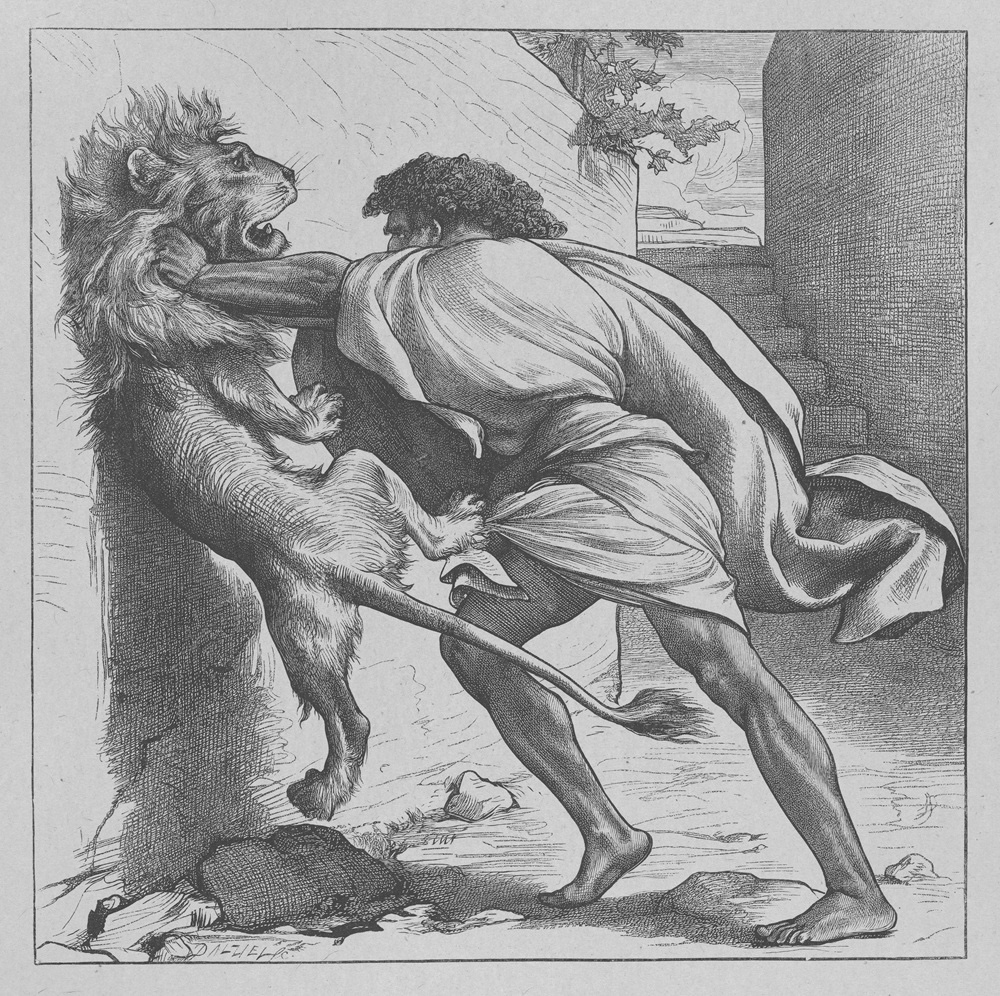
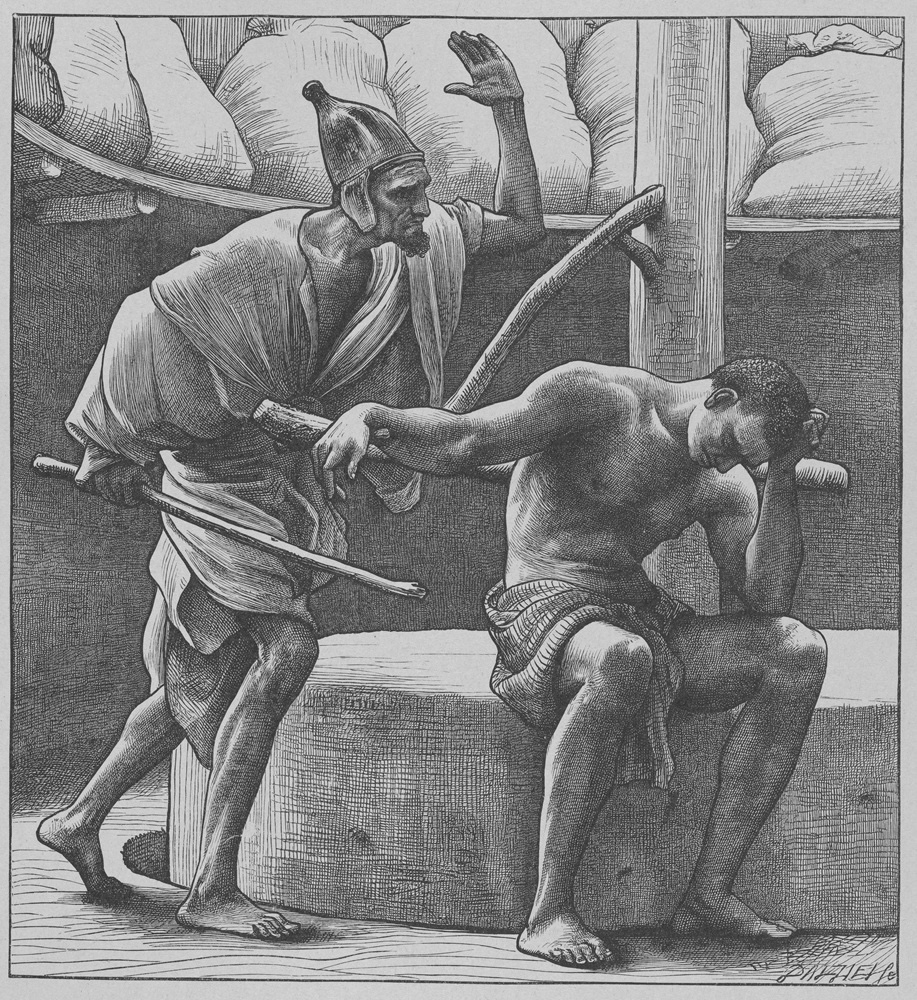
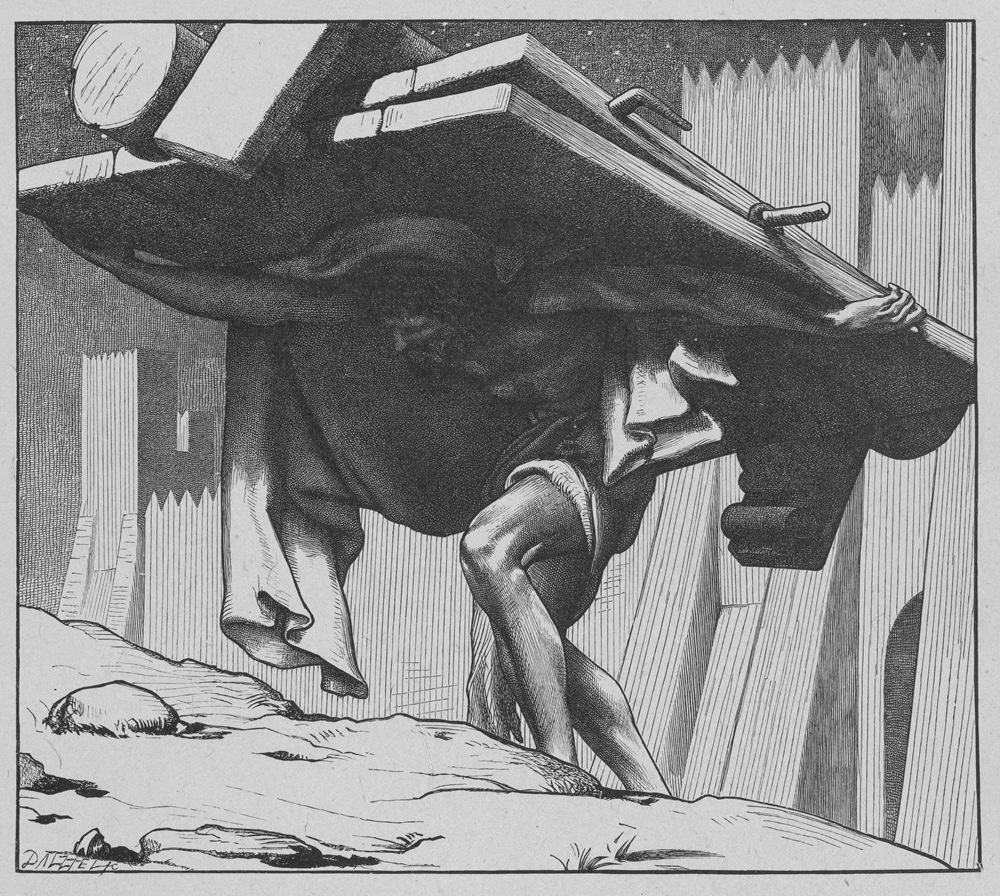
Leighton’s telling of the story of Samson. Left:Samson and the Lion: Middle:Samson at the Mill. Right: Samson Carrying the Gates/
Leighton’s imagery parallels the classical idealization of male figures that also features in his sculpture, An Athlete Struggling with a Python (1877, Tate Britain) and his painting, The Sea Gave up the Dead, Which were in It (1892, Tate Britain).

Poynter, Moses Slaying the Egyptian.
This sort of heroic masculinity, with its celebration of male strength, is matched by the Bible Gallery’s picturing of violence. The killing of the lion is part of a larger pattern including Leighton’s version of Cain’s killing of Abel, Madox Brown’s The Death of Eglon and other celebrations of the righteous application of force such as Poynter’s graphic depiction of Moses Slaying the Egyptian, a scene in which the character kills his oppressor for mistreating a Hebrew worker. Poynter presents the event, nevertheless, as cold-blooded murder, revealing the moment just before the fatal blow is struck and the killer looks around suspiciously.
Other representations of violence, or implied violence, focus on military action, which are of course a central part of the Old Testament. Henry Armstead (misnamed in the book as Armistead) provides two vivid treatments of conflict. In The Fall of the Walls of Jerico he pictures the Israelite army circling the city, with the horns being sounded; and in The Sun and the Moon Stood Still he presents the Israelites’ onslaught on the retreating Amorites in a febrile design of thrashing figures that recalls the effects of a carved relief and closely reflects his main activity as a sculptor.


Armstead’s powerful graphic friezes: Left:The Fall of the Walls of Jerico. Right: The Sun and the Moon Stood Still. Both images again reflect the impact of archaeological research.
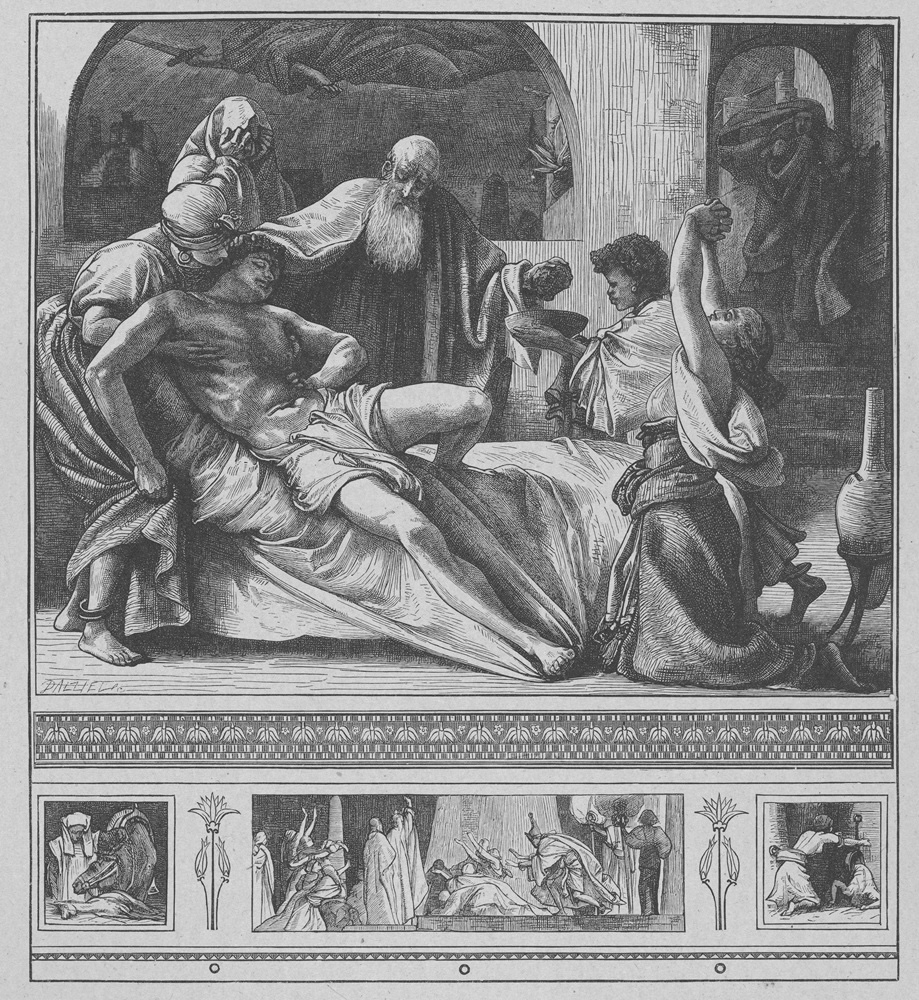
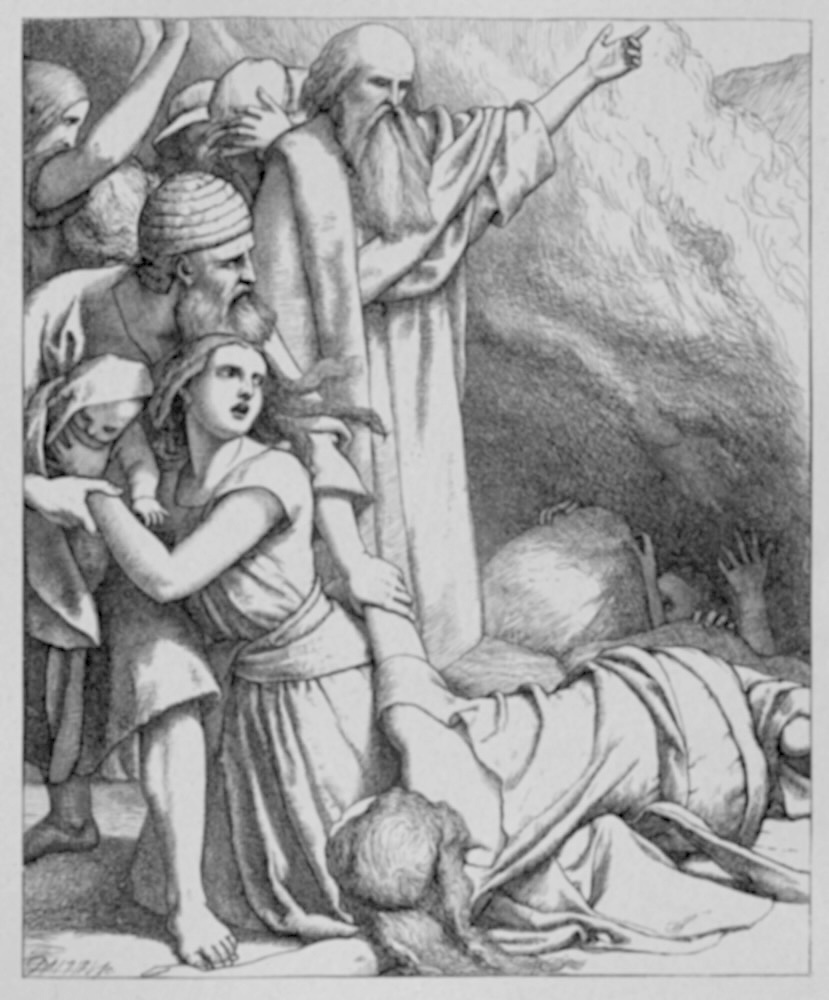
Left: Leighton’s Death of the Firstborn. Right: Pickersgill’s Korah Swallowed Up.
Running in parallel with these human actions, and underpinning them, are the divinity’s acts of punishment and retribution. Many of these are powerfully visualized. Leighton’s Death of the First Born vividly conveys the grieving of the bereaved in a series of gestures, and in Pickergill’s Korah Swallowed Up the horror of the event – signalled by hands disappearing into the earth – is projected by the observers’ distorted facial expressions and theatrical poses. Equally striking are Thomas Dalziel’s panoramic narratives of suffering as various afflictions are brought down on humankind. In The Water turned into Blood and The Boils and Blains, the artist presents the Egyptians in tableaux of agitated figures, head in hands, prostrate, or cradling the dead. Their placement within panoramic settings suggests the universality and inescapability of God’s punishment: all that can be seen, and by implication the whole world, is subject to Jehovah’s will. Dalziel further focuses on the divinity’s epic destructiveness in The Deluge and The Ark Upon the Waters, showing the raging of the elements in visceral designs of mountainous, sharp-peaked waves and white striations of rain that seem to tear the surface of the image. The Destruction of Pharoah in the tumultuous sea and the apocalyptic explosion in The Destruction of Sodom are similarly figured in dynamic, agitated designs in which the movement of light strafes the blackness to create an expressionistic effect.

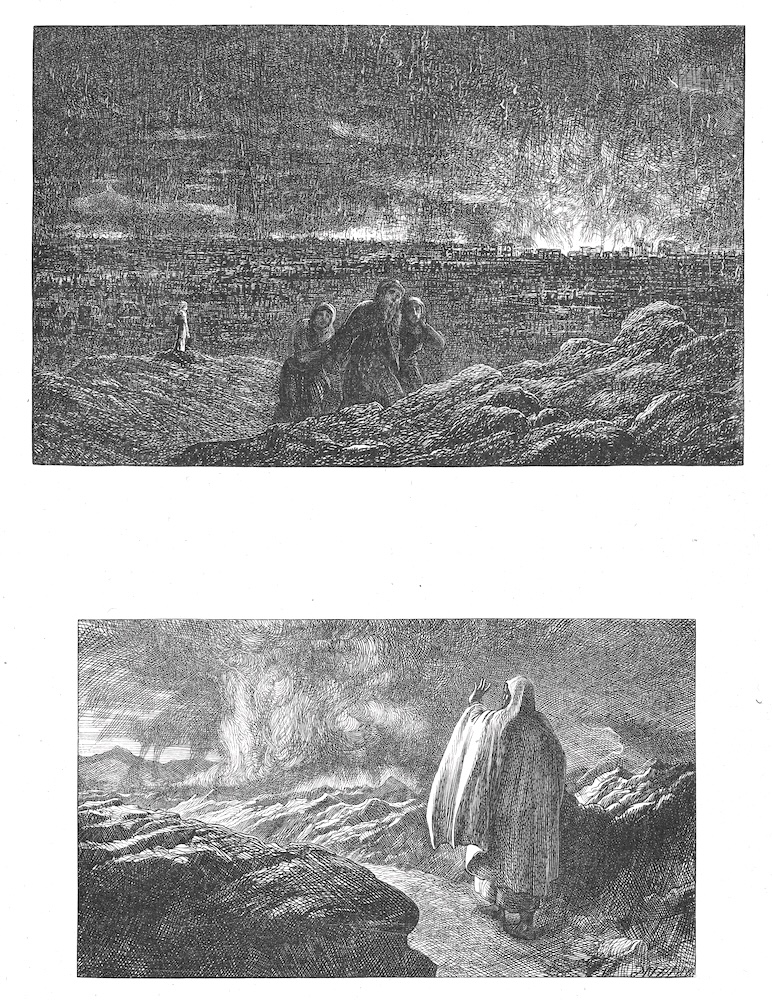
Images of destruction by Thomas Dalziel. Left:The Destruction of Pharoah. Right: The Destruction of Sodom.
In these designs, more than any other, the absolutism of a jealous deity is overwhelmingly materialized, showing God’s enemies as puny beings subject to the will of the omniscient and vengeful Almighty. Informed with more than moderate fervour, the Bible Gallery presents an orthodox treatment of the stories of the Old Testament, reproducing much of its brutality and horror: what could be worse than the God’s demand that Abraham sacrifice Isaac? But that primitivism is only part of the equation, and the Dalziels’ selection of scenes puts equal emphasis on the more gainful aspects of man’s relationship with the divine.
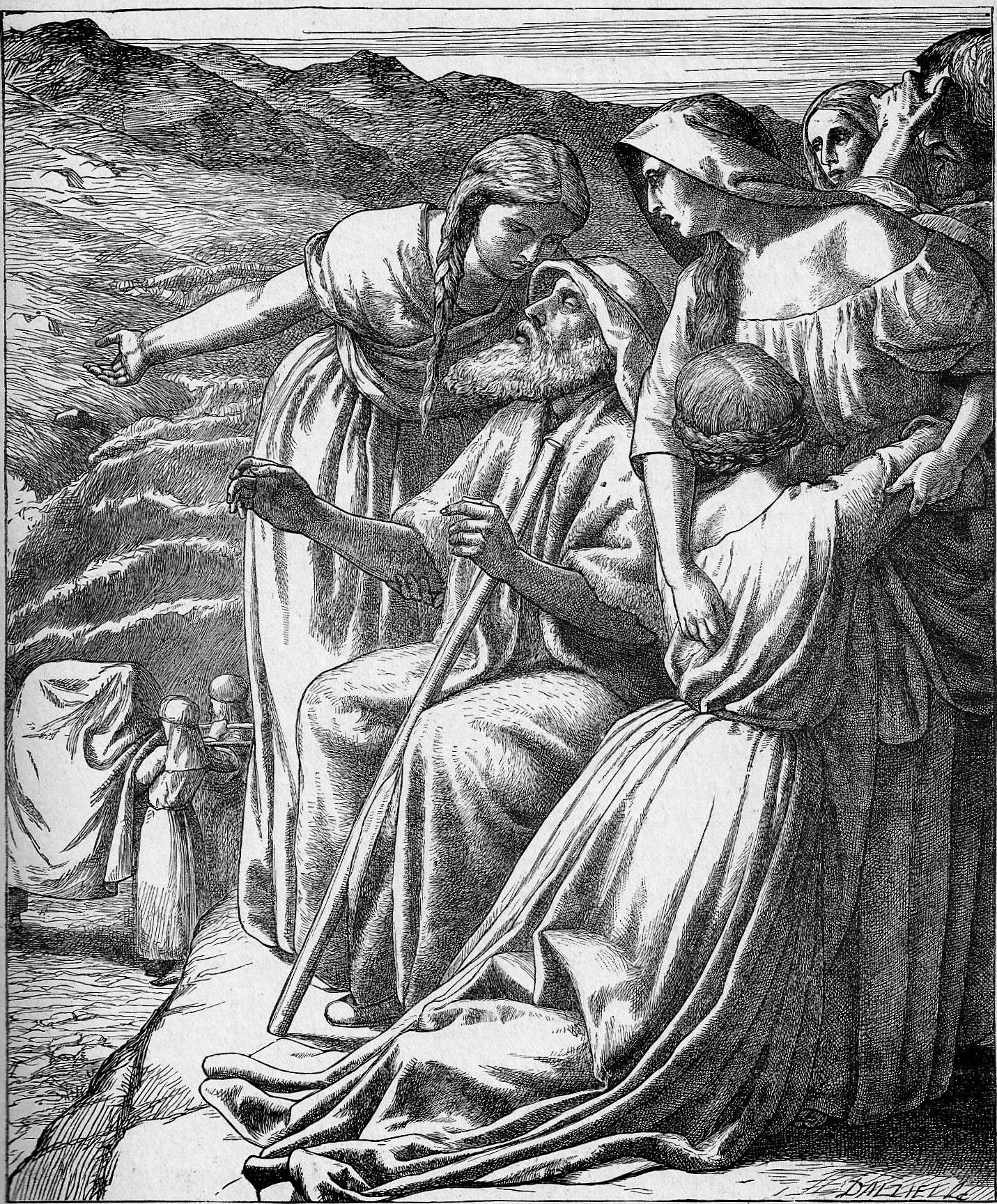
Both impressive and touching is Leighton’s Abraham and the Angel. Leighton crystallizes the moment when the angel tells the old man that his descendants will be as numerous as the stars. He embodies the theme of regeneration in the contrast between the aged Abraham and the highly idealized youthfulness of the divine messenger – a contrast that reflects on time and continuity. Leighton figures Abraham is endowed with a monumental form, with his hand stretched out in fragile incredulity and wonder: a moment of stillness that lasts into eternity. Deep emotion is similarly enshrined in the same artist’s brooding Moses, who is shown contemplating the Promised Land. Others concentrate more generally on God’s benevolence, such as Houghton’s Manna from Heaven (with small children eating the bounty) and Walker’s Elija Fed by Ravens.
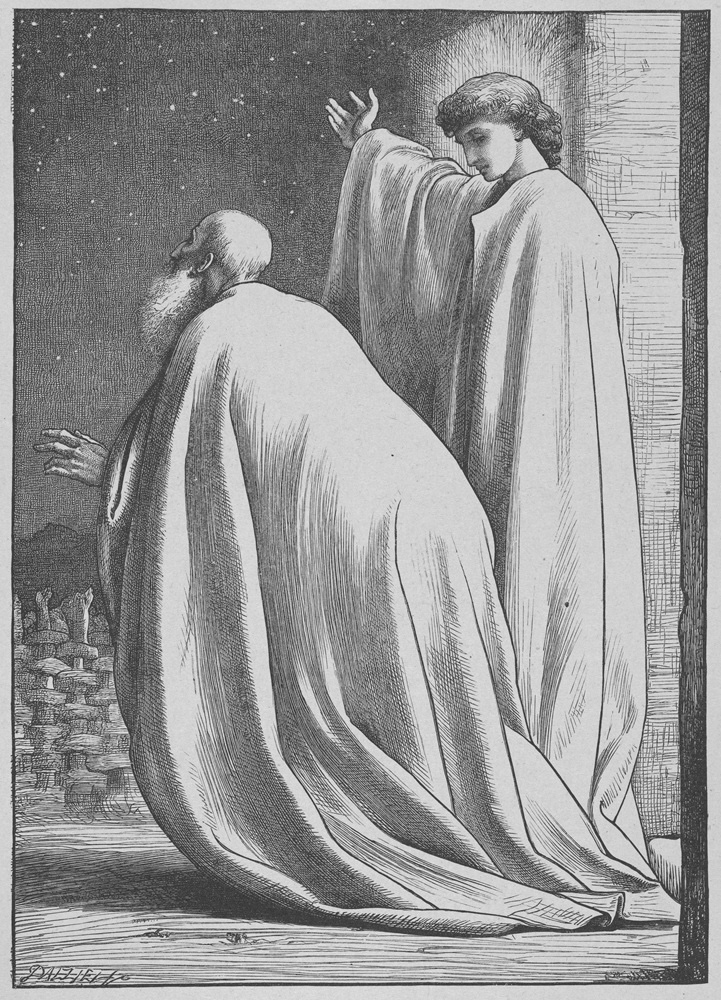
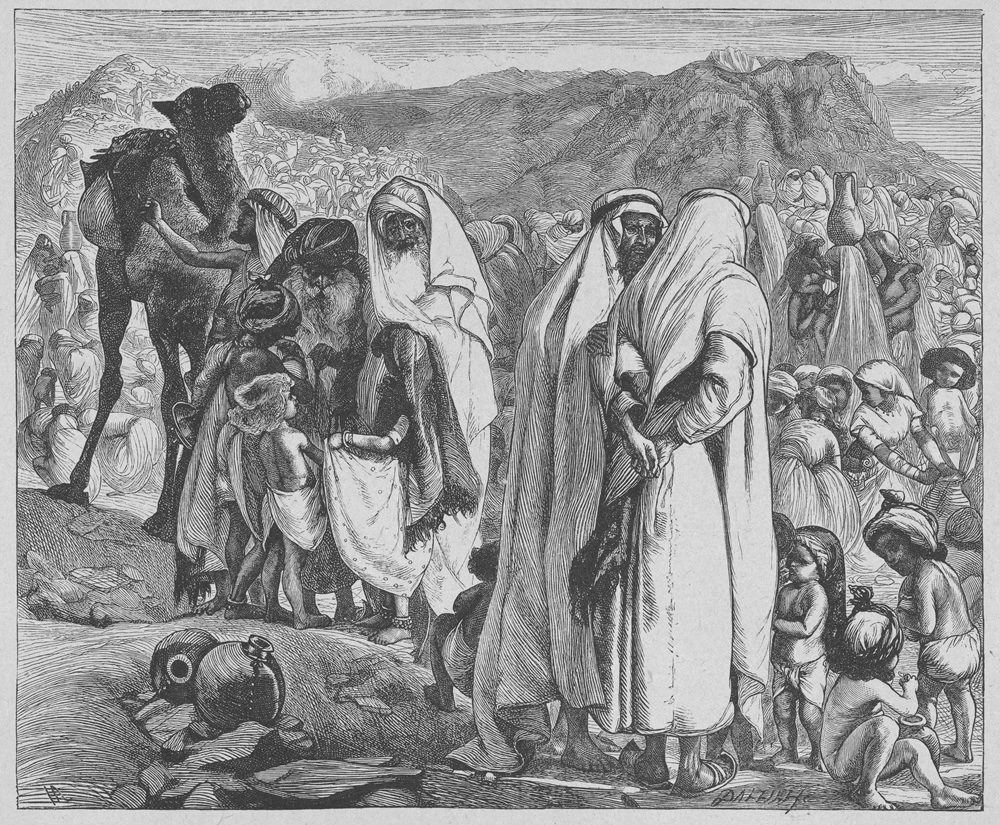
Left: Leighton’s Abraham and the Angel. Right: Houghton, Manna from Heaven.
The Workings of Humankind
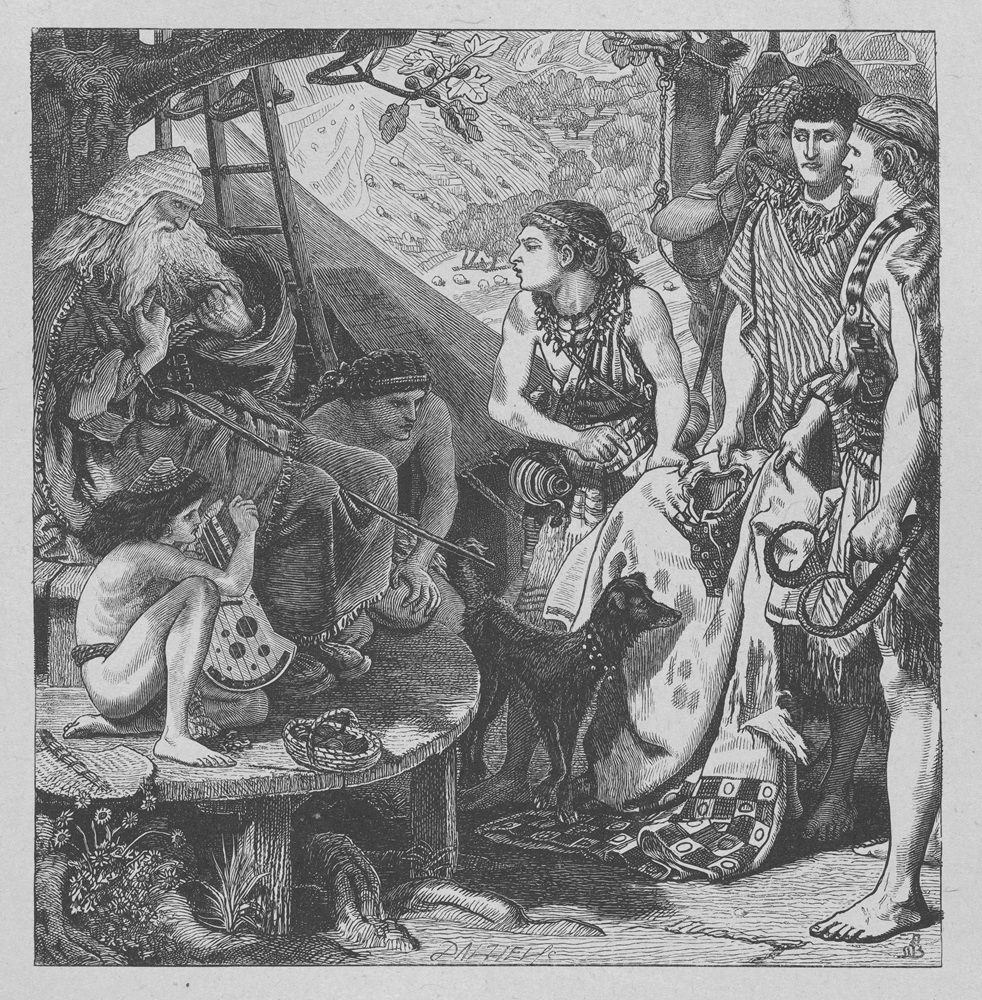
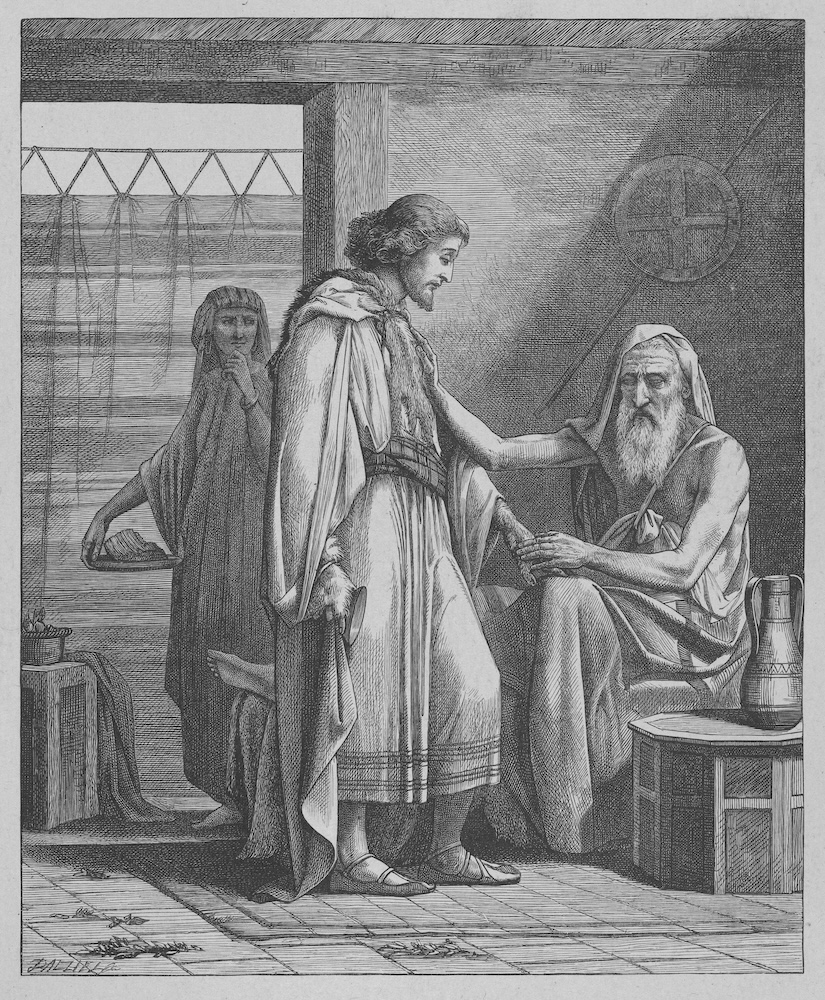
Left: Ford Madox Brown’s Joseph’s Coat. Right: Armitage’s Isaac blessibg Jacob.
These images are matched by illustrations of human behaviour and relationships, and act as signs of the nature of man rather than God, with a strong emphasis on the negative and destructive. Deceit is much to the fore. Madox Brown illustrates the moment when Jacob is confronted with evidence of Joseph’s death, ripping his clothes in grief; Armitage focuses on Jacob’s deception of the blind Isaac; and Dalziel represents Jacob’s stealing of Esau’s birthright.
Grief and loss are likewise figured as a key constituent in mankind’s emotional profile. William Small’s two designs, Cushti bringing news of the death of Absolon to David and Job receiving his Messengers are incisive representations of the moment of shock and dismay. David’s emotion is subtly conveyed in his downturned head and clutching hand, but Job turns round in astonishment.
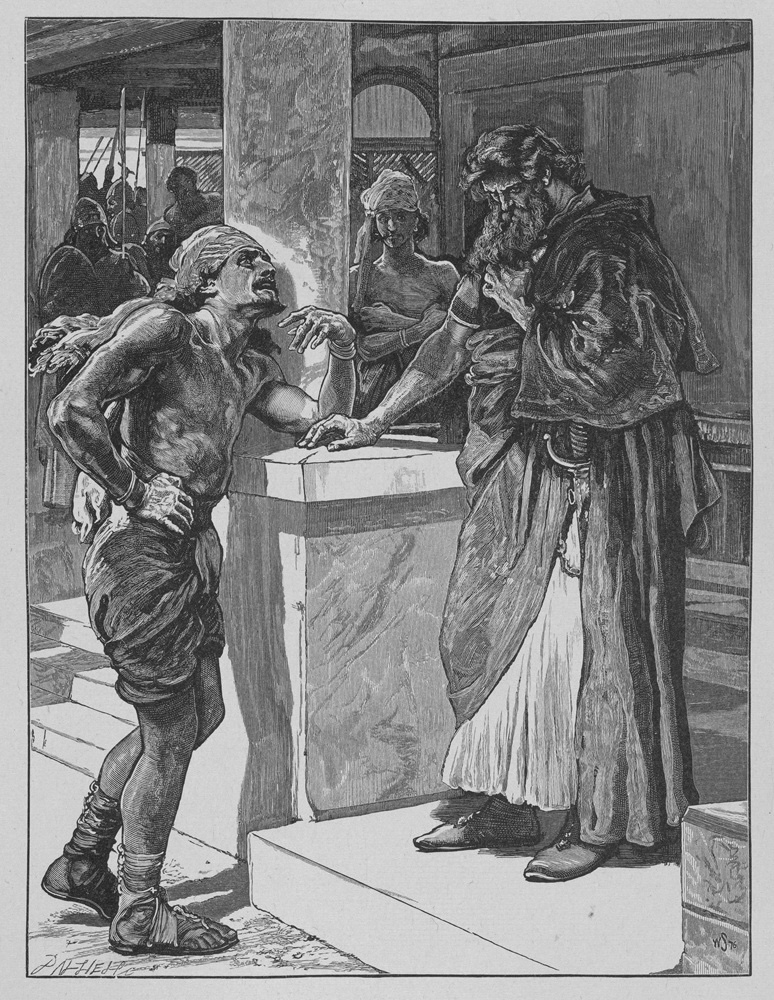
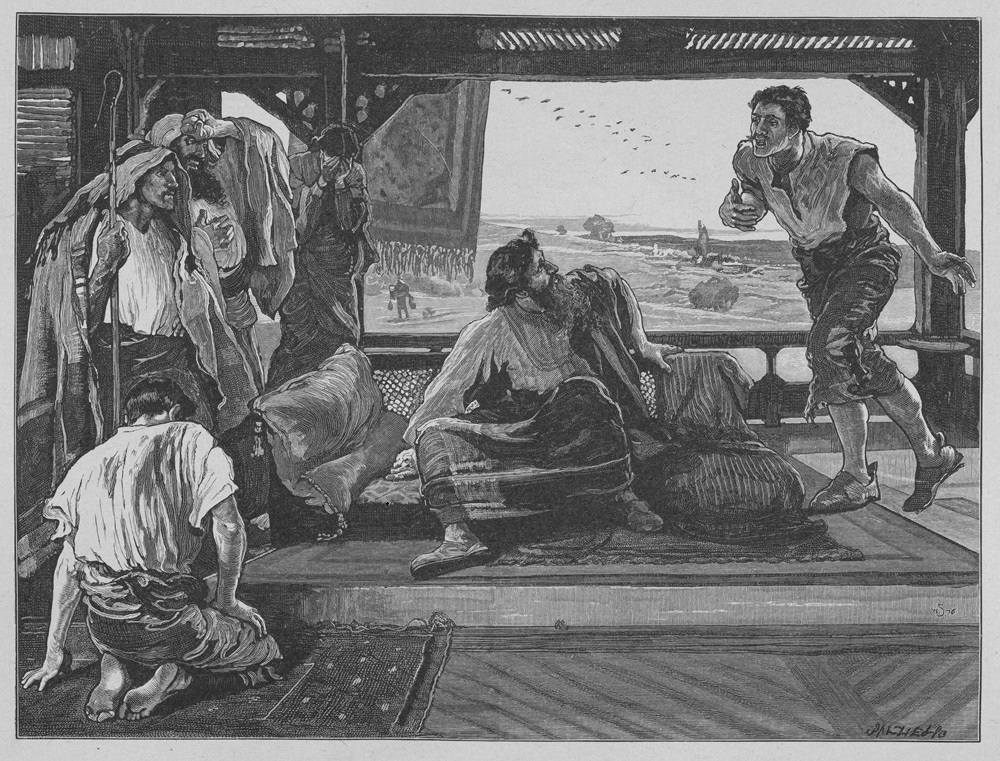
William Small’s dramatic scenes of unfortunate encounters. Left:Cushti bringing news of the death of Absolon to David. Right: Job Receiving his Messengers.
There are numerous representations of positive experiences too. If fathers are often deceived, they are also shown to be generous patriarchs, with blessings being given by Noah in Watts’s design when the Flood has subsided, and in the same artist’s treatment of Esau Meeting Jacob. Jacob is again represented, in an illustration by Pickersgill, blessing Ephraim and Manasseh. In these illustrations the artists deploy intimate gestures, showing their patriarchs reaching out to and embracing their children. Providers of a gainful life, the father-figures act as surrogates of God, notably in Madox Brown’s Elijah and the Widow’s Son, in which Elijah resurrects the child. Brown accentuates the joyousness of the scene, showing the mother in prayer and thankfulness as the old man comes out of the darkness of the upper storey interior into the full sun of life, carrying the child still in his shroud. Emblematic details underscore the theme, with a lit candle illuminating the blackness of death and a swift returning to its home acting as a symbol of the boy’s soul returning to his body.
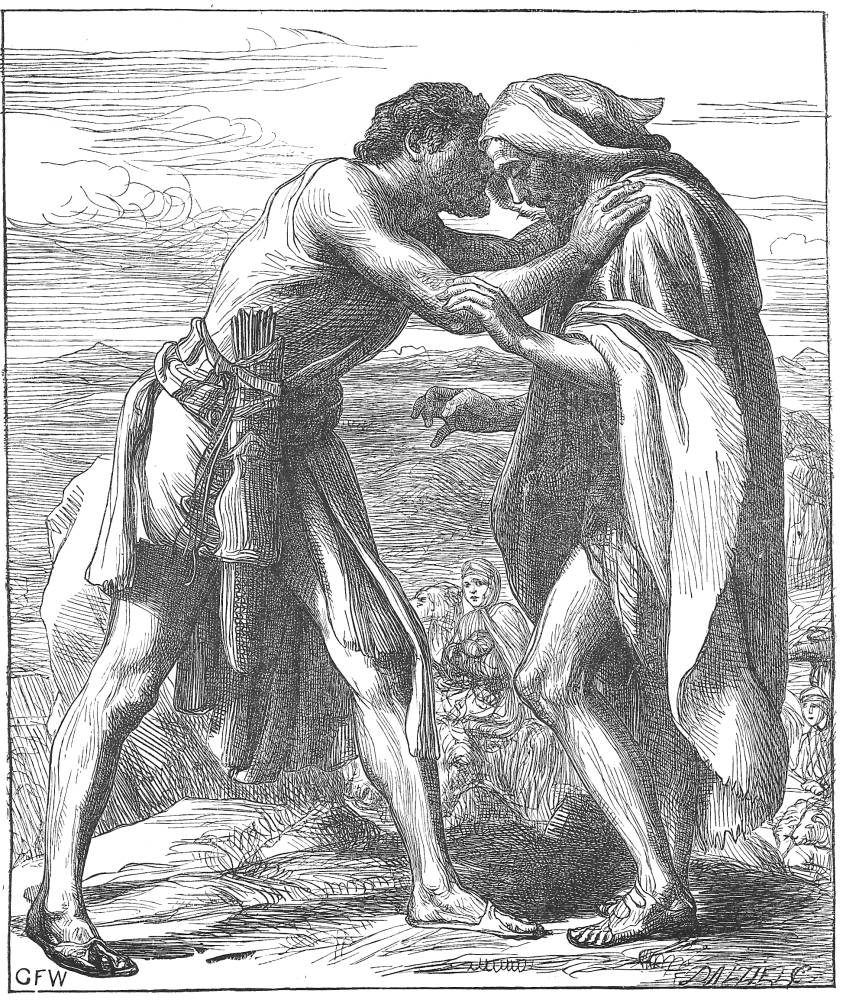
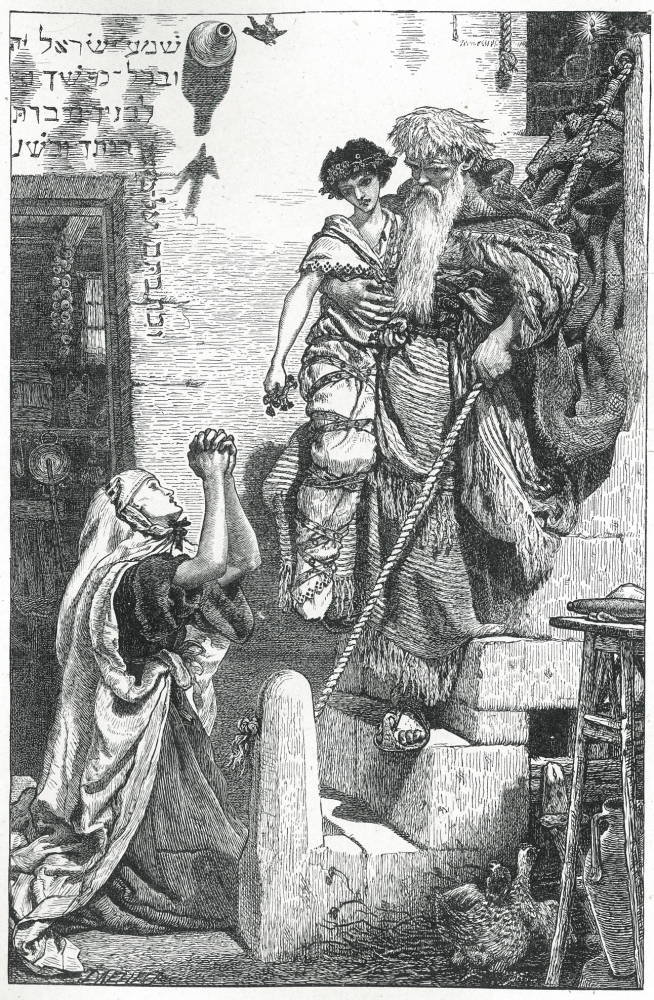
Left: Watts, Esau Meeting Jacob; Right: Madox Brown, Elijah and the Widow’s Son.
That positivity is further enhanced by images figuring relationships between men and women, with some attention given to the process of negotiating a match. The arranging of Isaac and Rebekah’s meeting is treated in three designs. Leighton depicts Eliezer looking for a generous woman, one who will offer him water: his focus is on the potential bride’s beauty, with Rebekah’s physical beauty connoting her moral qualities. His selection is carried forward in Holman Hunt’s scene of Eliezer and Rebekah at the well, with the servant presenting her with jewellery; and in Dalziel’s final stage in the process Isaac’s happiness at seeing his bride is economically conveyed by his upraised hand.
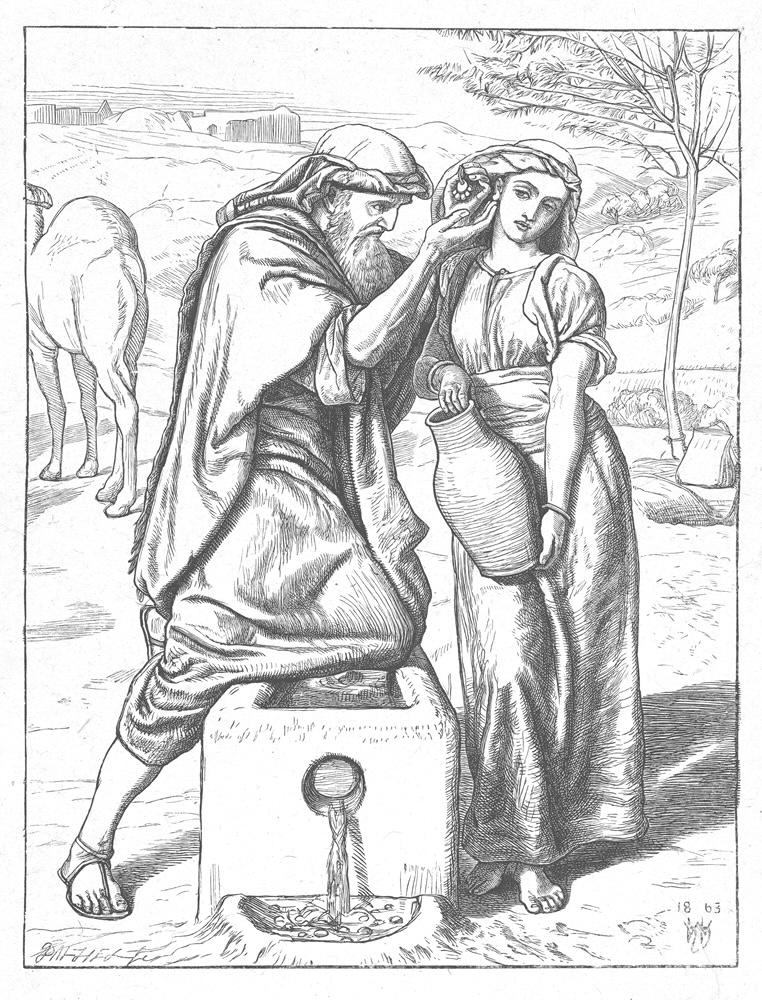
William Holman Hunt, Eliezer and Rebekah
at the Well
The goodness of women is more generally presented in illustrations which imagine them, with few exceptions, as virtuous beauties. The artists reproduce male stereotypes in their conception of the biblical heroes as muscular, classical types, whatever their age, and the treatment of women is similarly bound not only by the conventions of the Old Testament, but also by the gender norms of Victorian society. Leighton focuses on the statuesque dignity of Rebekah in his design, and Holman Hunt emphasises her modesty, endowing her with a doubtful expression as Eliezer beguiles her with gifts. Poynter’s women are likewise idealized female types, aestheticized, Amazonian bodies with perfect figures and regular features rather than flesh and blood.


Poynter’s Amazons. Left: Miriam. Right: The Water-Bearers.
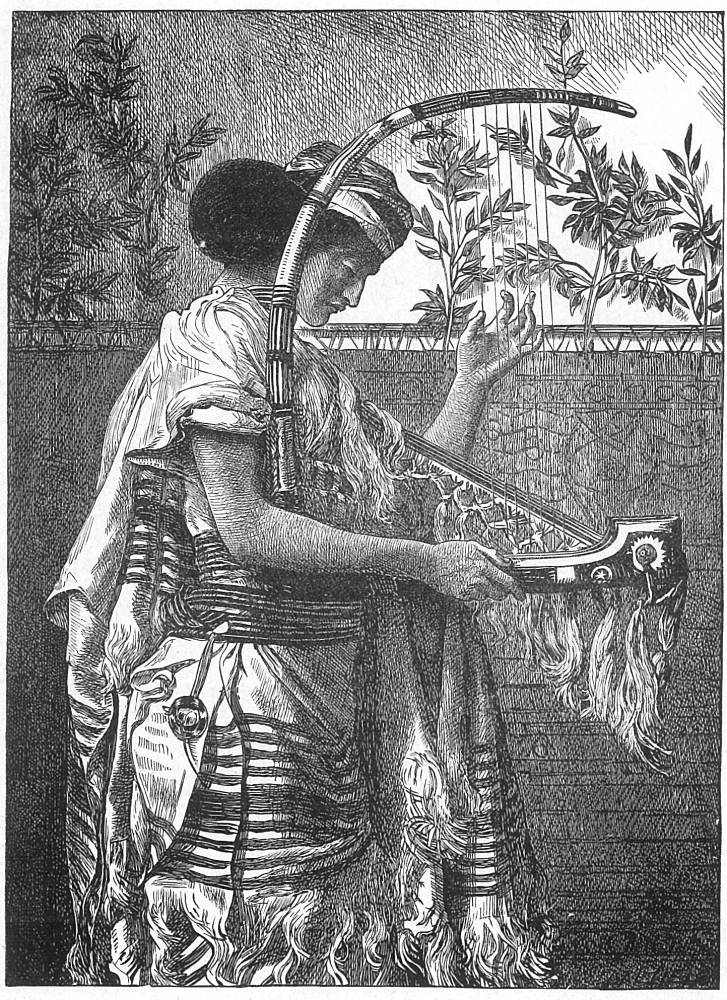
Simeon Solomon, Hosannah!.
The conventional treatment of gender is challenged, however, by Simeon Solomon’s presentation of androgynous figures. Well-known for his Pre-Raphaelite merging of male and female, Solomon’s younger biblical characters are far from the male stereotype – as in Hosannah! – and even his older, bearded personae are shown with lined faces and lighter build that forms a marked contrast with Leighton and Watts’s machismo.
Solomon is also notable for his sensitive treatment of family relationships, often achieving an emotional resonance that is lacking from the sometimes bellicose approach of the neo-classicists, Leighton, Poynter, Armitage and Armstead. The Infant Moses is a prime example of Solomon’s delicate treatment of a moment of tender love, and the same can be said of Naomi and the Child Obed. These designs focus on a mother’s love for a child, rather than a father’s, and stand apart from the formalized blessings of the biblical patriarchs.
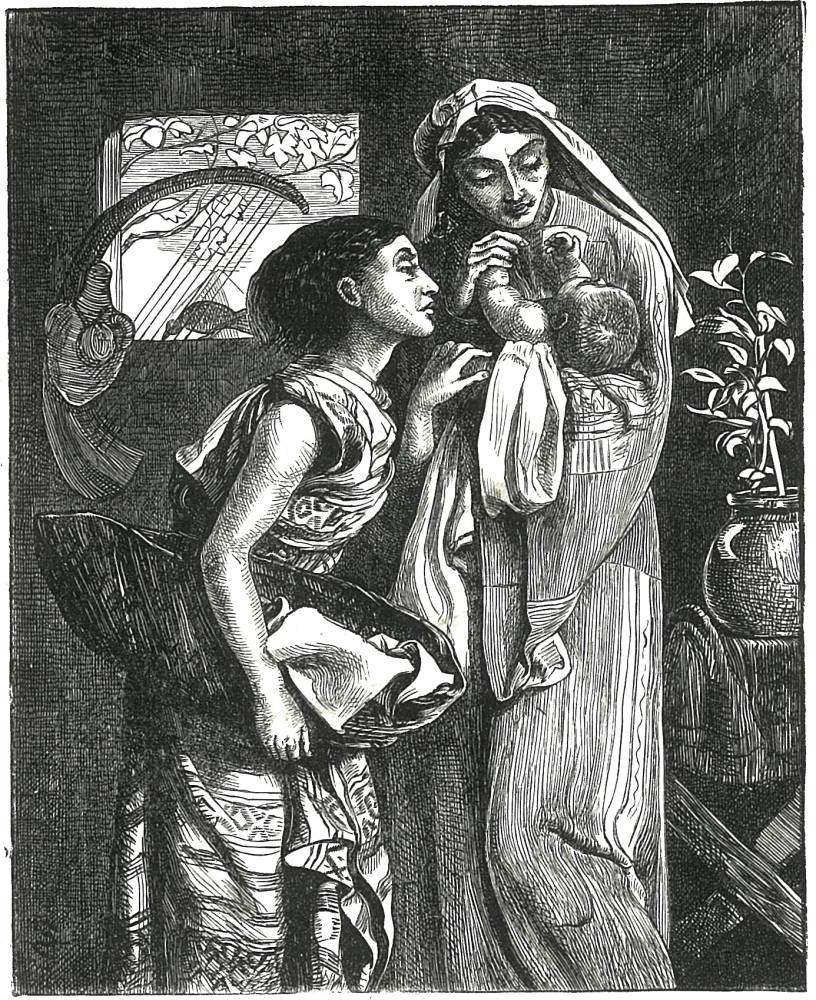
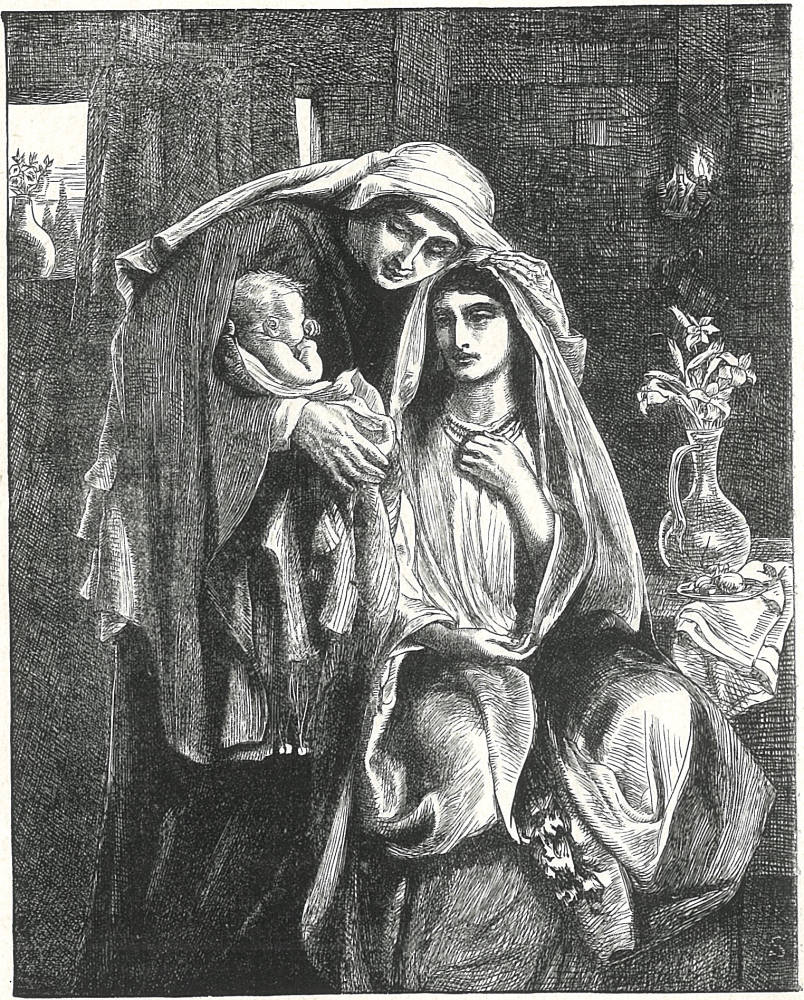
Solomon’s delicate treatment of Biblical subjects. Left: The Infant Moses, Right: Naomi and the Child Obed.
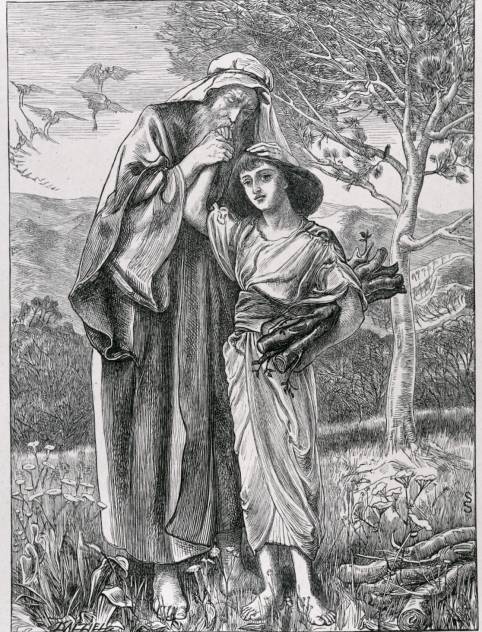
Solomon’s privileging of human emotion over blind faith
in his delicate treatment of Abraham and Isaac.
However, Solomon provides a parallel celebration of a father’s natural affection in Abraham and Isaac. Solomon’s scene does not present Abraham as a man grimly obeying God but as a parent whose love for his child is vividly expressed in his kissing of his son’s hand and his placing of one of his hands on Isaac’s head. Of course, that denial of that intense love is supposed to be God’s test – but Solomon’s heart-rending version suggests that Abraham’s commitment is not to the deity.
Responses
The visual material in the Dalziels’ Bible Gallery was arranged so as to create an epic, multifaceted montage incorporating at least some of the most important events and figures in The Old Testament. Unfortunately, the public did not appreciate its ambition, and (as noted earlier) the project did not generate any profits. The miserable tally of just 200 sales would not even have covered the Dalziels’ production and distribution costs, and the company’s extensive advertising in art and literary journals on both sides of the Atlantic (where it was published by Scribner), seems to have had no impact. It was out of fashion: wood engraving belonged, in the public consciousness, to the past. Nor was it helped by being sold as a Christmas book: too serious and highbrow to entertain in the festive season, its sonorous pages were unappealing to a readership used to the more usual form of light-hearted anthologies of poetry and pictures.
The price did not help, nor did the mixed reviews. The Portfolio noted that ‘both designers and engravers have done their best’ (‘Recent Biblical Designs, 14), while the reviewer in The Illustrated London News at least recognized the Brothers’ project as ‘the crowning work of their successful career’ (‘Fine Arts,’ 518); The Art Journal also thought it a surpassing work, with many fine engravings. But others damned the publication with faint, and fatal, praise. The Saturday Review typified this approach, claiming – inexplicably – that the engravings lacked individuality, even complaining that the hinges were not strong enough to support the pages (‘Christmas Books,’ 655).
The Dalziels were thus faced with a significant disappointment. A sure sign was the plummeting in value; as Carolyn Conroy reveals, copies were being sold for a fraction of the original 10 guineas only a few years after publication. The Bible Gallery did have an afterlife, however. In 1894 Aley Fox published the engravings for SPCK (The Society for the Promotion of Christian Knowledge) as Art Pictures from the Old Testament and again in 1903 with an additional seventeen designs that had been engraved by the Dalziels but not included in the Gallery. Reproduced using a photomechanical technique and printed on low quality paper in a much smaller format than the original book, Fox’s work at least provided a new opportunity to see the Dalziels’ brilliant project. But it was a poor ending for a publication of such high quality and epic ambitions, and it is only in the twenty-first century that its qualities are being appreciated in new criticism.
Bibliography
Primary
Art Pictures from the Old Testament and Our Lord’s Parable. Ed. Aley Fox. London: SPCK, 1894.
Bible Pictures. Illustrated by Schnoor von Carolsfeld. London: Williams & Norgate, 1855.
The Book of British Ballads. 2 Vols. Ed. S. C. Hall. London: Jeremiah Howe, 1842–44.
Dalziels’ Bible Gallery. London: Routledge 1881 [1880].
Doré’s Bible Gallery. London: Cassell, Petter & Galpin, 1880.
Secondary
‘Art Publications: Dalziels’ Bible Gallery.’ Art Journal 42 (1880): 319.
‘Christmas Books.’ The Saturday Review (20 November 1880): 655.
Conroy, Carolyn. ‘Dalziels’ Bible Gallery 1881.’ The Simeon Solomon Research Archive. https://www.simeonsolomon.com/ Accessed 30 September 2026.
Cooke, Simon. ‘The Book of British Ballads.’ The Private Library 7th Series, Vol. 7:1 (Spring 2024): 2–27.
—— . ‘The "Dalziels’ Bible Gallery.’ The Private Library 5th Series, Vol. 10:2 (Summer 2007): 59–85.
[Dalziel, Edward and George], The Brothers Dalziel. A Record of Work, 1840–1890. 1901; reprint, with a Foreword by Graham Reynolds. London: Batsford, 1978.
Esposito, Donato. ‘Dalziels’ Bible Gallery (1881): Assyria and the Biblical Illustration in Nineteenth Century Britain.’ Orientalism, Assyriology and the Bible. Ed. Steven W. Holloway. Sheffield: Sheffield Phoenix Press, 2006, 267–96.
‘Fine Arts.’ Illustrated London News (27 November 1880): 518.
Hewlitt, Madeline. ‘ Victorian Exodus: Visualizing the Old Testament in Dalziels’ Bible Gallery (1881).’ John Ruskin, the Pre-Raphaelites, and Religious Imagination. Eds. Sheona Beaumont & Madeleine Emerald Thiel. London: Palgrave, 2023. 223–55.
MacCulloch, Laura. ‘“Fleshing Out Time”: Ford Madox Brown and the Dalziels’ Bible Gallery.’ Reading Victorian Illustration, 1855 –75: Spoils of the Lumber Room.. Eds. Paul Goldman & Simon Cooke. Farnham: Ashgate, 2012. 115–136.
Ray, Gordon N. The Illustrator and the Book in England from 1790 to 1914. NY: Pierpont Morgan Library/Oxford UP, 1976.
’Recent Biblical Designs.’ The Portfolio (1881): 12–14.
Stevens, Bethan. The Wood Engravers’ Self Portrait (1881). Manchester: Manchester University Press, 2022.
Created 30 September 2026