
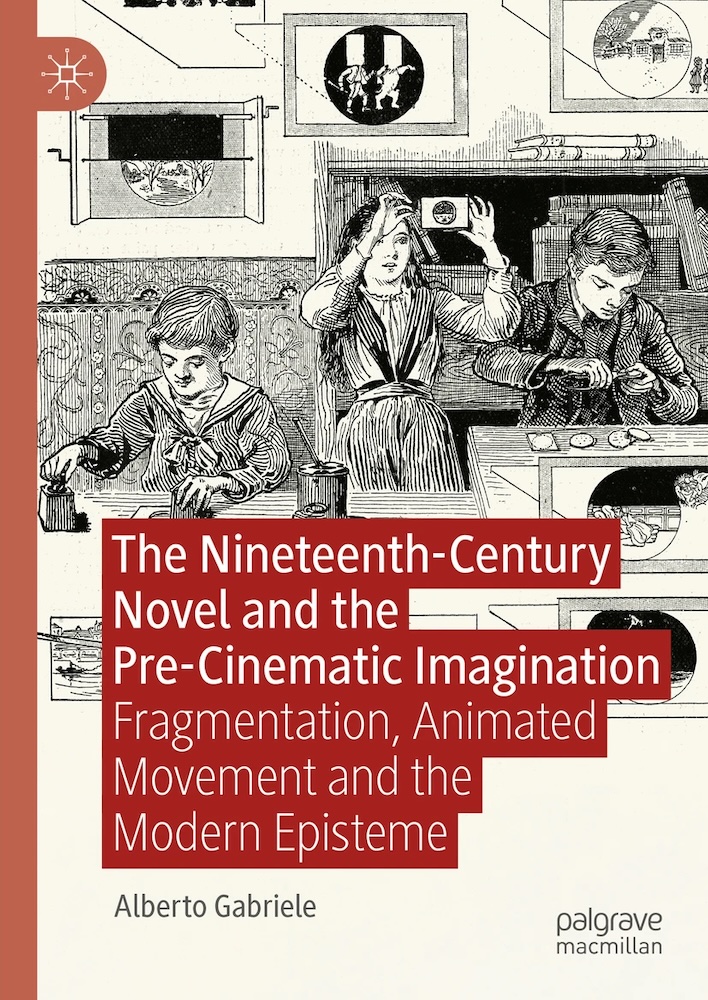

uilding on The Emergence of Pre-Cinema: Print Culture and the Optical Toy of the Literary Imagination (2016), in which he argued for the expansion of pre-cinematic visuality to include print culture, Alberto Gabriele in The Nineteenth Century Novel and the Pre-Cinematic Imagination continues to advance his case for rethinking the relationship between visuality and the nineteenth-century novel.
In his new book, Gabriele turns toward pre-cinematic philosophical toys that, he argues, help "to circulate, from the standpoint of the culture of the everyday, the formalisation of the new intellectual horizons of the modern episteme." Drawing on Michel Foucault's analyses, in Les mots et les choses (1966; The Order of Things, 1970), of "the nineteenth-century disciplines of philology, biology, and the theory of value," Gabriele finds that these toys — the thaumatrope, zoetrope, daguerreotype, and phenakistoscope — create a new institution that worked alongside biology, economics, and linguistics. This "literary imagination" in nineteenth century literature uses optical toys to suggest a modern aesthetic and epistemological fragmentation that continues a thread from Max Milner's essay, "La fantasmagoria" (1982): mainly, that literary production is linked to the history of optics and visual representation (6).
What could be seen as a mere taxonomy of pre-cinematic modes and visual culture in the nineteenth century novel is given new life by Gabriele, who views these emergent forms of visualization not only as a metaphor for the "narrative and rhetorical strategies of specific literary genres" but, also, as tools that help authors systematize what was previously an "unreadable reality of the emerging modernity" (5). By referencing these philosophical toys in their texts, Gabriele contends, authors introduce new ways of conveying visual perception and experience that interact with two contradictory modalities, "the fragmentary and the unitary." Gabriele finds these to be "steps in the same self-reflective move: a constructed view of the whole can be achieved only through a constant awareness of the constituting parts contributing to such a dynamic unity" (6). In other words, Gabriele maps how authors self-reflexively deploy visual tools in their novels to better represent fragmentary visual perception in the written form. The relationship between fragmentary experience and unifying thought animates Gabriele's readings of canonical texts, emphasizing how these authors use modes of visualization, and what he calls "experimental aesthetic modalities," to allow for better understanding of the relationship between visual culture and literature outside of "the tradition of pictorialism that had defined the parallelism between painting and literature" (6) to this point.
As novel writing became a site for experimentation with optical toys, novels engaged with these objects revealed the instability of interpretation and knowledge production. Gabriele places novel writing alongside technology, modern science, and political theory as "experiments in material and intellectual vision" that furthered understanding of how people came to know what they felt or believed they knew (6). The book takes a transatlantic and transnational approach in considering how various nineteenth-century authors — Herman Melville, Nathaniel Hawthorne, Honoré de Balzac, and George Eliot — deployed philosophical toys as a type of consideration for visual experimentation. In his readings of the relevant texts, Gabriele shows how each author treated these objects not only as metaphors for creativity, but also as metonyms for a new type of modernity. These toys become not only reference points in the novels, but also modes of suggesting how rapid urbanization and technological shifts changed perceptions of reality.
After outlining this dialectical fragmenting/unifying supposition, Gabriele turns to the texts. First, he considers Herman Melville's Pierre, or, the Ambiguities (1852). Here, Gabriele foregrounds the novel's use of visualization to give meaning to Pierre's internal struggles and highlights the novel's association with the thaumatrope, an early nineteenth century optical toy. The thaumatrope utilizes a double-vision, where two images on opposing sides of a two-dimensional circle are attached to a string and quickly twirled between fingers to create the illusion of association. A popular example is the image of a bird on one side and a cage on the other. Spun quickly, the bird appears to be placed in a cage. In Gabriele's reading, the toy acts as a metaphor for Pierre's inability to unify two contrasting portraits of his father, suggesting a modern fragmentation of character and experience. His failure to create a synthesizing and totalizing persona represent, for Gabriele, the "dynamism of the modern episteme that here resists even the systemic organisation of its parts in a structure" (80). Instead, Pierre is left with a contradictory and fragmentary understanding of both his father and the world at large. Gabriele's reading of the intertextual relationship between Pierre and Dante's Divine Comedy (1321), in addition to Shakespeare's Romeo and Juliet (1597) and Hamlet (1599-1601), emphasizes the novel's use of doubling. As Gabriele writes, "the act of reading becomes a form of remembering literary prototypes that predetermine a tragic destiny" (64). While Pierre is aware of the literary conventions that shape his experiences, he also acts as the author of his own text, again reflecting the dual images and back-and-forth motion of the thaumatrope.
Considering the daguerreotype and portraiture in Nathanial Hawthorne's The House of the Seven Gables (1850), Gabriele in his third chapter foregrounds contemporaneous scientific and mimetic shifts that speak to differences in photographic and painterly representation. By juxtaposing the contrasting aesthetic modes that Hawthorne exploits — fixed perspectival reproduction versus mobile technologies — he breaks open the nineteenth-century synergies between textual and visual representation, noting how Hawthorne utilizes modern technological shifts in underlying mimetic representation. If, Gabriele argues, the painted portrait cannot fully grasp the immediacy of the present—instead, it is always informed by the past—the daguerreotype is the only representational technology that can truly capture the shifting experiences of Hawthorne's characters. The chapter, then, looks toward the panorama, which allows the viewer to amass a series of "fragmentary impressions" that add up to a complete, unifying, picture (101). Gabriele reads the panorama, and its mode of vision, through Hepzibah's "commodity capitalism," especially the arrangement of goods in her adjoining store, which recreates the effect of a hall of mirrors in its dizzying accumulation of goods (101). These flashes of vision also manifest in Hawthorne's deployment of the phantasmagoria, suggesting a fragmented visual spectrum when Halograve sits by the well and summons the faces of the dead. For Gabriele, the phantasmagoria acts as a metaphor for the "new aesthetic regime of fragmentation that popular visual culture disseminated" (110). Altogether Hawthorne's visual strategies anticipate the importance of the fragment to literary modernism.
The fourth chapter crosses the Atlantic to consider Honoré de Balzac's La Comédie humaine (1829-48). Foregrounding the "innovative and experimental trends present in Balzac's vision," Gabriele resists "the conventions of painterly writing" so often discussed in relation to the author (137). Instead, he looks towards Balzac's use of the microscope, the daguerreotype, the diorama, and even the panorama as instruments for reflecting on contemporary debates about artistic representation and immersion. Gabriele reads these types of optical toys and their ensuing pre-cinematic spectacle on a textual level, comparing, for example, Balzac's use of verbal puns to "the sudden apparition and disappearance of projected images in a lantern show" (143). Taken together, these fragments unify to represent "the endlessly shifting reality" that Balzac observes (144). Gabriele then turns to the phantasmagoria as a representation of Balzac's "new reality made of disjoined fragments" that the author utilizes to explore perceptions of vision and subjectivity in his texts (151). More than the painterly strategies that have been classically read into Balzac's writing, these references to both the magic lantern and the phantasmagoria ultimately produce a unified vision of social reality and episteme, according to Gabriele.
The final chapter, focused on George Eliot's Middlemarch (1871), begins with Eliot's belief that portraiture is unable to represent shifting reality: "One must not be unreasonable about portraits. How can a thing which is always the same, be an adequate representation of a living being who is always varying?" (qtd. on p. 169). Using Eliot's observations as a starting point, Gabriele argues that her use of self-reflective narrative asides and provisional views creates a type of unity that exists beyond the type of fragmentation seen in Melville, Hawthorne, and Balzac. The novel creates an "illusionary perception of animated unity" through its constituent parts: quotation, chapter organization, and its episodic structure (172).
Unlike other critics, who have written about Eliot's prose in relation to the cinematic montage, referencing a type of prehistory of cinema narrative in the abstract, Gabriele identifies embodied cinematic technology as a means of exploring the play of fragmentation and unity throughout the novel. Instead of focusing on the fragmentary visual experiences of the philosophical toys mentioned in the earlier chapters — ones, like the panorama, that invoke movement and progression through rapid juxtaposition — Eliot's writing, in Gabriele's view, is more like the stereoscope or microscope. These optical instruments "insist on a static vision" that is anything but pre-cinematic; rather. "such a projection of invisible unity is achieved through a sidestepping of the perception of fragments so as to move into an intuited form of completeness" (175-76).
They are also representative of the two competing modes of apprehending reality that he reads in the novel: the analytical and the intuitive. He sees these contrasting modes embodied in Celia and Dorothea Brooke, respectively. Celia's "analytical approach to reality" is juxtaposed against Dorothea's disinterest in the present for "intellectual models of thinking that go beyond sheer observation" that gain a type of clarity (185). This synthesis of fragmentary and unifying visions are, then, presented by Dorothea and "found in sympathetic vision not challenged in the face of personal limitations, professional and environmental hostility, as the cases of Lydgate and Casaubon are" (206)
Overall, Gabriele traces the shift towards modernism in the different ways that authors deploy philosophical toys to contend with the fragmentation of the modern episteme. By highlighting the use of not only pre-cinematic toys—thaumotrope, panorama, phantasmogoria—but also static optical instruments like the stereoscope and microscope, he demonstrates how these tools are used as both metaphor and mimetic representations in the nineteenth-century novel to create what he calls an "aesthetic of fragmentation" (207). In the Coda, he then turns towards modernist writing, arguing that these representational forms reappear in the writing of T.S. Eliot's The Waste Land (1922), suggesting a heretofore "unacknowledged form of continuity rather than a radical rupture from the past" (207). For Gabriele, Eliot's poem reverberates "the aesthetic sensitivities that had emerged in nineteenth-century experimentations with vision and intellectual insight in the genre of the novel' (209). While the study sometimes overwhelms with its own type of microscopic analysis of these texts, it nevertheless creates a fuller picture of how nineteenth-century authors deployed these optical tools as modes of pre-modernist experimentation.
Links to Related Material
Bibliography
[Book under review.] Gabriele, Alberto. The Nineteenth-Century Novel and the Pre-Cinematic Imagination: Fragmentation, Animated Movement and the Modern Episteme. London: Palgrave Macmillan, 2024. 246 pages. ISBN 978-1-349-96116-0.
Foucault, Michel. The Order of Things. An Archaeology of Human Sciences. Trans. Alan Sheridan Smith. London: Tavistock, 1970.
Last modified 6 January 2026