
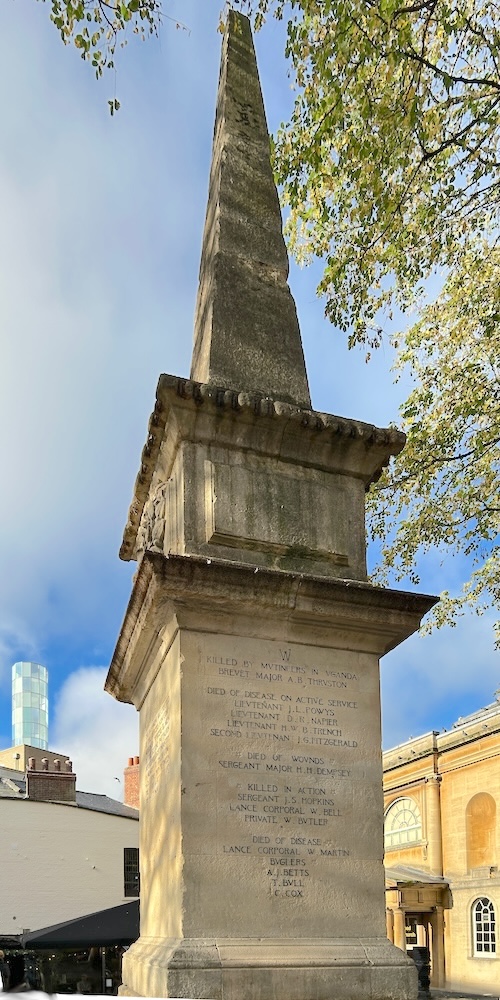
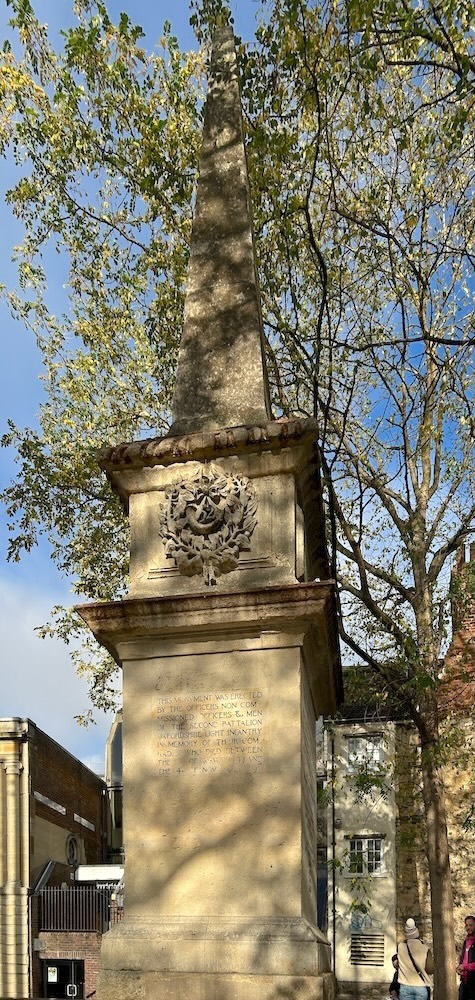
Left: Side showing the names of those commemorated. Right: Side showing the regiment's suspended bugle emblem, encircled by a wreath. [Click on all the images for larger pictures.]
Listed as the Oxfordshire Light Infantry Memorial, this monument on New Road, Oxford, with its fine stone carving, was erected in memory of soldiers who, all but one, died in Tirah and other campaigns on the North-West Frontier of India from 1897-98.
Grade II listed, the monument is described in its listing text simply as "Dated 1897-8. Stone. Square plinth with cornice topped by an obelisk," but further details are supplied on the War Memorials in Oxford site, which names the designer as Francis Inigo Thomas (1865–1950), and credits Messrs Franklin of Deddington for erecting it in 1900. More information is given here than in the listing text: "The twenty-five-foot high obelisk is made of stone from Monk’s Park Quarry, Bath and stands on a base of Doulting stone. It has foundations 20 feet deep."
The expedition which took these soldiers' lives was a punitive one occasioned by hostility on the troublesome North-West Frontier of India, or, in the words given out by the office of the Quartermaster-General towards the end of September 1897: "to exact reparation for the unprovoked aggression of the Afridi and Orakzai tribes on the Peshawur and Kohat borders, for their attacks on our frontier- posts, and for the damage to life and property which has thus been inflicted on British subjects and on those in the British service" (qtd. in Shadwell 27). It was the first time for British-led forces to penetrate the area, and the expedition turned out to be, as Leonard Shadwell concludes after his detailed account of it, "a very challenging one: The conditions of the country, of the weather, and of the nature of the fighting rendered it one of the most severe and demoralising that our armies have ever been engaged in" — yet, he continues, "the troops of the Tirah Field Force, both British and native, were always cheerful and uncomplaining, and exhibited a dogged courage that not only deserved, but commanded, the success they ultimately attained" (315).
In Shadwell's appendix, the 2nd Battalion of Oxfordshire Light Infantry is listed under the Peshawar Column (318). Submission was not complete at the time of writing, and Shadwell himself, while applauding the the very fact that the army penetrated the region, and commending the positive attitude of the men, is forced to acknowledge that the problems there were by no means solved. It seems hard, in retrospect, to justify the heavy losses both inflicted on the tribespeople and suffered by the army. It was indeed inhospitable territory. Most of those commemorated here (53 out of 62 named) died of disease, rather than in fighting.
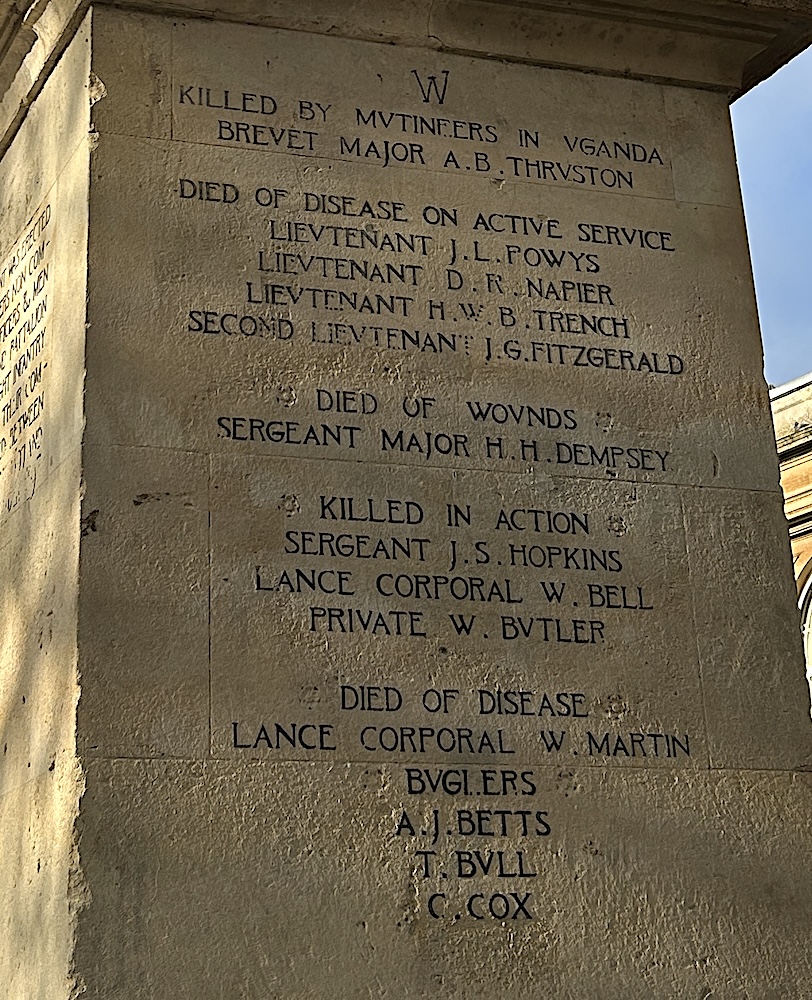
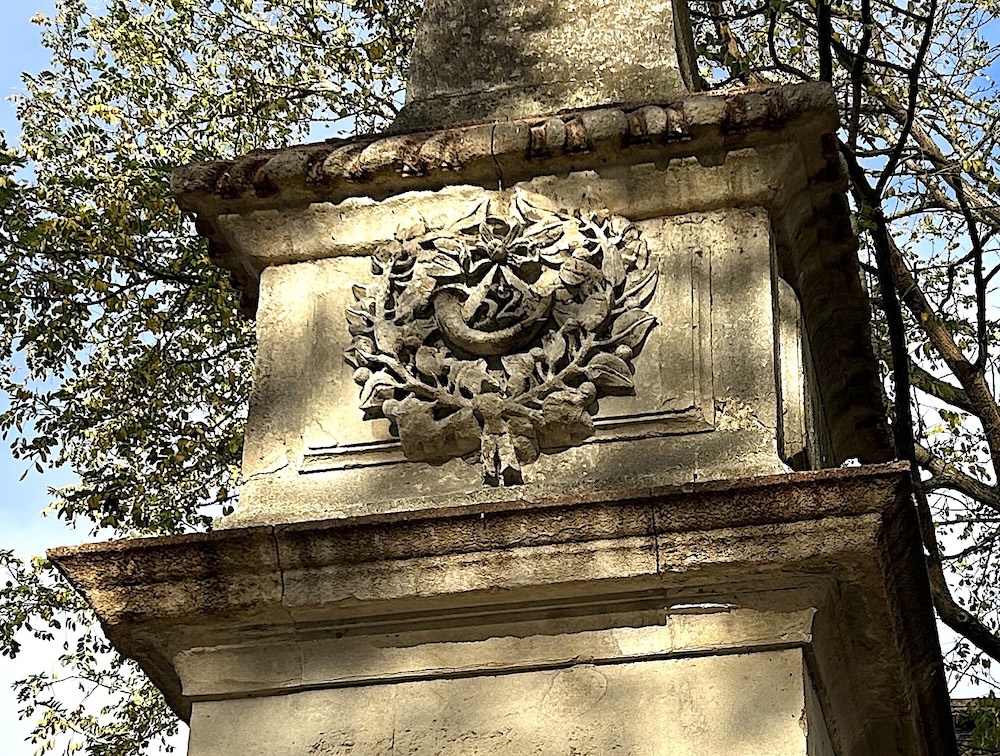
Close-ups. Left: The names of those memorialised. Right: The regiment's emblem.
Meanwhile, far from British India on the distant continent of Africa, an officer of the same regiment, Brevet-Major Arthur Blyford (A.B.) Thruston, whose name actually tops the list shown above left, died around the same time in Uganda. He was shot and killed there on 19 October 1897, by mutineers in the Protectorate's Ugandan Rifles. It was a particularly tragic incident because his purpose had been to reason with rather than confront the insurgents.
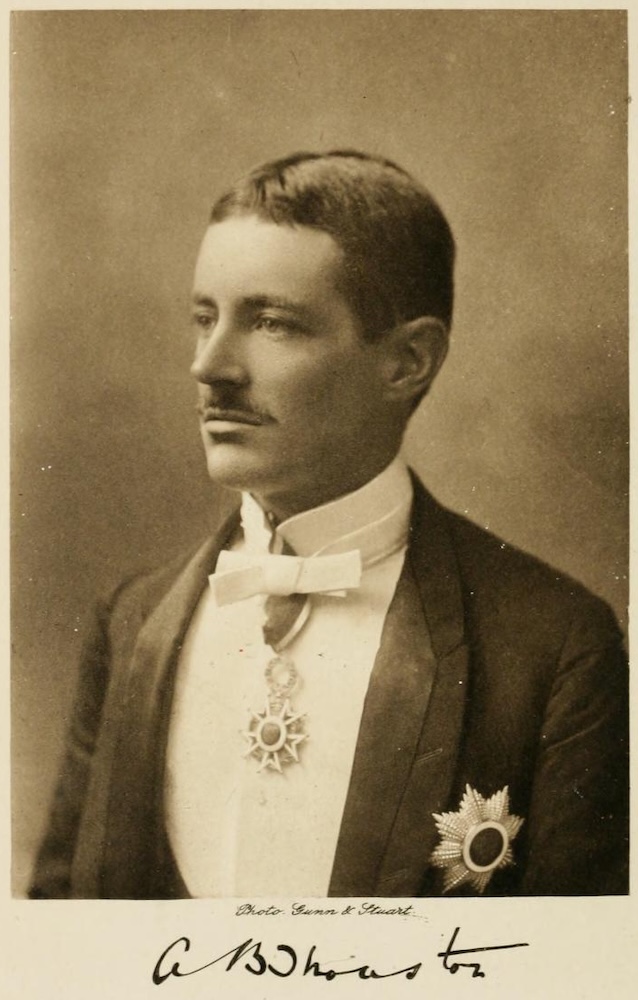
Thruston, shown on the right here in the frontispiece to his account of his experiences in Africa, merits particular attention not only because of his military prowess, but because of his personal qualities and scholarship. This is explained by Major-General Sir Archibald Hunter, K.C.B. in his introduction to the account:
He was a man of great courage, quick decision, a first-class horseman and camel rider, besides being accomplished as a scholar and an artist. He had passed the higher standard of Turkish in London, and qualified to pass that in Arabic, before originally joining the Egyptian Army. He speedily acquired an influence with the Hadendoa and Arab Sheiks and tribesmen in the Eastern Soudan. His chivalry, fearlessness, and powers of physical endurance won their admiration and respect: his tact and sympathy commanded their confidence and friendship.... he died fearlessly and nobly as he had lived. [14]
This, then, is a war monument with a difference, to a local regiment involved in engagements in the subcontinent not generally memorialised in this way, and to a young hero in the regiment whose death in Africa was especially mourned. Note that Thruston is also commemorated by a handsome memorial tablet in the crypt of St. Paul's.
Related Material
Photographs by Tim Willasey-Wilsey, who also kindly supplied some information; text by Jacqueline Banerjee. You may use the photographs without prior permission for any scholarly or educational purpose as long as you (1) credit the photographer and (2) link your document to this URL in a web document or cite the Victorian Web in a print one. [Click on the images to enlarge them.]
Bibliography
"Brevet-Major Arthur Blyford THRUSTON (1865–1897)." War Memorials in Oxford. Web. 20 October 2026.
"Memorials in Oxford to wars before 1899." War Memorials in Oxford. Web. 20 October 2026.
"Oxfordshire Light Infantry Memorial." Historic England. Web. 20 October 2026.
Shadwell, Leonard Julius. Lockhart's Advance through Tirah. New York: New Amsterdam Book Company; London: W. Thacker & Company, 1899. Internet Archive, from a copy in the University of California Library. Web. 20 October 2026.
Thruston, Arthur Blyford, and Edmund Heathcote Thruston. African Incidents: Personal Experiences in Egypt and Unyoro. London: John Murray, 1900. Internet Archive, from a copy in the University of California Library. Web. 20 October 2026.
Created 20 October 2026