
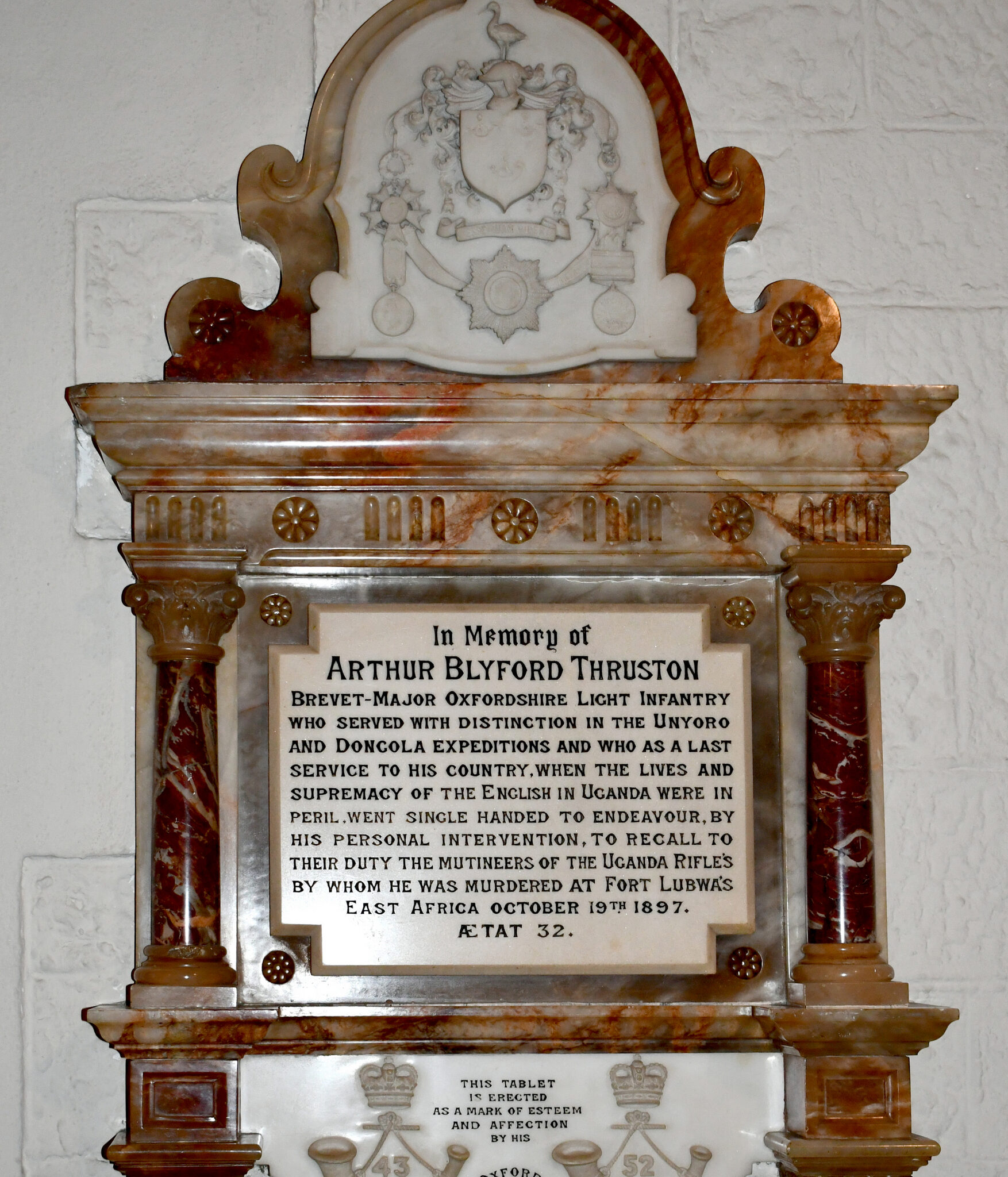
Monument to Major Arthur Thruston, post-1897, by the Army & Navy Company. Located in the Nelson Chamber in the east aisle of the crypt, St Paul's Cathedral, London. Image credit: St Paul's Cathedral, commissioned from A.J. Photographics: Fine Art Photographers. [Image via the Pantheons website (https://pantheons-st-pauls.york.ac.uk/) reproduced under the terms of the Attribution-ShareAlike 4.0 International Creative Commons Licence (CC BY-SA 4.0 DEED)]. Commentary and formatting by Jacqueline Banerjee. Click on the image to enlarge it.
Arthur Blyford Thruston (1865-1897) was a young highly regarded officer in the Oxfordshire Light Infantry, whose early death by treacherous hands touched his men greatly. The inscription on the white marble and alabaster memorial plaque explains that he had
SERVED WITH DISTINCTION IN THE UNYORO / AND DONGOLA EXPEDITIONS AND WHO AS A LAST / SERVICE TO HIS COUNTRY, WHEN THE LIVES AND / SUPREMACY OF THE ENGLISH IN UGANDA WERE IN / PERIL, WENT SINGLE-HANDED TO ENDEAVOUR, BY / HIS PERSONAL INTERVENTION, TO RECALL TO / THEIR DUTY THE MUTINEERS OF THE UGANDA RIFLE / BY WHOM HE WAS MURDERED AT FORT LUBWA’S / EAST AFRICA OCTOBER 19TH 1897.
Relying on his appreciation of the issues involved, and his linguistic ability, Thurston, now in command of the Ugandan Rifles, had hoped to reason with the mutinous Sudanese mercenaries in order to restore calm and prevent further problems. But he and a young official, together with an engineer, were taken prisoner by them and, after a couple of days, shot.
The episode seems especially sad in view of Thurston's sympathy for the mutineers: in a memoir published with Thruston's account of his earlier experiences in Africa, his brother Edmund acknowledges that the mercenaries had been "harshly treated, overworked, and underpaid" (25), and it is clear that Thruston himself realised this: the troops, it seems, had "murdered their best friend" (33). The Arabs with whom Thruston had worked also responded to news of his death with "unfeigned sorrow and indignation," in a show of "genuine feeling" (34). The memorial in St Paul's is a testimony to the respect in which Thurston was held by his brother officers, too, because it was erected by them in recognition of "his courage and self-sacrifice ... so that the memory of his short career will be guarded in that sanctuary" (34).
Thruston was buried in the the cemetery of another St Paul's Cathedral — the one in Uganda. He is also remembered in Oxford, where his name is inscribed at the top of the east side of the Oxfordshire Light Infantry Memorial.
The episode was not just unfortunate in itself: the chance of establishing better relations was lost, the rest of the garrison was "intimidated into joining the mutineers" (Thruston 28), and disorder in the Ugandan Protectorate, established by Lord Rosebery in 1894, continued for months, with losses on both sides. Uganda eventually got its independence in 1962.
Related Material
Bibliography
Cpt Arthur Blyford Thruston. Find a Grave. Web. 21 October 2026.
Thruston, Edmund Heathcote. "A Memoir of the Author." In African Incidents: Personal Experiences in Egypt and Unyoro by Arthur Blyford Thruston. London: John Murray, 1900. 17-34. Internet Archive, from a copy in the University of California Library. Web. 21 October 2026.
Created 21 October 2026