
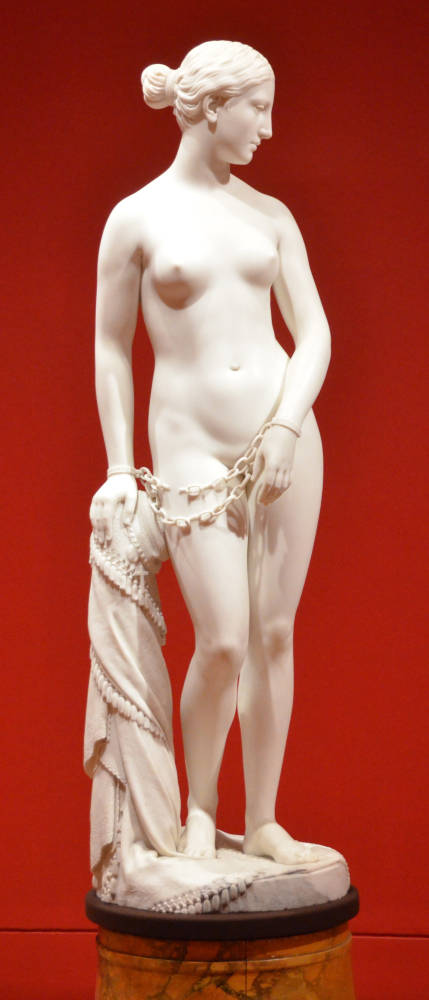
The Greek Slave
Hiram Powers (1805-1873)
1844
Marble
Exhibited at the Great Exhibition of 1851
Exhibited at Tate Britain in Sculpture Victorious (2015).
©The Rt. Hon. Lord Barnard T.D., Raby Castle, Co. Durham
Click on the image to enlarge it, and mouse over the text for links
The marble statue was first ordered in late 1843 by Captain John Grant of the Royal Artillery, who completed the deal in early 1844 when it was "blocked out and partly done to the waist" in Powers's studio in Florence (Reynolds 145). Grant was delighted with the finished work, which arrived in London the following May and was first put on display by Messrs Graves of Pall Mall, print dealers. It was Grant who would loan it to the Crystal Palace for display in the Great Exhibition. The statue was later bought by Henry Vane, 2nd Duke of Cleveland, who had it transported to his country seat at Raby Castle in Staindrop, County Durham, where it was put on display in the castle's Octagon Room in 1859. It is still at the castle, on its original pedestal.
The Octagon Room version is widely described as the "original" statue by Powers, of the six he produced during his lifetime (see Yale's interactive map for the location of the others). But, as Martina Droth and Michael Hatt explain, these six are all as "original" as each other, since they were all carved from the original plaster model. In fact, these critics submit, the truly "original" version is that plaster model, since it is "a precise replica of the clay figure from which it was made.... the primary record of the artist’s own work — all of its detail and nuances would be transferred into marble." However, Donald M. Reynolds points out that the sixth statue was slightly different, with "manacles instead of chains binding the wrists — though again, "its plaster model was cast from the original plaster" (146n.). — Jacqueline Banerjee