Monument to Vice-Admiral Horatio Nelson, by James Smith (1775–1815)
Jacqueline Banerjee, Editor-in-Chief, Victorian Web, with photographs by Tim Willasey-Wilsey

[Victorian Web Home —> Visual Arts —> Sculpture —> Funerary sculpture]
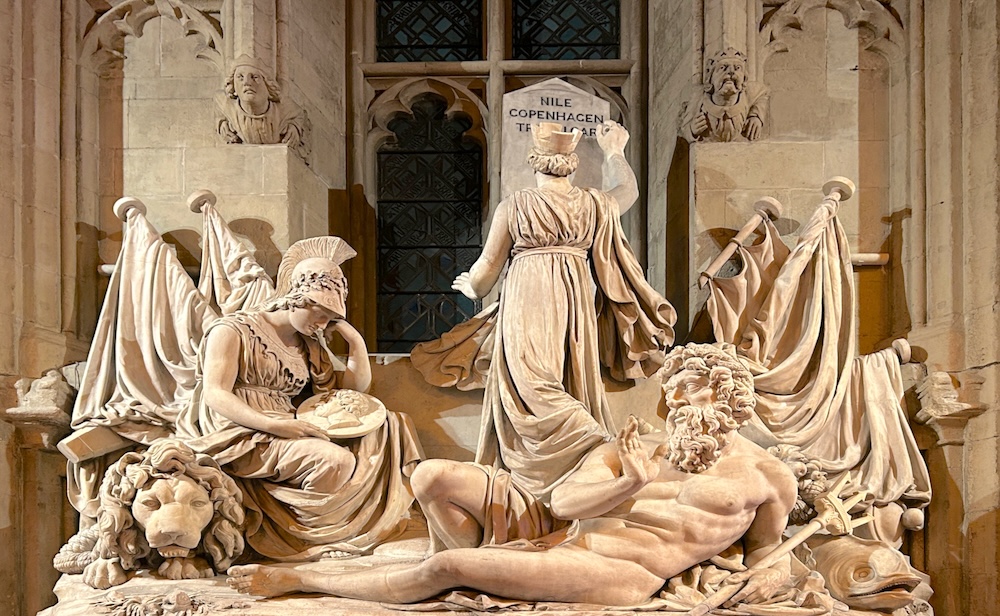
The memorial is James Smith's most prestigious and best known work. Smith had won a gold medal at the Royal Academy and had been an assistant to John Flaxman, whose own monument to Nelson is in St Paul's Cathedral. But Smith's promising career was cut short when he died in early middle age.
This grand marble, largely allegorical monument in London's Guildhall was one of several major memorials to Nelson, culminating in the famous column in Trafalgar Square, was installed in 1810 and cost the princely sum of £4442,7s.4d. ("Admiral Horatio Nelson"). It is not quite as Smith had envisaged it: he had originally planned to have two captive sailors placed at either side of the sea-battle below the main figures, but these were replaced by mourning British sailors. From the same source we learn that the sele was originally larger, and there was some war damage during World War II ("Admiral Horatio Nelson"). However, it is still very splendid.
James Clarke's Life of Nelson gives a useful description of it:
MONUMENT ERECTED TO THE MEMORY OF LORD NELSON, IN GUILDHALL.
The pyramid on the back-ground is supposed to be the tomb of the immortal Nelson, decorated with naval trophies, the fruit of his victories; while the female figure in the centre, (personating the city of London,) in grateful remembrance of the signal services he rendered to his country, perpetuates the memory of his great actions to posterity, and finishes with admiration the record of his last glorious achievement off Trafelgar.
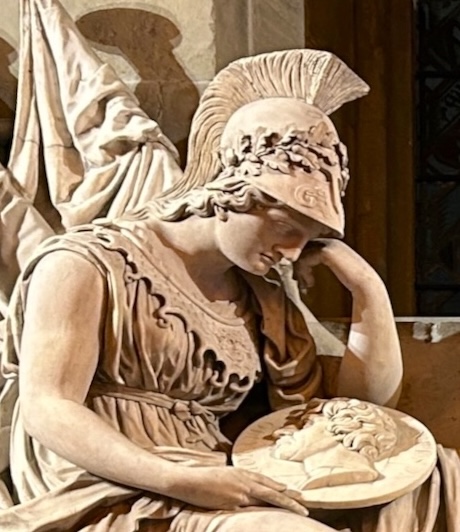
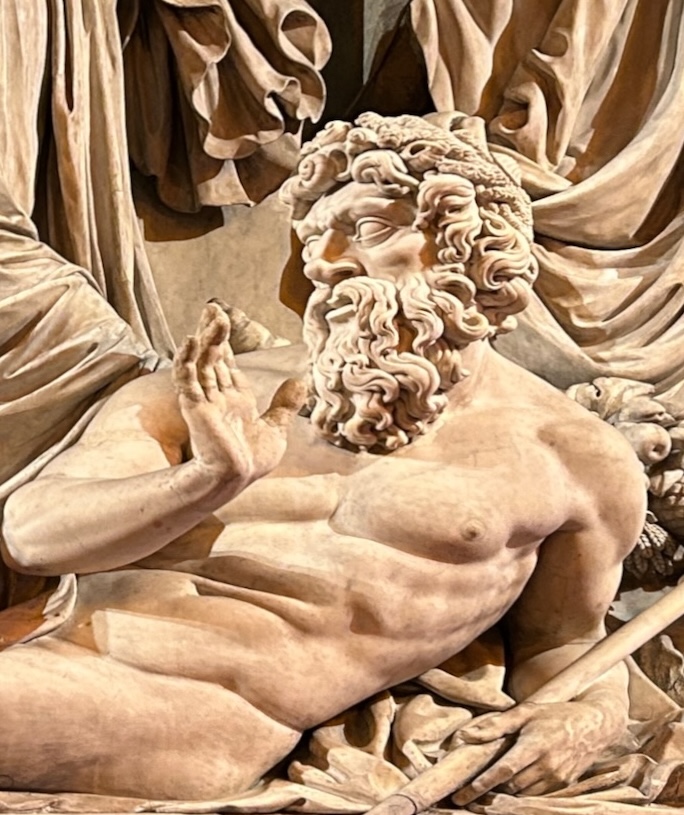
Britannia, on the left, supported by a lion, (the symbol of unshaken courage,) is pensively musing over a portrait of the conqueror, and in silent grief deplores her loss. The recumbent figure in the fore-ground representing the ocean, roused by the fame of his heroic actions, participates in Britannia’s sorrow and regret for her hero's fate.
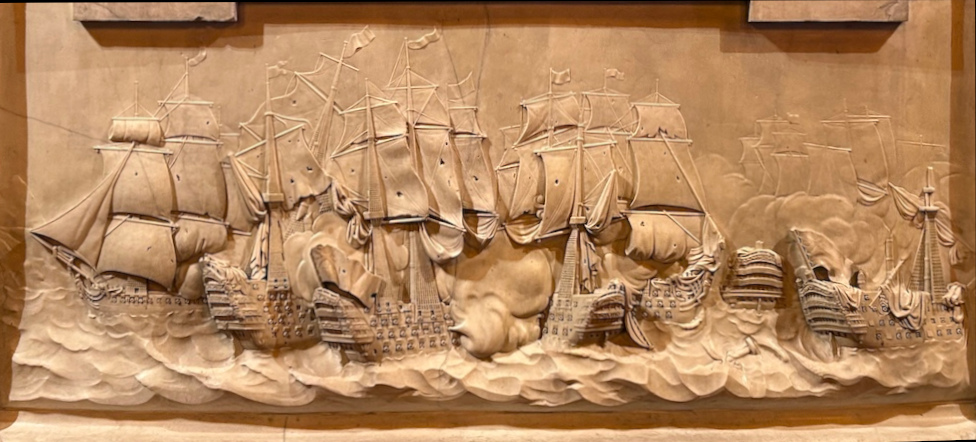
The naval action in front of the pedestal exhibits the situation of the fleet towards the conclusion of the battle, when the hero was mortally wounded by a shot from the mizen-top of a seventy-four, with which ship the Victory appears to be closely engaged. In the niches two British seamen, with implements of war and navigation, hear with deep concern the fate of their beloved hero.
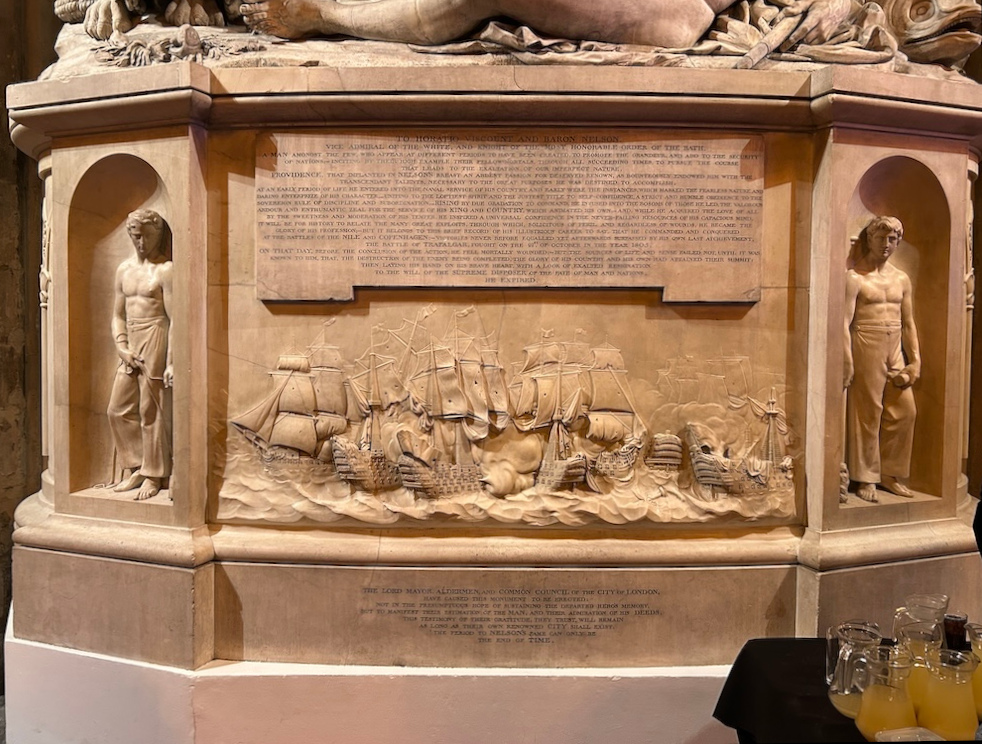
On the base is the following inscription:
Apostrophe.
The following ‘apostrophe’ on the events of Lord Nelson’s last victory is extracted from a etter written by a lady of distinction in Ireland:—
NEVER was there, indeed, an event so mournfully, and so triumphantly important to England, as the battle of Trafalgar: the sentiment of lamenting the individual more than rejoicing in the victory, shews the humanity and affection of the people of England. But their good sense, upon reflection, will dwell on the conquest only, because no death at a future moment could have been more glorious, and might have been less so. The public would never have sent him on another expedition; his health was not equal to another effort; and he might have yielded to the natural, but less imposing, effects of mere worldly honours. Whereas, he now begins his immortal career, having nothing left to achieve upon earth; and bequeathing to the English fieet a legacy which they alone are able to improve. Had I been his wife, or his mother, I would rather have wept him dead, than seen him languish on a less splendid day.
"In such a death there is no STING, -
"In such a GRAVE is everlasting VICTORY.”
The Guildhall monument was not quite the first to this national hero. The earliest was Richard (later Sir Richard) Westmacott's monument to him in Birmingham's Bull Ring (1807-09). But it was only in the eighteenth century that the decision was taken to memorialise national heroes in this historic civic hall: Nelson was the fourth to be honoured in such a way (Weinreb 363). Standing in the heart of the city, the venue of so many major functions, Smith's tribute is one of the most impressive of this very select band.
Related Material
- Nelson and the Victorians: Legend and Legacy
- John Flaxman's monument to Nelson in St Paul's
- Nelson Monument, Liverpool, by Sir Richard Westmacott and Matthew Digby Wyatt
- Westmacott's Nelson Monument in the Bull Ring, Birmingham
- Statue on Nelson's Column, London, by E. H. Baily
- The Nelson Monument in Montreal
You may use these images without prior permission for any scholarly or educational purpose as long as you (1) credit the photographer and (2) link your document to this URL in a web document or cite it in a print one.
Bibliography
"Admiral Horatio Nelson (City of London Memorial)." Reference WMO/275754. War Memorials Online. Web. 2 February 2026. https://www.warmemorialsonline.org.uk/memorial/275754/
Clarke, Richard. The Life of Horatio Lord Viscount Nelson, Viscount and Baron Nelson of the Nile. London: J and J Cundee, 1813. Google Books. Free to read. Web. 2 February 2026.
Weinreb, Ben, Christopher Hibbert, Julia Keay and John Keay. The London Encyclopaedia. 3rd edition. London: Macmillan, 2008. [Review]
2 February 2026