
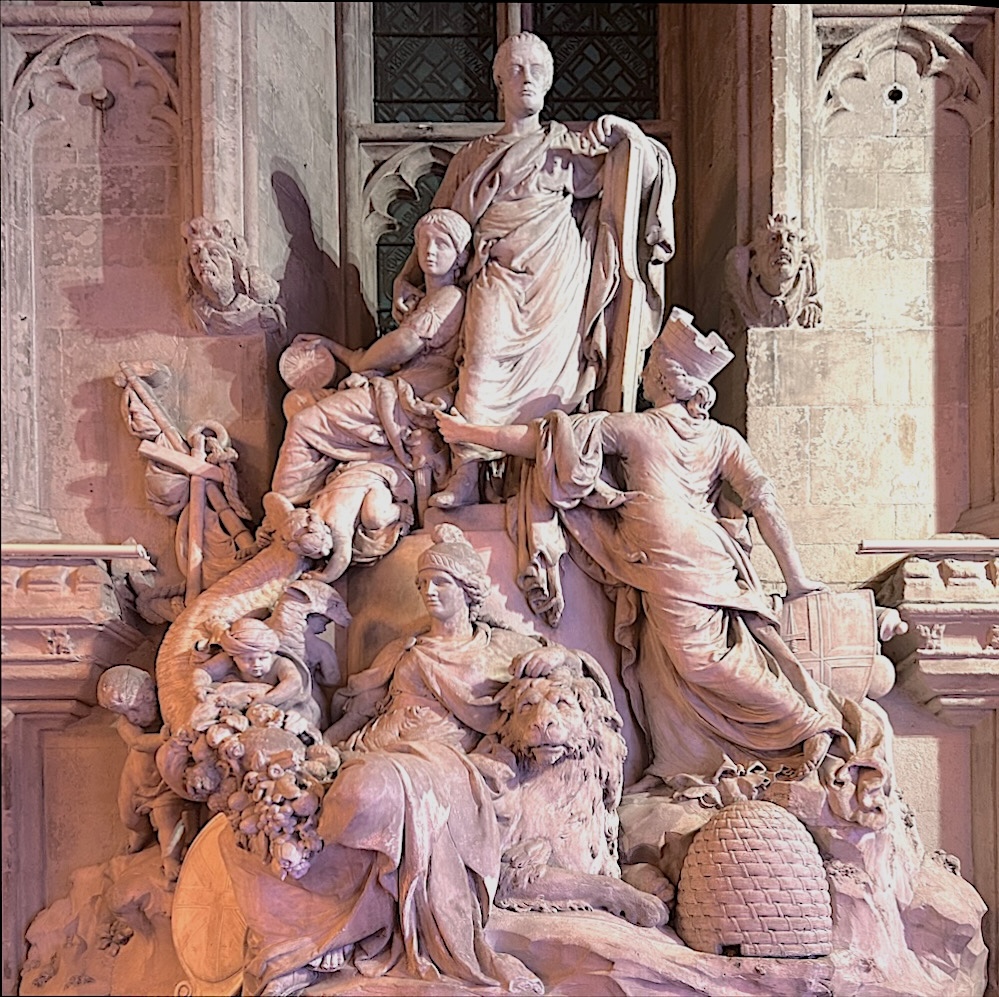
This complex marble group was completed in 1782 and celebrates the achievements of William Pitt, Earl of Chatham (Pitt the Elder); it is itself one of the grandest works of John Bacon, Senior (1740-1799). Grade I listed, it is 7.5m. high, and 4.3 m. in width (Ward-Jackson 166), and stands in the Guildhall in the City of London, the second statue of a prominent leader to have been installed there (see Weinreb et al, 363).
Pitt towers above the rest of the figures on his own dedicated stand, a senior statesman in classical robes. The supporting figures below him, all female, embody his successes: Commerce is seated with a compass on one knee, on the left, reflecting the expansion of global trade; the City with her mural crown, as a major beneficiary of this trade, stretches her left arm towards her, resting her right hand on a shield bearing the familiar device of the City of London; Britannia at the base of the triangular group, seated on the British lion, receives a shower of riches from Commerce's capacious cornucopia. Note also the beehive on the rocky base, representing industry. These allegorical elements would have been familiar to all at that time, although less so now.
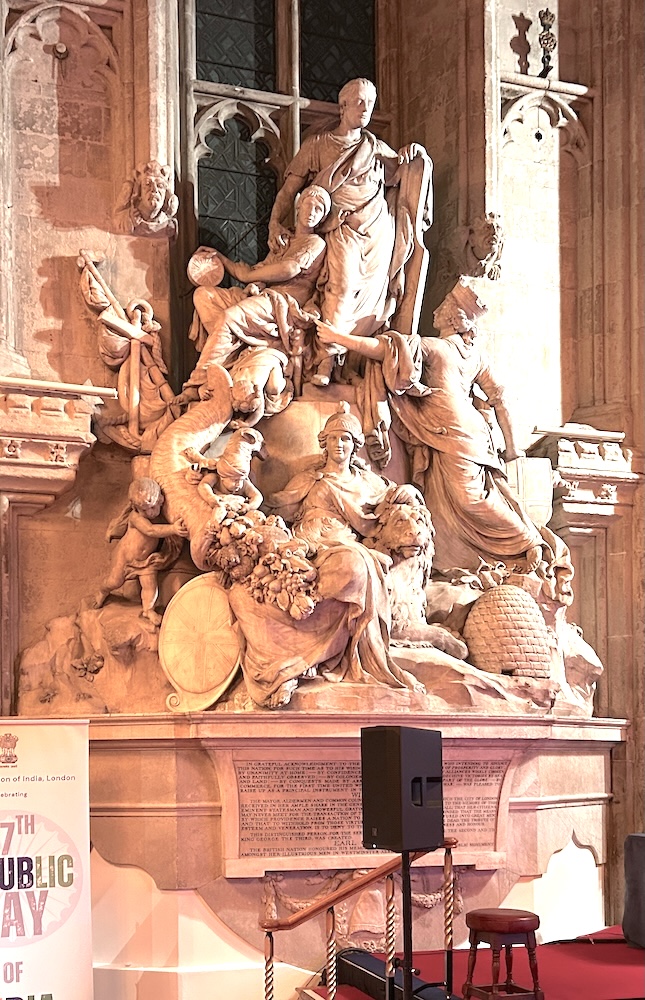
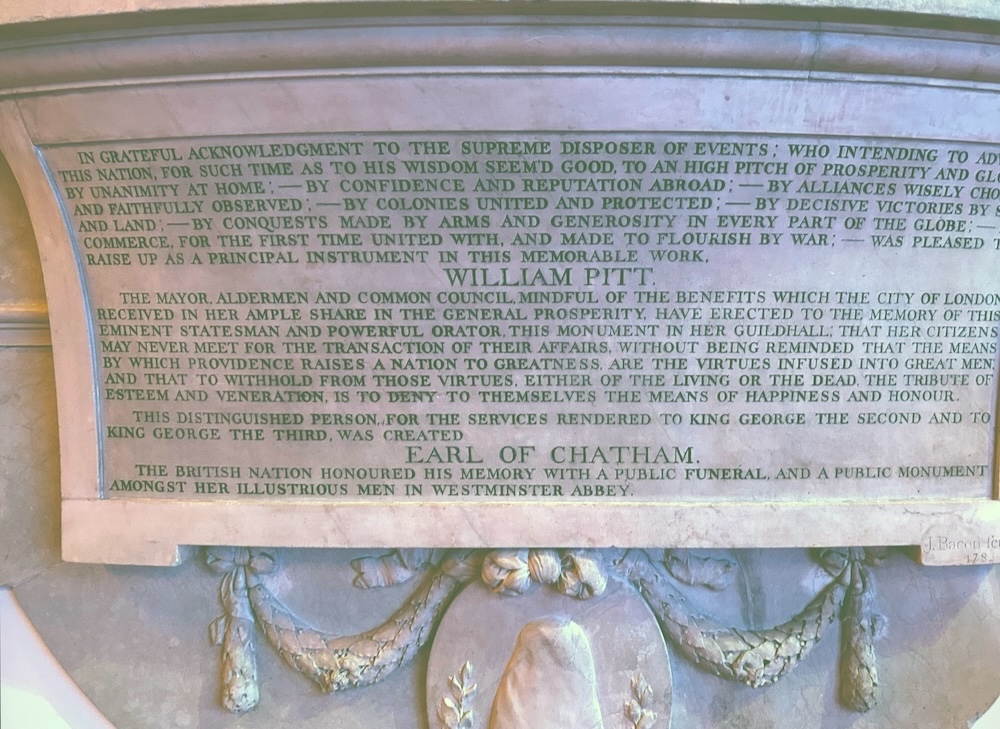
Left: A general view of the whole monument. Right: The lengthy inscription on the curved pedestal.
Another notable detail here is the suggestion of colonial origins in the cherubs dispensing the contents of the cornucopia: the one closest to the tumbling produce has a miniature turban, suggesting the source of some of these gains. Indeed the inscription mentions "conquests made by arms and generosity in every part of the globe" during his years of power — not a cause of national pride in our postcolonial age. As it happened, the monument was photographed on the occasion of India's 77th Republic Day, 27 January 2026.
Pitt was not without either his detractors or his problems at the time, and since then there has been a "downward drift of historians' judgement of the Great Commoner and Patriot Minister" (Pearce xii). History would provide a more nuanced assessment than the one embodied here. With its "bustling asymmetry," the monument too was much praised in its own age, but, like Chatham, came in for criticism later, when what was seen as its "Baroque confusion" had become unfashionable (Roscoe et al. 36).

Related Material
You may use these images without prior permission for any scholarly or educational purpose as long as you (1) credit the photographer and (2) link your document to this URL in a web document or cite the Victorian Web in a print one. [Click on them all for larger pictures.]
Bibliography
Pearce, Edward. Pitt the Elder: Man of War. London: Bodley Head, 2010.
Roscoe, Ingrid, Emma Hardy, and M.G. Sullivan. Biographical Dictionary of Sculptors in Britain 1660-1851. New Haven and London: Yale University Press, 2009.
Ward-Jackson, Philip. Public Sculpture of the City of London. Public Sculpture of Britain, Vol. Seven. Liverpool" University of Liverpool Press, 2003.
Weinreb, Ben, Christopher Hibbert, Julia Keay and John Keay. The London Encyclopaedia. 3rd edition. London: Macmillan, 2008. [Review]
Created 4 February 2026
Last modified 6 February 2026