
ppreciating Florence Nightingale's complexity as a person, and her contribution to public health, has never been more important. In the last few decades, adulation of the "Lady with the Lamp" has given way to a view of her as an upper-class Englishwoman whose reputation has unfairly overshadowed that of another pioneering care-giver: the Carribean nurse, Mary Seacole. But an unbiased understanding of both these important figures strongly suggests that they each deserve the honours they have received, and that the long-overdue recognition of Seacole, encouraged by more recent biographers and critics, should not come at the expense of the long-established respect for Nightingale.
Florence Nightingale in Her Own Times
When the novelist Elizabeth Gaskell went to stay with the Nightingale family, the younger daughter Florence was just about to leave on her nursing mission to the Crimean War. Gaskell was deeply impressed by her accounts of her recent work in Harley Street, as superintendent of the Institution for the Care of Sick Gentlewomen in Distressed Circumstances. But the two fell out over the issue of childcare: Gaskell was convinced of the importance of the bond between mother and baby, while Nightingale declared that infants would be better off in a crêche: "she said if she had influence enough, not a mother should bring up a child herself" (qtd. in Stadlen 105). This was a good early clue to Nightingale's trust in institutions rather than individuals. Yet her own image as a ministering angel, the "Lady of the Lamp," would soon be imprinted on the public mind. On what grounds does her reputation really rest, and with what justification is it now being challenged?
The earliest impulse
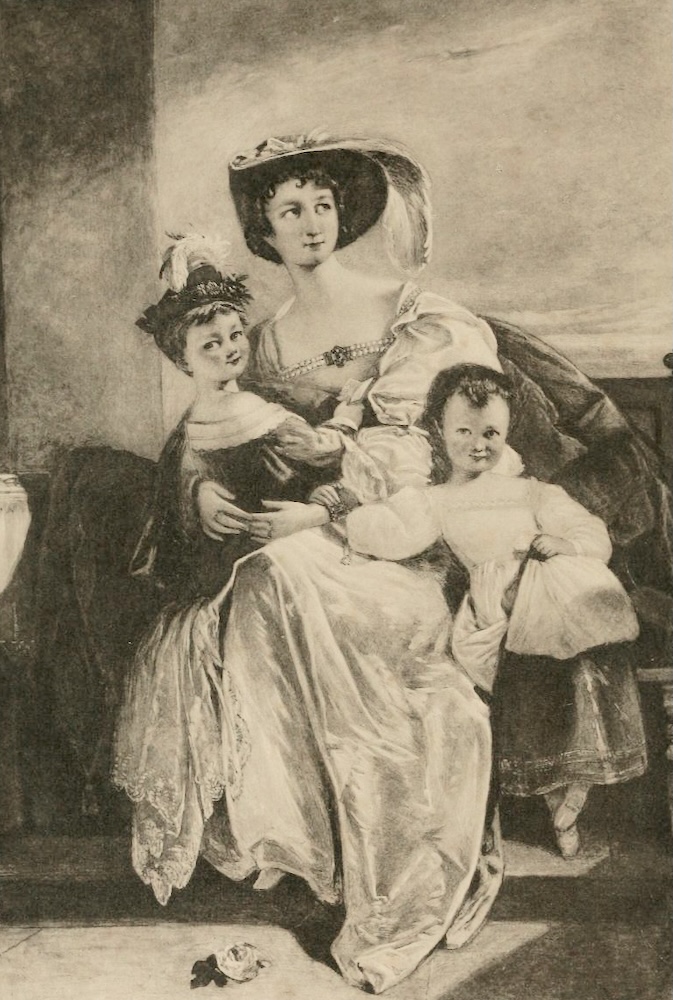
"Mrs Nightingale and her daughters." 1828. From a water-colour drawing; the very image of a fashionable upper-class mother and children. (frontispiece to Cook).
Nightingale's sense of vocation was derived from several powerful sources, and it was the combination of these that eventually propelled her to fame.
Ideal background material for the traditional view of her comes from the tales of the young Florence ministering to her dolls — mending them when her elder sister Parthenope had mischievously torn them apart, for example, and attending to the sick in the communities around her own childhood homes, Lea Hurst in Derbyshire and Embley in Hampshire. While not at all treating her in a sentimental way, that iconoclastic biographer of "eminent Victorians," Lytton Strachey, nevertheless noted that she "put her dog's wounded paw into elaborate splints as if it was a human being" and that her head was "filled with queer imaginations of the country house at Embley turned, by some enchantment, into a hospital, with herself as matron moving about among the beds" (6). The need to alleviate suffering seem to have come instinctively to her from her earliest years, and this understanding of her fits well with the image of the selfless nurse in the wards of the army hospital in Scutari, dispensing comfort to wounded soldiers.
Matters of faith
This scenario, however, was not achieved by the operation of instinct alone. Nightingale's resolve was stiffened by a fervent belief that she was fulfilling God's purpose. In discussing Seacole's motivations, Jane Robinson has suggested that Nightingale's own "urges and desires" were simply "disguised by, or subsumed in, the service ethic" (43). But this is to underplay considerably the role that religion played in her life. Nightingale's faith provided the motivation that she explored and explained most plainly: her great need was to feel of service not just to individuals, but to the working out of the divine scheme of human progress.
As an intelligent young person, Nightingale was inevitably drawn towards working out her own spiritual beliefs. She had, from the beginning, been subject to conflicting religious influences. Her parents had been married in the Anglican church of St Margaret's, Westminster, but her father William, son of a staunch and influential dissenter and Unitarian, had been baptized in the Presbyterian church, and her mother Fanny was herself the daughter of a prominent Unitarian; similarly, while still in Italy where she was born, the infant Florence was christened by her father's old college friend, Dr Thomas Trevor, then Prebendary of Chester Cathedral, but her birth was also entered "in the Protestant Dissenter's Register" at Dr. Williams's Library in London (Bostridge xi, n.2). Her own childhood observances were split between the Anglican and the Unitarian: at Embley, the Nightingales' Hampshire home, the family attended the local parish church of St Margaret's, while at their seat at Lea Hurst in Derbyshire they naturally worshipped at Lea Chapel, one of the earliest dissenting chapels, as well as one with which there was a strong family association. Moreover, the young Nightingale was tutored by her father, through whom she would have derived that "spirit of free enquiry into religious matters" that Mark Bostridge considers to have been ultimately inherited from her paternal grandfather (13). No one could have been more aware than she was of the religious controversies of the time, or so primed to work out her personal ideas about them.
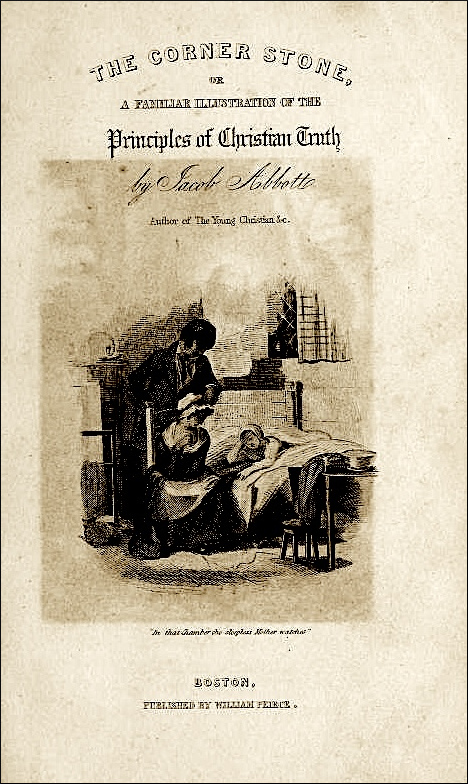
Title-page of Jacob Abbott's book, appropriately enough, with an illustration of parents watching over a sick child.
Her stance began to come clear to her at an early age. When she was not yet seventeen,and had recently been ministering to local victims of a flu epidemic, she read an inspiring book by the prolific American Congregationalist writer, Jacob Abbott (1803-1879). Abbott's emphasis was on "practical duty," words which recur in his popular work of 1830, The Corner-stone, or, A Familiar Illustration of the Principles of Christian Truth. Abbott advised his young readers not to get involved in metaphysical speculations, of the sort that she herself was beginning to engage in. A typical piece of advice from him was: "If we go far away from the region of 'practical duty,' our light goes out" (359). Fresh from doing her first rounds among the sick and eager to find a purpose, his young reader evidently took this to heart.
She felt, on this and subsequent occasions, distinctly called by God to pursue this course (see Cromwell 23). The point, her encouraging Aunt Mai had written to her once, "is to accomplish the welfare of man, not as a gift from Him, but as to be attained for each individual and for the whole race by the right exercise of the capabilities of each” (qtd. in Cook 121). This became her niece's tenet too, practicality blending inseparably into her theological thinking. In her Suggestions for Thought, Part II, for example, she recalled feeling that it was odd
that we should pray to be delivered "from plague, pestilence, and famine," when all the common sewers ran into the Thames, and fevers haunted undrained land, and the districts which cholera would visit could be pointed out. I thought that cholera came that we might remove these causes, not pray that God would remove the cholera.
At last, not from thinking what was likely to be, but from observing whether prayer was answered, and finding it was not, it occurred to me that this was not God’s plan, that His scheme for us was not that He should give us what we asked for, but that mankind should obtain it for mankind; that we were not paupers asking at a Poor Law Board for relief, but men working for themselves and their fellow-creatures. [59]
Cook argues convincingly that "this was the germ from which Miss Nightingale’s philosophy of religion was developed (I: 479). It was certainly the position that she took as she faced her own future.
The drive for fulfilment
Here, though, another impulse operated — one that further strengthened her determination to surmount the obstacles to her engagement in this vital work. Not satisfied with the traditional image of her as driven by sympathetic impulses and religious faith, Strachey argued that "[t]he Miss Nightingale of fact was not as facile fancy painted her. She worked in another fashion, and towards another end; she moved under the stress of an impetus which finds no place in the popular imagination. A Demon possessed her..." (1). More impressed by Nightingale than by most other Victorian figures, and understanding both that she was drawn to give succour, and saw her role as a servant of God, with "a secret voice in her ear" (6), he still emphasized something else — her raw feelings at being thwarted, her absolute determination to overcome obstacles set in the way to her self-fulfilment. Here, he felt, was the ultimate driving force.
In common with Nightingale's other biographers, Strachey gives the source of these obstacles: her parents' disapproval. This is what explains her unyielding stance in the argument with Gaskell. What seemed right to their daughter, what their daughter herself firmly believed was her future calling, had seemed entirely wrong to them. Their objection was not without grounds. After all, Strachey explains,
not only was it an almost unimaginable thing in those days for a woman of means to make her own way in the world and to live in independence, but the particular profession for which Florence was clearly marked out both by her instincts and her capacities was at that time a peculiarly disreputable one. A "nurse" meant then a coarse old woman, always ignorant, usually dirty, often brutal, a Mrs. Gamp, in bunched-up sordid garments, tippling at the brandy-bottle or indulging in worse irregularities. The nurses in the hospitals were especially notorious for immoral conduct; sobriety was almost unknown among them; and they could hardly be trusted to carry out the simplest medical duties.... It is not to be wondered at that her parents should have shuddered at the notion of their daughter devoting her life to such an occupation. [8]
But the issue was still broader than parental disapproval. It was left to more recent commentators to explain more fully Nightingale's relationship with the larger drive for women's rights. Elaine Showalter, for example, has described Nightingale's "anger and discontent with the female role," her "need to disguise her drives for knowledge, mastery, and power" (397). Partly because there was much else to occupy her time, and partly because she had no faith in the present capacity of most women, she rebuffed John Stuart Mill in 1860 when he solicited her support in the Suffrage cause; but she was determined to prove that women like herself, with energy and aspirations, should not be denied the freedom to engage in this great project of improving and perfecting humanity. She wrote to her father in 1846:
Why cannot a woman follow abstractions like a man? has she less imagination, less intellect, less self-devotion, less than aman? I think not. And yet she has never produced one single great work of Art, or Science, or Literature. She has never, with the exception perhaps of Deborah, the Virgin, & the Mére Angélique, been deemed a fitting vessel for the Spirit of God — she has never received the spark of inspiration, & though she may have indirectly left the impress of her character on the world, yet nothing she has said or done has had a record in history — & the Song of the Virgin Mary remains the only expression of female feeling, which has found its echo in every heart & every church. And why? why is her frame never deemed a worthy House for the Spirit of Truth? nor hers a worthy tongue to proclaim the service of the Kingdom of Good, by which I mean the struggle with Evil? Is it not because the habit of never interesting herself much, in any conversation, printed or spoken, which is not personal, of making herself & her own feelings the subject of speculation — (& what is the good of studying our own individuality, save as the reflection of the generality) — of making all she says autobiographical, & being always is a moral téte-a-téte, of considering her own experiences as the principal part of her life, renders her powerless to rise to any abstract good, or general view. It cuts her wings, it palsies her muscles, & shortens her breath for higher things — & for a clearer, but sharper, atmosphere, in which she has no lungs to live. She has fed on sugar-plums, her appetite is palled for bread. [Selected Letters, 30-31]
As if aware of betraying her own keen appetite for stronger fare, she ends the letter almost apologetically: "But I find these speculations so universally uninteresting — that I will stop, for fear of tiring you" (31).
Nightingale's natural bent and her ideological stance were, therefore, just two of the factors that led to her inspiring career: the other, hidden neither from herself or others, and far from demoniac to later eyes, was her discontent with her position as a woman, and her ambition to show what a woman could achieve. These factors together, no single one of them "disguising" or "subsuming" another, led to a career that was not only personally fulfilling, but promoted important advances in public health.
Nightingale's Achievements
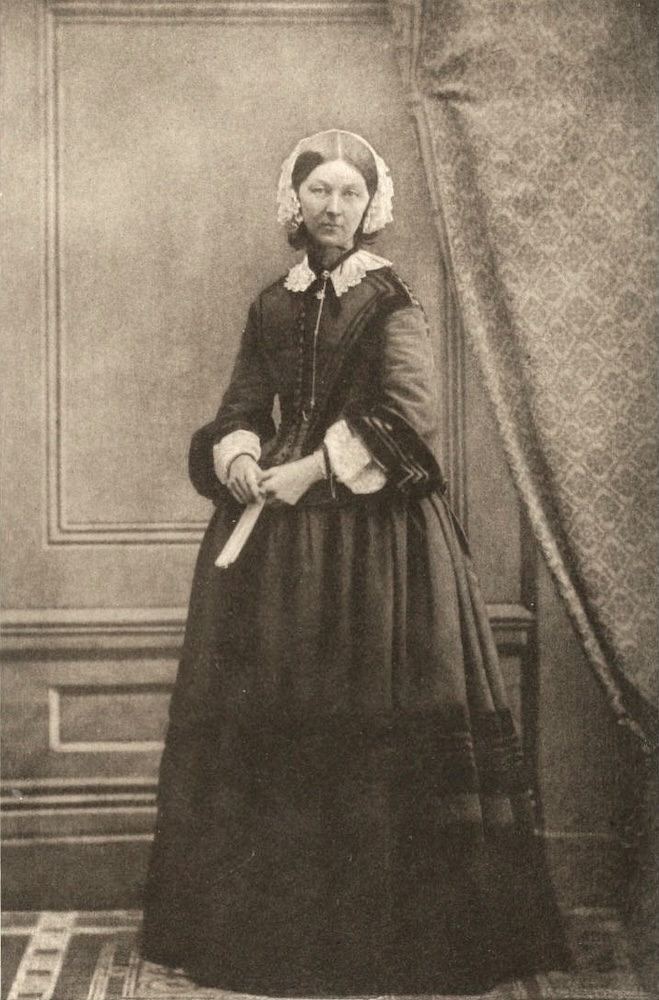
"Florence Nightingale, about 1858" from a photograph by Goodman (Cook, facing p. 394). Notice that she is wearing a cross.
Nightingale's most celebrated achievement was to accelerate the change from the tipsy Mrs Gamps of old to their more competent and well-conducted successors. She instituted standards of holistic care that would, when properly implemented, ensure the smooth running of the hospital experience, to reassure and instil confidence in the patient while the body heals. She attended to the minutiae of patient care. For instance, amongst the concerns in her Notes on Nursing is can disturb a patient, Nightingale cautions, and as for whispering about an operation almost within the patient's earshot, the effect of that on a sensitive soul might be fatal (35). Such instructions clearly came from personal experience at the ground level, and were conveyed simply and effectively, with anecdotal examples. Anne Marie Raffetery and her co-author, Chrisophe Debout, explain that her "understanding of the physical and psychological environment of the hospital and home reveal not only a deep scientific understanding of hygiene, but health and healing, details of care that added to comfort as well as nourishment of the human spirit."
Yet Gaskell's observation was correct: while deeply concerned with the way individual care-givers attended the sick, Nightingale put her faith in the institution rather than the individual. It may seem contradictory, but to forget her role in establishing protocols is a mark of her success. Her withdrawal from the front line, so to speak, when she took to her bed after returning to England, makes the following words in her Notes on Nursing particularly poignant: ".... people who are in charge often seem to have a pride in feeling that they will be 'missed,' that no one can understand or carry on their arrangements, their system, books, accounts, &c., but themselves," she admitted, but "[i]t seems to me that the pride is rather in carrying on a system, in keeping stores, closets, books, accounts, &c., so that any body can understand and carry them on — so that, in case of absence or illness, one can deliver everything up to others and know that all will go on as usual, and that one shall never be missed" (83-84).
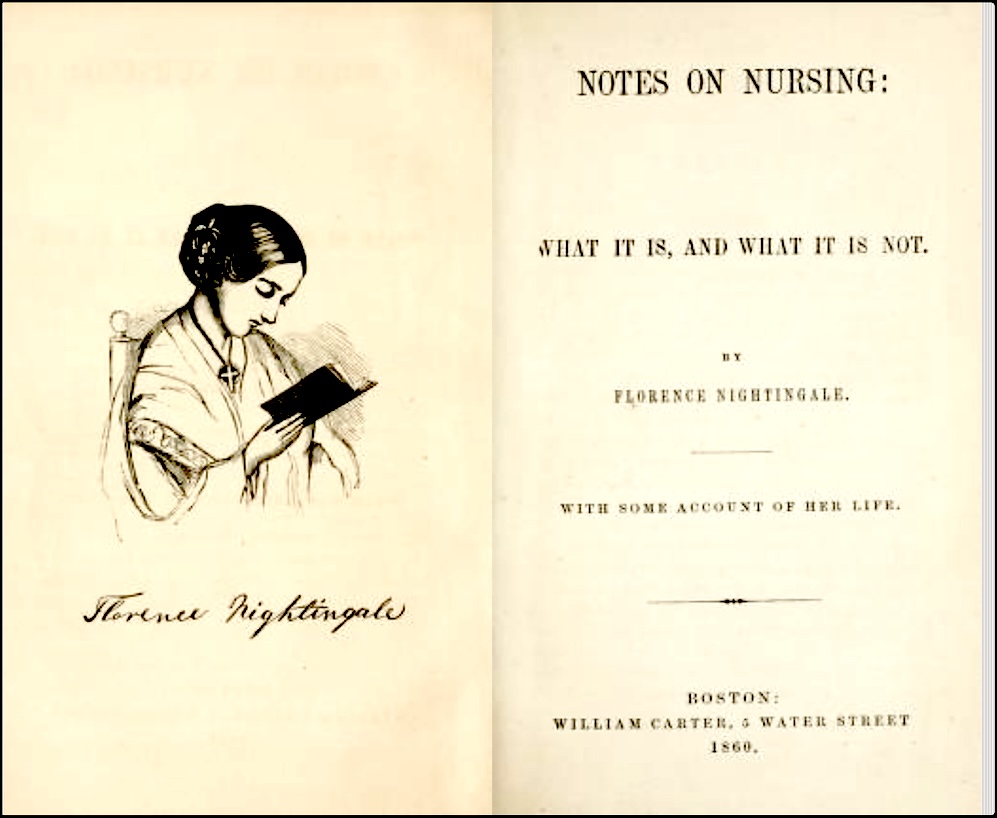
Frontispiece and title-page of a book which has never been out of print.
Nightingale's concern with putting systems in place for future hospital staff should, however, be remembered. It led to one undeniably major achievement to which her name remains prominently attached: the founding of the first institution dedicated to the training of nurses. This was originally at St Thomas's Hospital, where a nurses' school was opened in her name in July 1860, funded by five years' worth of donations. The first such training school in the world, apart from facilities in religious institutions, it became part of King's College London Department of Nursing Studies in 1998, and is now called the Florence Nightingale Faculty of Nursing, Midwifery & Palliative Care.
Another of Nightingale's key achievements came from a powerful skill that she developed in her post-Scutari years: this was her use of statistics, perhaps most valued now in their application to medical records. This too would be a part of her legacy:
Nightingale’s statistical and analytical skills formed the bedrock of her international and comparative statistics, anticipating the development of International Classification of Disease (ICD) codes today. Her research on hospital outcomes finds echoes in the work on staffing by Aiken et al. [Linda H. Aiken is the first author of many extremely widely cited articles on the correlation of nursing staff numbers and patient outcomes, and associated subjects]. She was, above all, a brilliant communicator both visually, through data, and verbally, through the power and epigrammatic prose style. She was adept at presenting data in a graphic form to dramatize her message and move her audience to action. She understood the power of statistics to change minds and encourage politicians to implement reform. [Rafferty and Debout]
Far from stopping with the individual patient, or even at an individual institution, she was able to use statistics to promote a whole range of health projects with far-reaching results, from slum clearance to sanitation to hospital architecture.
Nightingale's Reputation
Why, then, with this broad range of influence and such valuable outcomes to her credit, has Nightingale's reputation suffered in more recent years? This is partly because her role in some of them has been played down. That early mission to the Crimea, for instance, had a distinct advantage: a good proportion of the original hand-picked thirty-eight nurses who went out with her were already trained and experienced, fourteen of them in hospitals, many of the rest in religious establishments (Robinson 72). Still, co-ordinating the efforts of these women from their different backgrounds was challenging. Nightingale faced resistance from some, as well as initial hostility from the male medical personnel, all whilst dealing with the ugly wounds of battle and working in the most primitive and overcrowded conditions. Her letters from the Crimea reveal that she was taxed to the utmost. Editor and Nightingale scholar Sue Goldie makes very clear in her introduction to the letters that she had to learn on the job, tempering her demand for "blind obedience" from her crew with concern for the "welfare of individual nurses" (9). It is greatly to her credit that the official report on their work in 1855, available in the National Archives, judged the nurses' services to have been "extremely vauable."
What of her larger projects, then? Writing in the British Medical Journal in 2008, Keith Williams takes aim at some of these, finding them less pioneering than they seemed. He notes, for example, that the need for an army medical school had been recognised almost since the beginning of the century, when the deployment of female army nurses started during earlier conflicts. The notion of a Medical Staff Corp was not hers, he explains, but had already been accepted, quite independently of her urging: "Although the idea for this has been attributed to Nightingale in a letter to Sidney Herbert in January 1855, it had, in fact, been proposed earlier by Smith and agreed by the War Office the previous month" (1462). Similar circumstances, Williams says, attended the setting up of a board for medical statistics, which were already in use by now. But the fact remains that her well-informed and passionate support for these schemes was vital to their initial development and later success. Hers was a concerted effort across a range of initiatives: "she exemplified a broader movement, an ideal, which came to fruition in her career, and to which she gave impetus by her life and work" (Goldie 10).
Looking at her work more broadly still, critics in our own times have taken Nightingale to task for being invested in Victorian ideas about gender, class and race. These are tricky issues. What she was by birth inevitably affected her deeply, in some points holding her back, in others facilitating her progress. She had had to struggle against society's expectations of her as a woman, but her work was indeed very much in the established tradition of "nurturing womanhood" (Holton 60). That early impulse to care for the sick never waned: here was the wellspring of that "utter unselfishness in serving and ministering" that Gaskell perceived in her (qtd. in Stadlen 105). She herself recognised that she had expended "motherly feeling" on the soldiers she had nursed (qtd. in Showlater 402). As for being brought up in a world of upper-class privilege, this too had disadvantages as well as advantages. On the one hand, it set hurdles in the way of her choice of career, and totally unsuited her for the hellish conditions of Scutari. On the other, she was able to get support from those in high positions: she was much helped, for instance, by Herbert, who, as Secretary-at-War, first wrote to her suggesting the nursing expedition to Scutari. Such connections allowed her to channel her energies productively. But did her social standing make her "a cold snobbish bigot" (Macrae), or, more specifically, a racist? Perhaps the best answer here is her work on behalf of the Indian subcontinent, where sanitation and famine relief were of the utmost importance to her, and where she strongly supported the most liberal of the viceroys, Lord Ripon when his policy of encouraging local self-government provoked huge opposition from the British residents. At that time, she went so far as to remind Queen Victoria herself of her earlier pledge "that there are to be no race distinctions, that where there is fitness the employment of natives and Europeans is to be alike; that race is not to be a qualification or disqualification" (qtd. in Bostridge 495).
Nightingale and Seacole
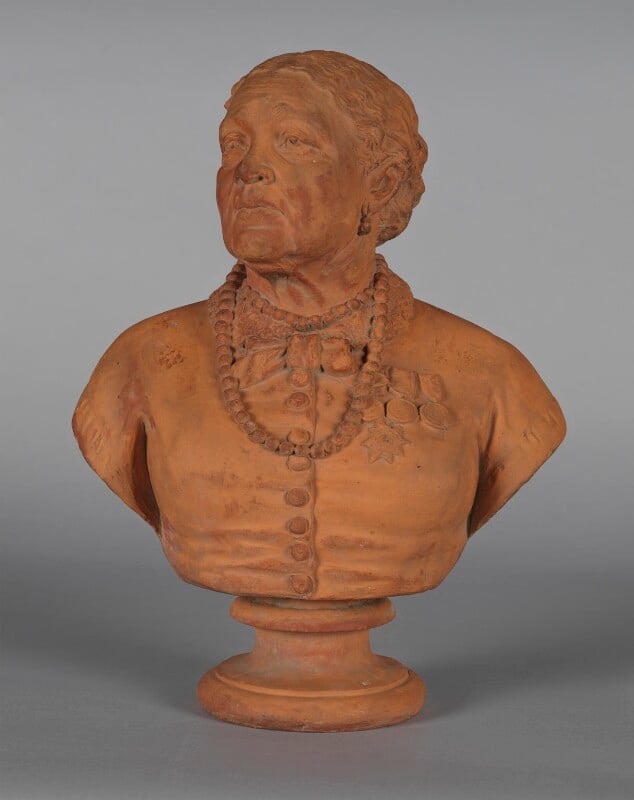
Terracotta bust of Seacole from 1871, by Count Gleichen.
The race issue is particularly pertinent when it comes to the supposed rivalry between Nighingale and Seacole, especially as it is a matter of record that another otherwise suitable applicant for the nursing mission to the Crimea (a certain Elizabeth Purcell) was turned down as being "too old and almost black" (qtd. in Bostridge 272). But Nightingale herself did not turn Seacole down for this mission: having volunteered late, Seacole was interviewed by someone else. At close to fifty, she too would have been considered rather too old for the mission; no mention was made of her darker colouring. Later, when asked for an opinion about her suitability for another mission, to the Franco-Prussian War, Nightingale was indeed ambivalent about her, but on grounds of laxity rather than race: "Anyone who employs Mrs Seacole will introduce much kindness — also much drunkenness & improper conduct, wherever she is" (qtd. in Robinson 191). This simply did not fit with the image of nursing professionals of unimpeachable virtue, far removed from the insalubrious hired attendants of the past, that Nightingale wished to project.
In truth, Seacole is a fascinating figure, vibrant, vigorous, outgoing, with none of those dull inhibitions that go with "respectability." Running the "British Hotel" in the Crimea, with facilities drawn on by officers rather than the rank and file, she provided comfort, respite and good cheer near the front line there, and on a few occasions did render valuable service by venturing on to the battlefield and attending to the wounded. After her return, her warm personality led to friendships with those in the highest circles. And she certainly deserves to be remembered, not just for her resourcefulness and hospitality, but for her skills as a "doctress," practiced from girlhood onwards, and before, during and after her stint in the Crimea. Here was an example of what could be achieved by a woman of colour (proud of her part-Scottish ancestry, she saw herself as "yellow" rather than black or brown) in society. Her spirited life-writing alone, in her Wonderful Adventures of Mrs Seacole in Many Lands (1857), merits a place in literary history and entitles her to be seen as a role model for future generations in our multi-cultural society. She deserves the current resurgence of her reputation. Nevertheless, as Lynn McDonald has said with some acerbity, to present her, as some have done, in a nurse's uniform, and sporting medals that were never awarded, is part of a "makeover myth" that is simply misleading. It was Nightingale and not Seacole who raised the status of nursing to a profession as well as a vocation, and who exercised an influence far beyond that as well.
Conclusion
Nightingale's achievements were widely recognised at the time, and marked by the award of the OM in 1907: the honour had only been initiated in 1902, and she was the first woman recipient, three years before her death in 1910. In more recent times, her high reputation has been challenged by research showing that her initiatives and recommendations were sometimes part of a larger process that had already started. More generally, she is seen as having shared some of the values of her age, including those that went with her role as a woman and her position in society. But it is clear that she earned her ionic status. Gaskell, who had noticed so early on that the younger woman put her trust in institutions rather than individuals, also realised that operating on more than an individual level had its value — it could be "a gift, and a very rare one" (qtd. in Stadlen 105). And indeed, it was through this gift that long-term changes were effected: there is really no room to doubt that Florence Nightingale's life's work was and remains vitally important in the whole field of public health.
Bibliography
Abbott, Jacob. The Corner-stone, or, A Familiar Illustration of the Principles of Christian Truth. Boston: William Peirce, 1830. Internet Archive, from a copy in the Library of Congress. Web. 24 January 2026.
Bostridge, Mark. Florence Nightingale: The Woman and Her Legend. 2008. London: Penguin, 2009.
Cook, Sir Edward. The Life of Florence Nightingale. Vol. 1. London: Macmillan, 1914. Internet Archive, from the digitallibraryindia; JaiGyan. Web. 24 January 2026.
Cromwell, Judith Lissauer.
"An extract from the 'Report upon the state of the hospitals of the British Army in the Crimea and Scutari' 1855, Catalogue ref: WO 33/1." National Archives. Web. 24 January 2026.
Goldie, Sue. Introduction. Florence Nightingale: Letters from the Crimea. Manchester: Manchester University Press, 1997. 1-14.
Holton, Sandra. "Feminine Authority and Social Order: Florence Nightingale’s Conception of Nursing and Health Care." Social Analysis: The International Journal of Social and Cultural Practice. No. 15 (1984): 59–72. http://www.jstor.org/stable/23169278
McDonald, Lynn. "Nursing's Bitter Rivalry." History Today (September 2012): 10-16. Available here: https://cwfn.uoguelph.ca/nursing-health-care/nursings-bitter-rivalry/
Nightingale, Florence. Ever Yours, Florence Nightingale: Selected Letters. Ed. Martha Vicinus and Bea Nergaard. London: Virago, 1989.
_____. Notes on Nursing What It Is and What It Is Not. Boston: William Carter, 1860. Internet Archive, from the University of California Libraries. Web. 24 January 2026.
_____. To the Artizans of England. Bookmundo (www.bookmundo.com), the original text published by Rob van der Peet in The Netherlands, 2025.
Rafferty, Anne Marie, and Christophe Debout. "Is Florence Nightingale Still Relevant Today?" King's College London. Web. 24 January 2026. https://www.kcl.ac.uk/is-florence-nightingale-still-relevant-today
Robinson, Jane. Mary Seacole: The Most Famous Black Woman of the Victorian Age. New York: Carroll & Graff, 2004.
Showalter, Elaine. “Florence Nightingale’s Feminist Complaint: Women, Religion, and ‘Suggestions for Thought.’” Signs 6, no. 3 (1981): 395–412. http://www.jstor.org/stable/3173753.
Stadlen, Naomi. A Grand Quarrel: Elizabeth Gaskell, Florence Nightingale and Mothers Today. Montag & Martin, 2025. [Review]
Strachey, Lytton. Florence Nightingale. London: Chatto & Windus, 1938. Internet Archive, from the University of California Libraries. Web. 24 January 2026.
Williams, Keith. “Reappraising Florence Nightingale.” BMJ: British Medical Journal 337, no. 7684 (2008): 1461–63. http://www.jstor.org/stable/20511629.
Created 26 January 2026