
Want to know how to navigate the Victorian Web? Click here.
THE INDIAN DURBAR HALL AT OSBORNE.
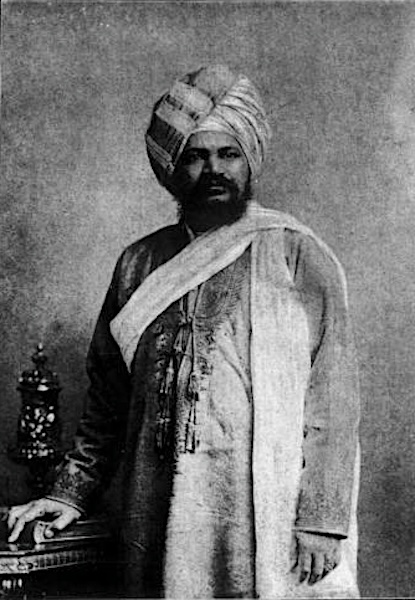
Photo by Messrs. Hughes and Mullins, Ryde.
RAM SINGH, THE DESIGNER OF THE INDIAN DURBAR HALL.
Her Majesty the Queen, as Empress of India, takes great interest, especially of late years, in studying the affairs of her vast Asiatic dominion, the condition of its different populations, their habits and manners, and the rank of its native princes, some of whom have been her visitors in England, and with whom she has learnt to converse, sufficiently for ceremonial intercourse, in the current Hindostani language. The portrait of her native Indian private secretary, who is a Mohammedan, recently appeared in this Journal. Another instance of her Majesty’s disposition to show all possible friendly regard to those who come from India as of her loyal subjects and faithful allies is equally deserving of public notice. This is the construction, in the new wing of Osborne House, East Cowes, the Queen’s favourite residence in the Isle of Wight, of a beautiful apartment, decorated according to ancient Hindu and Sikh ornament, to be used as hall of State Court receptions, upon occasions particularly concerning Asiatic guests of her Majesty. The work, at the Queen's private expense, was performed during the 1891 1892, under the personal superintendence of the designer, Singh, a native of the Punjab, formerly a pupil of Mr. Kipling, C.I.E. — father of the popular novelist, Rudyard Kipling — in the Mayo School of Art at Lahore. It was the Duke of Connaught [Price Arthur], when his Royal Highness was in India, who appreciated the merits of Ram Singh, and recommended him to the Queen for this employment, before which that ingenious and tasteful artist native artist — a master of architectural decoration, wood-carving, and cabinet-work—had achieved high success with his designs for the Chiefs’ College at Lahore, the Lahore Jubilee Museum, and the Municipal Halls of Ferozepur and Allahahabad, winning the prizes and the preference in open competitions. He also designed caskets, of ebony and silver, for presentation to the Queen and to the Duke of Connaught and furnished the decorations of the billiard-room and corridor in the mansion of his Royal Highness at Bagshot Park. We therefore willingly, in the belief that much is to be learned from India, as, indeed, has been already confessed, in these branches of ornamental art, give the portrait of Ram Singh, together with a view of the interior of the Durbar Hall at Osborne.
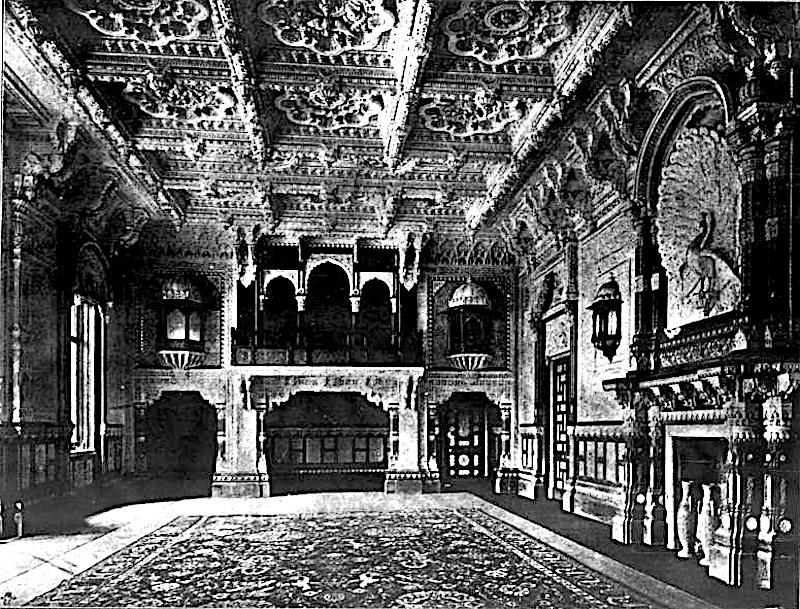
Photo by Messrs. Hughes and Mullins, Ryde. THE QUEEN'S INDIAN DURBAR HALL AT OSBORNE HOUSE, ISLE OF WIGHT.
The city of Amritsar, where Singh got his early training as a workman, is a great centre of trade, as well as the original headquarters of the Sikh national and religious community in the Punjab. Many of its houses are ornamented internally with the finest wood-carving, an art which there been practised by Indian workmen almost to an equal degree of manual skill with those of China and Japan, and with far better notions of richness and magnificence of effect, gracefulness of design, and the artistic treatment of surface reliefs. The ancient Hindu temples were probably unequalled in the beauty of the elaborate sandal-wood carvings on their ceilings and doors, of which the existing gates of the Somnauth [Somnath] temple are only a copy; these were carried off to Ghuzni, in 1024, by the Moslem conqueror, Sultan Mahmoud, and were recovered and brought to Agra by Lord Ellenborough, in 1542, after the first Afghan war.
AUG. 12, 1893
Transcribed, linked and reformatted by Jacqueline Banerjee, Editor-in-Chief, The Victorian Web. [You may use the images without prior permission for any scholarly or educational purpose as long as you (1) credit the person who scanned them and (2) link your document to this URL in a web document or cite the Victorian Web in a print one.]
Related Material

- Osborne House, East Cowes
- The Durbar Wing at Osborne House
- John Lockwood Kipling
- Hughes & Mullins, photographers
Bibliography
"The Indian Durbar Hall at Osborne." Illustrated London News Vol. 103 (Issue 2834): 198. Internet Archive. Web. 11 July 2026.
Created 9 July 2026