
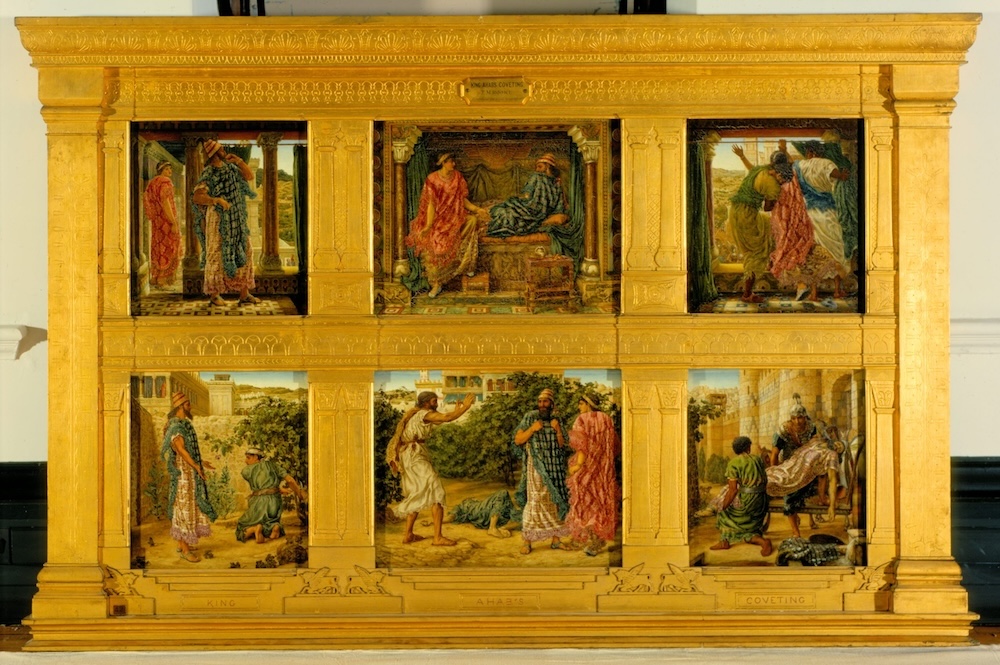
King Ahab's Coveting. Thomas Matthews Rooke, RWS (1842-1942). Oil on canvas. 1879, made up of six individual panels, the individual panels differing slightly in size as shown in the captions below. The whole work is shared here from the website of the Russell-Cotes Art Gallery and Museum, Bournemouth (see bibliography). It was initially exhibited at the Royal Academy in 1879, nos. 987-92, and is one of the most important of Rooke's compositions, presenting successive scenes of a story from the Old Testament. The picture was subsequently shown at a number of important exhibitions in the nineteenth century, including the New Gallery, Autumn Exhibition, in 1892, no. 183, and the Columbian Exhibition held at the Art Institute of Chicago in 1893, no. 415.
The biblical story of King Ahab and his coveting of Naboth's vineyard comes from 1 Kings, 21. Naboth the Jezreelite owned a vineyard in Jezreel, close to the palace of King Ahab of Samaria. Ahab wanted this vineyard to use as a vegetable garden because it was close to his palace and he offered to exchange it for a better vineyard or to pay Naboth whatever it was worth. Naboth refused, however, saying, "The Lord forbid it me, that I should give the inheritance of my fathers unto thee." Ahab became sullen and angry at this but when he mentioned the problem to his wife Jezebel she told him "Dost thou now govern the kingdom of Israel?... I will give thee the vineyard of Naboth the Jezreelite." She therefore arranged for false charges that he had cursed both God and the king to be brought against Naboth and the people subsequently stoned him to death. In this manner Ahab therefore took possession of Naboth's vineyard. God, incensed over this evil deed, instructed the prophet Elijah the Tishbite to tell Ahab that he intended to bring disaster upon him and on the house of Ahab: "In the place where dogs licked up Naboth's blood, dogs will lick up your blood" and concerning Ahab's wife that "dogs will devour Jezebel by the wall of Jezreel." Upon hearing this terrible pronouncement, Ahab repented of his sins toward Naboth, tore up his clothes, put on sackcloth, and humbled himself before God. Because of his repentance the Lord decided not to bring the promised disaster on Ahab during his lifetime. When Ahab was killed in battle against the Arameans, however, his blood was washed out of the chariot in the same place where Naboth had been stoned to death and dogs were there to lick his blood. Jezebel also met her fate as predicted as told in 2 Kings IX, 30-37. Jehu was a Jewish military commander in the army of Ahab who was secretly anointed king by a prophet sent by Elijah in order to overthrow the house of Ahab. Jehu immediately made haste to Jezreel where he killed two of Ahab's sons before proceeding to Jezebel's palace. Jezebel, under Jehu's orders, was thrown from a palace window by her eunuchs, "So they threw her down: and some of her blood was sprinkled on the wall, and on the horses: and he [Jehu] trode her under foot." Her remains were then devoured by dogs.
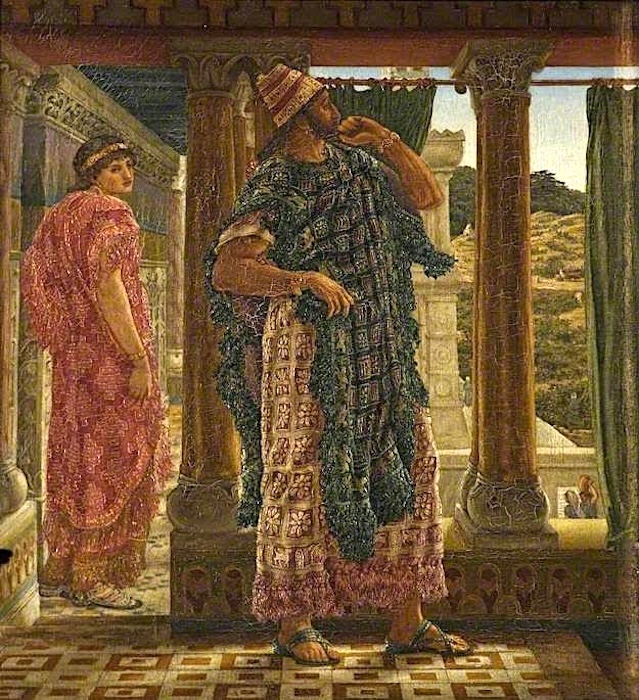
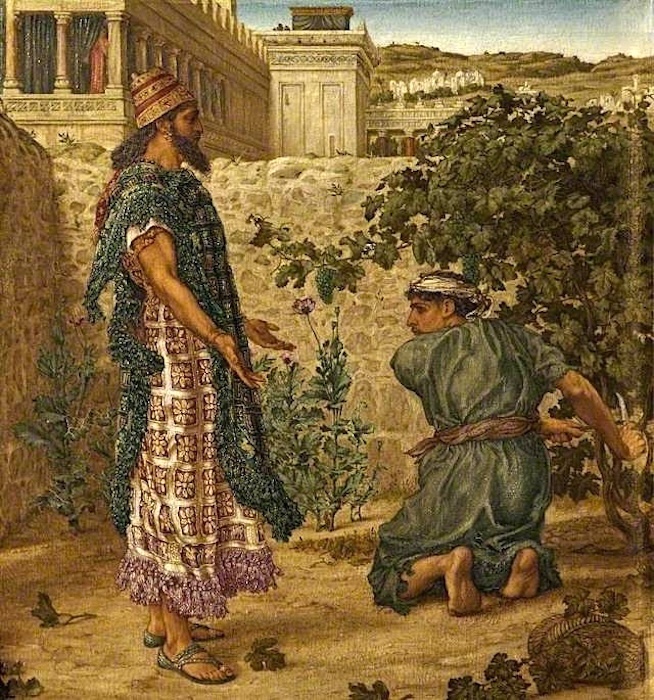
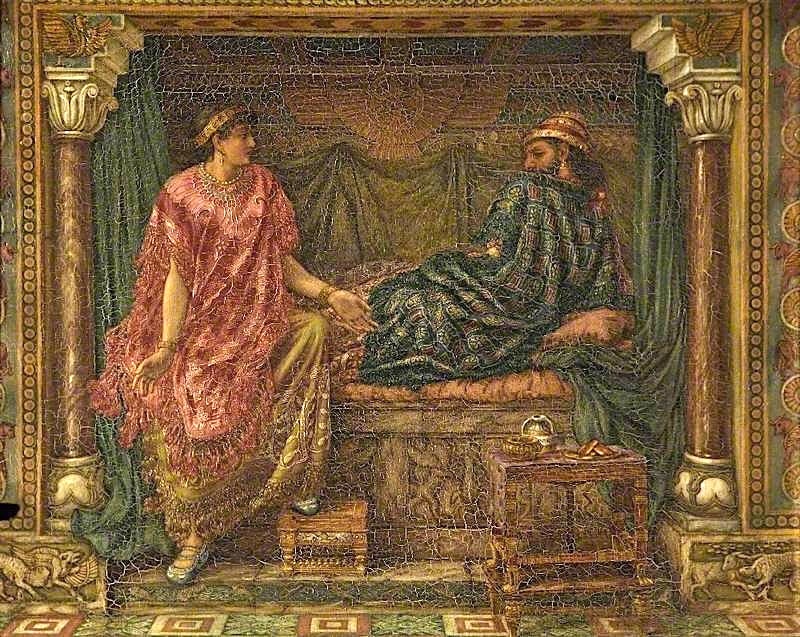
The upper panels from the work in the Russell-Cotes Museum, reproduced here via Art UK under the terms of the Creative Commons Attribution-NonCommercial-NoDerivatives licence (CC BY-NC-ND), from left to right: (a) Ahab Covets Naboth's Vineyard. 13 9/16 x 12 3/8 inches (34.5 x 31.5 cm). (b) Naboth Refuses Ahab his Vineyard. 13 9/16 x 12 3/8 inches (34.5 x 31.5 cm). (c) Jezebel Promises Ahab to Obtain it by False Witness. 12 3/4 x 12 3/8 inches (35 x 44 cm). [Click on the images to enlarge them.]
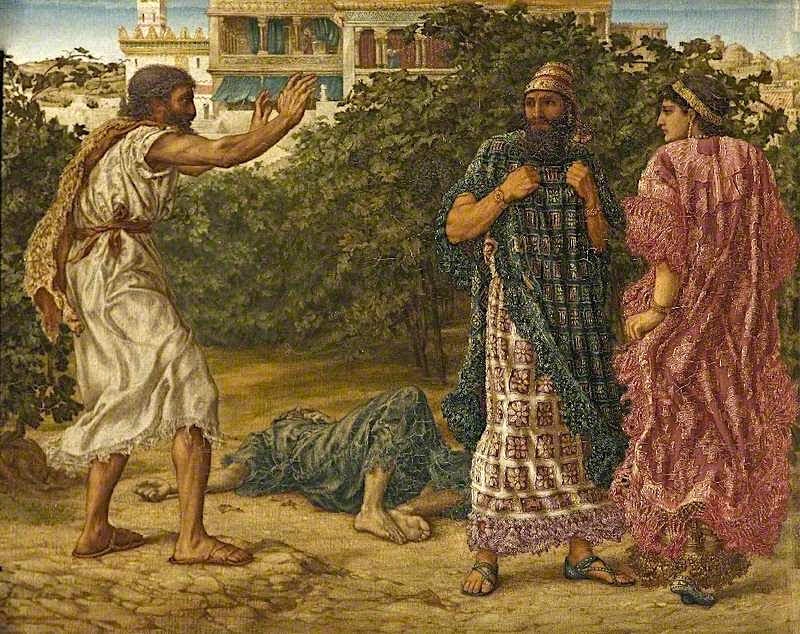
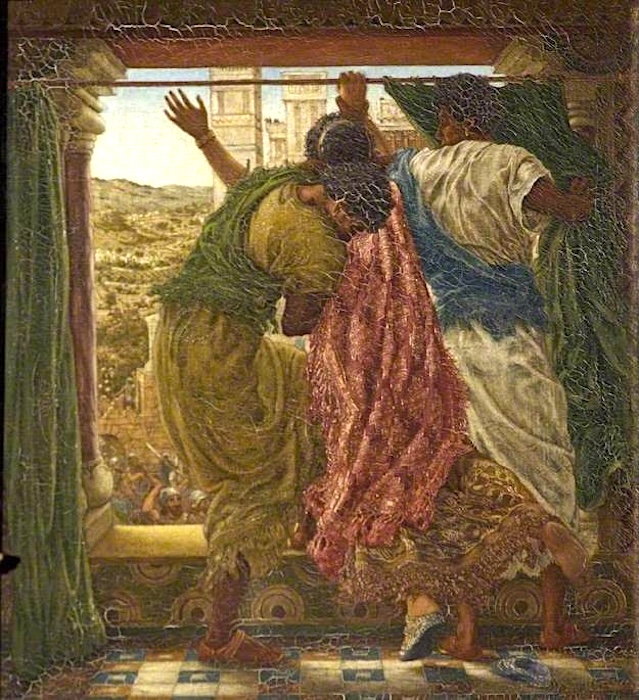
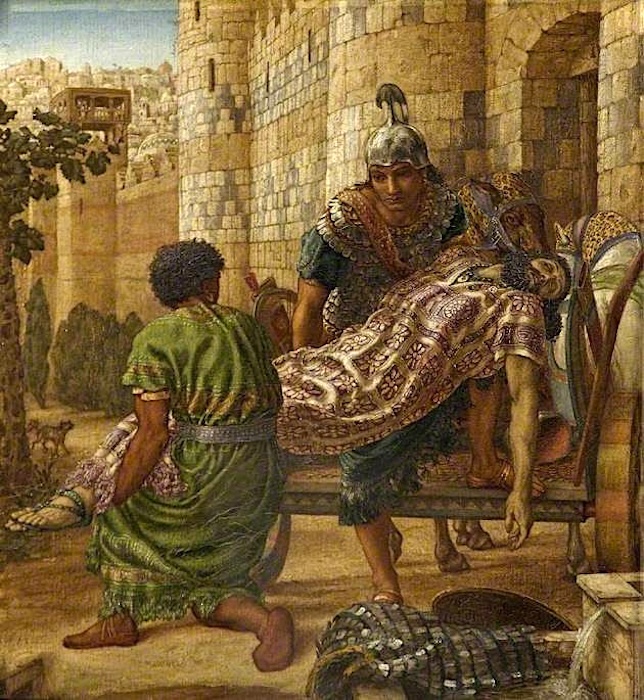
The lower panels from the work in the Russell-Cotes Museum, reproduced here via Art UK under the terms of the Creative Commons Attribution-NonCommercial-NoDerivatives licence (CC BY-NC-ND), from left to right: (a) Elijah Prophesises to Ahab and Jezebel Their End. 13 9/16 x 17 1/8 inches (34.5 x 43.5 cm). (b) Jezebel Thrown to the Dogs. 13 9/16 x 12 1/4 inches (34.5 x 31.2 cm). (c) Ahab's Body Brought in from the Battlefield. 13 3/4 x 12 5/8 inches (34.8 x 32 cm).
These six panels for King Ahab's Coveting explain the gist of the biblical story exceptionally well. Rooke was obviously fascinated with this particular story from the Old Testament, having exhibited two other paintings dealing with this subject already at the Royal Academy. In 1876 he had exhibited Elijah, Ahab and Jezebel in the vineyard of Naboth, the Jezreelite, no. 1254. This picture had initially been painted in 1875 for a student competition at the Royal Academy Schools. It was similar to panel IV in King Ahab's Coveting except that the image was reversed and it lacked the figure of the dead Naboth. In 1878 Rooke exhibited Death of Ahab, no. 533 and as late as 1899 Rooke did another version of Elijah, Ahab and Jezebel that is now at the Southwark Heritage Centre, accession no. GA0640.
Yet the story of King Ahab and Naboth's vineyard was not a common one for Victorian painters, although James Smetham painted a small oil in 1856 of Naboth in his Vineyard, and Frank Dicksee made an engraving of Jezebel and Ahab Meeting Elijah in Naboth's Vineyard published in The Graphic on 6 May 1876.
Contemporary Reviews of the Painting
A reviewer for The Architect praised both the design and colour of this picture:
Though very different in scale and treatment, it may be well in this place to draw the reader's attention to a series of original designs set in one frame and illustrating King Ahab's Coveting (987-992), by T.M. Rooke. We seem to trace some affinity to the style of Mr. Madox-Brown in this clever and curious work. The execution with loaded and broken pigment and the abundance of decorative detail in costume produce the effect of mosaic, the colour is gemlike and rich, the designs are powerfully dramatic with a touch of naïveté in the realism. [321]
Henry Blackburn in his Academy Notes was more ambivalent. He called the picture "One of the few serious works of religious art in the exhibition; it is decorative in treatment, similar to Ruth, which was exhibited at, and purchased by, the Royal Academy in 1877. These delicate designs are placed in trying juxtaposition to some glaring colours" (64).
F.G. Stephens in The Athenaeum felt the picture was an advance in design, handling, and colour over his earlier The Story of Ruth:
For an admirable series of painted designs of Italian fifteenth century character we are indebted to Mr. Rooke. Mr. Rooke achieved distinction in 1877 by a picture called Ruth, on the somewhat confused handling of which we are glad to see he has improved in King Ahab's Coveting (987-992) in six compositions. The story of the vineyard is told with dramatic energy; there is a great variety of action, character, and expression, and a rare and fine sense of colour. Among the best of these designs is that of Jezebel counselling Ahab, sitting on the king's couch; a very striking one shows how she was thrown out of the window; the last gives us the dead Ahab. [733].
Harry Quilter in The Spectator, however, thought the composition overlaboured, too filled with minutiae to present the subject effectively, as well as being too much influenced by Edward Burne-Jones:
Mr. Rooke, whose Story of Ruth we praised so highly in the same exhibition as Mr. Dicksee's [Frank Dicksee] Harmony, has here six small pictures, in an elaborately designed frame, entitled King Ahab's Coveting. We hope this sincere and very conscientious painter will forgive us for saying that these works appear to us somewhat inferior to those of two years since. An artist who bestows such severe and unsparing labour upon all his work, is peculiarly liable to the error of frittering away in minutiae the main interest of his subject, and though, as an artist once said to us of Mr. Rooke's work, that "he knew how to make a small piece of canvas precious with colour," he has in the present instance over-laboured his compositions, and the effect of the series is not to tell the story in anyway clearly, but rather to leave us with an impression of a beautifully designed piece of mosaic, in which scarlet draperies, green vine-leaves, and gold frame, all take a part. With a little less slavish adherence to the manner of the artist on whom Mr. Rooke has evidently founded his style, and a little more of that artist's spirit, this young painter may do great things yet. [563]
Bibliography
Ahab Covets Naboth's Vineyard. Art UK. Web. 13 January 2026.
Ahab's Body Brought in from the Battlefield. Art UK. Web. 13 January 2026.
Bills, Mark. A Victorian Salon. Paintings from the Russell-Cotes Art Gallery and Museum. London: Lund Humphries, 1999, cat. 41, 77-78.
Blackburn, Henry. Academy Notes. London: Chatto & Windus (May 1879): 64.
Christian, John. Burne-Jones and his Followers. Tokyo: The Tokyo Shimbun 1987, cat. 37, 99-100.
De Maio, Eduardo. Preraffaelliti Rinascimento Moderno. Milan: Dario Cimorelli Editore, 2024, cat.IX.12, 340 & 535-36.
Elijah Prophesises to Ahab and Jezebel Their End. Art UK. Web. 13 January 2026.
Jezebel Promises Ahab to Obtain it by False Witness. Art UK. Web. 13 January 2026.
Jezebel Thrown to the Dogs. Art UK. Web. 13 January 2026.
King Ahab's Coveting. Russell-Cotes Art Gallery and Museum, Bournemouth. Web. 13 January 2026.
Naboth Refuses Ahab His Vineyard. Art UK. Web. 13 January 2026.
"Painting at the Royal Academy." The Architect XXI (31 May 1879): 321-22.
Quilter, Harry. "Art. First Impressions at Burlington House." The Spectator LII (3 May 1879): 562-63.
Sparrow, Walter Shaw. Joshua to Job. London: Hodder & Stoughton, 1906. 104-08.
Stephens, Frederic George. "Fine Arts. The Royal Academy." The Athenaeum No. 2693 (7 June 1879): 733-37.
Temple, A. G. Sacred Art. London: Cassell and Company Limited, 1898. 149-57.
Created 13 January 2026