
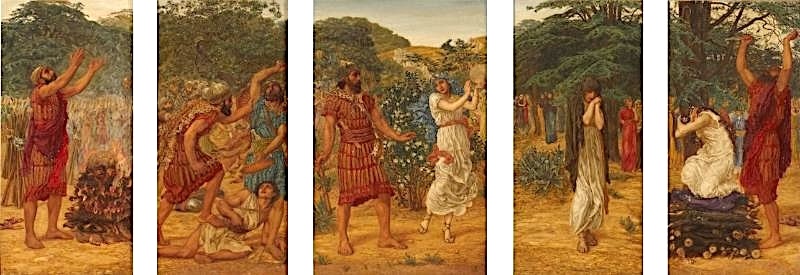
Jephthah's Vow, by Thomas Matthews Rooke, RWS (1842-1942). 1882. Each painting is oil on canvas, described as measuring 22 1/2 x11 inches (57 x 28 cm), though the central one looks wider. They are framed together in the collection of Southwark Heritage Centre, London, dated 1900, total size 221 x 915 mm, accession no. GA0639-1. The individual paintings are reproduced here via Art UK, under the terms of the Creative Commons Attribution-NonCommercial licence (CC BY-NC).
This is another in the series of religious paintings that became a speciality for Rooke. Jephthah's Vow, consisting of five panels framed together, was exhibited at the Royal Academy in 1882, no. 808. The biblical story of Jephthah's vow is found in Judges, Chapter XI, verses 30-38:
Jepthah [Jephthah], a mighty man of valour, was chosen by the elders of Gilead to lead their army in the war being waged against them by the people of Ammon: "And Jephthah made a vow to the Lord: "If you give the Ammonites into my hands, whatever comes out of the door of my house to meet me when I return in triumph from the Ammonites will be the Lord's, and I will sacrifice it as a burnt offering." Then Jephthah went over to fight the Ammonites, and the Lord gave them into his hands. He devastated twenty towns from Aroer to the vicinity of Minnith, as far as Abel Keramim. Thus Israel subdued Ammon. When Jephthah returned to his home in Mizpah, who should come out to meet him but his daughter, dancing to the sound of timbrels! She was an only child. Except for her he had neither son nor daughter. When he saw her, he tore his clothes and cried, "Oh no, my daughter! You have brought me down and I am devastated. I have made a vow to the Lord that I cannot break." "My father," she replied, "you have given your word to the Lord. Do to me just as you promised, now that the Lord has avenged you of your enemies, the Ammonites. But grant me this one request," she said. "Give me two months to roam the hills and weep with my friends, because I will never marry." "You may go," he said. And he let her go for two months. She and her friends went into the hills and wept because she would never marry. After the two months, she returned to her father, and he did to her as he had vowed."
This episode from the bible was popularized during the Victorian era in a poem by Alfred Tennyson entitled "A Dream of Fair Women."
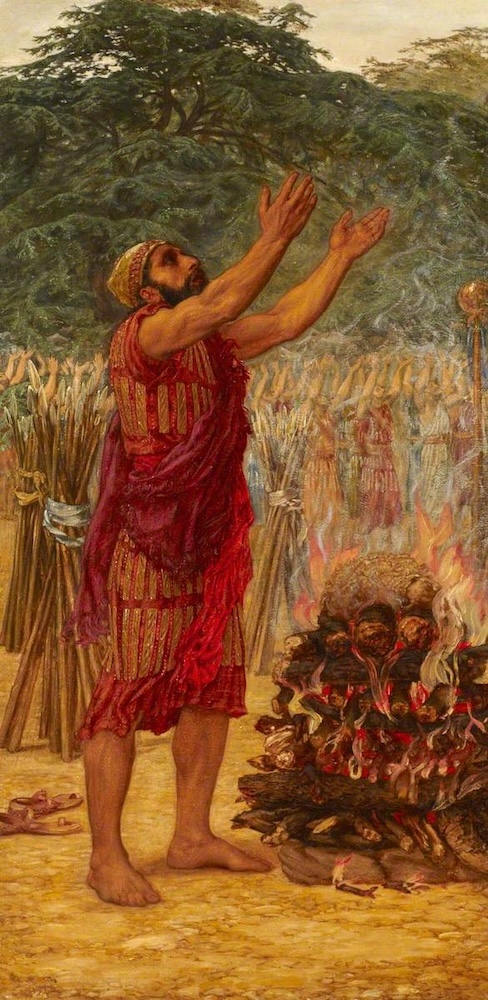
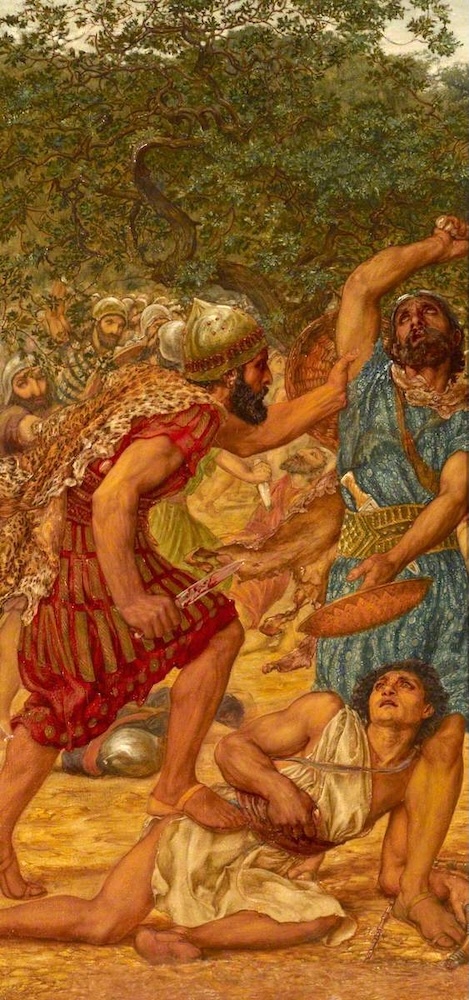
Left: Jephthah's Vow I – Jephthah's vow. Right: Jephthah's Vow II – His Victory. [Click on the images to enlarge them.]
The five panels in Rooke's picture tell the story well. The first panel shows Jephthah making his vow to the Lord. The second panel shows Jephthah defeating the Ammonites. The third panel shows Jephthah's daughter dancing to the timbrels and greeting her father upon his victorious return. The fourth panel shows his daughter roaming the hills with her friends. The final panel shows Jephthah preparing to sacrifice his daughter, a knife is in his right hand and his arms raised in prayer to the Lord. Jeptha's daughter, dressed in a white gown symbolic of her purity, cowers over the pyre of wood where she will be burnt as a sacrificial offering following her death. In the background the local inhabitants can be seen with their hands also raised praying to the God of Israel. Rooke was fond of using this technique of using multiple panels to convey a Biblical story, such as his King Ahab's Coveting in six panels exhibited at the Royal Academy in 1879.
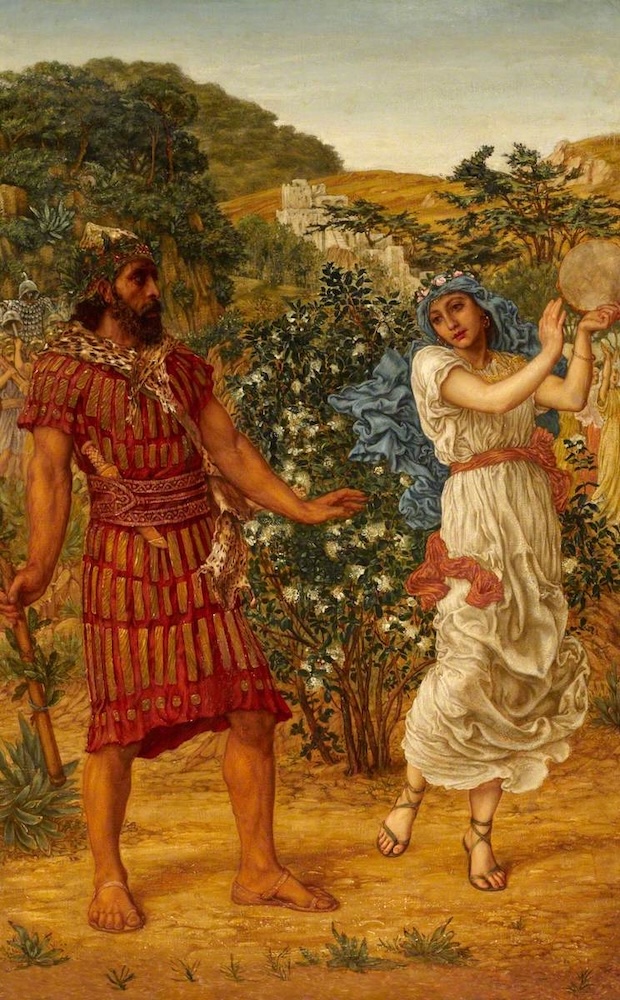
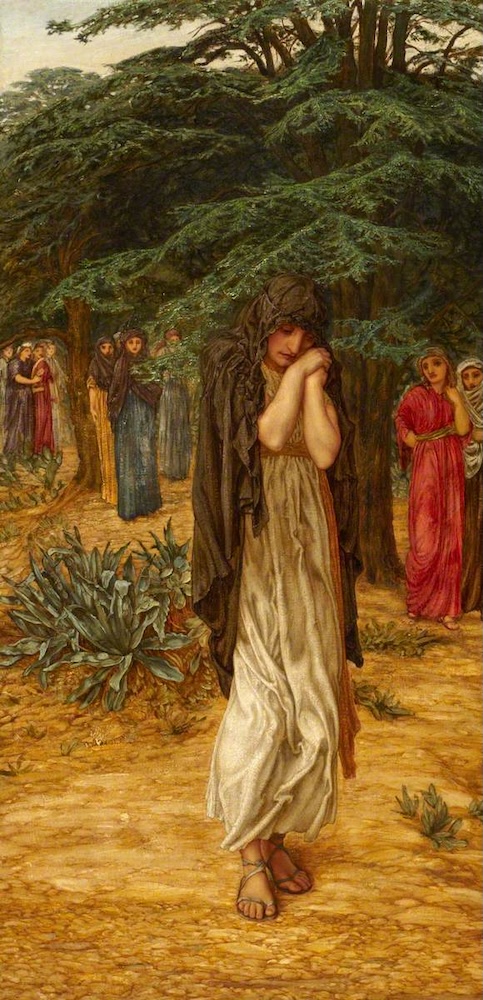
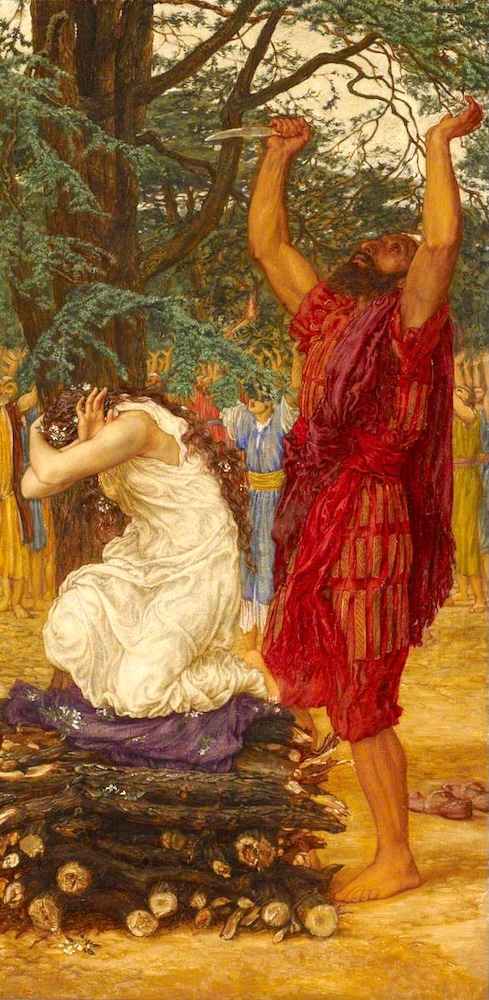
Left to right: (a) Jephthah's Vow III - The Meeting with his Daughter. (b) Jephthah's Vow IV - Her Mourning. (c) Jephthah's Vow V – The Vow's Fulfilment.
Rooke was not the only Victorian and Edwardian artist to deal with the theme of Jephthah's daughter. The best-known version is John Everett Millais's Jephthah of 1867 in the collection of Amgueddfa Cymru – Museum Wales, Cardiff. Elizabeth Siddal made a pencil drawing of Jephthah's Daughter in c. 1866, now in the Delaware Art Gallery, Wilmington. Henry Holiday made a finished pencil drawing of Jephthah's Daughter of 1889, one of the eight cartoons for his Chaucer's "Legende of Goode Wimmen" series. Other versions of this subject include George Elgar Hick's The Lament of Jephthah's Daughter of 1871, Edwin Long's Jephthah's Vow: The Return and Jephthah's Vow: In the Wilderness of 1885-86, both in the collection of the Russell-Cotes Art Gallery and Museum in Bournemouth, Jessie Macgregor's Jephthah of 1889 is in the Walker Art Gallery, Liverpool and Charles Ricketts' Jephthah's Daughter of c.1905-07 in the collection of the Ashmolean Museum, Oxford.
Contemporary Reviews of the Paintings
The Architect did not find this work to be up to Rooke's previous standards: "Mr. Rooke, who has shown undoubted capacity for design, sends a panel, in five divisions, of subjects from Jephthah's Vow. They are not equal to previous efforts, however" (292). F.G. Stephens in the Athenaeum gave the picture its most extensive, albeit mixed review, and complained of where it was hung:
Mr. T. M. Rooke is one of the few original artists who have appeared within the last decade. His work is so good and so fine that we turn with interest to everything he does; but the series of pictures which have been most inconsiderately hung above the violent colour and fuliginous Fight for the Standard [John Gilbert] do not afford unmixed satisfaction. Mr. Rooke's draughtsmanship does not grow more solid; those affectations of his which seemed to be temporary whims have become mannerisms, and in all these five illustrations of the legend of Jephthah (808-12) the critic will detect defective modelling, and want of simplicity and breadth in the designing of the figures and the disposing of their draperies. The best of the set is The Meeting with his Daughter (810), where the dancing girl in white is animated and elegant. In The Vow's Fulfilment (812) the daughter is well designed, but she lies on a pyre which would hardly burn one of her toes. The rich, harmonious, and sober colour of these pictures deserved a better fate than has befallen it here. [674]
Harry Quilter in The Spectator was his usual critical self: "Jephthah's Vow, by Mr. T. M. Rooke, - one of those pictures in several compartments of which this artist is so fond. It will please many, from his delicate manipulation and accuracy of detail; but it bears strong evidence of the weakening effect of continually painting very small figures. The actors in these five little dramas of Jephthah have no strength, freedom, or manhood about them; they totter rather than stand, they simper rather than smile. They are more like indifferently constructed puppets than human beings, and the amount of reality they possess is about equal to that of the saints in a Byzantine MS" (864).
Note: Scott Thomas Buckle kindly notified us that Rooke’s figure of Jephthah’s daughter dancing was reproduced as an attractive inset panel for an "Aesthetic mahogany bedside cupboard, ... height 82.5cm" (possibly made by Collinson & Lock):
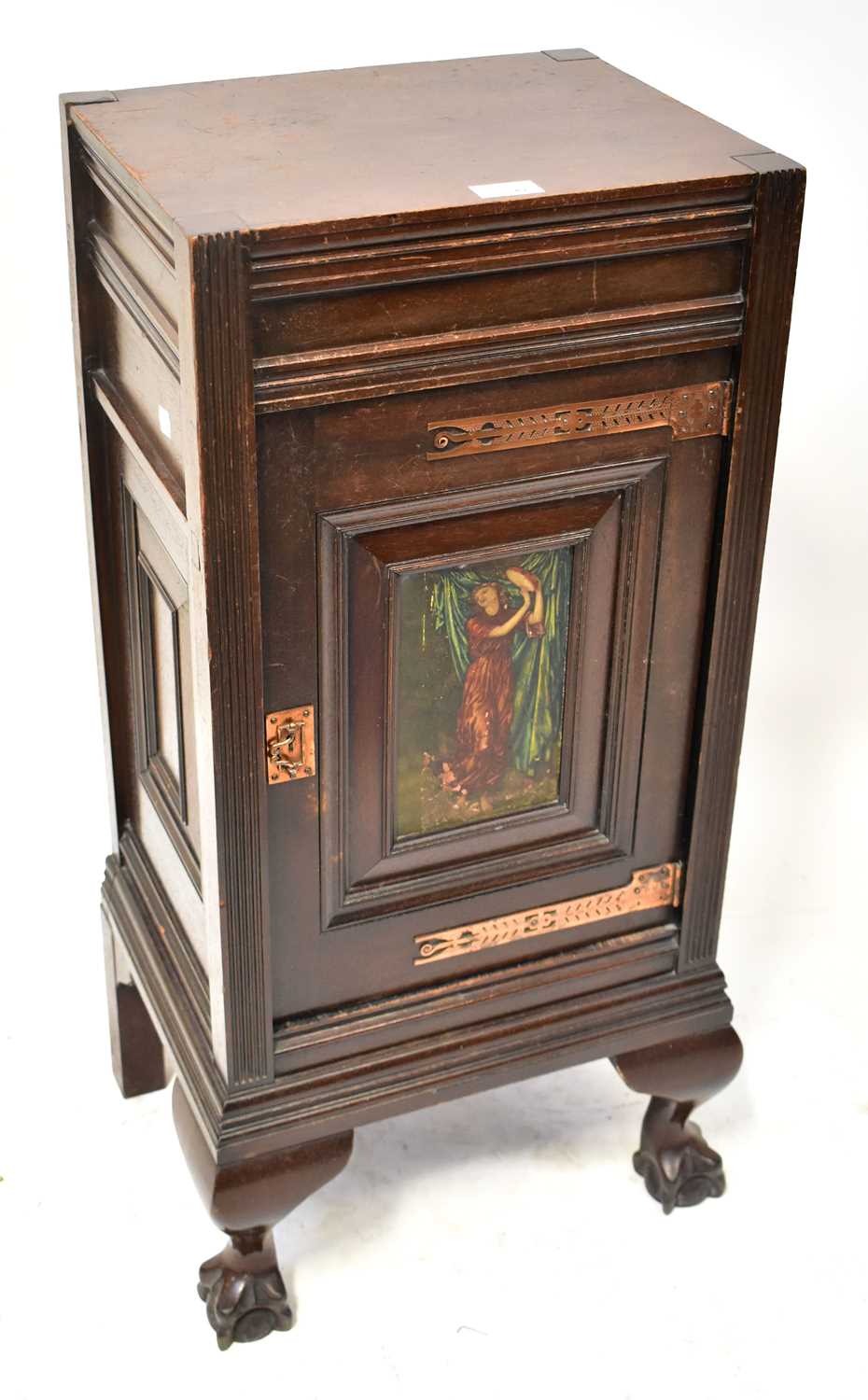
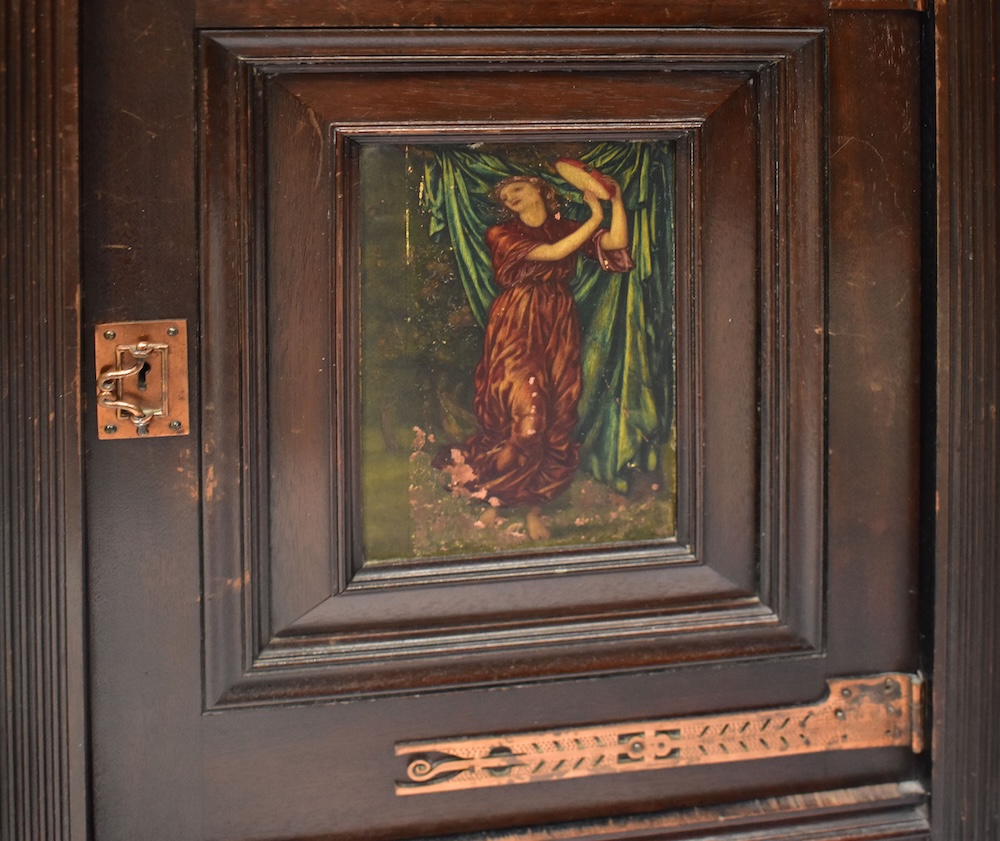
Left: The front, showing the inset panel. Right: The whole cabinet. Images of lot 49, 27 November 2025, reproduced by kind permission of Alan Partridge, Auctioneers and Valuers.
Bibliography
Lot 49. Alan Partridge, Auctioneers and Valuers. Web. 22 January 2026. https://auctions.adampartridge.co.uk/auction/lot/lot-49---an-aesthetic-mahogany-bedside-cupboard-the/?lot=195756
Blackburn, Henry. Academy Notes. London: Chatto & Windus (May 1882): 68.
Jepthah's Vow. Southwark Council. Web. 15 January 2025.
Jepthah's Vow — I. Art UK. Web. 15 January 2025.
Jepthah's Vow II — His Victory. Art UK. Web. 15 January 2025.
Jepthah's Vow III — The Meeting with His Daughter. Art UK. Web. 15 January 2025.
Jepthah's Vow IV — Her Mourning. Art UK. Web. 15 January 2025.
Jepthah's Vow V — The Vow's Fulfilment. Art UK. Web. 15 January 2025.
"Pictures at the Royal Academy." The Architect XXVII (13 May 1882): 291-92.
Quilter, Harry. "Art. The Royal Academy." The Spectator LV (1 Jul 1882): 863-64.
Stephens, Frederic George. "Fine Arts. The Royal Academy." The Athenaeum No. 2848 (27 Ma 1882): 672-74.
Temple, A. G. Sacred Art. London: Cassell and Company Limited, 1898. 91, 97 & 99.
Waterfield, Giles. Art for the People – Culture in the Slums of Late Victorian Britain. London: Dulwich Picture Gallery, 1994. 54-55 & 95.
Wildman, Stephen. "For love and mere journeyman’s wages": T.M. Rooke and his work for John Ruskin. The Ruskin Lecture, The Guild of St George, 2005. 7, 20, & 43.
Created 15 January 2026