
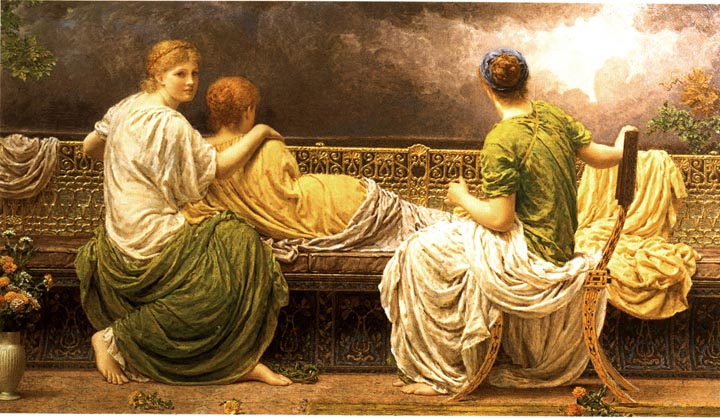
Lightning and Light by Albert Joseph Moore, ARWS (1841-1893). 1892. Oil on canvas. 34 1/2 x 57 3/8 inches (87.6 x 145.6 cm). Courtesy Forbes Magazine Collection.
Moore exhibited Lightning and Light at the Royal Academy in 1892, no. 672. It features three young women on a balcony watching a thunderstorm and startled by a flash of forked lightning. One is seated looking towards the viewer with her right hand around the shoulder of her friend who reclines on the carved marble bench. The third is seated on an inlaid chair of ancient Greek design and is turned around to look at the lightning. The maiden on the left wears a white gown with a green overgarment, while the damsel to the right wears a green gown with a white overgarment. The girl in the middle wears a yellow gown with a greyish-white overgarment. The background is largely a mass of grey clouds except for the brilliant flash of lightning to the right.
Lightning and Light signifies a new direction in Moore's art towards his "symbolist phase" where, as John Christian has written, Moore was "no longer simply concerned with aesthetic questions of form and colour, he began to admit an element of meaning and to suggest human emotion" (130). Most scholars attribute this change to the development of the malignant tumour in his thigh, from which he would die three years later. Christian suggests, however, that Moore's earliest paintings were narrative, so possibly this could be seen as "the return to origins which so often characterises the late works of artists" (130). Like Moore's previous works, Lightning and Light is also scientifically designed based on geometry. Robyn Asleson has noted that: "Emphatic, concentric curves generated by the figures' drapery (and echoed in details such as the chair legs) lead the eye across the canvas in a series of wave-like movements" (189).
A large pastel version of this painting, although in a damaged and repaired condition, sold at Christie's, London, on February 20, 2003, lot 136. It is currently in a private U.K. collection.
Contemporary Reviews of the Painting
Claude Phillips in The Academy liked the painting except for its depiction of lightning:
A very original harmony is that attained by Mr. Albert Moore in his delicate piece of decoration, Lightning and Light (672) – a harmony deliberately cold and restrained, but fresh, cool, and delicious. Three fair-haired damsels, of the Anglo-Greek type invented by this artist, are grouped on a balcony, opening out on a leaden sea and a threatening sky rent by lightning; their draperies are of yellow, green, and greyish white, while the balcony itself is adorned with plaques of cold blue and grey faience, and the whole is relieved by notes of orange-tawny and yellow supplied by scattered flowers. All is harmonious and subtly appropriate, save the sky, in which the representation of lightning is, even from the purely decorative standpoint which here necessarily obtains, impossible. [451]
Phillips, this time in The Art Journal, once again complained about the preposterous depiction of lightning:
In the fancifully-named canvas Lightning and Light Mr. Albert Moore has composed, out of elements which he has often manipulated before, a colour-harmony which, in its deliberate coldness, is yet of exquisite freshness and beauty. On a terrace looking out upon an expanse of threatening grey sky and sullen waters, are grouped Mr. Moore's three inevitable Anglo-Greek damsels, robed this time in yellow, green, and greyish-white draperies. The balcony is decorated with blue and grey enamelled tiles of subdued effect, supporting a yellow railing or trellis-work, while the requisite seasoning to the harmony is supplied by orange-tawny and yellow flowers, some placed in a buff-coloured earthenware, some scattered here and there. The simulation of lightning in the troubled sky is, however, really preposterous, and cannot be defended, even on the ground of decorative necessity; this blemish Mr. Moore should remove or modify, so as to leave unimpaired the beauty of a rare and curious performance. [218]
M. H. Spielmann in The Magazine of Art simply commented: "In decoration we have in the front rank Mr. Albert Moore, with his half-pleasing Lightning and Light, painted in soft green and saffron" (258). F.G. Stephens in The Athenaeum felt this work was not up to Moore's usual standards: "The Greekish girls Mr. A. Moore has so often painted have lost some of their charms as the novelty has worn off. In the whimsically named Lightning and Light (672) they are still seated in a row on the bench on which we have so often found them; lightning is visible, it is impossible to say why, in the sky behind them. The work throughout is inferior in crispness and firmness of touch to the standard of the painter" (672). The Artist praised the work highly: "Mr. Albert Moore gives us in Summer Lightning (672), one of those decorative triumphs beside which Tadema is as an outsider and Poynter but a neophyte" (164). A critic for the Builder compared Moore's work to that of G.F. Watts, who he accused of thinking more of expressing a meaning than making a picture: "Mr. A. Moore in his one picture Lightning and Light (672), represents, perhaps, the opposite error of thinking only of pictorial effect and being content with no meaning; but as painting, after all, is painting, this mistake is the least mischievous of the two" (349).
Bibliography
Asleson, Robyn. Albert Moore. London: Phaidon, 2000, 189-91. 196.
Baldry, Alfred Lys. Albert Moore. His Life and Works. London: George Bell and Sons, 1893. 65, 80.
Blackburn. Henry. Academy Notes XVIII London: Chatto and Windus (May 1892): 19.
Christian, John. Victorian Dreamers. Masterpieces of Neo-Classical and Aesthetic Movements in Britain. Tokyo; The Tokyo Shimbun, 1989, cat. 54, 130.
The Forbes Collection of Victorian Pictures and Works of Art. London: Christie's (19 February 2003): lot 27, 182-87.
Phillips, Claude. "Fine Arts. The Royal Academy." The Academy XLI (7 May 1892): 450-51.
Phillips, Claude. "The Summer Exhibitions at Home and Abroad. II - The Royal Academy and the New Gallery." The Art Journal LIV (1892): 215-23.
"Royal Academy. General Remarks." The Artist XIII (1 June 1892): 164-65.
"The Royal Academy Exhibition." The Builder LXII (7 May 1892): 349-50.
"The Royal Academy Exhibition." The Times (21 May 1892): 6.
Spielmann, Marion H. "The Royal Academy, 1892." The Magazine of Art XV (1892): 253-58.
Stephens, Frederic George. "Fine Arts. The Royal Academy." The Athenaeum No. 3369 (21 May 1892): 671-73.
Created 13 December 2004
Last modified 6 October 2026