

Yellow Marguerites. 1881. Oil on canvas. 25 7/8 x 19 3/4 inches (65.7 x 50.1 cm). Private collection. Image © 1991 Christie's Images Limited. Right click disabled; not to be downloaded.
Moore exhibited Yellow Marguerites at the Royal Academy in 1881, no. 114. It was later exhibited at the Glasgow International Exhibition in 1888, no. 283. A. -L. Baldry has given us a complete description of this picture:
Yellow Marguerites a seated figure, yet another adaptation from the Dreamers set. This one, however, when compared with the others, shows various modifications. It is really a study of the same pose that he had already painted in Jasmine, but the positions of the head and the left hand are different, and the stately maiden who is the subject of the picture is not asleep, but, with head raised and supported by a black silk cushion set against the wall behind, is gazing in a contemplative fashion straight before her. Her drapery is pale creamy yellow, and over her knees hang, festooned, ripping folds of white gauze. On her head is a rose-red cap and about her neck a row of white beads. The upper part of the background wall is green, but the lower half is covered with a dado of white lace. Couch and floor are green; on the right is a pale yellow fan with a pink edge, and on the left a glass jar filled with yellow marguerites. A black butterfly on the wall breaks the green expanse of the background, and a black, pink, and yellow rug half covers the floor. The colour effect of the picture is more than usually gay, and it is conceived in the spirit of almost flippant variety [51].
When the painting sold at Christie's in 1991 their expert, likely John Christian, explained the genesis of the picture:
The colour studies, painted in oil, that Moore habitually made in preparation for an elaborate figure composition were often turned into finished pictures in themselves. As his pupil W. Graham Robertson wrote: "After they had served their purpose as studies, he would often complete them by adding heads and backgrounds, and thus it came about that many of his pictures were so much alike: two or three only slightly varying studies of the same figure, each in turn developing into a finished painting" (Time Was, 62). Yellow Marguerites is a picture of this type, being started as the study for the central figure in Dreamers, an important three-figure composition exhibited at the Royal Academy in 1882. It is very lightly painted, in common with much of Moore's work at this time, and the underlying guide lines marking the main thrusts of the forms are clearly visible. In developing the study as a picture, Moore altered the position of the head, changed the background, and added the fan to the right and the vase of Yellow Marguerites in the lower left corner which provides the title. [80]
Contemporary Reviews of the Painting
The Art Journal found the picture "delightful and individual as usual, but differing only slightly from previous works of the same artist" (187). F.G. Stephens in the Athenaeum praised its colour harmonies: "Yellow Marguerites (114), by Mr. A. Moore, will please students of colour" (596). A reviewer for The Illustrated London News questioned Moore's continued use of similar subject matter: "Yellow Marguerites (114) the title of a female figure in classical draperies, by A. Moore, merely points, as usual, to an accessory in an exquisitely-refined scheme of colour. But, with the rare artistic gift here apparent, why does Mr. Moore content himself year after year by repeating single figures, generally in much the same attitudes?" (498).
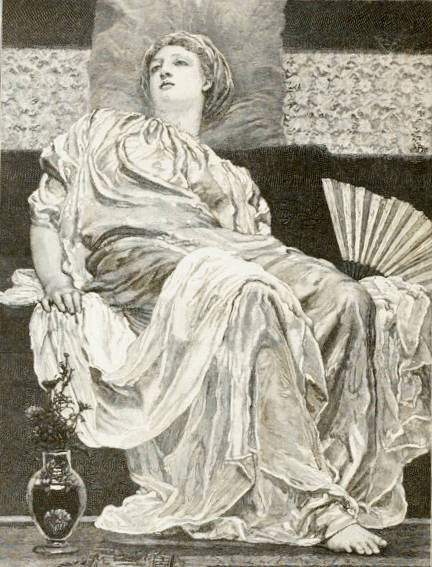
The The Magazine of Art engraving (p. 196), downloaded by George P. Landow. [Click on this image to enlarge it; it may be reproduced for any scholarly or educational purpose, with due attribution.]
Many of Moore's contemporaries simply did not understand his art or what he was trying to achieve. When this engraving of the work was published in The Magazine of Art in 1885 , Cosmo Monkhouse attempted to explain it to a philistine who observed of Yellow Marguerites: "Nice, but not really Greek, you know. She is an English girl, evidently. I question whether they had yellow marguerites in Athens; and as for that Spanish lace, it is a rank anachronism" (qtd. Asleson, 217, n.130):
The second class of complaint, which supposes that Albert Moore intends to give us pictures of Greek life, and fails, implies a total misconception of the aims of his art. He is no Alma Tadema seeking to reproduce for us the life of extinct civilizations. In such reconstructions archaeology is important, an anachronism is a defect, but not in the art of Albert Moore, who seeks only after beauty, and employs the robes and draperies of Athens only because they are to his eye far more beautiful than any costume which has been invented since. Remembering such criticism as applied to his work, he has been known to utter the astonishing dictum that "anachronism is the soul of art." To be bound by no convention, to be biased by no fashion, to keep his mind perpetually free to genuine sensations of beauty from any source – such is this artist's aim.
Monkhouse then went on to explain that Moore:
is Greek, nevertheless, in the spirit of his art. He seeks after beauty in the first place, and the beauty which he sees around him. He is Greek also in his choice of expressing himself greatly if not mainly by form, by accurate and delicate modelling – a sculptor almost as much as a painter. Still more Greek is he in the full expression of his work, which leaves little or nothing to the imagination, but contains his idea only, self-sufficient and precisely wrought. This independence of his art is in itself perhaps an anachronism, but it is a very welcome one in a life crowded as ours with overwhelming allusions and unbearable suggestiveness [195].
Bibliography
Asleson, Robyn. Albert Moore. London: Phaidon, 2000. 158, 217.
Baldry, Alfred Lys. Albert Moore. His Life and Works. London: George Bell and Sons, 1893. 20, 51, 53, & 104.
Blackburn, Henry. Academy Notes VII. London: Chatto and Windus (May, 1881): 20.
Fine Victorian Pictures. London: Christie's (October 25, 1991): lot 45, 80-81.
Hartnoll, Julian. The Moore Family Pictures. York City Art Gallery, 1980, cat. 70, 62.
Monkhouse, Cosmo. "Albert Moore." The Magazine of Art VIII (1885): 191-96.
Muther, Richard. The History of Modern Painting, Volume III. London: Henry and Co., 1896. 128.
Prettejohn, Elizabeth. Art for Art's Sake. Aestheticism in Victorian Painting. New Haven and London: Yale University Press, 2007. 103.
"The Royal Academy." The Art Journal New Series XX (1881): 185-88.
"Royal Academy Exhibition." The Illustrated London News LXXVIII (21 May 1881): 498.
Stephens, Frederic George. "Fine Arts. The Royal Academy Exhibition." The Athenaeum No. 2792 (April 30, 1881): 596-99.
Created 7 September 2013
Colour image and commentary added, 2 October 2026