

The Symbol, by Sir Frank Dicksee (1853–1928). 1881. Oil on canvas. 72 x 55 ¾ inches (181.8 x 141.5 cm). Private collection, image ©2003 Christie's Images Limited. Right click disabled; not to be reproduced.
The Symbol was exhibited at the Royal Academy in 1881, no. 175, accompanied by these lines in the exhibition catalogue from Lamentations I:12 "Is it nothing to you, all ye that pass by?" The painting was subsequently shown at the Royal Jubilee Exhibition in Manchester in 1887, no. 461.
When The Symbol sold at Christie's in 2003 their expert, likely John Christian, explained the genesis of this work and described its subject. He felt this work was, in some ways, similar to Dicksee's earlier picture Harmony, both seeking to establish mood or convey emotion without becoming too involved in narrative:
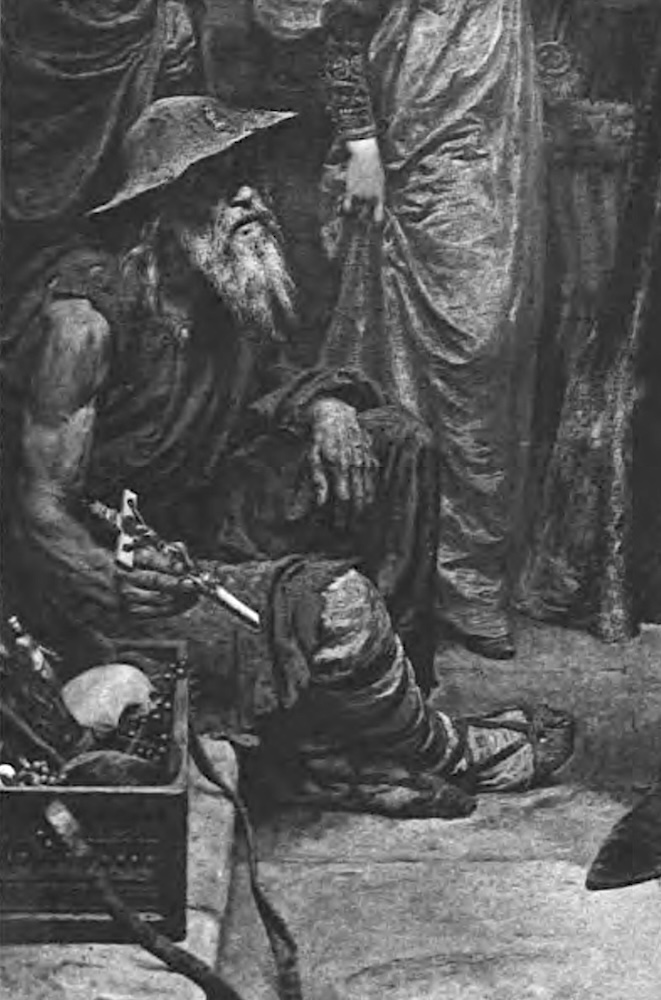
The Symbol was the result of a particularly inspired session at the Langham Sketching Club, a meeting place for artists who, in accordance with the rules of the Club, expressed ideas that crossed their mind on the spur of the moment. The scene is set in a mediaeval Italian city, probably Florence, although it should be noted that Dicksee did not visit Italy until well after the picture's completion. It represents a procession of revellers crowned with wreaths of flowers and leaves passing beneath a stone archway, which frames the city in the distance. Two of the male figures are occupied with song; one plays a mandolin, the other an instrument variously described as a tibia or a double flute. Heading the group is a lover and his mistress, who emerge from the shadow of the archway into the bright sunlight. They advance between a marble bench over which hangs an orange tree, while to the left of the composition is a raised kerb upon which sits an aged relic-seller. From a box of wares, a skull is prominent among them, the vendor has chosen a crucifix; this he offers for sale, arresting the young man's attention, while the girl, stepping a little aside, plucks an orange from the tree. The moral of the story is not difficult to decipher, and is, indeed, reinforced by the sub-title taken from Lamentations 1:12: "Is it nothing to you, all ye that pass by?" Thus a poignant note is added to an otherwise joyful scene, striking the perfect balance between jest and profundity and raising the picture to a higher level than if it was simply an exquisitely conceived and ordered composition of figures and architecture. Dicksee was fond of evoking this kind of psychological tension.
An engraving of the picture, from which the detail on the left below was taken, was reproduced in The Magazine of Art in 1881, volume IV, opposite page 265. (This image is in the public domain; click on it for a larger version.)
Contemporary Reviews of the Painting
A critic for The Architect liked the concept of the painting but felt its colour could be better:
Mr. Dicksee has, at any rate, a worthy motive in his picture of The Symbol (175), wherein a grey-bearded vendor of chaplets and relics holds up a crucifix to the gaze of a scornful gallant and his mistress as they pass from beneath a dark archway into the light among the garden blossoms, followed by their laughing and jesting companions. The expression of impatient indifference on the face of the young man, interrupted in his light dream of love and merriment by that sorrowful image on the cross, is admirably given, and has a true touch of mediaeval sentiment. The figures are grouped gracefully and significantly, the picture having a consistency of poetic conception maintained throughout. In colour it is not, however, so good as Mr. Dicksee might have made it; something artificial and stage-like in the greens and reds, and a kind of mellow yellowness, as of stage lightning, strikes one unpleasantly. [319]
The reviewer for The Art Journal, however, found the colour stunning:
As a party of Florentine revellers are passing under an archway, the glance of the leading youth is arrested by an old man seated, with a basket of holy symbols for sale, and holding in his hand a crucifix. The sight brings a momentary expression, half of regret and half of annoyance, to the young man's face, but his gay companion, as she plucks an orange from an overhanging bough, pays no heed to the mute appeal, "Is it nothing to you, all ye that pass by?" and is not likely to let the incident dwell upon his mind. A beautiful, highly finished picture, resplendent in depth and glory of colour. [188]
The Artist speculated that the young woman plucking an orange may have been intended to symbolize the biblical Fall of Man: "Frank Dicksee, A.R.A., has equalled himself in a fine picture of a Venetian subject. A group of both sexes is going to, or returning from, some scene of revelry: the chief male figure, a young male, has his attention arrested by a crucifix being offered for sale by a beggar: the chief female figure is plucking an orange as she passes — a hint of the Fall. The colour of this fine work is essentially Venetian" (98). A critic for The Illustrated London News found the painting remarkable for so young an artist:
Mr. Dicksee sends a kind of painted "morality," with figures in Italian costumes of the cinque cento, entitled The Symbol (175), a title referring to a crucifix which an old mendicant, crouched in a corner of the picture beside a basket full of other religious wares, offers to the foremost couple of a string of merry-makers, who approach with gest and gibe or singing, playing guitar and tibia, and love-making. Only the leading youth, attired in sumptuous garments, casts a momentary look of seriousness at the solemn symbol – his mistress turning aside significantly to pluck a ripe orange from a pendant bough. The colour is splendidly rich – if inclining a little to 'hotness'; and altogether it is a very remarkable work for so young a painter. [459]
F. G. Stephens in The Athenaeum gave the painting one of its most extensive reviews, comparing it to the work of Frederic Leighton:
Mr. F. Dicksee in The Symbol (175) testifies to the strength of his admiration of the P.R.A. In motive, design, colour, and general treatment Mr. Dicksee is here at his best. In all respects, notwithstanding its larger scale and the complexity of the subject and design, this work is a great advance on former productions of the fortunate A.R.A. Two lovers with companions and attendants are emerging beneath an arch, at the foot of a flight of steps in a Florentine street. They wear gorgeous Florentine costumes of the fifteenth century. They are in the full flood of happiness; the lady turns to the heavy fruit of an orange tree at the side of the path, but the gentleman, notwithstanding his finery, is startled by the appeal of a gaunt relic-seller, who crouches near his feet, and while offering a crucifix reveals in his basket a grinning and jawless human skull. The moral is not difficult to depict, but we cannot say that the artist seems to have designed his sermon spontaneously or energetically. There is much good and creditable painting in the dresses, the attitudes are graceful and natural, and apt expressions are not wanting. Skilful the whole is, but academic. A grain of Holbein, a drachm of Leonardo, Millet, Dürer, or Descamps, was wanting to put fibre into this picture. [628]
Sydney Hodges in The Magazine of Art noted that this picture was exhibited in the same year that Dicksee was elected an Associate of the Royal Academy:
His election was followed by the exhibition the same year of his picture called The Symbol, which is certainly one of his finest works…. It represents a group of revellers in the gayest costumes coming through an archway in some old-world Italian town. The girls, beautiful in form and face, are disporting themselves in true Bacchanalian fashion, but the attention of the leader of the troupe, a gaily-dressed gallant, is suddenly arrested by an old man with a basket of relics by the wayside, who holds up a crucifix for sale. The moral of this story is conveyed by the motto attached to the title, "Is it nothing to you, all ye that pass by?" The writer of this article took the late William Eastlake to see this picture when it was in the artist's studio. Eastlake — a nephew of Sir Charles — was one of the keenest critics of the day… On coming away from Mr. Dicksee's, after seeing this picture, he said, "I have seen nothing to approach that in colour and power in any of the studios I have visited. It reminds me of the work of the old Venetians." It is a curious fact, however, that Frank Dicksee did not visit Italy until after the production of this picture. [218-19]
Bibliography
"Art Chronicle." The Portfolio XII (1881): 103.
Blackburn, Henry. Academy Notes VII. London: Chatto and Windus (May, 1881): 24.
Dibdin, E. Rimbault. Frank Dicksee, R.A. - His Life and Work, special issue of The Art Annual (1905): 7 & 32.
Hodges, Sidney. "Mr. Frank Dicksee, A.R.A." The Magazine of Art. 10 (November 1886-October 1887): 217-22. Internet Archive. Web. 21 October 2014.
Important British & Irish Art. London: Christie's (June 11, 2003): lot 7. https://www.christies.com/en/lot/lot-4112665
"Pictures at the Royal Academy." The Architect XXV (7 May 1881): 319-20.

"The Royal Academy." The Art Journal New Series XX (1881): 185-88.
"Royal Academy Exhibition." The Illustrated London News LXXVIII (7 May 1881): 459.
Stephens, Frederic George. "Fine Arts. The Royal Academy." The Athenaeum No. 2793 (7 May 1881): 628-29.
"Studio News." The Artist II (1 April 1881): 97-100.
Toll, Simon. Frank Dicksee 1853-1928, His Art and Life., Woodbridge: ACC Art Books, 2016, cat. no. FD.1881.2, 48-50 & 226.
Created 21 October 2014
Last modified (commentary and extra image added) 15 July 2026