
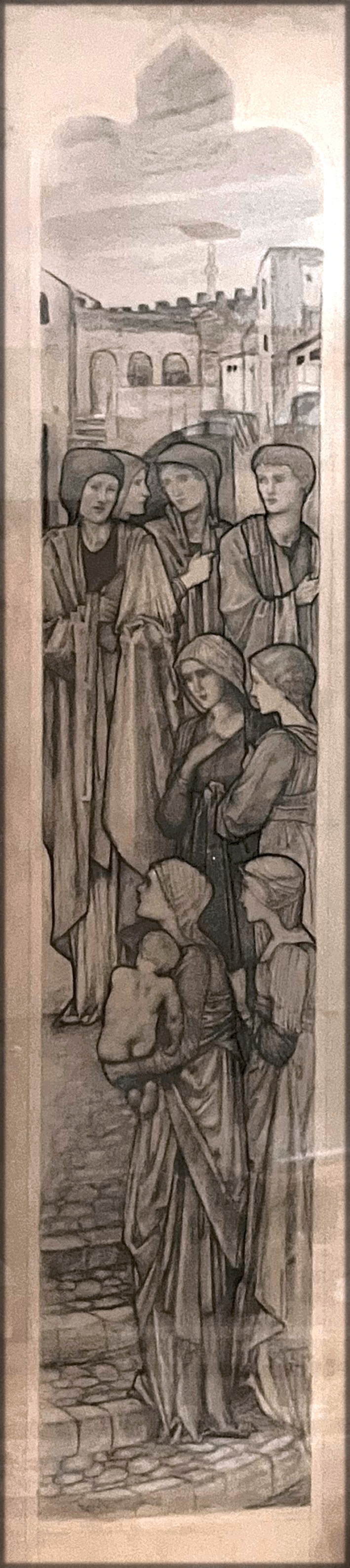
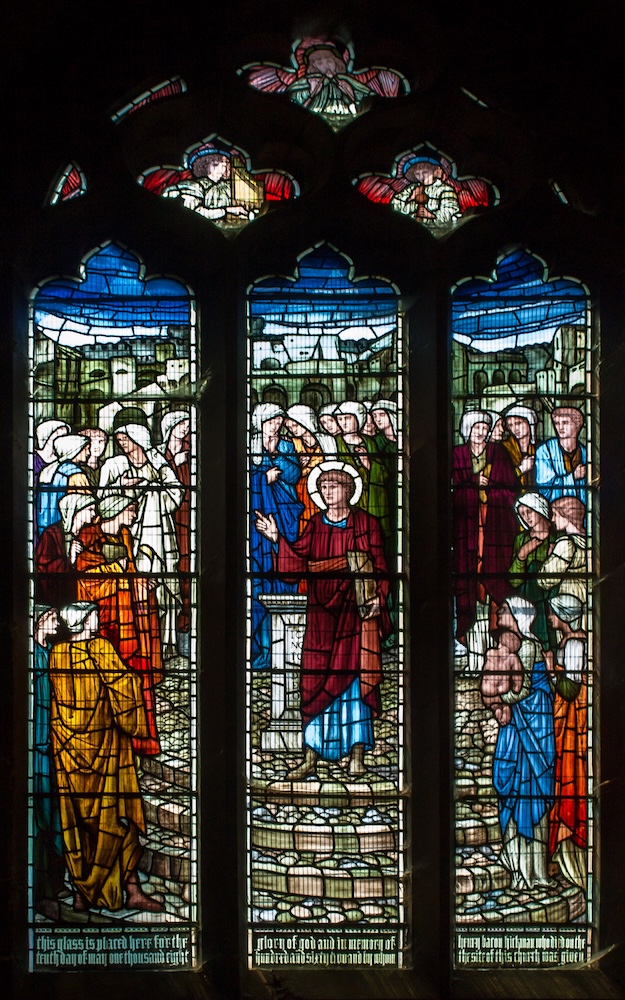
The Athenians are shown listening to St Paul as he preaches at Mars Hill near the Acropolis (Acts 17: 22-31), in a three light window designed late in his career by Sir Edward Burne-Jones (1833-1898). c.1891. This is one of a series of ten windows in the Grade II* listed church of St Paul's, Morton, Lincolnshire.
Left: Charcoal and pastel drawing for right-hand light: 96" x 22", ©TroveStar. Upper right: Whole window (South transept west), © J. Hannan-Briggs. Lower right: Detail from the drawing, showing some of the listeners more closely, ©TroveStar. The windows were executed by Morris & Co., and added from 1891-1914 (list entry). See permissions note below for links to the sources of these images. [Click on all the images to enlarge them.]
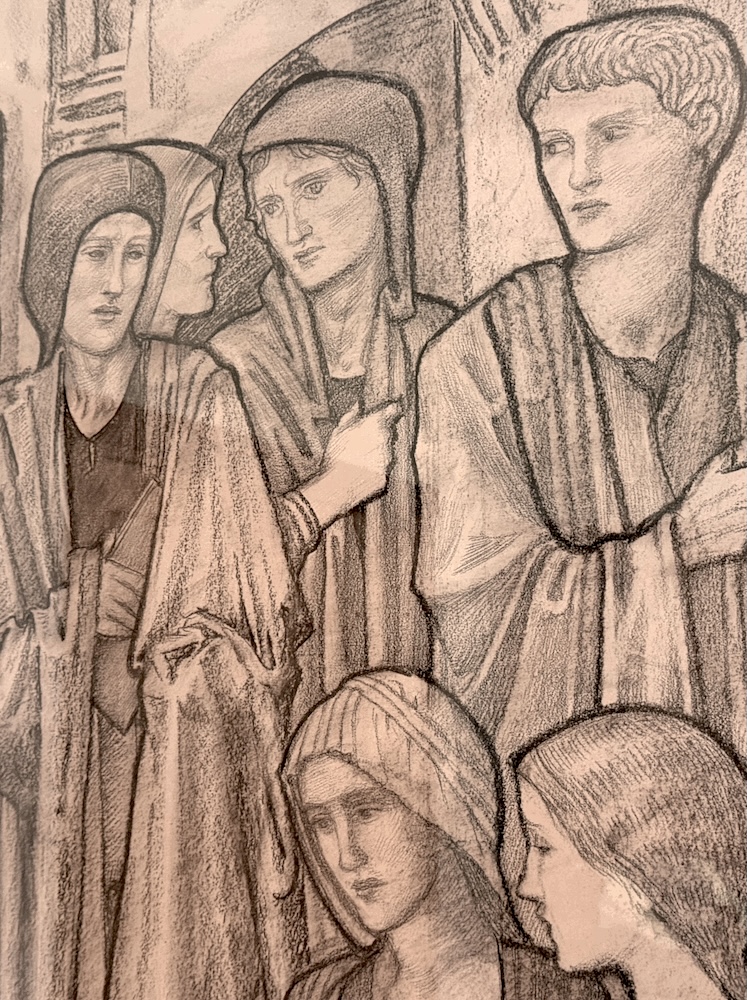
The design is a powerful one, focused on St Paul as he preaches from a height: his scarlet robe and eminence above the broad, curved steps give him a striking presence. His audience is solemn, some of the Athenians looking round at each other, others looking down, as they take in the implications of what he says (this is his famous sermon about God's demand for repentance, when indeed there were varying responses from the crowd). The figures are elongated and angular, delineated in bold lines for the stained-glass cartooning, yet with a marked fluidity in the hang of their robes — always a speciality of this artist — and fine facial detailing. Their expressions are pensive, wondering: "when they heard of the resurrection of the dead, some mocked and others said, We will hear thee again on this matter.... Howbeit certain men clave unto him, and believed" (v. 32 and v. 34). One of those mentioned as having believed him is "a woman named Damaris" (v. 34), so it is particularly appropriate that women are shown in the foreground. In this way, the reception of the sermon is fully conveyed.
The church's own website describes the series of windows as "a rare and valuable possession.... They are believed to be the finest collection of windows by this artist of any church in the country.... not only rare in this country but in Christendom, they depict ‘The Adoration of the Shepherds’; the ‘Stoning of Stephen’; ‘Paul preaching on Mars Hill Athens’ and 'The Apostles, Saints and leaders of the Church.'" They were installed when the small Victorian church on this site (built 1845-46) was replaced by a larger one (retaining the old tower) in 1890-91, by the architects J. T. Micklethwaite and Somers Clarke. The generosity of the donor of the original site, Sir Hickman Bacon, who is described on the church's website as having been "the Premier Baronet of England," allowed the new church to be splendidly fitted out.
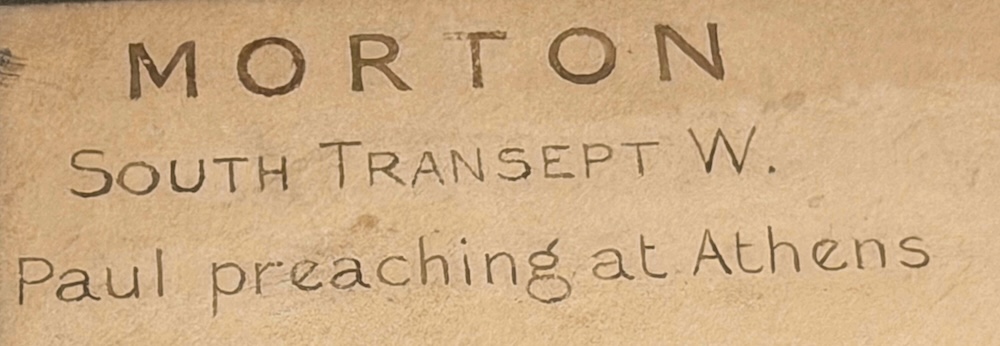
Of special interest, according to the listing text, is the fact that the painters of the individual windows are known from Morris & Co.'s original documentation. The design for this light takes us a little further back in the production process, to the artist's own inspiration and vision when designing one of the scenes.
Related Material
The photographs of the Burne-Jones drawing are by George Michaels, and are reproduced here by kind permission of TroveStar, while that of the whole window, as installed, is by J. Hannan-Briggs, and is reproduced from Geograph under the terms of the Creative Commons Licence (Attribution-ShareAlike 2.0 Generic CC BY-SA 2.0 Deed). See bibliography for links. Text and formatting by Jacqueline Banerjee.
Bibliography
"Burne-Jones, Edward Coley - Charcoal and Pastel - St. Paul in Athens." TroveStar. Web. 6 September 2026. https://www.trovestar.com/catalog/item/238450
Hannan-Briggs, J. "Stained Glass Window, St Paul's Church, Morton." Geograph. Web. 6 September 2026. https://www.geograph.org.uk/reuse.php?id=3999574
"Parish Church of St Paul, Front Street." Historic England. Web. 6 September 2026.
"St Paul." National Churches Trust. Web. 6 September 2026.
Created 6 September 2026
Last modified 16 September 2026