
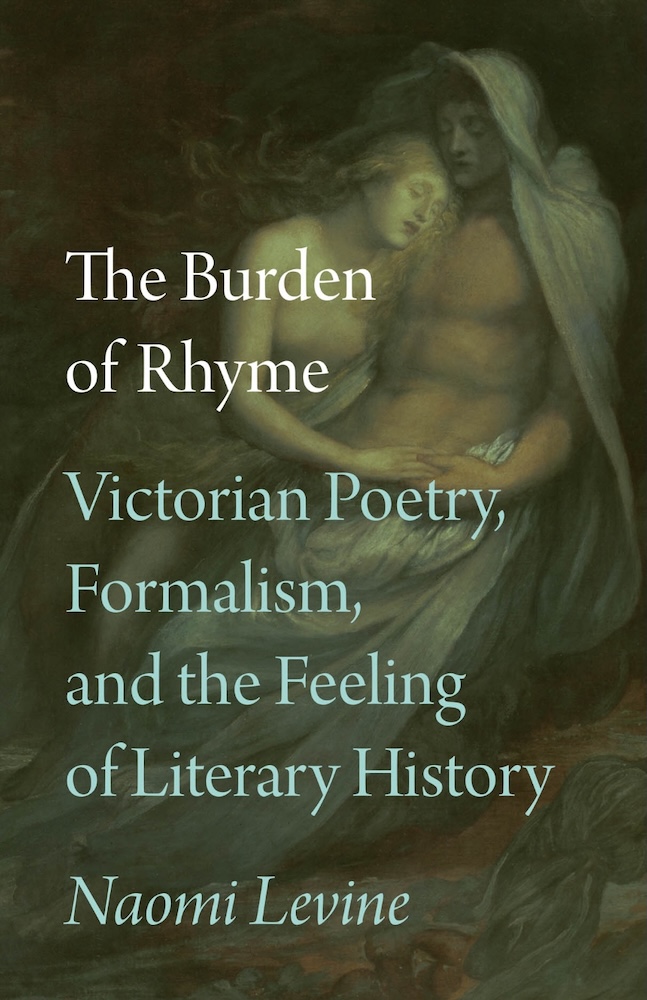
 aomi Levine's project in this short but very impressive
study is to recover what was lost in the devaluation of the Victorians
and their poetry in the twentieth century, especially in the wake of the New Criticism's
insistence on purely formal analysis and the dissociation of rhyme from
its origins and history.
aomi Levine's project in this short but very impressive
study is to recover what was lost in the devaluation of the Victorians
and their poetry in the twentieth century, especially in the wake of the New Criticism's
insistence on purely formal analysis and the dissociation of rhyme from
its origins and history.
Accordingly, Part I of The Burden of Rhyme "reanimate[s] nineteenth-century literary historiography" in order to "show how it determined Victorian experiments with form" (2). Levine does this by describing how, in the early decades of the 1800s, the (now long forgotten) generalist literary histories of Germaine de Staël (1766-1817), August Schlegel (1767-1845), J.C.L. Simonde de Sismondi (1773-1842), and Henry Hallam (1777-1859) established a "genetic formalism" that gave Victorian poets an international and multilingual sense of the origins and development of rhyme's meaning and affective power, as they "set out to think with, and think in, rhyme" (40).
Although, as Levine shows, Henry Hallam was then England's pre-eminent historian of Europe in the Middle Ages, and of its literature from the fifteenth century to his own times, it was his son, Arthur, who, as Alfred Tennyson's closest friend and muse, was the Victorian poet's most significant contemporary source of literary history and ideas about rhyme and poetic form. Arthur Hallam drew much of his knowledge of that history from his father's scholarship, but he also subscribed wholeheartedly to Sismondi's belief that the origin of rhyme could be found in Arabic lyrics, before it first appeared in Europe in the troubadour songs of courtly love and then developed in the romantic poetry of Italy, best exemplified by Dante's Divine Comedy (1321) and Petrarch's sonnets.
According to Levine, Arthur Hallam drew the idea that rhyme contains "a constant appeal to Memory and Hope" directly from Sismondi (53, 55ff). In other words, beyond the immediate "temporality on the page and in the ear" (56), rhyme connects erotic and elegiac feelings with an evocative and powerful history. For Sismondi, Arthur Hallam, and their contemporaries, that literary history of yearning for the fulfillment of love and grieving for its loss is, Levine asserts, "the burden rhyme carries" (73).
In Part II, "Historiographic Forms," Levine applies this understanding of how an immediate aesthetic experience of rhyme can also be an encounter with literary historical ideas. She begins by considering the often recognized "strangely sad" feeling of the tetrameter ABBA stanza of Tennyson's In Memoriam (1850) created by the "melancholy feeling of its progressive and regressive rhymes [...] Without the literary-historical aspect of Hallam's ‘Memory and Hope' formula," Levine writes, "we can't really account for the precision of Tennyson's technique." Reading Tennyson through Sismondi's "genetic theory," however, reveals "that the emotional force of Tennyson's stanza derives from an amour-de-loin understanding of rhyme: an effort to draw attention to the spatial and temporal coordinates of stanzaic form — understood also as emotional coordinates — that accord with his elegiac theme" (77).
The "felicitous correspondence" between the poem's rhyme structure (ABBA) and the poet's elegiac intention was noted by its Victorian readers. Writing for The Leader in 1850, George Henry Lewes (1817-78) thought that "the stanza chosen, with its mingling rhymes, and its slow, yet not imposing march, seems to us the very perfection of stanza for the purpose" ("Tennyson's New Poem," qtd. on p. 81). In an essay ("Tennyson") published in Fraser's Magazine in the same year, Charles Kingsley (1819-75) described the stanza as "so exquisitely chosen, that while the major rhyme in the second and third lines of each stanza gives the solidity and self-restraint required by such deep themes, the mournful minor rhyme of each first and fourth line leads the ear to expect something beyond, and enables the poet's thoughts to wander sadly on, from stanza to stanza" (qtd. on 81 and n. 3). In Levine's words, Tennyson's first readers immediately heard and felt the "significant feeling in In Memoriam's form — and frequently [did so] with an ear to the 'Memory and Hope' dynamics that Arthur Hallam described." In the context of both Hallam's and Tennyson's interest in Dante's use of poetic structure as more than a vehicle for thematic content, Levine suggests that "[f]or expressive potential to be found in the organization of a stanza, that potential would have to be understood to be latent within a stanza's component parts" (81-2).
In Chapter 3, Levine examines Arthur Hallam's review of Tennyson's Poems, Chiefly Lyrical (1830) and related ideas in his "Cambridge Oration on the Influence of Italian Works of Imagination on the Same Class of Compositions in England." In the review, published in the August 1831 issue of The Englishman's Magazine and entitled "On Some of the Characteristics of Modern Poetry, and on the Lyrical Poems of Alfred Tennyson" (henceforth "Characteristics"), he describes Tennyson as a "Poet of Sensation," who is, very much like his Romantic predecessors, Keats and Shelley, "more alive to sensory experiences than his fellow men"; but is also distinguished from them by his "original genius" in capturing the spirit of his age in innovative forms of poetic expression (qtd. on p. 86). As Levine shows, "Hallam's account of sensation and reflection isn't without historical resonance," for "[e]choes of Sismondi's argument can be heard throughout" (90-1).
Levine turns next to Hallam's reading of two of Tennyson's poems from the 1830 collection, Poems Chiefly Lyrical, "Recollections of the Arabian Nights" and "The Ballad of Oriana." The two poems, as Levine notes, "couldn't be more different from one another," one being an orientalist fantasy associated with medieval Arabia, and the other based upon a Scottish border ballad. Levine, with great precision, argues that, taken together, "they measure out the extraordinary scope of Tennyson's early lyric craftsmanship" (91). "Along with its heavy-handed historical fiction and conventional repertoire of orientalist tropes," Levine writes, "'Arabian Nights' exhibits a surprisingly sophisticated approach to historical form." For there, within the "uniform stanzaic frame" — fourteen stanzas, each of eleven rhyming lines, culminating in a refrain that repeats itself, with only the smallest of variations on the same formula — Tennyson's rhymes "appear inconsistent almost to the point of randomness." Yet, as Levine points out, "his ability to sustain the impression of arbitrary rhyming across the sequence of stanzas results in a virtuosic display of combinatorial possibilities," to the point that Tennyson "is devising a fresh interpretation of an eleven-line rhyme pattern for nearly every stanza." Levine concludes: "Because of its extraordinary exertions to avoid repeating rhyme schemes, 'Arabian Nights' allows us to see prosodic variety as design rather than accident" (93).
Levine additionally observes that the relation between the stanzaic form, on the one hand, and the rhyme pattern that seems to generate that shape by an appeal to both eye and ear, on the other, is such that in many of Tennyson's early poems "these aspects are almost indistinguishable." As a result, Levine contends, "the outer architecture of the stanza and its internal music appear mutually constitutive" (95 and n. 43). But in "Arabian Nights," she argues, "these two aspects of stanzaic form are pried apart. The visible stanza constitutes one kind of design, while each rhyme pattern constitutes another: a design within a design." This procedure, she adds, "highlights the aesthetic and synesthetic experiences of stanzaic reading — the hard work a poet performs to both enable and mystify those experiences." She adds that "to the extent that these stanzas articulate the poem's aesthetic fantasy in their rhyme patterns," they might be described as "mimetic" (95).
This is not, Levine argues, "a matter of finding in the archive of literary history a verse form that particularly matches the narrative or historical material of the poem." In fact, she insists that "from the perspective of historical fidelity," the "Arabian Nights" stanza is "an anachronism." It doesn't look like Sismondi's medieval Arabic forms, but rather is like his descriptions of "Provençal and Italian canzone, with its refrains and its interlaced stanzas and its acrobatic sestinas and its rhymes" that vary "in a thousand different ways" (96-7). In other words, Tennyson's stanza is here "more a historiographic than a historic form." The poem, she says, "represents literary history as a dream — or the recollection of a dream." For, as "each stanza circles back to its refrain," the poem reminds itself and the reader that "the golden prime/ Of good Haroun Alraschid" names "a kind of desire — for perfection, for beginnings — rather than a historical time or place" (97).
In her discussion of Arthur Hallam's response to "The Ballad of Oriana" Levine then shows that there he finds "the poetic technique of Italian lyric operative in ballad form" and that "this prompts him to elaborate the affective component of genetic formalism: the idea that old forms carry the old feelings they were invented to express." But, she says, "like the stanza of 'Arabian Nights,' the stanza of 'The Ballad of Oriana' also tells a larger romantic story about stanzaic form" (97). It is obvious that Tennyson's borrowings from the ballad tradition include the "trope of tragic love" and the "form of the refrain," but she notes that Tennyson has managed to distill into a new form the "spirit of the old ballads that partakes of both the past and the present," as he draws inspiration from Walter Scott's ballad of "Fair Helen of Kirkconnell Lea" in the Minstrelsy of the Scottish Border (1802). In other words, "through the same intuitive art" that governs Scott's ballad, Tennyson "creates an original poem that operates in the same way [...] by establishing a correspondence between the formal and affective registers" (98). But, Levine adds, it is important to know that Hallam insisted that Tennyson's inspiration also came from "a deeper literary source than Scottish balladry: the lyric poetry of medieval Italy, especially that of Dante and Petrarch" (98).
In an insightful analysis of Tennyson's early mastery of rhyme, repetition, alliteration, and refrain, Levine extends Hallam's argument so that we can see "how vowel tones and their rhymes might accumulate into feelings" and recognize the "affective consequences" of the "sonic thickening" in the rhyming lines and refrain of "Oriana" (99). In the conclusion to this chapter, she reminds her reader that, just as "Sismondi had used the rhyme-and-refrain pattern trying to prove the genetic relationship between Provençal and Arabic lyric," Tennyson, in "The Ballad of Oriana," "adapts it into English by way of Italian, restoring the history of the English and Scottish ballad to a longer and more international history of rhyme" — "a form full of feeling" and "romantic" in a "historiographic sense" (103).
In the second of the four illustrative chapters in Part II, "Elizabeth Barrett Browning's Unblank Verse," Levine points to the inadequacy in modern literary history's usual description of blank verse as "a triumphantly rhymeless form" by considering the complexities of Barrett Browning's use of rhyme:
Certainly, EBB's Petrarchan sonnets are seen to represent her engagement with medieval rhymed lyric, whereas her blank verse Aurora Leigh apparently belongs to another canon altogether [...] Yet categories of rhyme and rhymelessness are an awkward fit for the poetry of Elizabeth Barrett Browning, who was notorious for rhymes that did not rhyme enough. Sonnets from the Portuguese is full of off rhymes (move/strove, ways/grace), while Aurora Leigh employs the range of rhyme effects [...] from unusually dense patterns of internal rhyme, alliteration, assonance, and consonance to perfect end rhymes that turn verse paragraphs into stanzas. (106-7)
Levine finds "compelling formal reasons" to imagine that Barrett Browning was engaged in "a continuous prosodic project" despite the variousness of her body of work. Rather than being clearly split between rhymed and blank verse, "her poetry suggests a spectrum of rhyme gradations" (107). Levine shows that Barrett Browning was "heavily invested in the nineteenth-century discourse of literary historiography," that she engaged in "live debates" about "the origin and development of rhyme, the periodization of poetic history, and the nature of aesthetic form," and that these discussions "powerfully shaped" the poet's "evolving understanding of the affinities between blank and rhymed verse" (107). The evidence for Barrett Browning's participation in these debates comes from the poet's correspondence, her marginal annotations in her copy of Henry Hallam's Introduction to the Literature of Europe in the Fifteenth, Sixteenth, and Seventeenth Centuries (1837-39), and from her own anonymously published essay, The Book of Poets (1842), which show how her "charged responses to Hallam's history registered in her own work" (107), not just as rejections of his despotic evaluations of various poets, but rather as a disagreement about how the relation between poetic forms such as rhyme and blank verse might be more open and flexible.
Levine suggests that this "serious engagement with contemporaneous literary-historical scholarship" explains much of the formal "strangeness" of Barrett Browning's poetry, for, as her correspondence shows, her manipulations of blank verse and rhyme derive from it. As Barrett Browning explained to a correspondent, "A great deal of attention, ... far more than it wd. take to rhyme with conventional accuracy, ... have I given to the subject of rhymes, — & have determined in cold blood, to hazard some experiments [founded on] much thoughtful study of the Elizabethan writers [and on] the authority of Mediterranean poetics" (quoted in Levine, 108-9 and n. 13). Levine sees Barrett Browning's poetry as articulating her Romantic vision of literary history, for "[s]he treats poetic form as a uniquely powerful language for making — and settling — historiographic arguments" (108). To illustrate this, Levine singles out Barrett Browning's engagement with Milton, in particular her "subtle readings of his prosodic forms." As Levine rightly says, the "interchange that EBB notes between the sonic properties of the Miltonic sonnet and those of the Miltonic epic [...] presents a powerful literary-historical rationale for her own iconoclastic prosody" (124).
In considering "William Morris's Fleshly Rhymes" (Chapter 5), Levine turns to the Pre-Raphaelites' fascination with romantic literary history and the poetics of amatory love. But here she chooses to focus on Morris because, compared to Dante Gabriel Rossetti and his sister, Christina, Morris's "poetic imagination was more profoundly genetic." Levine means by this that "he looked beyond individual sources (and even traditions) toward a synthetic picture of literary history; and his use of prosody was enriched by historiographic theory":
[T]he relationship between the rhyme-form and the love-content is a matter not only of literary-historical precedent (love poems often rhyme) or of analogy (the form of rhyme somehow resembles the form of love), though it is these things, too. More importantly, rhyme and love are bound together, metonymically by a historiographic idea: the momentous arrival of romantic literature. To look closely at this idea and how it shapes Morris's erotic verse is to see a particularly Pre-Raphaelite intensification of historiographic form (126-7).
As Levine acknowledges, the meaningfulness of rhymes can be seen as semantic, allegorical, or mimetic. But, after some consideration of those possibilities, she puts them aside in offering an example from Morris's "The Defence of Guenevere" (1858) in which the rhyme of kiss and bliss in the form of terza rima offers "a different possibility altogether": "that a form like rhyme has its own meaning or content, independent of the reader and the writer and even the poem" (130). In short, she says, "the idea of rhyme in the nineteenth century was so connected with the idea of love that love could be considered part of the content of rhyme. Rhyme presented itself in that period as a way to speak about love in advance of any particular thematic material or stanzaic form" (130).
In the rest of the chapter Levine offers an astute analysis of Morris's The Earthly Paradise in the context of Thomas Warton's use of the word "romantic" as a historical category in his History of English Poetry (1824), of Walter Pater's interest in the historical "impassioned" meaning of the word "romantic" in his Studies in the History of the Renaissance (1873) and in his 1868 review of Poems by William Morris, and of G. W. F. Hegel's influence upon them both, arising from what, in his Lectures on Aesthetics (1835), he sees as the "medieval" development" of romantic love to "the experience of the self's subjectivity and of the beloved's exquisite particularity that he finds only in romantic art" (132-3, n. 24). Levine concludes that "to a Victorian mind and ear attuned to literary-historical myth," rhyme was "a form of desire; literary history made it so." And in the poetry, as in the painting of the Pre-Raphaelites that desire most certainly had a "fleshly form" (145).
Even though recent criticism has positioned Coventry Patmore's The Angel in the House (1854) as more than a merely sentimental record of Victorian patriarchy, Patmore might be thought a strange choice for inclusion in this study. Yet, as Levine argues in Chapter 6, "Coventry Patmore's Passionate Pause," his work was also "a generic experiment, and a surprisingly rich exploration of the form and temporality of conjugal love" (147). Nevertheless, as Levine notes, the majority of Patmore studies now focus on his "Essay on English Metrical Law" (1857). Though it contains much about nineteenth-century prosody, and had some influence on such late Victorian poets as Gerard Manley Hopkins, Alice Meynell, Francis Thompson, and Thomas Hardy, this often-revised theoretical essay is problematic, nonetheless, because of its very idiosyncratic ideas about meter and poetic genres.
As Levine explains, Patmore contended that accentual-syllabic English poetry is measured by regular "isochronous intervals" that we hear as an "ictus" or beat, which "has no material and external existence at all, but has its place in the mind, which craves measure in everything" (149). This idea of an internal measure, she says, allowed him "to imagine counter-intuitive ways to scan a line" and "let end-of-line pauses — or catalexis — count in the same way that so-called accents do: as "subjects" rather than "interruptions [...] of metrical law" (149). Patmore, she notes, at first saw the extensions of pauses, not only as metrical abstractions, but as keys to how a poem manages emotion: "The longer the catalectic pause is in relation to the syllable count of the line, the more powerfully does the poem strike us as sad" (150). The chosen example is a stanza from "Night and Sleep," which, in the "most solemn all our measures," consists of six syllable iambic lines with three accented syllables:
How strange it is to wake
And watch, while others sleep,
Till sight and hearing ache
For objects that may keep
The awful inner sense
Unroused, lest it should mark
The life that haunts the emptiness
and horror of the dark. (Patmore, "Essay on English Metrical Law", 27; qtd in Levine, p. 150).
It is Patmore's contention, Levine says, that when reading these lines we understand them to be really four-beat lines that invariably move us by their pregnant pauses, for "the affective content of the poem resides in the pauses that we feel and count and do not voice" (151).
However, as Levine points out, once Patmore had "established that the beat is in the mind, and that emotion is in the pause" that can and must extend to register greater intensity, he seemed to recognize the absurd limitations of his argument, for he was suddenly seized of the significance of rhyme as a "regulating power." For Patmore, she says, "[r]hyme makes a stanza where no stanza could otherwise be, and rhyme designates the limit of the line" (151). To this she adds Patmore's own description of rhyme as "the highest metrical power we have" and "the great means, in modern languages, of marking essential metrical pauses" (151; Patmore, "Essay on English Metrical Law," 41, 31). This new conception of his argument, Patmore drew from Samuel Daniel's The Defence of Rhyme (1603) and from "the historical analogue supplied by Hegel, who, Levine points out, argued that rhyme became a prosodic necessity when absolute classical quantity gave way to the more arbitrary accentual system" (151-2). The generous conclusion to this section of Chapter 6 is that Patmore's attempt to borrow an element of time measure from classical duration was necessarily incomplete until he took into account the interplay of rhyme and rest at the end of a line (154). But, as Levine says, "[t]o think of his metrical theory in terms of literary history, is to recognize that his historical scale is very large": "the journey from classical Greece to Victorian England as a long process of change, loss, and emergence" (154).
In the chapter's penultimate section, Levine takes up Patmore's attempt to develop a form of ode that expresses not the spirit of ancient Greece or Renaissance Europe but the character of modern English prosody, with its distinctive language of feeling. Levine points out that his odes "don't look or behave like classical or neoclassical odes. They are often narrative and elegiac rather than vocative and encomiastic," and they don't exhibit the structural features associated with the Pindaric or Horatian models that Edmund Gosse, in the early twentieth century, enshrined as the authoritative definition of the genre (155-6). By contrast the prosodic principle of Patmore's ideal irregular ode would see "each syllable and pause contributing to the poem's orchestration of feeling" (163). This discussion sets up Levine's closing gesture, a sensitive, personal reading of Patmore's elegiac ode, "The Azalea" (1877). A tribute to his deceased first wife, the ode, Levine argues, almost perfectly embodies the ideal of expressive feeling and prosodic control within an irregular structure of the sort that Patmore had theorized. In doing so, this marvellous poem, so eloquent a realization of the poet's terrible loss, with its ABBA rhyme pattern at the opening and closing, recalls the mastery of form and feeling in Tennyson's In Memoriam, which Patmore had praised in his review in the North British Review of 1850.
In a brief conclusion titled "The Spirit of Romance," Levine summarizes her intentions in writing this book: the hope of recognizing what was lost in the twentieth century's devaluation of the Victorians and their poetry, and the possibility of regaining a critical capacity for feeling and thinking about history and form together that was available in the nineteenth century. She also raises the possibilities of thinking anew about the practice of rhyme in the twentieth century by recognizing that "free verse isn't actually free of meter or rhyme; it simply takes those prosodic techniques in new directions, toward expressively irregular rather than fixed forms" (174-5). The more interesting question she sees is the continuity of Victorian conceptions of rhyme, especially the model of romantic rhyme explored in this book: "If we allow rhyme to mean what it meant to Victorian poets, we can discern a much richer legacy for Victorian rhyming in twentieth-century poetry. Instead of seeing free verse as rhyming nonetheless, we can start to see it as one more variety of rhyme practice: an extension of the historiographic experiments of the nineteenth century" (175).
This very impressive, well researched, and compelling book is a significant contribution to our understanding of the context in which English poetry was written and read in the Victorian period. It is not a surprise that, as such, it has been chosen the winner of the NAVSA prize for the best book published in 2024. But given the suggestion that Patmore's "Essay" on meter and rhyme had some influence on the poetry of Hopkins, Meynell, Thompson, and Hardy, one cannot but wish that this short volume were longer and included more of Levine's cogent analysis of the historical debts, forms, and feelings in their works.
Links to Related Material
- In Memoriam as an Experiment in Genre
- In Memoriam and the Literary Canon
- Barrett Browning and the Ballad Tradition
- Poets in the Pre-Raphaelite Circle
- Why Did the Victorians Love Sir Walter Scott's Writings?
Bibliography
[Book under review] Levine, Naomi. The Burden of Rhyme: Victorian Poetry, Formalism, and the Feeling of Literary History. Chicago: University of Chicago Press, 2024. 256 pp. Paperback. ISBN 9780226834979. $27.50
Barrett Browning, Elizabeth. Aurora Leigh. Ed. Margaret Reynolds. New York: Norton, 1996.
--. The Works of Elizabeth Barrett Browning. Eds. Sandra Donaldson et al. 5 vols. London: Pickering and Chatto, 2010.
Gosse, Edmund. "Ode." In Encyclopaedia Britannica. Vol. XX. Cambridge: Cambridge UP, 1911. Pp. 1-2.
Hallam, Arthur. "On Some of the Characteristics of Modern Poetry, and on the Lyrical Poems of Alfred Tennyson," The Englishman's Magazine 1 (August 1831): 616-628.
--. The Writings of Arthur Hallam. Ed. T. H. Vail Motter. New York: Modern Language Association of America, 1943.
Hallam, Henry. Introduction to the Literature of Europe in the Fifteenth, Sixteenth, and Seventeenth Centuries. 4 vols. London: John Murray, 1837-39.
--. View of the State of Europe during the Middle Ages. Vol. 3. London: John Murray, 1826.
Hegel, G. W. F. Aesthetics: Lectures on Fine Art. Trans. T. M. Knox. 2 vols. Oxford: Clarendon Press, 1975.
Kingsley, Charles. "Tennyson." Fraser's Magazine 52 (September 1850): 245.
Lewes, George Henry. "Tennyson's New Poem." The Leader 13 (June 22, 1850): 303-4.
Morris, William. "The Defence of Guenevere." In The Pre-Raphaelites and Their Circle. Ed. Cecil Y. Lang, 161-70. Chicago: University of Chicago Press, 1975.
--. The Earthly Paradise. Ed. Florence Boos. 2 vols. New York: Routledge, 2002.
Pater, Walter. "Poems by William Morris." Westminster Review 90 (October 1868): 144-49.
--."Postscript (Romanticism)." In Selected Writings of Walter Pater. Ed. Harold Bloom. New York: Columbia University Press, 1974.
Patmore, Coventry. Coventry Patmore's "Essay on English Metrical Law": A Critical Edition with a Commentary. Ed. Sister Mary Augustine Roth. Washington, DC: Catholic University of America Press, 1961.
--. "In Memoriam." North British Review 13 (1850): 532-5.
Sismondi, J. C. L. Simonde. De la littérature du Midi de l'Europe. Vol. 1. Paris: Treuttel et Würtz, 1813.
--. Historical View of the Literature of the South of Europe. Trans. Thomas Roscoe. 4 vols. London: Henry Colburn, 1823.
Tennyson, Alfred. In Memoriam. Ed. Eric Gray. New York: Norton, 2004.
--. Poems, Chiefly Lyrical 1830. Oxford: Woodstock Books, 1991.
--. The Poems of Tennyson. Ed. Christopher Ricks. 3 vols. Harlow: Longman, 1987.
Warton, Thomas. The History of English Poetry. London. J. Dodsley et al., 1778.
Created 2 December 2025
Last modified 5 December 2025