
 he fourteen relatively compact essays comprising Dickens the Enchanter
blend such elements as the author's personal experiences as a reader of
Charles Dickens, impressions of Dickens gleaned from stage and film adaptations,
historical references, and Dickens's own musings about his work.
Conrad's purpose is to show Dickens as "a magus" (7): spellbound,
transported to a higher plane, and sacerdotal. Perhaps nowhere is this
Dickens more clearly present than in the book's markedly un-Victorian
frontispiece, by Neville Dear (b. 1923), in
which Dickens appears to be reading with a high theatrical intensity to
a rapt group of auditors.
he fourteen relatively compact essays comprising Dickens the Enchanter
blend such elements as the author's personal experiences as a reader of
Charles Dickens, impressions of Dickens gleaned from stage and film adaptations,
historical references, and Dickens's own musings about his work.
Conrad's purpose is to show Dickens as "a magus" (7): spellbound,
transported to a higher plane, and sacerdotal. Perhaps nowhere is this
Dickens more clearly present than in the book's markedly un-Victorian
frontispiece, by Neville Dear (b. 1923), in
which Dickens appears to be reading with a high theatrical intensity to
a rapt group of auditors.
Dickens did perform such readings, as Conrad notes, and these performances were apparently powerful. "Before publishing The Chimes, Dickens tested its impact at a reading for a select and highly receptive group," Conrad writes. "During the performance [Dickens] noticed the actor William Macready weeping, overcome by compassion for the woebegone Trotty," the novella's working class protagonist. Dickens was aware of this power. In a letter to his wife Catherine about the event, Dickens wrote, "what a thing it is to have Power" (qtd. in Conrad, p. 7), a phrase, Conrad claims, that "is one of his most forthright self-declarations. In readings like this [Dickens] actually deployed triple powers, as a writer, an actor and a magus: his words created life out of thin air, his performance gave the characters physical presence, and his almost priestly ministrations made the event as uplifting as a church service" (7).
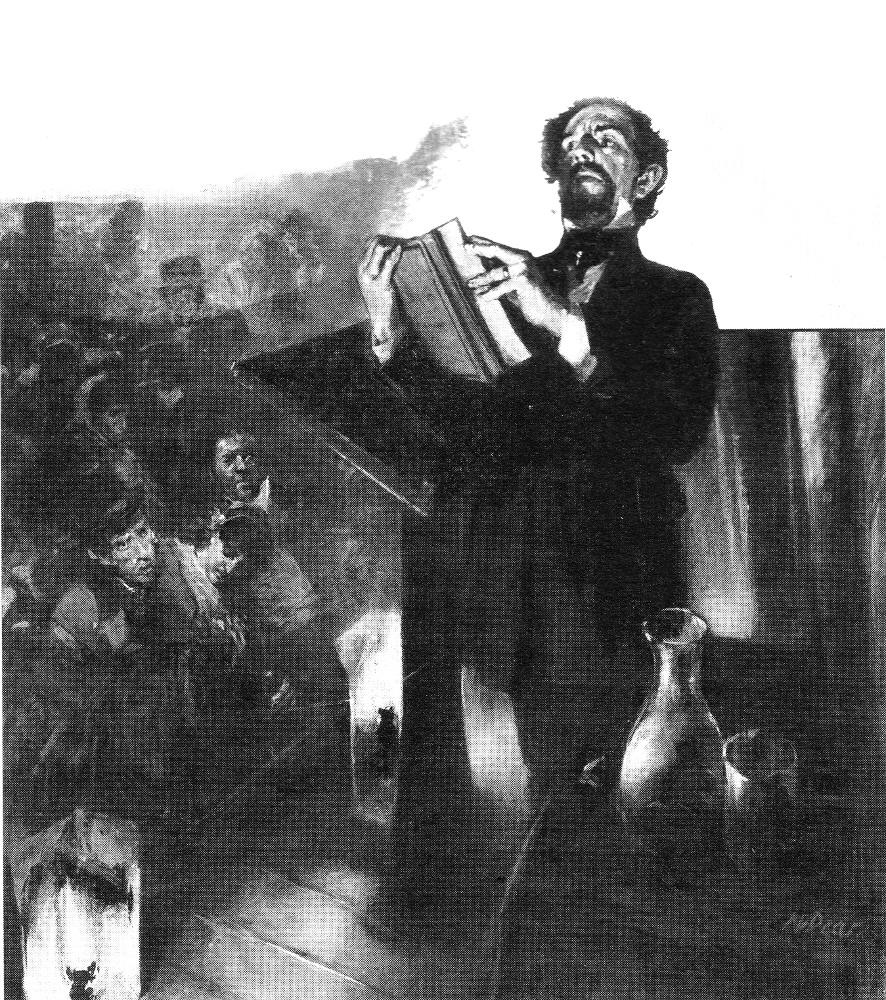
Left: Illustration by Neville Dear, "Dickens at a public reading by flickering gaslight, with some of his characters in the audience."
Conrad is prepared to sacrifice depth for a sweeping breadth to present Dickens's various performative modes, giving us "Dickens the Enchanter" rather than "Dickens the Novelist." This approach is particularly fruitful in such essays as "In The Family," in which Conrad applies Wordsworth's pronouncements about the innate virtue of childhood to Dickens's characterizations of childhood and parenting. Conrad draws upon his extensive knowledge of Dickens as neglected child, dutiful husband, and father of ten frequently nicknamed children. Here, too, Dickens' fictional progeny make their appearances: notably David Copperfield, his favourite child, but also Walter Gay, Paul Dombey, and Amy Dorrit, not to mention Little Nell, the Artful Dodger, Pip, Estella, and all the rest. Nor does Conrad neglect parental figures such as Abel Magwitch, Peggotty, Mrs. Nickleby, and so on. As Conrad notes, "[a] blithe childhood like Wordsworth's was a luxury" (17), especially in Dickens.
But Conrad's rejection of a conventional biographical approach, such as that taken by Ackroyd or Slater, leads to problems in chronology. Chapter 4 alone, for example, ranges among works as early as the fourth Christmas Book, The Battle of Life (1846) and as late as Our Mutual Friend (1867), so that "Kabbalistic Words" (56-77), for example, advances his challenging thesis about Dickens as the performative communicator of covert messages through telling metaphors without offering an in-depth analysis of any one novel.
Relying on biographical interpretation to stitch everything together, Conrad additionally draws not merely upon the great writers of prose and verse who preceded Dickens — Ovid, Shakespeare (of course), Milton, Defoe, Fielding, Blake, Byron and so on — but also upon Continental figures rarely referenced in commentaries on Dickens, such as Stendhal and Baudelaire. Conrad also considers the writers who followed Dickens such as George du Maurier, George Bernard Shaw, and Robert Louis Stevenson, as well as prominent figures working further afield, such as Charles Darwin.
Exploring the "demonic" aspects of Dickens' literary imagination, what Harry Stone has termed the "night side" of Dickens (xvii), Conrad moves beyond the conventional approaches to consider the "ephemeral Dickens," Dickens as the journalistic reporter of the Victorian urban underworld, evident in both his personal correspondence and his travelogues and essays. Conrad's considerations of the "twilight realm" material "between lucidity and delirium" (37) is largely unfamiliar even to Dickens's most enthusiastic readers today. However, Conrad also references plenty of more familiar "mortifying storytelling," particularly bizarre interpolated manuscripts such as that of the Madman in Pickwick, and macabre material that even the general reader will recognize, including allusions to Master Humphrey's Clock, David Copperfield, Bleak House, and A Christmas Carol.
Although it does not immediately suggest Dickens as an entertainer, the fourth chapter, "Kabbalistic Words," discusses the writer's most innovative and whimsical approaches to grammar, usage, and "word-mangling" for a host of quirky characters, including the "verbal sorcery" of such minor characters as Pyke in Nicholas Nickleby and the accidentally inventive Tony Weller in Pickwick. Conrad does not hesitate to associate Dickens's "[v]erbal sorcery" (58) with the mystical "Kabbalah's hermetic lore" (58). Conrad writes: "When reflecting on language he often referred to the Kabbalah, the Jewish oral tradition that brought to light the recondite wisdom enshrined in scripture, and in doing so he aligned his own writing — sometimes ironically, sometimes not — with Holy Writ" (56-57). As Conrad observes, Dickens played freely with language in his own right. The narrator of A Child's History of England ranged over many topics, from "theological riddles to political conspiracies" (58), through what Conrad implies is a mystical lens.
Although we cannot be certain whether Dickens actually read the Kabbalah, he certainly would not have been aware of the first sequence in Wagner's operatic epic Der Ring des Nibelungen (1869, 1876), and therefore could not have known about the dwarf Mime and the demon King Alberich when creating the grotesque character of Daniel Quilp. Nevertheless, Conrad implies a connection between the pair and the devilish, lascivious dwarf of Dickens's Old Curiosity Shop (1841). Perhaps Conrad is merely alluding to the spirit of the age as reflected in these characters. More convincing is Conrad's proposed connection between the biblical Witch of Endor and "the optical illusions in the phantasmagoria, a playground for apparitions whose shadows were cast onto screens by magic lanterns." Here the link is more plausible given Dickens's interest in popular theatre. Without doubt, Quilp does indeed "resemble [...] the spooks in these shows as he glares at Nell's friend Kit, dwindling in size and then bulbously swelling as he steps back and then returns to glare from close quarters 'like a head in a phantasmagoria'" (109).
Conrad is on safer ground in Chapter 7, "In Arabia." This chapter traces the influence of such Arabian Nights tales as "Aladdin and the Wonderful Lamp" on Dickens. Like that young wastrel Aladdin who was about to be consigned to a humble trade (tailoring) before he discovers the sorcerer's lamp, Dickens would have been consigned to an undistinguished life of drudgery, but for his early-discovered talent as a writer. Dickens's reading another pair of Arabian Nights tales ("The Third Calender's Tale" and "The Story of Prince Agib") eventually contributed to his dazzling career as a trans-Atlantic reader:
The idea first came to him in 1847, when he told Forster that he felt drawn to the loadstone rock; he was alluding to a magnetic mountain that, in a story told by a dervish, tugs nails from the hull of approaching ships and causes them to fall apart and sink. In A Tale of Two Cities this legend explains the compulsion that near-fatally lures Charles Darnay back to Paris and lands him in the Bastille. Dickens eventually returned to America in 1867 for a tour that earned him a fortune but left him ill and exhausted: the fable was his horoscope, which he chose to ignore. (120)
In the seven remaining chapters, Conrad conducts a wide-ranging analysis of Dickens's works from Pickwick to Drood. For example, he considers such issues as both scientific and social Darwinism in Chapter 8, "Species and Origins," discussing works such as Disraeli's Tancred (1847) alongside Martin Chuzzlewit (1844) and characters that pre- as well as post-date the publication of Charles Darwin's Origin in 1859. In an unsigned notice about Origin published in All The Year Round, for instance, the "anonymous contributor [...] seems, as he contemplates 'the immense variety of living creatures,' to have the productivity of the magazine's owner and editor in mind" and elsewhere seems to render "succinct homage to Dickens" (157).
In Chapter 9, "In the Carvery," Conrad discusses how Dickens "regarded life as a rehearsal for literature and living people as first drafts of his characters" (164). "Whether dealing with bodies or buildings and their contents," Conrad avers, "Dickens carves things up or anatomically breaks them down, then finds quirky new ways of reassembling them" (180). The umbrellas belonging to Mrs. Gamp, Mrs. Bagnet, and Miss Mowcher, for example, are idiosyncratic representations of the human condition.
In Chapter 10, "In the Forge," Conrad shows how Dickens uses inebriated, exhilarating, and electrifying imagery to link magic and medicine. Dickens's imagery of human consciousness as a blast furnace or blacksmith's forge is less significant for Conrad than is the image of some sort of electrical charge that animates both mind and body in Dickens's fiction. "People in Dickens's novels," he writes, " do not exist because they think, as Descartes proposed; they are alive thanks to a power that activates their bodies and tingles round the circuits in their heads" (196).
In Chapter 11, "Arranging the Universe," Conrad explores Dickens's fascination with tales of the supernatural as well as the discoveries of contemporary astronomers like John Flamsteed and John F. W. Herschel. Showing how their ideas pervade Dickens' novels, Conrad asserts that "Dickens came to delight in such metaphorical vendettas against what we think of as reality," (208) oddly connecting science, industry, and myth. Much of the chapter is devoted to Dickens's descriptions of London. "[S]prawling amorphously in space and growing both backwards and downwards in time," the city was "Dickens's universe in little" (216). For readers familiar with the urban Dickens, this chapter will prove vastly entertaining, particularly Conrad's leisurely discussion of Dickens's examinations of the fourteen-foot figures Gog and Magog, "the giants whose grotesquely bug-eyed statues glare down from a balcony in the Guildhall" (219).
In the following chapter, Conrad turns to matters of agency and identity, paying special attention to Esther Summerson and David Copperfield, neither of whom completely fulfills the reader's expectations for them to become the heroes of their own lives. In David's case, "we read his book to make the acquaintance of the comic characters he incidentally encounters, not to follow his sentimental education or the progress of his literary career" (226-227). Conrad links the book's constantly nicknaming characters to the quest for identity as Dickens's arbitrary labels become both short-hand definitions and guides to character. Although David Copperfield accepts Miss Mowcher's reproof, that her disability has nothing to do with her essential character, Conrad argues that Dickens persistently regards the mind of the character as being "written on the body" (229).
Adopting such pseudonyms as "The Author," "Master Humphrey," and "The Uncommercial Traveller," Dickens seems to have embraced anonymity in private life, happy to be an isolated observer of the human condition, emulating Shakespeare as a behind-the-scenes author-director, even as he assumed a very public persona as a highly visible stage-player: a dichotomy reflected in his being simultaneously the all-controlling magus Prospero and the philosophical Prince Hamlet: "he jostled and even gently mocked the writer whom he viewed — although he was careful not to openly say so — as his only rival" (244). Even as he bade farewell to public reading in March 1870, "he reminded the public that he would reappear, though not in person, as the first instalment of The Mystery of Edwin Drood was about to be published" (243-244).
In the concluding chapter, "In the Crypt," Conrad connects the derailment at Staplehurst, Kent, in June 1865 on the Southeastern Railway [1], Dickens's visit to the Paris morgue in The Mystery of Edwin Drood. Dickens began Drood in 1869 after conducting a final "confidential Interview with himself": "All indications suggest that Edwin's uncle John Jasper murders him in a fit of sexual jealousy and stows his body in a lime pit in the crypt of the cathedral" (qtd. on p. 259). Cementing his identification with the murderer, Dickens confided that the clarifying conclusion "would be written in the condemned cell" (qtd. on p. 259), a location which he had used so tellingly in Sketches by Boz, Oliver Twist, and Great Expectations. The incomplete novel's most effective scene remains the opening, in a London opium den, which reflects not merely Jasper's dual existence, but Dickens's. Conrad explains:
Like Jasper moving between Cloisterham and the East End, [Dickens] was officially resident at Gad's Hill but commuted from there to the obscure addresses in France, Windsor and south London where he kept his mistress Ellen Ternan tucked away, using a pseudonym when he paid her rent. In a milder way he also shared Jasper's addiction. During his second American tour he began dosing himself with laudanum as a painkiller, a sleeping draught, and perhaps as a creative aid. (263)
Altogether Conrad shows how Dickens inscribed his characters from the outside in. Appearance, gesture, verbal tics, and even clothing were the outward and visible signs of his characters. His chief means of character revelation was not interior analysis, but action, interaction, and dialogue. Throughout his career, Dickens's uncanny ability to become a character on stage revealed his performative aesthetic as well. His immediately recognizable characters were admirably suited to his trans-Atlantic readings and remain compelling even a century and a half after his death.
Notes
[1] On page 258, Conrad appears to confuse this event with the Stapleton Road accident in Bristol in 1921.
Links to Related Material
- Dickens as Performer
- Major Biographies of Dickens: A Critical Overview
- Charles Dickens Relieving the Sufferers at the Fatal Railway Accident Near Staplehurst
Bibliography
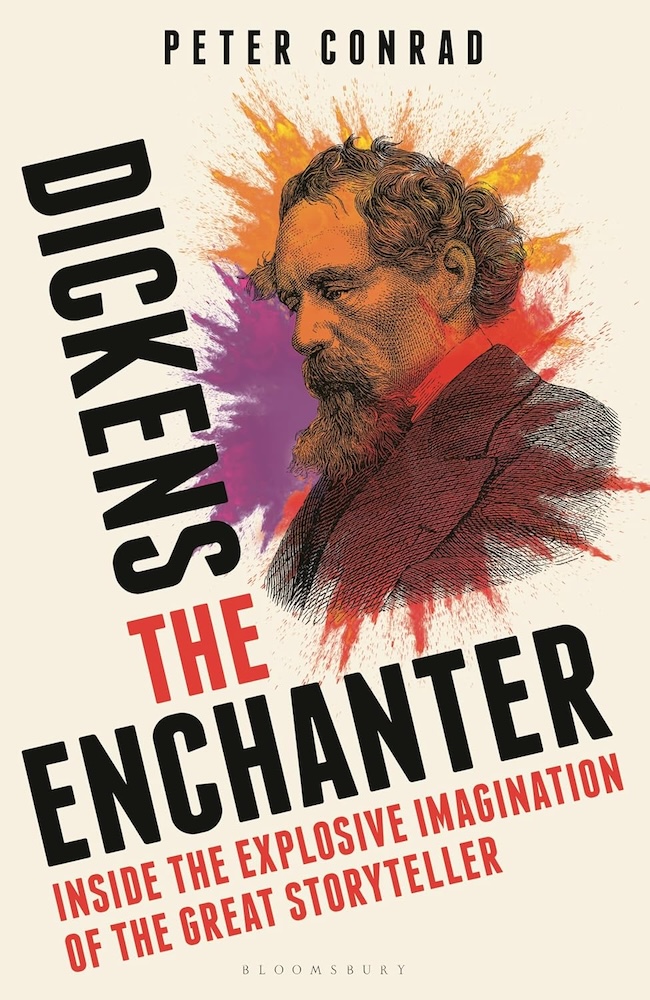
[book under review] Conrad, Peter. Dickens The Enchanter: Inside the Explosive Imagination of the Great Storyteller. London and Oxford: Bloomsbury Continuum Press, 2025. Pp. vi-ix + 289. ISBN HB: 978-1-3994-0919-3.
Ackroyd, Peter. Dickens: A Biography. London: Sinclair-Stevenson, 1990.
Slater, Michael. "'The Turning-Point of His Career': England, Italy, England, 1842-1845." Charles Dickens. New Haven: Yale University Press, 2009. Illustration 22, p. 232.
Stone, Harry. The Night Side of Dickens: Cannibalism, Passion, Necessity. Columbus: Ohio University Press, 1994.
Created 16 April 2026 Last modified 17 April 2026